
Full moon, full mind, fallow fields

What’s the best antidote for the heavily gravid sensation of a restless mind at the full moon?

After several days of exhaustion severe enough to put me to bed well before the little guy’s eight o’clock curfew, tonight finds me still physically debilitated but unable to settle into anything like sleep while the hours march on.

The ends of a few threads of thought have been teased out of my jumbled mind, but I don’t have the concentration to work on big ideas. I want to talk about the wonders of parallels discovered in my recent reads about Barcelona, Africa, and Churchill and Orwell during WWII. I simply haven’t the wits to show you the hidden shapes I find so exciting.

Personal stories keep fluttering into my attention, but none of them seem universal enough to share, or impersonal enough to be offered up to the world at large without serious reflection upon the living characters and my own motivations. The last thing I’d like to write is a gossip site, and one gift of my religion is a prohibition against lashon hara*, or telling tales.

This is the miserable agitation of the in between. I’m between absorbing projects, books that can’t be put down, trips to be taken, and demands powerful enough to dictate orders to my attention.

My next necessary steps are all menial errands I’m too addled to arrange whilst moonstruck. Being bathed in silvery light suggests time better spent on wonder or magic, neither of which flow from my fingers tonight.

There’s little left to do but stand by an open window in October’s mild chill and watch light clouds scud across the brightness behind the shivering trees. Ships may sail past on the ocean; witches may fly by on the breeze.

I’ll stand by, resting my fallow fields and taking in the scene, saving the contemplation for another time, when solar brightness makes ratiocination real and lunacy the dim threat in dark corners of silvered minds.

*Lashon hara, literally “evil tongue,” includes gossip of any sort–even if it’s true–as well as telling lies and using words for deception.

Media glory for villainous cowards who shoot innocent multitudes must stop

I denounce yet another pathetic, impotent coward hiding behind the false bravado of a pile of guns who tyrannized thousands, wounded hundreds, and murdered dozens of citizens peacefully partaking in the public life of my country.

Shame on the media for giving a sniveling traitor the fame that drives these base actions when he deserves nothing but ignominy.

I don’t want to hear a word about this Outis* or his playmates.

Sing the praises of heroes who protected others with their bodies, held the hands of the dying, and organized relief for victims.

Speak out with solutions to this mass hysteria—such as denying glory to recreant perpetrators—and use your power to demand action from laggards in government who found better things to do today than address egregious violence against our citizenry.

The value of the Fourth Estate is cheapened by producing clickbait at the expense of the public good and profiting from violence.

Newsweek story about media coverage encouraging mass violence

The National Review makes a similar argument

After Newtown, CT, as reported in International Business Times

*No one, as Odysseus called himself while battling the cyclops

24 hours in twenty years: marriage, discovery, and a matter of time

Do we ever really know another person? How long might that take? Twenty years can’t possibly be enough if my example is any indication of the scope of the discovery.

My husband took note recently of the fact that I opt to have the time displayed in 24 hour format when possible. He noticed this as the evening grew dark and visiting friends wondered about the prudence of getting their kids home to bed. I woke up my phone first as it was sitting rather rudely before me on the dining room table.

“20:12?” DH asked. “Your phone is set to military time?

Keep in mind that we’ve known each other for almost 20 years, and been married for most of those.

This becomes rather more amusing if you’ve ever visited my home, ridden in my car, or viewed any of my electronics. All of these conditions have been met by my husband, with most of them occurring on a daily basis.

Both of my children have had noisy arguments with me within DH’s earshot about my insistence that they learn to read a 24-hour clock and an analog one before I will buy them the digital watches they oddly covet.

In our kitchen, the microwave oven and a digital clock give the time in 24 hour format. Come to think of it, DH has always complained about being unable to find the time in our new house. Perhaps he thought those were kitchen timers in constant use?

time 24 hr clock face - 1

In the communal study the kids and I call the “workroom,” there is a digital clock set to 24 hour time displayed prominently on DS’s desk. You can’t walk through the room—which DH must do to reach his own office—without seeing its face.

The clock in my minivan displays 24 hour time and it has since I set it on the day I drove it home.

The sunrise clock on my side of our shared marital bed shows military time, too. To be fair, though, DH has his own clock on his side so he needn’t read mine with any regularity.

Are you sensing the pattern? I don’t think this is a subtle one.

I prefer the efficient notation of written time in fewer characters. I like the frequent tiny mental math problem of subtracting twelve. I don’t like the look of the abbreviations for ante- and post meridiem unless they are in small caps, and those can be annoying to implement (in WordPress, for example.)

None of these reasons matter in the least, of course, though it’s amusing that the same husband who teases me for clinging to the archaic Imperial system of measurement seems to have a similarly irrational preference for a less concise system for measuring time.

I pronounce the time in the standard twelve hour format, so, without his ears to help with the heavy lifting of comprehension, DH can be excused for never noticing what was right before his eyes.

It’s easy, after a decade and a half, to assume we know it all about a partner and a constant presence. It is very often true that I can predict exactly what DH will say, or choose, or prefer.

But, then again, human beings are awesome in their complexity, and my mate is no exception. Every day, each of us goes out into the world, changes it, and is changed by it. We grow. We evolve. Hopefully, we learn a little, too.

We aren’t the same young people who met online, like proper nerds, dated, and fell in love. We’re older, saggier, and otherwise more time-worn.

One of us prefers miles and military time; one of us is all metric, but goes to bed at 8 o’clock instead of 20:00.

The joy of it is being tickled by discovery this far in. The wonder is that we still have so much to discover, and so much desire to do so.

Does poetry offer the best analogy for humanity’s greatest scientific breakthroughs?

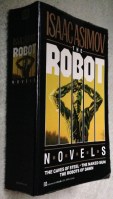
In the novel The Robots of Dawn, third in Isaac Asimov’s Robot trilogy, a preeminent scientist, the best on his or any other world in his field, says:

“You know it always bothers some of my colleagues when I tell them that, if a conclusion is not poetically balanced, it cannot be scientifically true. They tell me they don’t know what that means.”

Baley said, “I’m afraid I don’t, either.”book Asimov Robot novels - 1

“But I know what it means, I can’t explain it, but I feel the explanation without being able to put it into words, which may be why I have achieved results my colleagues have not. …”

I made note of the quote as I re-read this classic novel last week because it echoes so closely something I myself have struggled to put into words for my entire adult life.

As a teenager, I chose the identical comparison for explaining my delight with certain physics experiments:

[The experiment’s demonstration of the concept] is so perfect. It just sings. It’s like poetry.

I know I’ve repeated the phrase, “it’s like poetry,” many times in conversation about great ideas. I have yet to find a better expression for “the intuitive sense of the rightness” of a theory. It’s definitely something to do with harmony and balance.

Having devoured Asimov’s Robot novels in middle school*, it is now obvious to me that I’d read the quote with which I began this post well before I myself used the poetry simile. I’m now begging the question, did I get this idea from Asimov, leaving it to quietly percolate for another half dozen or so years before I re-expressed it, taking a distant memory for my own idea?

Or is this notion a truth, existing in the intellectual universe, waiting to be uncovered by one likely mind after another?

Does anyone else find herself using this expression to express a certain balanced perfection in knowledge?**

If you do, did you also read Asimov at a formative age?

Is poetry as distillation of language from the prosaic to the artistic a fundamentally apt metaphor for great leaps in scientific discovery and the expression thereof, or does the comparison only resonate with creative writers? Pardon me, please, for lumping my humble efforts with the greatness of Asimov in this respect!

Finally, as an aside, I want to shout to the world that the Robot series holds up well for revisiting decades after their impressive effect on a young reader. Asimov was a genius, and these books remain a fantastic diversion.

*roughly age 12

**Here’s a person writing about science and poetry in a literary journal. She maintains that the disciplines aren’t mutually exclusive, though they might seem so to less perceptive thinkers. A search also shows me that someone once had an e-zine at poetryandscience.com, but the link appears to be broken so I can only wonder at what took place there.

Baltasar Gracián’s 17th C “Art of Worldly Wisdom” offers sound guidance today

§80     TAKE care when you get information. We live by information, not by sight. We exist by faith in others. The ear is the sidedoor of truth but the frontdoor of lies. The truth is generally seen, rarely heard. She seldom comes in elemental purity, especially from afar—there is always some admixture of the moods of those through whom she has passed. The passions tinge her with their colors wherever they touch her, sometimes favorably, sometimes odiously. She always brings out people’s disposition, therefore receive her with caution from him that praises, with more caution from him that blames. Pay attention to the intention of the speaker; you should know beforehand on what footing he comes. Let reflection test for falsity and exaggeration.

Emphasis is mine.

Written in the 17th Century, Gracián’s thoughts in The Art of Worldly Wisdom* seem equally apropos today; perhaps even more so.

Replace “the ear” with “the internet” in sentence four:

The internet is the side door of truth but the front door of lies.

I’d say that fits.

What a powerful tool for crowdsourcing information and bypassing traditional nodes of centralized power.

What an easy way to disseminate propaganda, falsehoods, and forgeries, enticingly wrapped up with all of our cognitive biases.

It behooves us all to think critically about our sources of “truth.”

Let reflection test for falsity and exaggeration.

Humans are uniquely blessed with critical faculties. We live in an era uniquely abundant in sources to which we may—and must!—apply our highest powers of thought.

If we fail to do so, our technology may prove to be our undoing, calling to mind the soft, feeble Eloi in H.G. Wells’ The Time Machine.

Think! Or prepare for your descendants to be fed to the Morlocks.**

*I’m reading Joseph Jacob’s translation on my Kindle

**Metaphor!  Follow the link about Eloi or pick up a copy of The Time Machine and find out for yourself.