
Men, consider trying a tunic or dress before you fall for the romper trend

Rompers—or, the specifically male garment being promoted on KickStarter as the RompHim™— should not become the next hot trend in men’s clothing. Elle magazine posits that I’m not accepting of this trend because of my underlying sexism.

Am I disturbed by men in traditionally feminine clothing?

Nope. Quite the opposite. I believe in function first for clothing.

Some of humanity’s first articles of clothing were tunics, clearly the precursor to the modern dress. These are clothes for “humans,” not for men or for women specifically. They do a great job of protecting sensitive skin from sun exposure, and they simply and serviceably provide as much modesty as one prefers.

playful boy tunic

Put a baby boy in a tunic, and he’ll just keep playing like a comfortable little boy

Kilts predate miniskirts, and were designed for men when women wouldn’t dare to show so much leg. And that beachwear? Does the bottom really need to be called “bikini,” or is it just a reinvention of the loincloth?

Dating back to my teenage discussions of school dress codes, I have always advocated that the only fair policy allows all students access to all pieces of the accepted uniform, including girls in pants and boys in skirts. Anything else is inherently unfair.

Our noun, uniform, obviously relates to the adjective and its definition of “sameness.” Where there is no practical reason discernible for variations, it’s fair to assume they are derived from social constructs of questionable value. Next, ask the question: do we need to differentiate this piece of kit for males or females?

If the article of clothing doesn’t specifically encase a body part (brassieres and athletic cups being the obvious examples), I personally reject any notion that the object is sex-specific.

People should wear clothing that suits their need for comfort and personal expression within social standards for professionalism, modesty, and hygiene. Let the naturists bare their skin in accepting company. But please, if nudity is allowed by law, include a provision for mandatory towels on shared seating surfaces…

The man isn’t the problem; the romper creates problems

My problem isn’t with the man in the romper. I object to the wearing of a romper by  adults who have productive work to do. They are fiddly garments to manage in public life.

I speak from experience. I bought a chambray romper in the 1980’s, when I was a young teen. Wearing it generated more thinking about what I was wearing, allowing less time for useful activity. I thought it was cute, but it wasn’t very practical.

Fashion isn’t inherently a bad thing, but most of us have to balance style with getting things done. Most of us should be thinking about more than how we’re wearing our clothes.

A Kardashian or fashion model has time to wear a romper. All that’s required of these professions is showing off the garments worn, presumably generating interest in the consuming masses.

James Bond/Sean Connery wearing a romper (Goldfinger, 1964) in his down time also seems reasonable. We all know his romper’s going to come off the minute the Bond Girl walks in. (You can see Connery sporting his baby blue knit romper with gold belt buckle in the Elle article I mentioned in paragraph one.)

But rompers are ill-suited for people who need to, say, take care of their own bodily functions in public restrooms. They  actually present less challenge to men than women in this regard, because many men don’t fully remove their lower garments to urinate.

A man who never needs to defecate, however, doesn’t need a romper; he needs a doctor! Does any man really want to wear clothes that will have to come all the way off—or puddle in their entirety on that dubiously mopped subway station floor—in order to take care of his necessary business?

baby doll diaper

Rompers for baby

Without snaps at the crotch, a romper is an impractical garment. With snaps at the crotch, the degree of infantility becomes creepy. Tear-away clothes should remain the province of strippers. A snap-crotch should be ensconced beneath another layer of clothing, like on a bodysuit, lest a wardrobe malfunction make one the next viral video sensation.

“Whoops! There go my romper’s crotch snaps!”

It sounds like something former congressman Anthony Weiner would do. No one wants to be that guy.

Rompers, jumpsuits, and coveralls share similar traits. There’s a reason they are best suited as over-layers to protect regular clothing beneath, removed once the messy work is done. They also have a place as specialty garments like spacesuits (with toilet built in!) or formal wear (which isn’t designed to be practical anyway.)

Try a dress before you buy a romper

Men, if you want the freedom of a garment that extends from shoulder to hemline, consider just wearing a dress. Call it a tunic if you don’t think men should wear dresses. You can buy one for a lot less than $119 (RompHim™ suggested retail) and you’ll have more fabric options.

Romper man mayhem sketch

Make sure a romper fits this crucial measurement

As most women have discovered for themselves, if your thighs rub or you want more coverage, it is far more comfortable to wear leggings or fitted shorts beneath a dress than to bind up the skirt of one’s dress into a romper. Be aware: the crotch length on a romper is often not quite a perfect fit for one’s body, so you might feel an annoying seam in a sensitive place. Ouch!

It isn’t a sharing of our feminine freedom to make men discover these romper facts for themselves. Women who’ve worn them are being selfish by not sharing the reality with men considering buying them. Or, maybe, a lot of women do find this idea funny, because of sexism or a bit of cruelty.

There’s a reason romper trends in women’s fashion drift in and then go away. Wearing a romper is inconvenient, and they aren’t really cute enough to make up for it.

If rompers were so great, they would remain popular over time, like wearing pants. Surely everyone can agree that women, once “allowed” to wear trousers, have never shown the slightest inclination to give up these most practical garments.

Supporting men in their desire to wear rompers feels to me like convincing men they should try pantyhose. That would be mean, because pantyhose suck. They’re expensive and disposable, because they run (develop holes) with normal use; they don’t breathe so they’re unhealthy for your body; and they can be downright painful to pull on.

Gentlemen, I support your right to wear a romper, but I sincerely hope you’ll try a nice, sensible dress first, for your own sake.
Artist Sherrill Roland and his Jumpsuit Project

Today, I read a news story about a young man named Sherrill Roland. As he was about to begin graduate school as a fine arts student, he received a call from a detective with a warrant for his arrest. He was asked to turn himself in for crimes he didn’t commit.

The young man was tried, convicted, and spent 10 months in jail for crimes he didn’t commit. A year later, new evidence proved his innocence.

My reason for sharing this isn’t to repeat or attempt to fully reflect upon the shameful statistics about young black men—even innocent ones—and the American criminal justice system. What I feel compelled to share about this story is how this young, black man chose to respond to what happened to him.

Sherrill Roland is an artist.

He found a way to share his talents with other inmates during his time in jail:

“I drew for other inmates ― portraits of their families that they could send as gifts. … We on the inside did not have anything to give. It is really powerful creating something …, helping them get a gift from someone who can’t obtain one any other way. I was willing to make things as long as they meant something.”

Roland is now sharing his experience of incarceration and its effects with the rest of us via a performance art piece he began as an MFA student: the Jumpsuit Project. He wears an orange prison jumpsuit in public spaces, engaging with his “audience” according to their response to him.
In the article, he said:

“It’s not always about jail itself, but about overcoming things. Sometimes it’s just about getting through a struggle.”

He could have emerged too bitter to speak with us. He might have lashed out or given up in the face of a system willing to jail innocent black men. Instead, Sherrill Roland is making something that means something, including conversation.How many of us can claim to have wrought something so elevated from such base injustice?I hope I’m making a small contribution to Roland’s conversation by sharing it with you.

Being good at math, also female, and why I must talk about that

We all tend to repeat our favorite stories, and I thought I’d told this one to everyone I know. Naturally, my verbal shorthand led to offense. Again. Oops!

I’m good at math; my conversational skills could use work

I’m not always great at talking to people. That’s one reason for the blog. I like taking the extra time to clarify myself in writing. One major risk factor for my verbal missteps is that I routinely take great mental leaps during the conversation without bringing my audience along.

Lots of things are “obvious” in my mental space, but require explanation when I want to discuss them.

I’ll begin by stating what I thought was crystal clear to everyone I’ve ever spent more than a few minutes with:

I’m good at math.

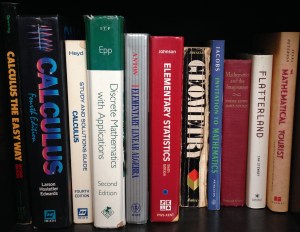
When I say “good at math,” I mean, “I successfully completed an undergraduate degree at a competitive US college with a major in Mathematical & Physical Sciences concentrating in Computer Science.”books math texts - 1

I have studied advanced math at the university level. I succeeded in those classes, often earning good grades. I have some innate talent in this area, and I applied concerted effort to developing these skills.

All of this “my own horn”-tooting is to make clear what I mean when I say, again:

I’m good at math.”

And now we’ll carry on to the meat of this story.

We were out to dinner with friends. Being a pair of introverts 15+ years into marriage and with a couple of kids at home, we go out like this around four times per year. Usually, we invite friends over and order pizza (because I’m bad at cooking; this post is not about how totally great I am.)

Sitting around the table, waiting for appetizers, I started telling a story about home schooling my oldest son. It’s an uncommon thing, so people often ask questions about our daily activities. Many academically inclined friends are sincerely curious: What is it like, going “back to school,” in a sense, by doing it all over again with one’s child?

I was going to tell a story about helping a friend’s daughter with math.

So I began:

“In high school, because I was a girl, naturally, I was bad at math…”

I should have used the mortifying—but edifying—air quotes gesture. This is when my friend freaked out.

“Not true! It’s nonsense! Girls are perfectly capable of…”

Right! Of course! That was my point, too, but I went into the story all wrong. I can see now that I took liberties with my audience. Hopefully I fixed it with my friend, at her birthday dinner, no less. Sheesh. Way to go, me.

Let’s call this a teachable moment. I needed a reminder of something I’ve come to take for granted.

Even though I’m sure I’ve told this story before; even though it is obvious to anyone who’s ever worked with me; even though it should be clear to any person with whom I’ve held a conversation about education.

Let me reiterate that I:

  1. am good at math
  2. worked as an engineer in the (logic-based, i.e., “math-y”) field of computer technology
  3. lean technocratic and abhor non-objective criteria for advancement of platforms or people

In spite of all this, I really can’t tell a humorous yet informative story about being “bad at math” without the usual lead-up. I must always preface this statement with the fact that I erroneously believed myself to be “bad at math”…

because society;

because gender roles;

because socialization.

I saw through part of the illusion in high school, but it took years before I really got it. I believe most people—men and women—who claim to be bad at math are really the victims of poorly implemented math instruction.

Realizing math instruction was bad, not my math ability

High school was mostly boring. I was there doing time and ticking boxes so I could get into a good college to begin my real education. I wanted to be excited about school like I was about learning, but boy did the system make it tough.

I realized that science classes were more challenging to my logic-oriented brain, and I craved real learning of the sort that revved my engine.  I registered for as many science electives as I could squeeze in, graduating with eight science credits on my transcript. I was proud of that!

And yet…

…even with eight science classes on my transcript, by the end of high school, I was failing Calculus and more convinced than ever that I was “bad at math.” I could no longer conceive of being good at math, though I “knew” this fact in grade school.

I was privileged, and smart, and relatively enlightened. Still, it was that difficult to perceive the reality of what math was, how I could engage with it, or why I should.

Failing Calculus had more to do with not doing my work than a failure to grasp essential concepts, but I didn’t clue in to that until I repeated it in college. You see, I was interested in science and computers, and spoke about these subjects at college interviews, but I doubt I ever mentioned math.

“Math” was a hurdle I would have to clear to get to these fascinating, juicy fields of study. “Math” lived in my consciousness as a threat to be avoided.

Our K-12 system gives a very poor illumination of the field of mathematics

Math is presented in our schools as a skinny, rigid ladder to be climbed. There is one straight path from ignorance to Calculus, and success is measured by computational accuracy.

Almost no effort is made to highlight the diversity of thinking in math, the creativity that goes into the work of real mathematicians, and the awesome power of mathematics to solve real world problems.

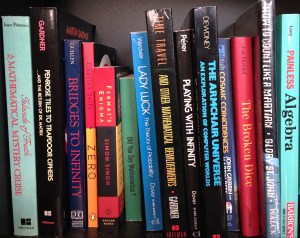
books math texts - 2Ostensibly, Common Core is fixing this problem. In practice, I have grave doubts.

I read a fascinating book about a year ago before I kept a handy reading list like I’ve posted on this blog. I think it was Jo Boaler’s What’s math got to do with it?. The most important takeaway I got from that book had to do with a learned, innate fear of math that pervades American society, and female Americans in particular

And guess who’s teaching our children math? In 2011-2012, 76 percent of public school teachers were female. Women sure as hell can do math, but teachers with unaddressed phobias often unwittingly pass them on to their students.

For decades, I’ve repeated something I heard and find powerfully telling:

Americans feel perfectly comfortable admitting that they’re bad at math. Women, especially, feel free to flaunt their innumeracy.

“Tee hee, titter, titter, I’m so bad at math!”

How many people are equally blasé about their illiteracy?

Virtually none.

Teacher training can make a huge difference in breaking this pattern. Vocal and visible advocacy by female mathematicians and engineers make a difference, too. I talk about my enjoyment of math, logic, and puzzles more often than I probably should, but I want people to hear me. I’d like to be one more pebble in the pile of evidence it takes to make a self-evident mountain.

I’m good at math. I’m female. I’m going to keep talking about that.

What I eat affects how I feel: consider an elimination diet for chronic pain

The Internet is full of dietary advice, much of which has as much basis in opinion as fact. I won’t try to define for you what constitutes healthy eating, but I can share an effective strategy for testing your own diet that could potentially improve your health and well-being.

You could feel healthier within weeks, and it is free

Twice in my life, I have undertaken “elimination diets.” I credit this process with measurably reducing symptoms that were severely impacting my quality of life. In my case, I was able to reduce migraine headache symptoms from daily to just a few episodes per year. More recently, I shifted constant, debilitating joint pain and fatigue associated with autoimmune disease to a still regular, but less incapacitating, condition.

In both cases, I was able to stop taking some preventative prescription drugs and take fewer pain relieving drugs (an objective and measurable result.) I also made myself feel better (a subjective improvement in my well-being.)

You don’t need to spend an extra penny to try it, and you should know within a month if it is going to work for you.

What is an elimination diet?

An elimination diet is not designed to eliminate weight and/or fat. This isn’t a weight loss diet. I think of it as a health gain diet; you could also consider it a symptom loss diet. I prefer to focus on the positive.

Reduce foods you eat to a “safe” list

Put simply, an elimination diet involves first reducing your diet to a limited list of foods known to be inoffensive. By inoffensive, I mean foods that are not commonly allergenic or irritating to the system. At this stage, you would eliminate any food you think might be triggering your own symptoms.

Re-introduce different foods one at a time

After a period (typically around three weeks) on the very restrictive diet, you re-introduce new foods one at a time into your meals and see if symptoms recur or increase. If you feel worse, you remove the offensive (or “trigger”) food again and go on to the next test food. Ideally, you wait a day or two after being “triggered”/negatively affected so your body can return to a neutral state.

Continue this process until you have tested the foods you prefer

You continue this process until your diet includes everything you prefer to eat (excluding trigger foods!) Speaking again from my own experience, it took me a few months to recover from almost daily migraines; I experienced profound relief on day four of my elimination diet for autoimmune disease symptoms.

Elimination Diet food picture - 1

I began with a low-fat, vegan diet of exclusively cooked foods, mostly vegetables. Olive oil was my only fat. I included rice, quinoa, and black beans. I avoided foods that I previously ate the most frequently.

What foods are safe to start an elimination diet?

The first time I did an elimination diet, my primary care doctor gave me a “migraine diet” that I used as a starting point. On my second go ’round, I consulted with a nutritionist recommended by my regular physician to compile a food list for myself based upon a website and a book I regarded as trustworthy.

I used the book, The Elimination Diet by Segersten and Malterre. I borrowed it from my library and read the whole thing, but you don’t need the book to try this technique. This couple does offer many useful resources as free printables on their website, however, and they do a nice job providing a thorough blueprint for those who don’t want to do a lot of planning for themselves.

The point of this intervention is to find out, for yourself, how specific foods affect you.

If you don’t know which foods to start with, begin with a recommended diet from a professional—either your own health provider, or a list from a book or website whose credentials you trust.

An elimination diet is a short-term experiment

Perhaps the most vital thing to know about this diet is that it is never meant to be permanent. I hate the experience of working through an elimination diet, especially those early, very limited weeks, but I like the results enough to commit to a few weeks of deprivation to feel much better.

If you undertake this process and finish up with a long list of foods you plan to permanently eliminate, I strongly encourage you to consult a dietician or doctor to ensure your nutritional needs will be met. In my case, only a few key foods seem to be responsible for a majority of my current symptoms.

Look beyond the usual suspects

Perhaps the most interesting thing I learned in my most recent elimination diet phase was that two common foods I’d barely suspected give me the most trouble. I won’t name them because it’s easy to label foods as “bad” and then proselytize for others to avoid them.

Please do your own experiment and find your own best diet. My two “bad foods” are not any of the foods so popularly demonized these days. (Hint: neither of them is a grain or gluten!)

Your long term diet should be healthy and sustainable

I’ve learned that other foods—some of which are commonly listed as likely triggers—affect my symptoms, too, but they do so in a more gradual, symptoms-building-up sort of way.

For example, I can include some dairy and some organic wheat in my diet and live pretty comfortably. I don’t eat freely of these foods, limiting them to special occasions, but I enjoy life a lot more. Allowing these, in moderation, means more excitement and variety in my meals, which is another factor in long term, emotional well-being.

The myth of “the” healthy diet

My two dietary interventions happened about 20 years apart and resulted in the adoption of somewhat different “ideal diets” each time. The biggest similarity between the two situations was the process.

Did I misinterpret my results the first time I did an elimination diet? Have my needs changed? Has food itself changed? All of these are possible.

It is really difficult to do great studies on human nutrition. To put it very simply, this is because:

  1. There’s no expensive product to market afterwards, so no one wants to pay for long term, well controlled studies of large groups, and
  2. People have really complex lives so it’s hard to design great studies that give straightforward results.

For this reason, I take every bit of nutrition advice with a grain of salt, and I try to stay very open-minded as new research is published. I think it is likely that different people have unique dietary needs based upon lifestyle and genetics, the same way we are susceptible to different injuries and diseases. I think we probably need different nutritional inputs at different stages of life.

I also believe that the adoption of modern, processed foods has likely affected human health in currently unknowable ways. After all, “traditional diets” sustained us for thousands of years, and they differed around the world. What are the odds that one very specific diet could optimize health for all individual human beings?

In the USA, our doctors typically receive little to no training in nutrition. They can advise us when we need to lose weight, or tell us to “eat a healthy diet,” but they aren’t necessarily in a better position than we are ourselves to create a specific blueprint for what we should feed ourselves.

I advocate this particular approach to health through nutrition experimentation because I have personally experienced success with it, twice. It is also free, costing more in time and commitment than financial outlay. You will have to do some planning to successfully undertake an elimination diet.

I don’t believe that we are responsible for every ailment that befalls us. Sometimes, we get hit with an unlucky break, in health as with the rest of life. But here is an opportunity to shift the odds back in our favor by putting in a bit of effort.

If you are suffering, consider trying an elimination diet. The most you have to lose is a little time—and the enjoyment of a few favorite meals—over a few weeks. What you stand to gain is good health.

Have you tried, or considered, an elimination diet? What were your results?