Health care system makes me sick: negotiating bureaucracy through a haze of pain

In April, I wrote a post about my doctor’s departure from the American health insurance system.

In short, he now operates his practice as “direct primary medical care.” You sign up for his service, pay a set monthly cost, and come in, call, email, or text when you have a health issue. It’s so simple, and yet the experience feels revolutionary.

Urgent need? He’ll respond to your text right away.

Wondering if a symptoms requires an office visit (and time off work, fighting traffic across town, etc.)? You can spend as much time as you need explaining your concerns on the phone. There’s no push to make every question an office visit, unlike with providers who are only reimbursed by insurance for in person consultations that correspond to specific codes.

There’s also no bureaucracy, and no paperwork. Unless you have labs, there’s no need to take out your wallet. Remember, you’ve paid up front for whatever care you need. You pay cash for lab work done in the office, but, without insurance markups, these costs are reasonable—perhaps a few dollars.

I almost forget how wasteful, time consuming, and inefficient it is to get care elsewhere. I forget, that is, until I’m not feeling well, and I visit a specialist’s office or a local hospital. That’s what I did the other day, and it all came rushing back to me. Continue reading

Welcome back to school; I miss you while you’re there!

I dislike sending my little guy back to school on the day after Labor Day. In direct contradiction to the nonsense spouted in television commercials, not all parents cheer to have their kids out of the house.

If I were selfish, I would educate both of my children at home, to suit my personality and my interests. I send the younger one to school instead because it suits his.

I miss our long, quiet summer mornings. There’s time for us, then, to sit down together over breakfast. I miss saying yes to late night stargazing and other adventures because there’s no need to worry about a busy schedule.

I miss DS2‘s good company around the house during the day. He’s blessed with great wit and a loving temperament. He’s generous with his hugs.

I am excited to begin the new school session with DS1 here at home. He studies year ’round, but our schedule changes to a different pattern every September, December, January, and June. This choice is energizing, and keeps subjects feeling fresh.

DS1 is a pleasure to keep at home with me. We’re both fairly introverted, so we often work quietly, side by side. Quietly, that is, until one of us gets excited about a project or idea. Continue reading

Such a simple solution: cold feet cured with a double duty metal water bottle

A hot water bottle by one’s frigid feet is a classic winter comfort. If you suffer from ice cubes for toes and haven’t yet discovered the joy of this simple but effective warmer, do try one as the nights regain their chill.*

Here’s a so-simple-it’s-silly solution to the same problem in an overly air conditioned hotel room or when encountering unseasonably cold weather camping:

Use a refillable/reusable metal drink bottle full of hot water as a bed- and foot-warmer. Consider it a more petite cousin of the old-fashioned rubber hot water bottle you could pick up at a pharmacy.
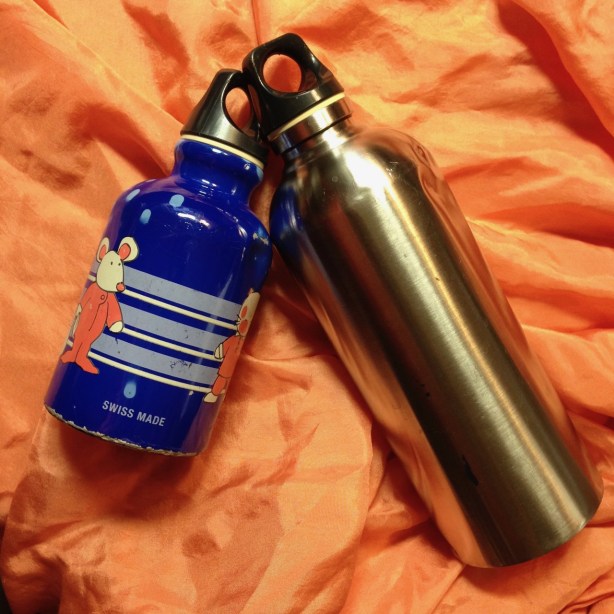
Sigg water bottles - 1

Swiss made aluminum bottles by Sigg, well used for almost a decade; dented, but still leak-free

Fill your bottle from the coffee machine (run it without coffee in the basket), the hot tap in the bathroom, or even use water you’ve heated over a campfire. I’ve tapped all of these for fuel to fight freezing feet. Just pour carefully as your source water gets hotter.

Esbit stove hot water - 1

If you have to heat your water this way, allow lots of extra time before bed…

Make sure your bottle has a tight-fitting, secure lid that won’t come loose inadvertently and soak your bed! I like flip top lids for daily use, but I only travel with bottles that include sturdy screw caps. I also routinely carry a small but super absorbent PackTowl in the same pocket of my pack to catch small leaks and drips before they threaten my papers and electronics.

Sigg metal water bottle in PackTowl - 1

PackTowl Personal model in Face size 10×14″ 0.7oz (25×35 cm, 21g)

Consider slipping the warm bottle into a sock (or a spare pillowcase) for insulation. This is vital if you’ve used scalding hot water. You want to avoid burns. Also, as the bottle cools, it will become a less cozy object to encounter. Don’t startle yourself awake by kicking a hard metal tube in the middle of the night.

You could just carry a traditional rubber hot water bottle while globe trotting. From my perspective, though, they are too large to include in a carry on travel bag. At around 12 oz, they’re also fairly heavy.rubber hot water bottle - 1

A rubber hot water bottle is a single task item. Those of us who enjoy traveling with fewer encumbrances often seek out smaller, lighter, and multi-functional gear for trips. I take no small measure of pleasure in the coup of finding tremendous extra benefit from something I was already carrying.

I always bring my own drinking water bottle to fill post-security at the airport to avoid both disposable plastic bottles and the exorbitant prices at the gate area kiosks. At home and on road trips, we have a water bottle in the car for every family member. Now, I’m simply specifying a particular bottle that can serve an additional function, and I’m a lot more comfortable for the effort.

Gentle heat, thoughtfully applied, can also provide soothing pain relief for some conditions, like my joint pain. It’s hard to overstate the value of something like that to anyone with a chronic condition that’s exacerbated by travel.

There’s just one problem that I’ve discovered with this clever solution: my family has caught on to how I’m using my bottle to warm my bed. The kids give me sad eyed looks and tell me their feet are cold! If you’re traveling as a family, it might be best to upgrade everyone’s drink bottle to a sturdy stainless steel model with an excellent lid.

Your cold feet will thank you, even if the kids don’t.


*If you’re like me, your cold feet may recur regardless of season or outdoor temperature, which is what prompted me to begin writing this post in August!

Pain makes me less approachable; pain makes you like me less

When I’m in pain, I am certain that I’m less receptive to the good in the world around me.

A recent study showed that it is possible to diagnose depression remotely by analyzing the photos people post to social media. Depressed people view the world so differently, their acts of self-expression change.

Along similar lines, I’ve noticed that I view people around me in a different light when my chronic pain flares. I’ve caught myself cynically judging the sincerity of a smile on a woman’s face, or angry at a pedestrian for his freedom to walk presumably without pain.

This isn’t my natural personality. I have a sincere love for—and trust in the goodness of—humanity that my darling husband finds charmingly(?) naive.Untitled

I like to joke that I’m a functional misanthrope, but that’s got more to do with my introversion and some social anxiety than any real disdain for humanity. I am overjoyed by the heights of human achievement. I believe that we, as a species, will persevere and do wonderful things.

That’s my perspective. That’s who I really am.

Pain, however, distorts my every impression.

And, I’m less likeable when I’m in pain. Continue reading