My doctor won’t take my insurance, and I’m thrilled

I liked my doctor, but I never got to see him

I’ve had the same primary care physician—the health care professional we used to simply call “my doctor”—for about a decade. I’ve always liked him, both professionally and as a human being.

A few years ago, I started looking around for a new doctor. I didn’t like my physician any less, but I hadn’t seen him face-to-face in years. Instead, every time I made an appointment, I saw a different nurse practitioner or physician’s assistant. I liked some of them; others, I didn’t spend enough time with to form an opinion. Even when I made an appointment for a physical eighteen (18!) months in advance, I could only see random members of my chosen doctor’s group practice staff.

The final straw came when that physical with the nurse practitioner that I’d scheduled one and a half years ahead was canceled one week before it was due to happen. My kids were younger then, and I’m their primary caregiver. It’s a role I take seriously. Parenting is my job, so I organize my life in order to do that job well.

I had scheduled all of my own “routine maintenance” appointments for the same summer week: eye doctor, physical, well woman exam, teeth cleaning. If I had oil, that’s the week I would’ve changed it. I enrolled the children in summer day camp so all my “business hours” were free for one week. I wanted to take care of my health needs without distraction or discomfort from discussing sensitive topics in front of little ears.

Modern group medical practice didn’t prioritize patient needs

The disinterested office staffer who called and blithely informed me that I must reschedule my physical for a date a few weeks later—after the school year had started, after my full slate of mommy responsibilities had resumed, at a time that absolutely did not work for me—clearly did not understand my frustration with her message. She certainly had no power to fix my problem, and she didn’t seem to care. That’s when I resigned myself to finding another health care provider.

Considering the current shortage of plain old family doctors in the United States, none of this is surprising. Having “good” health insurance seems like an oxymoron. If I can’t see a doctor, how is my health “insured”?

I did some research on the Internet. I’d read an article about doctors foregoing insurance to simplify their finances by accepting only cash payments, and I looked for one of those. None appeared to be practicing in my physician rich corner of New England, though specialists who can take advantage of my “good insurance” abound.

There were no good alternatives for straightforward routine care

I had reached the uncomfortable position of interviewing “concierge doctors” by late 2013 as I tried to find a solution I’d be happy with. I’m okay with the idea that some people want to pay large sums to have a doctor available at their convenience, but my needs seemed much simpler and very… common.

I’m willing to make an appointment. I’m willing to wait my turn. I don’t care if the office is luxurious, or exclusive, or much more than conveniently located and hygienic. I just wanted to see my doctor when I had a scheduled appointment, and have at least a chance of seeing him or her when I had an urgent need. I wanted my doctor to be familiar with me and my health history.

I didn’t think I was asking for the moon, but alternatives were lacking.

After six weeks of frustration and having selected the concierge doctor I liked best after interviewing the few available candidates in my price range, I happened to Google my old doc’s name one more time. You see, when I’d called his old practice to inform them I wouldn’t be showing up to see the nurse practitioner I barely knew at the inconveniently rescheduled time, they told me Dr. So-and-so had left the practice. They “couldn’t” give me a forwarding address. (Later, Dr. So-and-so himself told me that the practice was well aware of his new office, but they appeared unwilling to lose patients by sharing that information.)

My doctor was as frustrated with the system as I was.

Guess what I discovered when I Googled Dr. So-and-so? He had left his old physicians group practice because he didn’t want to practice medicine that way anymore. He was sick of being rushed through 20 appointments every day during which he couldn’t take enough time to hear out a patient. He was tired of being an insurance-appeaser when he had set out to practice medicine. He was leaving the system. He was as frustrated with it as I was.

I knew I liked Dr. So-and-so for a reason!

I’d stumbled onto an article in the local paper about my good old primary care doctor’s foray into the everything-old-is-new-again “direct primary care” provision of medicine. I could pay cash directly to my preferred doctor to receive medical care when I needed it.

Revolutionary? It strikes me as obvious. And let me add cost effective, convenient, and finally!

The simple analogy used in the direct primary care model is that it’s like routine maintenance on your car vs. getting repairs after a major accident you couldn’t predict.

You know you need oil changes and the occasional new tires for the car, so you factor that into your budget and carry on. That’s the stuff my doctor handles. I see him for an annual physical, when I’ve caught a cold, or if I sprain my ankle. I have his cell phone number; he answers it himself. I can email him or send a text message and I hear right back. He can fit me in today. He has time to talk to me until I have said everything I have to say about my problem.

Monthly payments to the doctor cost half as much as a cable bill

I pay my doctor a monthly fee that covers as much medical care as I need. It costs less per month for me than my cable bill, or my husband’s data heavy cell phone bill. That’s or, not and. If you can afford to spend $4 per day at Starbucks buying coffee, you can afford this caliber of medical care for one adult and one child at my doctor’s practice. This is a manageable bill for a middle class family.

I still have health insurance. It’s that <cough> good kind. I use it to see my specialist care providers, or when I need an expensive test like an MRI or a bone scan. My doctor can still order tests for me at the same local hospitals, and he can still submit the forms for those big ticket tests to my insurance provider, but he also tells me what the cash price would be. Thousands of dollars out of pocket? Yes, let’s do paperwork.

Cash prices for simple tests can be just a few dollars ($3)

But many simple blood tests done in the doctor’s office cost just a few dollars, so I pay the bill and skip the forms. A cholesterol test costs less than a latté when it hasn’t been marked up for the rigmarole of insurance reimbursement. It becomes fairly obvious why insurance rates are so high when you compare these prices for yourself in the context of your own care. It turns out that there’s a huge cost created by the complexity of the insurance system itself.

When you use your insurance, you’re paying for extra billing staff in every medical office, the insurance company’s offices, the army of employees at said offices, and even profits distributed to investors in those private insurance companies. You aren’t just paying for your blood test, so the cost of your lab work goes up.

I’m still insured against a catastrophe

If the big stuff hits, that’s when my health insurance will kick in, like the major bodywork you’d seek after a car crash. God forbid I ever need it, but, of course, I will use my insurance if I require expensive hospitalization or ongoing care for a major illness or injury.

The insurance company keeps sending me letters encouraging me to find a PCP and get a physical. Their closed loop system doesn’t have any way to acknowledge that I’m receiving preventative care without asking their permission or sending them bills. It’s eerily hard to get the records at my specialist’s office updated with my doctor’s details because they can’t match him to an insurance provider ID in the computer system. It’s like he doesn’t exist. I think they literally put a sticky note in my paper file in case they need to reach Dr. So-and-so.

That’s a little frightening considering the push toward electronic record keeping. Is the insurance model so entrenched that it is inconceivable for a legitimate doctor to be working outside its bounds?

Frankly, it offends my sensibilities that something as personal as health care is becoming the exclusive territory of monolithic institutions that provide no additional expertise when it comes to medicine, instead introducing financial complexity and bureaucratic overhead to what was once a straightforward relationship between medical provider and patient/recipient.

Direct primary care works well for my family

My experience with direct primary care medicine has been wholly positive. It has removed obstacles to my receiving prompt care, and it has enhanced the care I get by providing the time and access necessary for excellent communication with my physician. The closest thing I’ve got to a complaint is how hard the insurance industry red tape makes it to integrate my direct care doctor with everything else.

Direct primary care won’t solve America’s health care crisis, but it is a sound model that could go a long way toward alleviating the pain of accessing routine medical care for many average families. That seems like a good solution to one pretty big problem to me.

Do you have convenient access to your preferred doctor? Are his or her costs reasonable? Do you get enough time with him/her at every visit?

Would you consider following a doctor you like to a fee-for-service or direct primary care practice if you were given a choice?

Packing for a train trip

or

sleeper car compartments require different solutions

You may be the world’s most experienced traveler, ready to fly on a moment’s notice with a super-organized one bag solution that works every time… but you may not be ready for your first overnight in an Amtrak* sleeper compartment.

Train travel isn’t like most other modern trips. Yes, the train provides for your conveyance from point A to point B, just like your bicycle, the SUV in the garage, a Greyhound bus, or a Boeing 737. However, unless you customarily hit the road in a small RV, your typical ride isn’t also your home away from home for a night or two. I’m not familiar with any other type of travel where every inch counts for so much.

Cruise passengers may be the closest commercial counterparts to travelers enjoying the train compartment experience. A ship will take you from place to place, and will provide for your sleeping and toilette accommodations along the way. Even the tiniest interior stateroom on a modern cruise ship is palatial when compared to Amtrak’s sleeper car offerings, though, and knowing what to expect can make or break what may be a once in a lifetime trip through some of America’s most spectacular scenery.

Before I frighten you away from the train—one of my favorite modes of travel!—let me assure you that you will have more personal space than you endure enjoy on any commercial flight. An average- to plus-sized American will fit comfortably in every seat on the train, including those in the smallest sleeping compartment. If you can fit yourself and your belongings in a domestic first class airline seat and overhead bin, you are more than prepared for the daylight hours aboard the train.

The difference comes once the beds are “made down” in your sleeping compartment, prepared by your sleeping car attendant for the night’s repose.

The cozy dimensions of spaces on the train are never more obvious than during the transition from day to night (and back again, come morning.) Unless your attendant gets your bed made down while you are in the dining car, you will have to step into the hall while s/he performs this task. There simply isn’t room for an extra body in the compartment during the transformation. They are that small. Luckily, it only takes a skilled attendant a few minutes to accomplish the task.

Once back in your private compartment, the under seat areas you could reach easily during the day become difficult, if not impossible, to access with a bed stretched from wall to wall. You might be able to reach the bag, but not get it past a metal leg that now blocks the opening. Even if the bag can slide under the obstruction, if it has a rigid side, it may not have room to come far enough out to lift it up leaving it halfway in and halfway out of its under seat dungeon until freed in the morning.

Happily, solutions are easy! Forewarned that your wheeled carry on is not the best bag for a train trip, you can plan ahead to have a comfortable and convenient journey.

1) Rigid-backed, wheeled bags will be hard to access under seats, and heavy to stow in upper storage bays in Viewliner cars. It will also be hard to find room to open them for access at night. Soft-sided bags are a smarter choice on the train.

Your wheeled luggage is a fine choice for checked bags. On the bi-level Superliner trains out west, rigid bags can be conveniently stored in the luggage rack you pass upon entering your sleeping car. They won’t be in your compartment, but they will be accessible during travel. You would still face the inconvenience of finding a large, open space to open an inflexible bag, like the floor in the middle of the hallway by the toilets. Ugh.

Better choices for overnight bags to access in the privacy of your compartment include soft-sided luggage and simple duffel bags. Backpacks are the easiest to carry aboard, but use caution when stowing bags with loose straps under seats. I’ve had bags get hung up on the bed transformation mechanism underneath. A travel pack with self-storing straps is probably ideal, but not a necessary purchase if you won’t use it again.

2) Hanging bags are space- and sanity-savers in small compartments.

One utterly unique piece of luggage that seems a perfect option for use in a train compartment is the Rolo soft, rolling, hanging bag. I wouldn’t purchase one for a single trip. It isn’t a requirement for a good journey. If the organization of this bag appeals to you, it worked better on my most recent rail journey than anything I’ve used before.

Rolo bag empty roll hang suitcaseRolo is unique because it hangs up like a garment bag, which would also work well on the train if still own one. Unlike an old-fashioned garment bag, Rolo has zippered pouches more suited to folded or rolled casual clothing. Larger men’s sizes might not fit, but it was the perfect size for a change of clothing plus nightwear for one of my kids and me.

Every Amtrak compartment has at least one coat hook as a legacy of an earlier era when people dressed up to travel. This little foldaway hook is the perfect place to hang a long, flat bag. Garments stored in such hanging bags will be accessible even when the beds are deployed.

Another option would be to use a lightweight bag with long handles to temporarily store just you want for the night and early morning and hang that bag from the coat hook. You’ll need to plan ahead before bed, but this cost effective option can keep your belongings under control and accessible overnight.

In spite of half a dozen overnight journeys on Amtrak and reasonable planning and packing skills, I invariably end up sleeping with a lightweight bag on the bed near my feet. I’m not very tall, so this is comfortable for me, but it might not work for every passenger. If you are petite, it can be easier to sleep with yesterday’s laundry than contort into position to stow it after dressing for bed.

3) Toiletries should hang up, too.

Only the sleeping compartments known as “Bedrooms” have full en suite baths on Amtrak, but all sleepers have access to toilets and showers. Your toilet might be in your compartment (all Bedroom compartments, Viewliner Roomettes) or down the hall (Superliner Roomettes, Family Bedrooms.) Showers are en suite in the Bedroom compartments, and down the hall for all Roomettes and Family Bedrooms.

It’s a good idea to bring a robe or other quick-to-don garment for modesty during trips through the corridor if you are staying in anything but a full Bedroom.

Whether you will be sharing the facilities or using your own in a Bedroom, it can be handy to have a hanging strap or hook on your toilet kit. The train moves, shimmies, and shudders on rough tracks, and anything that isn’t fastened down can shift, sometimes suddenly. I always hang my toiletry bag on the coat hook (yes, there’s one in each toilet and shower room, too) lest it take a tumble into a sink or onto a floor that’s been left less than immaculate by the user before me. Your Bedroom or Viewliner Roomette sink will be as clean as you’ve left it, but it won’t pitch any less from side to side. An unsecured bottle can roll into an inaccessible corner under the bed pretty quickly, leaving you without your favorite toiletries. It’s safer to tuck them back into your hanging bag as you go about taking care of your toilette.

Particularly in the shower compartment, I take great care to place all of my clothes into a securely hung, water-resistant bag before running the water to wash. I managed to drop my clean pants into a puddle on the floor during my first Amtrak trip, and it made for an uncomfortable morning. Now, I wear yesterday’s clothes into the shower room and only bring my fresh undergarments to put on there (beneath my old clothes.) When I make it back to my sleeping compartment, I change out of yesterday’s outfit and into my clean, dry clothes for that day.

4) Eyeglasses and bedside necessities

In case I haven’t made this point clear enough yet, the train is moving, and sometimes that movement is abrupt. You might have a shelf or ledge next to your head while you sleep in your compartment, but important items you place there may not stay still through the night. If you wear glasses, use a travel alarm clock, or have other items you’d like to access in the night, a soft bag with a strap that can disconnect to wrap around or hang from a hook or bar is a very good idea. I use the same Tom Bihn Packing Cube Shoulder Bag for this that I use for comfort items on a plane. It’s about the size of an average ladies’ purse. The key is the strap that can disconnect so it will work with either a hook or a fixed arm/bar.

Bags on hooks Waldsee

Green bag at left is my expensive and perfect Tom Bihn Packing Cube Shoulder Bag, but the cheap white mesh shower organizer on the right has its uses

The upper berths (top bunk beds) always seem to have a built-in pocket for personal items, but I’m very reluctant to use them. I’d say that these pockets are likely about as clean as the seatback pockets on an airplane—not very! If you do plan to put your things in here, consider bringing an empty gallon size Ziplock bag to line the fabric pouch with first for hygiene’s sake. I’ve seen a wad of used chewing gum, for example, in a seatback pocket.

5) Cash

This final suggestion may be ridiculously obvious to some, but caught me off guard on my first cross-country Amtrak trip. It is wise to make sure you have enough small bills to last throughout your journey. There is no ATM on the train.

Food is included with Amtrak sleeper car fares; full service, sit down meals in the dining car were included in the price of your ticket. Since tipping is customary in American restaurants, and service charges have not been included in your fare, it is usual to leave a cash tip for the wait staff after every meal on board. Traveling as a family of four, we typically leave $5-10 at breakfast and lunch and $10-20 after dinner.

We had cash with us, but not enough small bills, during our first trip. If you are in a sleeper, you may not spend any other money during your trip, so you won’t be getting any more change. Drinkers who purchase alcoholic beverages in the Diner or the Café Car would be an exception to this.

Traditionally, one would also tip the sleeping car attendant who makes your beds and keeps the facilities tidy. Amounts vary—and Amtrak’s service is known to range from exemplary to downright awful—but I budget up to $20 per compartment per day for this. The only time I didn’t tip the attendant at all was when I literally didn’t see him the morning I left the train. That was an unusual case.

* Commentary applies about equally to Amtrak trains in the United States and ViaRail trains in Canada, though I can’t remember if there were as many coat hooks in the Canadian sleeper car. The ladies’ room in the ViaRail sleeping car was the nicest train restroom I’ve ever seen, and was both larger and cleaner than any other. That was the one train washroom where I didn’t feel compelled to corral my toiletries in their bag at all times.

I haven’t traveled on any other nations’ overnight trains to make additional comparisons.

Organizing the chuck box & storing camp kitchen gear

If you’re like me (perpetually messy and disorganized in the physical realm) but you want to go camping, sometimes on the spur of the moment, you could probably benefit from storing your camp kitchen equipment in a dedicated “chuck box.”

“Chuck box” is a synonym for grub box, camp box or patrol box. Any of these terms means “your portable camp kitchen in a container.” These days, many car campers use a large Rubbermaid tote as a chuck box.

Until a couple of years ago, we used a large plastic bin for all of our smaller camping equipment, too. What really prompted my chuck box organization project was realizing how inefficient it was to set up camp with everything coming out of the same large bin in the back of the car simultaneously. We kept getting in each other’s way!

Typically, we pull into a campground, and DH sets up the tent while I keep the kids out of trouble and begin setting up everything else (that doesn’t go into the tent.) On particularly bug-infested camping trips, simply leaving the back hatch of the car open as we dig for one item after another feels like a major mistake. It was obvious I could design a better system than the “one large plastic bin” default that had performed adequately before he had children.

Looking back to my own childhood of once or twice a year, week-long camping trips, I wanted to avoid the over-stuffed van (yay! Volkswagen bus!) and the inevitable late arrival with profanity-laden tent erection in the dark. My parents packed too much stuff!

On the other hand, a strictly minimalist camp simply isn’t comfortable enough, or convenient enough, for me to enjoy camping. Some items make a camping trip significantly more comfortable, like sufficient padding under a sleeping bag (physical comfort), or a set of marshmallow sticks that give every kid a simultaneous s’more after dinner (mental well-being.)

Upon reflection, it was obvious to me that I needed to improve the modularization of our camping equipment. In some ways, our gear was already stored in a modular way. After all, the clothing was in a duffel bag ready to go into the tent, and the sleeping bags were similarly corralled in an oversized canvas sack. We hadn’t yet taken this to the next logical step, however, and separated the other gear into collections by function. DH and I were nudging each other out of the way or tapping feet waiting to dig the next piece of equipment out of the same giant black hole Rubbermaid tote leading to inefficiency and sometimes frayed nerves (mine!)

Step one was to create a master checklist for all of our camping equipment. I started with the one from REI’s website and adjusted it to match our style and gear. I simply listed the Chuck Box and Cooler on the master list, and then created a separate list for everything related to camp kitchen equipment.

Listing all the items you’d like to have with you on a camping trip can be enough for some campers all by itself. Checking off each item as you grab it from your kitchen or garage and load it into the car means you will get where you’re going with the gear you expect. This saves the expense of duplicating household items you already own, but it does take time, and it also exposes what may be expensive or delicate household items to the dirt and rugged conditions of life outdoors.

Many, if not most, campers own at least some dedicated equipment for duplicating household chores in a natural environment. My own mother still has a lovingly constructed camp “pantry” made by her woodworking father for her childhood camping forays. That box probably weighed at least 70 pounds when she loaded it up with canned goods, but it is still sturdy and attractive over fifty years later. It also stirs up good memories for me every time I see it in her garage. While solid wood has largely been replaced by lighter weight materials in modern sporting goods stores’ camping aisles, there’s something to be said for having a piece of kit than can literally qualify as a family heirloom.

Mom isn’t willing to pass along her camping pantry yet, but I recognized my new chuck box almost instantly when I found it by web search. You can jump to Blue Sky Kitchen right now if you want to see it before finishing my soliloquy. My chuck box is the one he doesn’t call a chuck box: the Extended Work-Top Box camp table.

Every other chuck box design that I found online—homemade or commercial, old-fashioned wood or high ticket aluminum—shared one similar characteristic that I knew would not create a relaxing camp environment for me: a high center of gravity.

Suffice it to say that a high center of gravity means something is easier to tip over. I’m not the most graceful person. I have poor eyesight, and I am prone to distraction. I’m a grown up who still sometimes forgets about the tent guylines and trips in broad daylight. I’ve been known to shatter a glass by missing the table while engaging in spirited dinner conversation. The sight of a camp kitchen perched on tall, skinny legs on the uneven dirt ground doesn’t give me peace of mind.

I love my Work-Top Box because I can set up the raised work surface and extension leaves while keeping the bulk of my equipment stored in the box body safely down on the ground. The weight of the box itself keeps the raised area steady, and any equipment inside only adds to the ballast.

While the Work-Top Box is obviously a utilitarian piece of equipment, it is also a wooden box (oak hard ply and redwood) made by a human being, not a roto-molded plastic bin churned out by a factory. It was designed by an American entrepreneur who obviously enjoys camping and likes to share his expertise. He offers plans, kits you can build yourself, and fully built boxes ready to stock and take camping. I get an extra measure of satisfaction every time I see my Work-Top Box stored away in the garage because I feel good about every aspect of this purchase, and it brings back fond memories of camping trips past.

Having settled on the ideal storage box for my camp kitchen, I loaded it up and took it camping a few times. Once deployed, it met my needs and expectations, but I realized a few things about set up that could obviously be improved.

Chuck box no interior organizationS

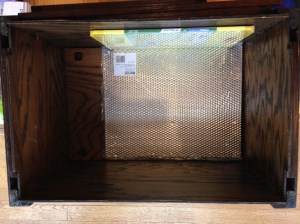
Chuck box, haphazardly stuffed with camping equipment

First of all, the fully loaded Work-Top Box is something I can slide a few feet to get it out of my way, but not something I can safely lift, let alone carry. I can split the load with someone, but it isn’t ideal for our camp set up scenario for me to require assistance with one of the first tasks I need to accomplish. I want the chuck box up and out of the way in case DH finishes setting up the tent before I’m done and wants to access more gear from the car.

I don’t want the box to be lighter for any scenario except moving it, so I’m not looking for permanent changes to the box. Once again, modularization can solve my problem.

Upon arriving at camp (or returning home), I can take the lid off the chuck box and remove a few interior bins—one at a time!—to keep the weight of each load from being too much for my arthritic hands. Choosing lightweight bins made of washable materials means I can set them down on the picnic table, the ground, or whatever surface is convenient. I can also enlist the help of even my younger child to carry a dish pan sized load. With the heavy cookware thus shifted, I can lift the empty—or nearly empty—Work-Top Box and carry it to the desired location before setting up camp (or cleaning up the soiled equipment in the dishwasher back at home.)

Chuck box steam pans empty stackedS

Food-safe, dishwasher-safe, lightweight, commercial quality steam pans

Checking the interior dimensions of the Work-Top Box, I discovered that readily available commercial cooking equipment called “steam pans” were a very good fit inside the box. You’ve probably seen food served from these at buffets in metal chafing dishes. One full size steam pan almost completely fills the box from side to side, but leaves room to store a full-sized cutting board between its lip and the long side of the box. (A standard, full size steam pan measures 20-¾ inches long by 12-¾ inch wide.) These pans come in different depths, but 2-½ inch, 4 inch, and 6 inch deep pans are common. A four inch deep full size steam pan will hold all of my long, skinny BBQ sized cooking utensils, the pot holders, and a host of other kitchen equipment. I will keep this at the top of my Work-Top Box when it is fully packed.

Chuck box ready to re load with organizationS

Chuck box ready to pack with steam pan organizers; oversized yellow cutting board and silver heat-resistant mat fit along side and bottom

One full size pan is the equivalent size to two “half” pans, 4 “quarter” pans, and so on, available in several other common fractional sizes. (A half size steam pan measures 12-¾ inch by 10-½ inch.) For my purposes, I was also looking to replace my standard plastic dish pan with a smaller size that would fit more efficiently in my new box. Two six inch deep “half” steam pans, one made of stainless steel and the other in less expensive, lighter-weight polypropylene plastic, stack neatly next to each other beneath the full size pan. These two pans are big enough to wash my camping dishes.

The stainless steel pan, being a cooking implement, could actually be used directly on the stove or by the fire to heat water, though I’ll probably continue to heat water in a kettle on the stove during dinner as I have in the past.

Lids are available for these, but I didn’t buy any since the rims of the half pans provide sufficient support the full pan. The extra depth of the 6-inch half pans allows me to pack taller items, including a 4-cup Pyrex measuring cup, inside each one. If I decide that I want to store the two half pans above the full size pan once we’ve field tested this system, a flat, full-size pan lid should allow for the pans stack in this configuration.

Chuck box half pans not ideal on top of full panS

Full pan underneath would require a lid to support half pans above

Colander inserts are available that perfectly line any given size steam pan. Since I was looking to add a space-efficient colander to my chuck box, I opted for a half sized one that nests beautifully in one of my dish pans. Big round objects are always hard to pack efficiently, so I was pretty excited to find these.

The Work-Top Box is about 12 inches deep with the extension leaves stored inside, so stacking the six-inch and four-inch deep pans will leave plenty of room for last minute additions or somewhat oversized items at the top. Loading up the box this way isn’t fiddly or time-consuming. It also makes it much easier to find and remove any given utensil compared to the jumble inside when I first loaded the box. Kitchen tools also stay organized while the Work Top Box is deployed in camp.

Chuck box deployed state with equipmentS

Blame my photography, not my Work Top Box, for looking crooked

Chuck box deployed state with equipment close up full panS

The full size steam pan goes back in the box once the Work Top Box is set up, adding weight to keep that center of gravity low

Buying a bunch of specialty equipment isn’t necessary to enjoy camping, but it certainly can make packing and unpacking more convenient. How do you organize your camp kitchen equipment?

A quest for the ultimate iPad2-compatible bag

I’m not a fancy purse girl. I love nice things, but I look first to functionality for an item I’m going to use constantly. I will happily pay more for high quality materials and even tactile pleasure, but only if the function is there. Also remember that I’m dragging a pair of little boys around with me day in and day out, so my reality involves dirt, peanut butter, and other things I’d prefer not to dwell on getting smeared all over my stuff.

I want a bag that can hold my essentials (wallet, cell phone, iPod touch, lip balm, comb, re-usable shopping bag), “mommy” essentials (hand sanitizer, wet wipes, one diaper, a granola bar), my survivalist paranoia gear (first aid kit, mini pry bar, pocket knife, flashlight, and the amazing Adventure Medical Kits Pocket Survival Pack), plus my new iPad2 with its Smart Cover, the largest item in the bag at about 7 1/2 by 9 1/2 inches.

When the iPad2 finally arrived, I first tried it in my classic Coach leather Station Bag. I’ve had this bag since college. It is by far my highest quality purse, and I know it will never go out of style. While the iPad2 fits inside the perfectly placed slip pocket in the Station Bag, and the exterior flap covers all the bag’s openings, the hasp can’t reach the fastener with such a tall object in the bag. The flap is about one inch too short! I added a Coach Willis Bag to my wish list since it is similarly styled but about an inch larger in each dimension. I think a Willis Bag would work if it shares that large internal slip pocket, but I’m not really looking for a career or special occasion bag at this stage where my lifestyle is very casual and often downright messy.

The Eagle Creek Bohemian handbag that I’ve been carrying for the past nine months almost makes the cut. I can actually squeeze the iPad2 into the Bohemian, even with my full complement of stuff already on board. It isn’t trivial to get the iPad2 in the bag, however, which makes it fairly impractical. With one small design change, Eagle Creek could make this bag perfect for my needs. There are full-length exterior zippered pockets on both sides of the Bohemian. Up until now, I’ve used the shorter, deeper, gusseted pocket for just my wallet and any receipts I save throughout the day. The flat, somewhat taller zip pocket on the other side typically holds one diaper/pull-up and a pocket-sized packet of wipes.

If the flat pocket only zipped at the top (next to the main compartment zipper) instead of 80% up the side of the bag, this would be my ideal–a quick-grab exterior flat iPad pocket with some means of securing the device inside. Instead, while I can slide the iPad2 into the pocket, it is impossible to wiggle it all the way in such that the pocket could be zipped unless the rest of the bag is virtually empty. I would gladly stop carrying the pull-up in my purse to make a dedicated iPad pocket a reality. Maybe Eagle Creek will re-work this product in the future to better meet the needs of the emerging tablet market. We don’t all want something that looks like luggage or a messenger bag!

I’ve been coveting Red Oxx products since I read about the Sky Train suitcase at the carry-on traveler’s mecca, OneBag.com. Since I have a cheap carry-on that serves the same purpose and is still functional, I’m holding off on the pricey Sky Train, but I did jump right to Red Oxx when I ordered my new iPad2 and knew I’d need to up-size my current everyday handbag.

IMG_3859

Red Oxx Rock Hopper sling bag

I wanted so desperately for the Red Oxx Rock Hopper to be the bag I was looking for! While not exactly my aesthetic cup of tea, mainly because of the black webbing and prominent (2 inch) logo,  I could overlook style issues for a bag that works. I love the presence of a flat, contrasting color slip pocket in each main compartment, and the fact that there are two big sections. I love the bright red interior to make finding what’s inside a little easier. The workmanship is everything I expected—tight, without visible flaws, and every element feels sturdy as heck.

But here are the downsides, which, unfortunately, outweigh the good for my purposes.

Fundamentally, this bag is just too big for me! This alone would warrant my return of the Rock Hopper. Frankly, it is as big as my backpack, and, if I’m carrying something that size, I’d rather have two straps to spread the weight out a little more. (The little side strap does do an amazing job at stabilizing the Rock Hopper, but it doesn’t shift any weight off the wearer’s shoulder.)

I am a short woman (5’ 3”) with a short torso for my size, and the narrow top portion of the Rock Hopper feels uncomfortably high on my neck when I wear it. Aside from the fit issue, my current Eagle Creek Bohemian holds all of 325 cubic inches, so the 1000 cu. in. capacity of the Rock Hopper is probably just more space than I need every day. With size comes weight, all borne by one shoulder in this case. If Red Oxx produces a smaller version of the Rock Hopper as they did with their rucksacks (check out their C Ruck and Mini Ruck), I will likely try one on for size.

My other complaints are more nit-picky, and I would’ve worked around them if the bag fit me correctly. I think I would prefer one of the two large compartments to be shallower than the other, though this ties in to my overall feeling about the Rock Hopper’s size. Also, I would enjoy seeing more interior pockets, possibly a small one with a zipper in the kind of useless, narrow, upper part above the slip pocket where only the end of a yoga mat is ever likely to go. Pen slots or even a strip of webbing or a D-ring to which I could attach my own mini pouches or tools on carabiners would also use that space well.

My biggest daily gripe would likely be the one big zip pocket on the bag’s exterior front. Ugh! I hate a pocket that opens in the middle leaving wasted interior space above the zipper–why, that’s exactly my complaint about the Bohemian I have now! Make the front with a more sensible pair of flat pockets, perhaps a side opening small one at the upper, narrow end of the kidney shape, and keep the larger one below the current zipper position. That way, I can grab my cell or iPod out of one pocket without risking dumping my wallet at the same time.

IMG_3879

Potential every day carry bags for iPad2, side by side

I haven’t decided whether to exchange the Rock Hopper and try a Chica, where the aesthetics feel more offensive since it looks like an ugly purse instead of a unisex utilitarian electronics bag, or just return this poor fit and keep dreaming of the day I can justify the Sky Train I know I will own and love someday.

Originally posted via iWeb Saturday, May 21, 2011