Lazy laundress’ towel tip: color saves time

This is an idea so simple as to be almost silly, but I find it helpful every week when doing laundry, so I’ll share it with the world. Note that this is a tip for the lazier housekeeper. Martha Stewart and my mother don’t need it!

Growing up, we had sets of carefully selected towels stacked in each bathroom. In the blue bathroom, Mom alternated blue and white towels, whereas peach and green were to be had in the master bathroom to match my parents’ bedroom color scheme.

When I was about to be married and we were registering for household linens, an idea occurred to me. I thought it would solve a problem that came up after laundry day in my single girl’s apartment where I was making do with a few mismatched towels received as high school graduation gifts.

Being The World’s Least Interested Housekeeper, I would usually wash my clothes and get them dried, then leave them rumpled* in the basket for days (or forever) as opposed to putting them neatly away. Hurrying to get ready in the morning, I would reach into the towel basket for a bath sheet only to pull out a washcloth or hand towel in the same color.

With visions in my affianced head of a gigantic jumbled basket stuffed with a household’s complete set of matching towels, I devised this solution. I chose colors to go with the pink floral tile in our marital home’s dated, 100 year old bathroom:

  • Face cloths in green,
  • Hand towels in pink,
  • Bath towels in white.

towels in laundry basket - 1You’ve never been in my bathroom, but I bet you could find the body towel in an instant without digging through this basket of clean laundry.

A related tip I really did get from Martha Stewart is the wisdom of selecting darker toned washcloths. I rarely wear makeup, but the idea that these little workhorses might be stained by cosmetics or plain old dirt as our family grew made a lot of sense. My darkest towels are and always will be the washcloths.

Pink for the hand towels was a matter of attempting to match an element I couldn’t change in the old bathroom. As the hand towels wore out, I moved to light grey for that room, and we’re still using some of each color in the bathrooms at our new house.

White for bath towels was the simplest decision of all. I will never tire of the look of fluffy white towels. I dreamed of renovating our really quite terribly decrepit first bathroom, and knew I wouldn’t need new towels to go with it when I did** if I stuck with white.

Though I rarely use chlorine bleach in our laundry, it is reassuring to know that it is an option with white towels when one ponders infectious skin conditions or other communicable horrors of the sort children unwittingly bring home. There can be blood, too, with growing kids, but I’d rather we didn’t talk about that.

Another nice feature of white towels is their constant availability at Costco at a value price geared toward hospitality industry buyers. The old white towels go perfectly with any new ones I add as the collection ages.

When I reach into the large basket of freshly laundered toweling after my most hurried shower, I grab something white, and it is the suitable object for drying my body. When a kid needs a washcloth for a skinned knee, he knows to grab the old green ones or the grey stripes we added when we moved into a house with a second bathroom to stock.

This works really well if you live out of your laundry baskets, even just sometimes.

Way back when we were married, I kept my original college towels (and some of DH’s mismatched collection from his hovel apartment) folded as sets for visiting guests who might be uncomfortable with a towel not visibly distinguished from those of the household. I had learned by that stage in life that some families see towels as personal linens, as intimate as one’s own clothing, where others buy towels as needed in a jubilant blend of colors and styles and pick through the commotion in a common linen closet.

Color-coded toweling isn’t for everyone. My mother doesn’t even understand what I mean about “the towels that aren’t folded yet, still sitting in a basket the next morning.” Somehow, I suspect the reader recognizes immediately whether my system might offer time savings for him or her.

Those of us who routinely dry and dress ourselves out of laundry baskets know who we are.

*I do fold actual clothing, most of the time, but it can be selective folding. Towels and underwear fulfill their functions equally well when wrinkled; outer garments do not! I’m fairly careful to fold/hang items that I might otherwise need to iron to make them presentable.

**I never did! We remodeled the kitchen, but moved before we got to the bathroom.

Does every family camping trip end with, “We need a bigger tent?”

We went car camping as a family in August. There are four of us. We’ve enjoyed our affordable, easy to erect Coleman Instant Cabin six person tent for a little over six years now. It has never let us down.*

Camp Coleman Instant Tent 6

Tent

Upon arriving home, one of the first things I did (after a long shower and donning fresh clothes without the scent of smoke) was to begin researching new tents.

According to the reviews I found, “Honey, we need a bigger tent!” is a pretty common refrain.

I find myself asking:

Does every family camping trip end with a wish for a larger tent?

I’ve posted before about my new favorite car camping accessory: a set of Disc-O-Bed Cam-O-Bunk XL stacking bunk bed cots. Lifting two of our four sleeping positions up off the floor allowed for a vastly improved storage situation, and a much more comfortable path to the door. Not to mention improved sleep quality for those of us lucky enough to rest on them!

The cots do fit in our Coleman tent, but only just. If used as a pair un-stacked for twin beds, the cots wouldn’t touch the tent walls. Due to the inward slope of the walls heading up toward the roof, the top bunk, when stacked, does press against the fabric and produce small about 1″ protrusions visible outside.

If you’ve never camped in a tent, you may not be aware that touching its side walls when it rains sometimes causes moisture to migrate through the fabric from outside in. The classic blunder is a child reaching up to touch the tent immediately above her face. For the rest of the night, drip! drip! drip!

Most kids learn the “why we don’t poke the tent” lesson via natural consequences.

It’s true that modern tent materials are much better at preventing such leaks, but it is also my opinion that it is always better to be safe than sorry about staying dry when sleeping outdoors. For this reason—and to avoid added wear and tear on my tent’s sidewalls—I would be happier if my tent were at least six inches longer in the door-to-back-wall direction.

Camp Disc-O-Bed Cam-O-Cot XL in tent by door

End view, seen through the tent door

We have yet to find ourselves in a campsite that wouldn’t accommodate a modestly longer tent than the one we have, especially since I don’t see any need for it to be simultaneously wider. Our current tent is 9′ x 10′. I think my ideal tent size is 9′ x 12′ for a family of four.

On the other hand, as you can see in the photo of the cot visible through the Coleman tent’s door, we could also make do with the exact size we already own… if the door were centered instead of set to one side. You see, in my ideal world, I would have two sets of Cam-O-Bunk cots stacked to sleep our family of four. A pair would sit on either side of the tent with a clear aisle in front of the door.

Two bunk beds would allow all of us to sleep off the ground, but, more importantly, also get all of our clothing and personal gear under a bunk, out of the way, yet not touching the potentially damp side walls of the tent.**

The newer Coleman model with the same name as ours seems to have been updated in precisely this way. I bet I’m not the only adult who wanted to walk right into the open full height center of their tent, leaving beds snugged against either side wall. You can see from my photograph that the XL Cam-O-Bunk blocks the majority of the tent’s doorway, and at the least convenient side of the door.

It would be possible to enter our tent with the cot there, but it would be constantly annoying. Even shaving off 7 ¼” of width by choosing the narrower Cam-O-Bunk L set for the kids would leave the door about halfway blocked, on the side with the zipper, no less.

Am I going to buy an almost identical tent to replace the one we have to solve this problem? No, almost definitely not, unless our old tent is actually destroyed.

We will probably buy an additional, larger tent to use for longer trips or those with greater probability of rain. We’ll keep our trusty Coleman Instant Cabin – 6 person for quick trips and fair weather. I’ve yet to see another tent as easy to erect as the one we own.

REI Kingdom 8 tentI’m leaning toward the Kingdom 8 from REI. It’s 8.3′ x 12.5′ which is almost exactly the size I seek. Its centered door means the narrower width should suit us well. The available floor-less garage sounds like a dream come true for soggy trips or sandy*** areas assuming a combined 27.5′ length would fit the site. Side walls of approximately 57″ would allow for the bunk bed cots (36″ high) to stand quite close to the edges of the space.

At 104 sq. ft., the Kingdom 8 isn’t that much larger than our Coleman Instant Cabin – 6 which measures about 90 sq. ft, but the extra square footage appears to be exactly where I need it.

There’s a Coleman Instant Cabin – 8/10 (retail $310) widely available for less than half the REI tent’s price, but its 140 sq. ft. are still arranged in a more square-ish 10′ x 14′. These dimensions just don’t strike me as more helpful to my ideal layout. It is also worth noting for new campers that having more volume inside your tent means it is less likely to feel cozy due to the warmth of your family’s bodies. This could be great in very hot or humid weather, but is a negative for climates with cool/cold summer nights.

With a retail price of $529, I wouldn’t suggest the Kingdom 8 tent to a first time camper with limited funds. I paid only $136 (retail $180) for our Coleman, and I have a strong hunch that it would prove easier to use for most beginning campers. For reasons of quality and comfort, you don’t want the very cheapest tent you can find for your first camping trip, either. Try to find a balance between reasonable price and features/ease of use.

When my family camped during my childhood, we had an heirloom (old!) canvas and wood tent that absolutely, definitely leaked in the rain when a kid poked it with a finger. Do you need to ask me how I know? It took my dad a long time to set up with much cursing and he needed my mother’s help to manage that beast. Before I reached my teens, newer materials arrived that gave us the option to buy a spacious family tent one person could put up on his own. These new tents kept us drier, too.

Some research is warranted on a purchase of this size for most middle class families. A tent can be seen as a reasonable investment in many years of affordable family vacations. If you aren’t comfortable, you won’t end up camping as often, and your money could be wasted.

You might want to ponder how you think you will use the interior space before selecting your first tent. At home, do your kids climb into your big bed, or do some (or all) of you prefer more defined personal sleeping space?

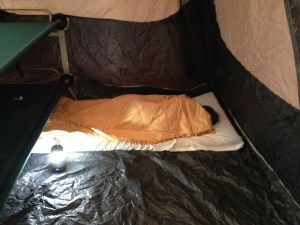
sleeping in tent - 1Families who share queen size air mattresses will enjoy the more rectangular tents such as Coleman’s Instant Cabin line.

Those of us who are using individual foam or air pads (or cots!) may prefer a longer, narrower rectangular arrangement—or not. Taller individuals, too, may be grateful for reserving open space in the tallest, middle area of a family tent.

*FYI for new campers: tents usually fail by collapsing or leaking. Most often this is a result of user error, but better designs lessen the odds of a failure.

**Aside from rain water migrating through the walls of the tent, it is also common for condensation to form inside a tent, especially when the air outside is cooler than your little fabric shelter full of warm, breathing bodies. Condensation is cured by ventilation, such as leaving the mesh windows somewhat open at night instead of zipping everything up tight.

***Unless you take off your shoes every time you step into the tent, the floor will end up very gritty. If you have kids, it’s pretty much a guarantee. Keeping a mini broom and dustpan by the door helps manage this, but it is a fact of life of tent camping.

Such a simple solution: cold feet cured with a double duty metal water bottle

A hot water bottle by one’s frigid feet is a classic winter comfort. If you suffer from ice cubes for toes and haven’t yet discovered the joy of this simple but effective warmer, do try one as the nights regain their chill.*

Here’s a so-simple-it’s-silly solution to the same problem in an overly air conditioned hotel room or when encountering unseasonably cold weather camping:

Use a refillable/reusable metal drink bottle full of hot water as a bed- and foot-warmer. Consider it a more petite cousin of the old-fashioned rubber hot water bottle you could pick up at a pharmacy.

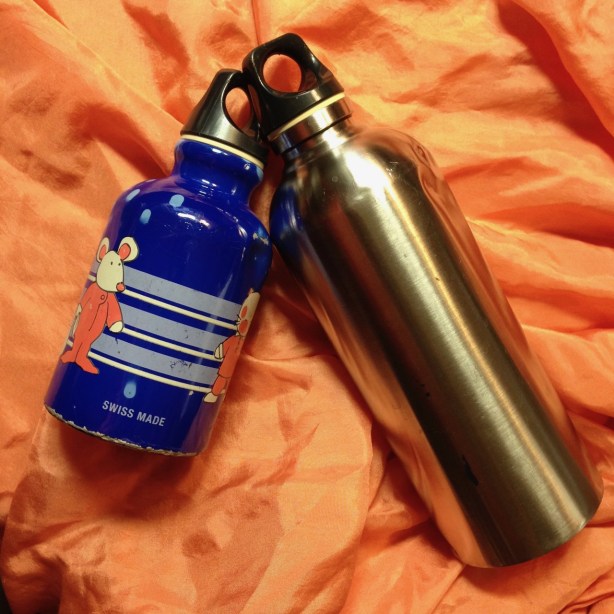
Sigg water bottles - 1

Swiss made aluminum bottles by Sigg, well used for almost a decade; dented, but still leak-free

Fill your bottle from the coffee machine (run it without coffee in the basket), the hot tap in the bathroom, or even use water you’ve heated over a campfire. I’ve tapped all of these for fuel to fight freezing feet. Just pour carefully as your source water gets hotter.

Esbit stove hot water - 1

If you have to heat your water this way, allow lots of extra time before bed…

Make sure your bottle has a tight-fitting, secure lid that won’t come loose inadvertently and soak your bed! I like flip top lids for daily use, but I only travel with bottles that include sturdy screw caps. I also routinely carry a small but super absorbent PackTowl in the same pocket of my pack to catch small leaks and drips before they threaten my papers and electronics.

Sigg metal water bottle in PackTowl - 1

PackTowl Personal model in Face size 10×14″ 0.7oz (25×35 cm, 21g)

Consider slipping the warm bottle into a sock (or a spare pillowcase) for insulation. This is vital if you’ve used scalding hot water. You want to avoid burns. Also, as the bottle cools, it will become a less cozy object to encounter. Don’t startle yourself awake by kicking a hard metal tube in the middle of the night.

You could just carry a traditional rubber hot water bottle while globe trotting. From my perspective, though, they are too large to include in a carry on travel bag. At around 12 oz, they’re also fairly heavy.rubber hot water bottle - 1

A rubber hot water bottle is a single task item. Those of us who enjoy traveling with fewer encumbrances often seek out smaller, lighter, and multi-functional gear for trips. I take no small measure of pleasure in the coup of finding tremendous extra benefit from something I was already carrying.

I always bring my own drinking water bottle to fill post-security at the airport to avoid both disposable plastic bottles and the exorbitant prices at the gate area kiosks. At home and on road trips, we have a water bottle in the car for every family member. Now, I’m simply specifying a particular bottle that can serve an additional function, and I’m a lot more comfortable for the effort.

Gentle heat, thoughtfully applied, can also provide soothing pain relief for some conditions, like my joint pain. It’s hard to overstate the value of something like that to anyone with a chronic condition that’s exacerbated by travel.

There’s just one problem that I’ve discovered with this clever solution: my family has caught on to how I’m using my bottle to warm my bed. The kids give me sad eyed looks and tell me their feet are cold! If you’re traveling as a family, it might be best to upgrade everyone’s drink bottle to a sturdy stainless steel model with an excellent lid.

Your cold feet will thank you, even if the kids don’t.


*If you’re like me, your cold feet may recur regardless of season or outdoor temperature, which is what prompted me to begin writing this post in August!

Pain makes me less approachable; pain makes you like me less

When I’m in pain, I am certain that I’m less receptive to the good in the world around me.

A recent study showed that it is possible to diagnose depression remotely by analyzing the photos people post to social media. Depressed people view the world so differently, their acts of self-expression change.

Along similar lines, I’ve noticed that I view people around me in a different light when my chronic pain flares. I’ve caught myself cynically judging the sincerity of a smile on a woman’s face, or angry at a pedestrian for his freedom to walk presumably without pain.

This isn’t my natural personality. I have a sincere love for—and trust in the goodness of—humanity that my darling husband finds charmingly(?) naive.Untitled

I like to joke that I’m a functional misanthrope, but that’s got more to do with my introversion and some social anxiety than any real disdain for humanity. I am overjoyed by the heights of human achievement. I believe that we, as a species, will persevere and do wonderful things.

That’s my perspective. That’s who I really am.

Pain, however, distorts my every impression.

And, I’m less likeable when I’m in pain. Continue reading

Go camping with less commitment: 3 steps to get started without spending a fortune

Let’s say you’ve heard of this camping thing, but you haven’t tried it. Perhaps your family camped when you were young, but you didn’t take notes while your parents pitched the tent, and didn’t their stuff fill half the garage? Maybe you’re interested in the benefits of forest bathing, but you don’t have any gear.

Do you have to spend a month’s salary at REI to make a foray into the wilderness experience?

No.

Camp Coleman Instant Tent 6

Tent

Here’s some really simple advice for taking a relatively comfortable first camping trip.

Begin with the basics:

  • Shelter,

  • sleep,

  • food.

You’ll be miserable if you miss any of these big three, but they needn’t be complicated or expensive to manage.

Find a campground that will serve your needs

Before anything else, choose the season and location where you like nature best. If you can’t get enough of hot weather, go at summer’s peak to a sunny site; if you prefer shade and moderate temperatures, aim for a wooded site early or late in the camping season.

You already know what kind of climate you prefer. Let that information inform your decisions about when and where to camp.

If you’ve never camped before, you may be surprised to learn that there exist very rustic campgrounds with almost no facilities at all. That means pit toilets or burying (or carrying out!) your own human waste, and bringing every drop of water you’ll require with you from civilization (or treating water you find on site to sterilize it.)

On the other hand, some may be equally surprised to realize that many campgrounds provide amenities like electrical power, water, and cable TV right at individual sites for compatible trailers and RVs.

It is relatively easy to find campgrounds with hot running water in the communal bath houses. Note that you may have to insert quarters every few minutes for a hot shower.

Most public and commercial campgrounds have shared (cold) water spigots and basic toilet facilities, all within an easy walk of your picnic table. Almost all sell firewood on site since this prevents the spread of woodborne insects that infest local trees. Some have a convenience store or a coffee shop.

It pays to carefully read the description of your chosen campground’s amenities. Most have a ranger or manager who will be happy to talk to you about what to expect before you make your first reservation. Make use of this free resource, because these are usually people who love camping and can’t wait to share the great outdoors with a newbie.

You don’t have to hike for miles carrying everything on your back in order to enjoy nature. That’s a great experience to try, but not one I’d recommend undertaking alone or without some practice car camping.

Car camping means driving right to your campground—and often into your own dedicated campsite—with your own vehicle hauling as much as you want of your own stuff.

Shelter

If you’ve never camped before, I’d advise looking into state campgrounds that offer rustic shelters in addition to tent sites. Some private campgrounds may have these, too, but my experience veers toward public lands.

These vary from log cabins to semi-permanent tents, but they do almost guarantee protection from sun and rain.

Don’t expect a bathroom or kitchen or any running water at your site. More often, you’re reserving a glorified tent, possibly one with rustic bunk beds. Read the site description carefully so you aren’t surprised, and expect to do your cooking outdoors and your toileting and bathing in communal facilities nearby.

You may (or may not?) be surprised to learn that reservations are made much like those for hotels or flights. These days, that means online as well as by phone. Check out Reserve America to see what’s available in your area. Some states may use their own proprietary reservation systems; if you’re interested in a particular park, find its website and follow the links.

Costs are higher to reserve a shelter instead of a nearly empty tent site with just a picnic table and a fire pit, but you will still spend much less than you would for hotel rooms. A yurt at one Oregon state campground costs $44 per night; a tent site is $21 per night. At a Vermont state park, a lean-to starts at $25 per night while a tent site is $18+.

Erecting a shelter that will stand up to wind or rain is probably the trickiest step involved in camping. Skip it entirely for your first trip, and you can get a good sense of whether you enjoy the basic experience, especially if mother nature throws any “interesting” weather your way. You also won’t have the expense—or storage issue—of a bulky tent you might not use again.

I think there’s value in learning new things, but there are others you can concentrate on right out of the gate. Properly siting a tent involves evaluating the ground, remembering a number of steps, and tying clever knots. If you’re willing to invest your time in these skills, renting a tent is an affordable option.

Sleep, don’t suffer

Some people will sleep undisturbed on the bare ground with a simple bedroll; most of us won’t!

It’s absolutely possible to bring regular bedding camping, but sleeping bags are the gold standard for a few reasons. They are compact and easy to re-roll and pack. They keep you warmer because they your body heat gets trapped within their enclosed confines. They are sold with easy to compare temperature ratings printed right on the tags giving you a vital clue as to which one best suits your trip.

Borrow, buy, or rent an appropriate sleeping bag for your climate. It is unwise to skimp on this vital piece of kit. Err on the side of a somewhat warmer (lower printed temperature rating) bag because you can unzip it if you get too warm, but getting too cold in the wilderness is a real safety threat.

The threat is less in a campground with facilities, your vehicle, and many people nearby, but it’s best to respect nature’s power from the get go. Never leave civilization unprepared for keeping yourself warm in the given climate! Maintaining your body temperature can be a matter of life or death.

This is another time to know thyself. If you tend turn off the heat at night in winter and sleep with your feet sticking out, you may want a less insulated sleeping bag. If you’re the one who puts freezing cold footsicles on your partner in July, buy a warmer one.

In addition to one sleeping bag per person, bring a sleeping pad or air mattress for everyone, too. You might be the rare soul who doesn’t feel the rocks and twigs. Go ahead and try stretching out on the ground one night, but have at least a little cushioning available in case you want it.

If you’re over forty, consider investing in a “deluxe” level of padding. Many people prefer a softer nest as their joints age.

For car camping, where bulk and weight don’t matter too much, I always include at least one extra foam pad with my camping supplies, even when we intend to use self-inflating or standard air mattresses. Air mattresses spring leaks at the most inopportune moments. Without a backup mat, I would probably choose sleeping in my car over directly on the ground. Foam mats are cheap, often less than $10. I can’t think of a single serious downside to layering an extra piece of foam beneath any and all other mattresses.

Bring at least one old blanket (or a new one that’s sturdy, thick, and washable.) Wool is the classic material; fleece is a cheaper, less allergenic modern equivalent in all ways except flame resistance. Layer it under you if the ground is too hard, over you if your sleeping bag isn’t warm enough, and fold it to cushion the picnic table bench if you get tired of rustic seating. Curl up in it while you stargaze around the fire after dark.

If you enjoy a throw blanket on the couch at home, you’ll absolutely adore it when the temps drop at night in your campsite.

Eating—and cooking and washing up—alfresco

A camp kitchen can be extraordinarily elaborate, or incredibly simple.
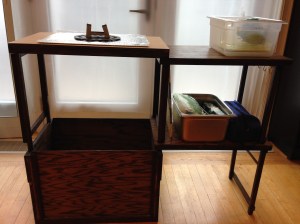
Chuck box deployed state with equipmentS

My camp kitchen gear, assembled over more than a decade of trial & error

For a first timer, even one who loves to cook at home, I would recommend starting with a minimal investment in specialty gear.

If you’re bringing perishable food, you will require a cooler. Hard-sided coolers keep ice longer than soft-sided. Larger coolers are more efficient than small ones. If you can buy ice locally near your campground, these concerns are less vital.

One good tip is to eat your most perishable foods at the beginning of the trip. Food poisoning will ruin any experience. If you’re unsure how to keep fresh food at a safe temperature, bring only commercially packaged, shelf-stable items. There are plenty of options.

Consider pre-packaged backpacking meals that are reconstituted with boiling water, or dead simple preparations like meat cooked directly over the campfire. Baked potatoes wrapped in foil are a great accompaniment, can be eaten right from their wrappers, and need very little clean up. All campsites I’ve visited have had at least a fire ring, and most of those also included a grate for cooking or supporting a (fire safe, such as cast iron) pot over the fire.

Remember that if you are bringing reusable dishes or utensils, you will also require a basin in which to wash them and a means of heating a large quantity of water. That’s fine, but it may not be obvious when you’re used to hot and cold running water. You should also make sure the dish soap you plan to use is biodegradable so it doesn’t damage the natural environment you’ve come to enjoy.

A brief camping trip may be the time to be less environmentally conscious and use some disposable items. I like a balance of washable items where they count (sturdy flatware and sporks, plus rigid handled mugs for hot drinks) with paper plates for eating sticky or greasy meals (going into the fire as tinder the next day.)

I’m lazy, so I try to wash dishes only once per day while camping. Carrying and heating water can be a really big chore. Don’t underestimate the effort required for this one.

On the flip side of this issue, never leave dirty dishes or food outside overnight. You’ll wake up to a huge mess made by the nocturnal creatures who enjoyed the “buffet.” Pack food and garbage away in your car overnight (or into provided receptacles if so advised by the campground.) This is both a hygiene and safety issue. It’s also harmful to wildlife.

Esbit stove in front of fire - 1

Esbit stove with folding-handle cup heating water

I wouldn’t plan more than a few hours in the wild without at least the means to boil water. My most basic method is a very inexpensive folding stove that takes small cubes of fuel ($11 on Amazon today, or $13 at REI.) This would fit in any backpack, and many pockets. I bought this and the folding-handle metal cup (~$10) before I had a family to feed, but I still use it to boil the water for my morning cup of tea if I’m the first person awake at a campsite.

There are many other small, simple backpacking and car camping stoves for sale with various learning curves, features, and downsides. I begin with the Esbit because I think it is foolproof and a bargain. I also own and like a JetBoil backpacking model (around $100) that uses fuel cans, and a Kelly “Storm” Kettle (~$90) that burns twigs and locally sourced brush. The Kelly Kettle is my favorite to use when multiple adults want hot beverages and there’s no call for a full campfire.

Taking the plunge ~ how many nights in camp?

The final consideration is how many nights to spend on your first outdoor overnight. Though I advocate moderation in most things, I would recommend at least a weekend (2 nights😉 a three day weekend (preferably not on a holiday) is even better.

Arrive relaxed on a weekday—or by midday Friday. This is much, much better than setting up camp while tired with the sun going down.

Give yourself the benefit of lots of time, energy, and daylight to prepare your first campsite. This holds even more true for families with kids!

Don’t arrive starving unless you picked up a prepared meal to go. If you plan to cook over a fire, it will need time to burn down from high flames to useful, glowing coals.

Even a simple campsite can feel like it requires a lot of setup. New equipment requires a learning curve, adding to the perceived effort.

I’ve heard this from friends, and I feel the same myself: you might as well set up camp for a week as for a weekend. It’s the same amount of work. You just bring more food.

If you manage a successful and enjoyable camping weekend, try a longer trip the next time. You’ll probably agree that the rewards for the effort feel much more substantial.

Don’t forget to invite your friends. Sitting around a campfire in great company under the stars is one of my greatest pleasures. I hope you find the same to be true for you.


Camping friends - 1