Multi-generational co-housing: sharing a home with my in-laws

A few years ago, we made the choice to move, together with my husband’s parents, into one large, shared house.

We sold a three bedroom, one bath home; my in-laws sold their own similarly sized three bedroom house.

They contributed to the down payment on the new place and paid to remodel their portion. This included adding interior walls and a second kitchen for their exclusive use to create a true in-law apartment. They have an exterior door that leads from the driveway to their space, three bedrooms, a living room, and two bathrooms, all their own.

We share a short hallway from the garage, basement and garage space, and the yard itself, though we agreed upon one patio area for their outdoor furniture and primary use. Our main entrance is the original front door, so none of our guests pass through the other’s private spaces.

It’s not a rentable second residence (we share utilities, for example), but we don’t have to share cooking space, bathrooms, or exterior entryways. We can open interior doors to see each other, but we can also close them for privacy.

We took on a mortgage of a similar size to what we would have spent moving alone into a larger home. Sharing a 35 sq ft (a little over 3 m2) bathroom—with a bad layout, asbestos panel walls requiring professional abatement, degraded brass plumbing, and a cast iron tub in dire need of refinishing or replacement—with three males had become a daily nuisance, and I was demanding an upgrade one way or another.

I’ve had people commend me for being “willing to allow” my husband’s parents to move in with us, but it was actually my idea. DH is very close to his parents. He took virtually no convincing, though he was concerned about how I would respond to living together. My rationale for entering into this arrangement—unconventional in 21st century Western society, but “traditional” when considering human history—was multi-faceted.

First, my husband is an only child, and care of his parents is his sole responsibility. If or when, in the future, they need more assistance, he is duty-bound to provide it, and I wouldn’t wish for him to behave any differently. My hope was to create a comfortable home in which we could all co-exist peacefully before circumstances forced the issue.

How much better is it to move joyfully forward into a great new house we’ve picked out together than to cram an ailing or recently widowed elder into a house that’s ill suited for aging in place? We were barely squeezing our family of four into our old place. Any sudden addition to the household would have been difficult, maybe impossible, if infirmity had been the motivation for the change!

I grew up with my maternal grandfather sharing our home. He joined our household when I was a preschooler, after he had been a widower for a few years. I’m sure my decision to expand our household beyond our nuclear family was made easier by the experience growing up with Grandpa just another familiar daily presence. He had health issues and spent most of his time in his room listening to classical music, but he was there, and he was just part of the family.

Besides these more emotional reasons for expanding the scope of our family home, I must admit that I also believe in the sensibility, and sustainability, of the modern co-housing movement. There are economies to be gained by living in groups, even small ones.

I loved the idea of buying a unit in a co-housing community, but had never made headway convincing DH it was a good idea. Sharing a household with my in-laws does put some of my environmental principles into action.

For example, a periodic energy usage report from the local utility says we use 25% more energy than neighboring households. That bothered me until I remembered that our one home replaced two. Also, three members of our six person combined family are home (consuming power and keeping the heat or air conditioning at comfortable levels) for most of every day. A mere 25% above average is actually an energy savings win.

It was hardest to coax my father-in-law (FIL) into the arrangement. DH’s mother (MIL) would have moved into our old (detached, unheated) garage without complaint if she thought it would serve the family. She’s also generationally and culturally inculcated to go along with her husband’s financial decisions. Aside from making clear that she didn’t want to live in a basement, MIL was on board with the co-housing idea from the moment she heard it.

FIL felt differently. He still works, and he’s fit and active. The first time we broached the subject, it was pretty clear that he didn’t want to be assumed as our “responsibility.” I think he appreciated the fact that we were expressing care and concern for their future, but he was not ready to “move into his son’s house.”

An alarming health scare a couple of years later, which, happily, turned out to be a false alarm, brought FIL around to our plan. I believe he acted then out of concern for his wife. What if something had happened to him? What would happen to MIL? As soon as FIL expressed a tentative interest in the idea of moving in together, I called a realtor and began readying our place for sale.

We were able to buy a much larger home in an ideal neighborhood by combining the value of two properties. Neither household was compromising or downgrading comfort, space, or property values in the move. We have enough room that no one is on top of each another. We had plenty of options at this higher end of the market to find houses that were easily adapted to multi-generational living.

Another really important point to my story is that FIL and MIL really weren’t “giving up” on independence and “moving in with” their son. We gain at least as much by having them living downstairs as they get from us!

MIL is the traditional Jewish grandmother in one obvious way: she always wants to feed her loved ones. If you’ve read some of my other posts, you may recall that I’m a reluctant cook. The boys get nutritious, home cooked dinners four nights a week with their grandparents. I get to skip cooking four nights every week during the time of day that my energy is lowest. I’m very content to dine alone on leftovers while the boys enjoy vegetable soup and котлеты and lots of doting attention.

Also, I get an hour to myself to recharge my (introverted) emotional batteries after spending all day with DS1, who learns at home. My husband deserves to be greeted, after a long day at work, by my best self, and he’s more likely to get her if I’ve had a chance to take a break. I’d like to be an eternally happy housewife, but I’m simply not without regular intervals of peace and quiet.

And speaking of the home school scholar (DS1), FIL is a great help with that process. He is not just willing, but eager, to tutor his grandson in math, history, computer science, and the Russian language. MIL, who was a concert pianist, accompanies DS1 while he practices his violin. Their experience and wisdom definitely enhances DS1’s education.

Finally, it’s worth mentioning the social consequences of the in-laws moving in with the “kids.” I think FIL was a little worried that their friends would judge them for making this change. After supporting himself and his family for decades, would it seem like they were financially needy, even derelict? Instead, attitudes seem to be quite the opposite. If little birds can be believed, many friends feel rather jealous.

“Your daughter-in-law asked you to move in with them?!?”

What better proof that you are valued, loved, and that your presence is appreciated?

Cruise report: HAL Maasdam from Montreal to Boston with elementary school aged kids

Our party of three—one adult with two elementary school aged kids—traveled from Montreal to Boston on the Holland America Line (HAL) Maasdam during the last week of August 2012.NS Sydney port

Family travel, cross country, without cars or planes

I opted to make our usual New England to Pacific Northwest summer visit without flying on any airplanes in the summer of 2012. I accomplished this by booking the train across the USA westbound (Amtrak), then a combination of train (Via Rail) and this cruise to complete our voyage home via Canada.

As in the USA, there are vast, gorgeous swaths of undeveloped country in Canada that are simply inaccessible by road. The train travels through some of them. Others are better reached by water.

A traveler who goes by ship, not a dedicated cruiser

I am a traveler who sometimes goes by ship, not an inveterate cruiser. I love the convenience of unpacking once, then seeing many ports. I can sit by a window and stare at the open sea for hours, so I like to travel by ship. The ship’s amenities are less exciting to me than the voyage itself.

Continue reading

Are land line phones as archaic as the nuclear family?

My husband and I have a long-running joke that goes back, I think, to our first experience traveling together. Our shorthand for this very long discussion is:

“It’s all about the sharing, and the commitment.”

It began with a difference of opinion (ongoing!) about combining both of our belongings, intermixed, into two shared suitcases vs. packing individual bags. I prefer the former; he prefers the latter.

DH believes this is an entirely biological imperative: I am the female who needs full relationship participation from my mate and maximal expression thereof so I can ensure the successful maturation of our offspring. I’m putting my eggs (wardrobe) in his nest (suitcase), so to speak.

My argument on the subject is that suitcases are regularly lost, and the distribution of at least one full outfit per person in the other bag means less chance of radical inconvenience if a bag goes missing. It is also nice for my loving feelings that we are sharing, which corroborates the commitment.

I’m right about this, of course*, and I follow the same strategy when traveling with my children, so it isn’t all about co-opting DH’s suitcase real estate, but that’s not my main point today.

Moving beyond the travel example, this sort of discussion arises over other daily actions like asking for a bite of his meal (the sharing), or asking him to weigh in on a household decision he might not really care about (the commitment.)

Sharing and commitment are the very nexus of healthy relationships. It’s hard to imagine a family thriving without them.

So what does any of this have to do with the great 19th century innovation of the land line telephone?

For the first time since phones became ubiquitous in the USA, cellular only households now outnumber those with a traditional land line. This is hardly surprising, and there are a number of downsides to this trend that have been covered by major news outlets. The most obvious relate to dispatching emergency services, power outages, and rural or elderly populations who depend heavily on wired phone lines.

Nowhere have I seen mentioned what I’ve found the most personally disruptive feature of a cell phone only culture: it is no longer possible to call a family as a unit. I have to choose an individual to contact, even when my business is with the whole group.

Sometimes, that’s inconvenient: “Hello, neighbors, your garage door is open and the sun’s going down,” or, “I’m driving by and want to drop something off to whomever is at home.”

No, it’s not the end of the world to spray a series of texts or voicemail messages, but it fundamentally ignores the shared nature of a household and its tangible collective purpose.

Sometimes, that’s kind of sad.

Is a family home anything like a collaboration of tenants in common? Should it be?

For individuals who choose co-housing for financial or other reasons, the personal cell phone is a great innovation. Anyone who’s lived in a dorm or otherwise shared a public hall phone knows the benefits of a private device. But is there any advantage gained by a family in the same scenario?

It’s positively quaint to watch an old TV show set at home and see teens racing to answer the communal family phone, or demanding that a sibling conclude a conversation quickly lest an important incoming call be missed. I showed my kids Family Ties last summer, and I marveled at the repetition of that once common scene—now inconceivable—every time.

I don’t mean to romanticize the inconveniences of sharing, but I do question what role the act of frequent sharing has on members of a family. Might these regular points of casual contact mean a more regular chance to check in? I’d guess that it would act in much the same way that sharing any habitual activity leads to better communication between teens and parents simply by providing a low stress opportunity for it to happen.

And then there’s the effect of sharing itself. Parents spend an awful lot of time and energy teaching this vital skill to their young children. Why? Because we want them to grow up into caring adults who treat others well. Participating in a shared family mode of communication means taking part in the functioning of the family itself.

To be clear, I wouldn’t advocate spending twice to have both a cell phone and land line in a scenario where every penny counts. If you have to choose between buying vegetables and having two phones, I vote for the healthy green stuff. If only one phone is in the budget, a mobile phone provides the most flexibility and would be my choice, too.

But for families more like mine—having the privilege to elect music lessons and summer camp, organic food and restaurant meals—the move away from a family phone seems short-sighted. We are constantly bemoaning how hard it is to communicate with our kids while literally cutting the copper lines we used to share.

Shifting more and more experiences from public to private space—personal iPad viewing vs. negotiating the channel of the family room TV, meals on the run vs. around the family table, and, yes, a social life conducted primarily through a tiny handheld computer instead of in the yard or the living room, or even at the mall or the movie theater—every one of these is a vote, intentional or not, for the primacy of the individual experience over a commitment to the family.

These are choices, conscious or not. They are every individual family’s to make, and I don’t presume to know what’s best for yours.

I do, however, hope that I’ve made my point that these are choices best made based upon one’s values, and not by default. It is easy to convince oneself that a situation is made by circumstances and not by choice. Sometimes, its harder to live with the consequences.


*This is a joke. I respect my husband’s opinions as he respects mine. We both think we’re right, obviously. But, probably, I am, which is a joke that’s become recursive…

Mother’s Day is the gift: one perspective to consider when shopping for Mom

Speaking for myself, and my kids have heard some of this before…

I don’t need a Hallmark card on Mother’s Day.

I don’t need a mug that says “Mother.” I don’t need any thing at all. You don’t even have to buy me flowers.Mother's Day flowers

On Mother’s Day, I’d like your time, your love, and your cheerful participation.

I’d like to sleep in

I’d like to sleep in, on Mother’s Day, until I wake up with a yawn and a smile and no alarm clock—digital or demanding human—in sight.

Then, when you’ve heard sounds of my stirring, I’d like my two favorite kids in the history of the universe to come joyfully in and jump in my bed with hugs and kisses like I got when you were toddlers and I was the center of your world.

No one’s too old to kiss his mom on Mother’s Day.

I’d like someone else to cook & clean

I’d like someone else to cook breakfast, but I don’t care if its fancy. I want the dirty dishes to disappear without my saying a word. In fact, I’d like to find the kitchen clean at the end of the day, even especially if I never set foot in the room.breakfast skillet

A running dishwasher without prompting is like a love song to me on Mother’s Day.

I’d like to spend time with you

On Mother’s Day, I propose we build a jigsaw puzzle with nary an eye roll and no suggestion that a video game would be more fun. I like playing Ages of Empires with you, or The Sims, but I enjoy building things more.

If you bought me a gift over my protestations, I hope its a 1000+ piece puzzle with an image you like, too. Or maybe a Lego City set—one of the modular town buildings that I love. We could spend a whole day assembling and playing with that.

If there’s a gift, I hope you bought it with the intention that we would enjoy it together.

Show me your best self

Order takeout or pizza for dinner, if you don’t want to cook again. I don’t mind; I just like to be fed.

Show me your consideration by remembering what I like, or use that excellent brain to observe that I’ve marked up all the menus with everyone’s usual order. That’s how I make sure your favorite dish is never forgotten.pizza

If you looked, you’d find my cookbooks full of similar notes, too. Who likes what? How must I challenge Betty Crocker so you like a recipe better? Have you ever noticed that this is just another little way that I take care of you every day?

Serve the food on plates, not from the boxes. Remember to put napkins on the table without being reminded that we’re civilized. Ask me if I’d like a glass of water instead of asking me to get one for you. Bring silverware for everyone, even your brother.

Use your very best, cruise ship manners.

Tell me, show me, acknowledge me

Tell me you love me. Show me you love me. Today is the day to acknowledge my boundless love for you.

That’s what I’d like for Mother’s Day.Mom hug

How will you celebrate Mom on Sunday, May 14?

I love Lego, and I built a platform on an IKEA base to host a city where I can play with my growing kids

I love Lego

True confession time: I love Lego.

I don’t just mean love in that generic, parental, “I love to buy Lego for my kids so they will grow up to be engineers and support me in my old age” way. No, I love Lego in an “I won’t share my bricks with my kids” way.

Lego is one medium with which I still know how to play.

I had a few bricks as a child, but I really started collecting Lego sets when I  was a young professional. Living alone and working long hours as a software quality engineer, I sought a relaxing pastime to keep myself off the computer for a few hours a day. It started when I discovered ancient Egyptian themed Lego sets during a spontaneous trip to Toys “R” Us one evening after work…

I won’t share my Lego with my kids

I hoard my Lego bricks, and I store them separately from the children’s toys. They don’t sort their bricks properly the way I prefer. Also, I like to keep the parts for my favorite sets together, though I don’t keep the boxes or treat them as collectibles. I just enjoy the option of re-building without too much digging for specific pieces.

Family Lego city display MOC in progress

My modern office building MOC in progress. I need over $100 worth of grey and clear bricks to turn my vision into a reality, so it’s on hold. A construction site is a fun spot for creative play in Bricklyn

My spoiled little darlings own enough Lego to stock a store, but I could fill a large Rubbermaid tub with my own bricks. Actually, maybe two tubs. And, realistically, I wouldn’t desecrate my greatest builds by stuffing them unceremoniously into a bin.

I guess I’m a little spoiled, too.

I love model cities

I’m geeky enough to admire model train sets. I grew up thinking how cool it would be to build such a thing in my future home. I’d love to have a toy train running from room to room on a suspended track like I saw once in a small town Maine restaurant.

I love Lego builds on a grand scale, too. I not-so-secretly identify, just a little, with the dad (spoiler alert: a.k.a., Lord Business) in The Lego Movie. I would never glue my bricks together, but I would expect a cohesive vision to be respected by my family as a labor of love, at least for a while.

family-lego-city-display-front-e1493311369289.jpg

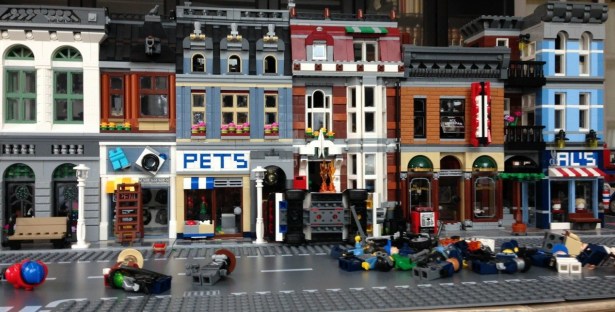
“Bricklyn” main street; battle carnage courtesy of DS2

I absolutely adore the modular Lego City Creator sets. They have an early 20th century downtown vibe that’s aesthetically pleasing to these adult eyes. I own a few now. I enjoyed building them, and I really wanted to display them instead of putting them away.

I’ve found that kids are drawn to the finished buildings in an adult space. They just cry out to be played with, but I didn’t want to be constantly policing children or tempting them with untouchable objects on a coffee table. That’s just mean.

Here’s how I found a way to keep my sets intact, for my own enjoyment, while also creating a fun, inter-generational play space for my family and friends.

I built an “open source” Lego “platform” for family sharing

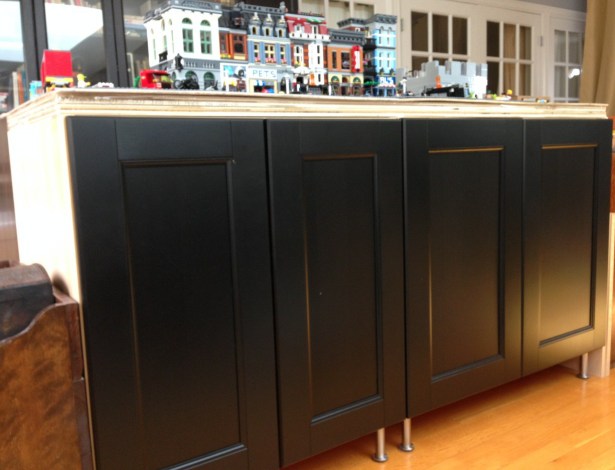
We set up a fairly large (48″ x 66″), counter height surface on the library side of our great room. I assembled four IKEA kitchen cabinets for a base, then used a sheet of plywood for a level platform. It isn’t beautiful, but it is tolerable in a space that also functions as our “formal” living room. Obviously, our lifestyle isn’t really very formal!

IKEA Lego display platform cabinets

I have the veneer to finish the ends of the cabinets to match, but that’s also waiting for “someday.” I’d rather play with my Lego sets than finish my home improvement projects…

Someday, I’ll get a proper counter top to replace the plywood we edged with packing tape to reduce splinters. Most of the surface is covered with base plates anyway, or will be when we’ve added a few more buildings. A simple edge treatment would improve the looks of this project more than anything else.

The IKEA cabinets below “Bricklyn”, as DS2 dubbed our little town, created storage space for all of our board games. Two cabinets each at 24″ x 30″ and 24″ x 36″ hold a lot of family clutter. I opted to use drawers on one side, and cupboards with doors on the other. The drawers are easier to keep organized, but much harder to assemble if you’re an IKEA novice.

To add stability and prevent dangerous tipping over of the heavy cabinets, we fastened the same-width units back-to-back. We also keep heavy objects on the lower shelves and in the bottom drawers so the unit isn’t top heavy. The plywood top extends across multiple cabinets to further cement the units together. Even with every drawer open on the back side, the unit doesn’t budge.

Three rules keep the peace during playtime

There are just three rules for our play table, and even visiting children have been willing to abide by them.

  1. Each family member “owns” some of the baseplate “lots” that cover the table; we each get to define our part of the neighborhood. We can build anything that fits the confines of our plate. Roads are public and may be used by everyone.
  2. Whoever built a structure or vehicle controls the rights to modify that structure or vehicle.
  3. Anyone may move vehicles and minifigs within the cityscape without fear of reprisal, but no one may remove vehicles or minifigs from the display unless s/he put them there.

It helps that my kids are old and mature enough to have some respect for private property. Each has a smaller table in his room set aside for personal building that is sacrosanct. Bringing something to Bricklyn is an agreement to share.

It also helps that the cabinets keep Bricklyn about 40 inches off the ground; our rare infant or toddler visitor can’t reach what s/he shouldn’t take! We keep a step stool handy for our small friends (usually around kindergarten age) to see the display and join in the play. So far, our youngest participants have shown a sort of reverential respect for what we’ve built, and they’ve played by the rules.

Mother’s Day is coming up, which is one of those holidays when I just might be lucky enough to receive a new Lego City building. If I do, I’ll build it in Bricklyn.