
Farmers to You gives my New England family direct access to regionally grown food

Let me tell you about my farmers.

Tragically, no, I don’t control my own fiefdom. The farmers in question are producers for, and partners of, Farmers to You, a farm-to-table direct grocer experiment in which we participate.

I call it an experiment because they are still tweaking their business model. I’m bringing it up today because our farmers are asking for our help.

We’ve been buying what we can from Farmers To You for several years. Essentially, I see it as an online version of the farmers’ market. Unlike a CSA, which we tried before but found too prescriptive, Farmers to You doesn’t dictate what we buy. Instead, each member family makes an agreement to spend a certain amount of money every week. This relatively constant level of spending is insurance for 83 partner farmers that there will be a market for their produce.

Most of my friends who participate in CSAs are health-conscious eaters or foodies. Without a doubt, buying local food means buying fresher food; buying heirloom varietals means eating better tasting fruits and vegetables. I’m pleased about these qualities in my food, but I’m also buying from the regional New England foodshed because I care about food security.

New England currently has 4 million acres of farmland; feeding New England’s population would require 16 million acres. Preserving farmland in every region of America serves as a buffer against catastrophic events elsewhere disrupting our food supply. It protects jobs and a traditional way of life that benefits local families and generates tourism. Farms also preserve green spaces and—especially in the case of farms managed with organic or integrated pest management methods—provide habitat for native species driven out of crowded urban and suburban areas.

Being a partner family with Farmers to You is easy. You can sign up online. There’s no fee. You only pay for the food you choose.

Update your order online over the weekend. If you don’t log on and make changes, you’ll get available products you ordered the week before. Orders are delivered to set locations—schools, churches, and other community spaces—on either Wednesday or Thursday at a set time. (The site you choose determines your day and time of pick up.) You go to your chosen site during the assigned hours and pick up a shopping bag already filled with the food you selected online. Unless you care to socialize, you can be in and out in just a few minutes. You might want to linger, though. The site hosts tend to be friendly and interesting people.

Oh yeah, and they have home and office delivery available in most close-in areas around Boston. You can be busy and still eat fresh, local food. It will be delivered by human-powered bicycle/truck in partnership with Metro Pedal Power.

Yes, sometimes in the dead of winter, I find it less enticing to fill my cart. We eat apples, but not as many of the storage vegetables like potatoes. That’s when I add a bag of dried beans, a bottle of 100% pure cranberry juice, or some real maple syrup to meet my minimum. I’ve never found it hard to find something my family would eat with this system. We used to throw away some of the mandatory vegetables when we were members of a CSA; we got stuff we just wouldn’t eat, and occasionally didn’t get around to giving it away before it wilted.

As I said, precisely what you put in your online shopping cart is up to you. Farmers to You offers the obvious fruits and vegetables, but also locally sourced meats, dairy, eggs, baked goods, and pantry items. They’ve added some not-quite-local extras like coffee (regionally roasted) and nuts (regionally packaged) to meet the desires of member families. Farmers to You doesn’t replace my regular grocery run, but it does prevent needing a mid-week trip to stock up on fresh vegetables and bread.

And speaking of bread… Having a loaf of Red Hen Baking Co. Whole Wheat bread arrive in our kitchen on Wednesday evening is our favorite treat. This is the slow-risen, naturally leavened staff of life Michael Pollan was talking about in Cooked. I’m not likely to make a bakery run on a school night, but an infusion of fresh food mid-week is well-timed and much appreciated.

In order to keep this model sustainable, Farmers to You is looking to expand the number of enrolled families, increase the size of the average order, and raise additional capital from investors. They’re asking all of us—the member families—to spread the word.

If you’d like to learn more about our experience with Farmers to You, let me know in the comments. Do you shop your local farmers’ market? Are you a member of a CSA? How and why do you buy locally produced food?
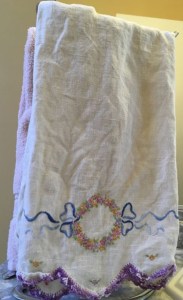
Hand-embroidered linens: a celebration of the unique gifts of mothers

I’ve got something you don’t have!

I say this gleefully, hand to mouth to hide my smile. But my treasure isn’t valuable in a monetary sense. Instead, I’m celebrating the absolutely unique nature of a collection of linens—primarily kitchen and tea towels—that my mother just sent. Most of them were hand-embroidered by the grandmother I never knew.


Linen hand towel wreath

Genuine linen. Not even ironed! In the guest bath!

My maternal grandmother died when I was a baby. I met her, but I was too young to be aware of it. I’ve always hoped that she was glad to meet me—her first grandchild—before she passed away.

My mother has pack-rat tendencies, though her house is immaculate and very well organized. She has more bedding than she could wear out in a lifetime. She keeps everything, just in case she needs it someday. While her attempts, thus far, at “down sizing” strike me as beginning the process of moving a mountain by picking up a pair of tweezers, she is taking steps to clarify things family members might want “someday” and she has gone so far as to gift items even she admits she’s unlikely to use. Grandmother’s linens fall into this category and arrived UPS in a medium size box.

Mom’s perfectionism meant a certain lack of freedom of expression during my childhood. I was involved in the decision to buy coordinating bedding sets for my bedroom, say, but under no circumstances could I have used pillow covers atop my bed that didn’t match the theme exactly. Some of Mom’s standards are pretty rigid. We did get to enjoy hiding our preferred, sometimes whimsical sheets out of sight beneath the spread. I used a particular set of Sesame Street sheets right up through my college dorm.

Other favorites of mine, once I was old enough to pick them out on sheet-changing day and tall enough to see them tucked away in the least used corner of the linen closet, were an array of delicately embroidered white cotton pillowcases that didn’t have matching sheets. Mom would let me use them with plain white sheets, which were close enough. (Sigh). My grandmother embroidered some of these, and some of them were wedding gifts to my grandmother from women she had known growing up. They were deemed too nice to use, I think, and so they waited in one closet, and then another.

I loved them, and I wheedled, and I used them. My mother didn’t mind too much. She did complain that they required more ironing than her preferred poly-cotton blends, but no bed sheet ever makes it into service without pressing in her house. No-iron means “easier to iron” in Mom’s lexicon. For all her compulsions, my loving mother has always tried to make her children happy, though she might grumble about some of what that takes.

As a teen, I dyed my hair the occasional interesting color, and I wore it black off and on. I ruined my very favorite embroidered pillowcase by sleeping on it one night after a dye job. I was really sad. Mom was somewhat cross. Then, we both got over it. I learned two lessons that day: first, to be more careful with wet hair that’s been dyed black, but, more importantly, that those wonderful things we want to save for a more important day are still better used and enjoyed than kept “safe” in a pristine prison. If we won’t use them, why have them?

Which brings me back to my new, old tea towels. Mom didn’t use those because they didn’t match her kitchen. Mom’s towels always match her kitchen, including the adjusted color schemes of her seasonal décor. Also, some of them have spots. Or stains. They aren’t perfect enough for my mother’s kitchen.

But I think she kept them all these years because they remind her of her mother.

Tea towels days of week

Racist embroidery depicts a stereotypical Chinese servant. It also likely reflects attitudes during my grandmother’s upbringing in early 20th c. California.

They must bring back memories of all the tuna-and-egg salad sandwiches made for a little girl’s lunch by loving hands. Perhaps even the stains convey nostalgia for a woman, my mother tells me, who was not a perfectionist, and shook her head over a little girl growing up already rigidly wedded to the notion of perfect matching sets and an immaculately made bed. I seem to be a little bit more like my grandmother, in this respect.

So I unpacked the box and unfolded towel after towel, napkin after tablecloth. They don’t match my kitchen. Some of them have stains. Their delicate embroidery may not hold up to my take-no-prisoners approach to washing kitchen towels.

I use them every day. I cherish every singular stitch. And every time I dry my hands, I think about the grandmother I never knew, and I’m grateful for the mother that I have.

Book review: “From Anna” by Jean Little

I read incessantly as a child, and I read some young adult fiction working in a bookstore as an adult (between my professional career as an engineer and becoming a full-time parent.) Then, I was the mother of a child who read far above grade level, but was still emotionally too young for some kinds of content, so I read many more children’s books in a newly critical way.From Anna by Jean Little cover

I found Jean Little’s From Anna (written in 1973) at our local library in 2012, read it, and shared it with my son. It appears to be out of print as of this writing (2017.)

It is an incredible statement from me that I believe this might be the most moving children’s book I have ever read. I finished it in just a few hours and loved everything about it. I had to hide my raging enthusiasm for it lest my son rebel and refuse to read it. I think this novel is a valuable read for every child.

The plot is straightforward: a German family decides to leave their homeland as the Nazis rise to power in the 1930’s. The youngest child, Anna, has an undiagnosed problem. She is almost blind, but no one realizes it. Her family loves her but assumes she is as stupid as she is clumsy since she fails miserably at school and in her household chores. A family connection to Canada opens a door for them to emigrate. After this huge transition, Anna’s disability is discovered and she finally gets an appropriate education where she can feel safe to come out of the protective shell she’s kept herself in all of her short life.

The reasons I loved this book are so much more than the plot.

The story is written very naturally, yet every word is well chosen. For example, I have struggled to appreciate German culture due to the legacy of the World War II and the Holocaust. Early in the story, before I cared about the characters, the lyrics of a song beloved by Anna’s family are presented: “Die Gedanken sind frei.” I was brought to tears reading the English excerpts in the book. Here’s a link to the full text and translation, Thoughts are free.

A family who would sing this song in spite of the very real dangers of doing so is one I will enjoy visiting in a novel. I care, desperately, about human freedoms. Knowing what would soon happen in Germany made this moment in the story achingly poignant for me. It also serves as a valuable reminder that dissidents persist under the most tyranical regimes, and the atrocities of a culture’s leadership should never be allowed to eclipse the good that inevitably remains, however deeply buried.

The child, Anna, is drawn realistically. Her family is good and loving, but they completely fail to understand her. She is treated unfairly, and the novel recognizes this without vilifying anyone. Her father loves her. She might even be the favorite of all five children. His love isn’t enough to solve Anna’s problems.

Anna is stubborn and grumpy and imperfect, but the reader sees why this is so and likes her in spite of it. Unlike some children’s books, there is no sugar-coating the experiences of a child with real problems. It recognizes that life can stink, even when a good person lives surrounded by other good people who love her. The failures of Anna’s family members in the story are noted, commented upon, and then forgiven. Anna herself comes to terms with her family in a very believable way, providing a beautiful role model for the child reader.

Share this book with your children. Read it yourself. Tell everyone you know about it, especially if they have a child with any special needs. I loved it.

*Adapted from my August 9, 2012 Amazon review of From Anna, by Jean Little

5 unforgettable films that transcend their stories: the greatest films according to me

I love great films, but my personal identity is not nearly so tied up in “myself as cinema-goer” compared to, say, “myself as voracious reader” or “myself as actor/theatre-patron.”* Still, I enjoy fine art in its varied forms, and I watch movies always hoping for a transcendent experience. Without a doubt, there is a short list of films that speak to me beyond a great story or a pleasant couple of hours passed. These land squarely in the realm of art appreciation, and here are my nominations:

Lawrence of Arabia

Epic, beautiful, brilliantly done; I’m not sure this one needs any justification. I had the pleasure of seeing Lawrence of Arabia on the big screen at an art house cinema. See this one in a theater if you can!

Stand By Me

Without question, I saw this movie at the right time in my life for its maximal impact, but it holds up for my adult self. Youth on a quest, buffeted and baffled by the adult world they will soon join but don’t yet fully understand… It’s all there, and with perhaps the best performances ever achieved by a few of its young stars. The story was believable, the cast succeeded in telling it, the visuals were a perfect complement: this is a great coming of age film.

Monty Python’s The Meaning of Life

Monty Python Meaning of Life VHSAs I composed this list during a bout of insomnia, I was fretting about the lack of comedies. I’m a funny person (if I do say so myself), and I enjoy watching comedy more than anything else. But, was there a truly great comedy in my history? And then, I remembered The Meaning of Life. Monty Python is always a hoot, but this is the one that wrapped it all up and tied it with a bow.
The Seven Samurai

Another epic; again, I’m almost embarrassed to add my 2¢ and attempt to express why this film is on my list. The camera work is breathtaking. To even imagine such mastery with the limited tools of the 1950’s boggles my mind. Though the setting in Japan is so foreign, the fundamental humanity of the story transcends time and place. Every one of us can empathize with the fearful villagers and the valiant samurai. And then, there is the performance by Toshiro Mifune as Kikuchiyo. It must be listed amongst the best performances of all time. I’ve never seen its equal.

And, finally, perhaps:

The Hours

The Hours is my only hesitation on this list. I loved it. It moved me deeply. I left transformed, and that’s why I’m writing about it today. I saw it fairly recently, and I haven’t returned to this film over a period of years like the others. Sometimes, though, there is an ineffable something about a work of art that latches onto your heart and won’t let go, and that’s what I felt here. In a decade, I’ll read this list and see if it was true love, or a passing fancy. The female leads carried the film in a masterful way, and the intertwining stories magnified each other, reflected and distorted each other, and created a whole greater than their respective parts. It’s rare to find the desperate lows and exultant highs of human experience exposed so well in the one story.

How I selected these titles

I think I demand something epic in the scope of the cinematography to call a film great. Size is a factor—the big screen, being big, seems to call out for spectacle! There is also the shared element of audience in cinema, as in theatre; these are works to be enjoyed in a group, though ideally evoking additional personal response within the communal experience. I want a film to have presence; it should stand out like a star, whether one of quiet dignity or gaudy sparkle.

A compelling story is a given, as are consistent performances by the cast, but I don’t demand a star or individual brilliance from the performers. The film itself should be brilliant to make this list. The movie must create a gorgeous, cohesive whole, impossible to imagine it made differently. It should feel perfectly, wholly itself.

Although the movie, overall, isn’t a favorite, I’m tempted to put Touch of Evil on this list just for the opening scene with the car driving through the town. It is the most agonizing three minutes of film I’ve ever watched. The suspense is brilliant, but the rest of the movie doesn’t stay with me in the same way.

Along similar lines, His Girl Friday and It Happened One Night both come close—very close!—but I think I’m responding as much to the dialog/acting/chemistry as to the film as a work of art, so those belong on a different list, which would also have Who’s Afraid of Virginia Woolfe

What do you think are the greatest films of all time? How do you make that decision? Cinematography? Cast? Story? Musical score? Or something I haven’t thought of here?

*I haven’t been on-stage in years, but, to my core, I see myself as an actor. It is as much who I am as a thing that I do or have done.

Simple and cost effective are great starting points for enacting change

I love to argue theory. I stand on my principles often enough that they are constantly dusted with footprints. When it comes to a difficult issues, I think it prudent to begin by looking for the simplest solutions that eliminate the biggest obstacles. I seek to maximize efficiency in decision making.

It’s fairly obvious why there are so few engineers or scientists in Congress. To anyone who has been trained to methodically and logically solve problems or discover the truth, the political process appears positively deranged.

I am much aggrieved by childish Members of Congress throwing down gauntlets to gain media attention and avoid doing their real work. Why did our national healthcare debate during the Obama era begin with talk of murdering the eldery and infirm and the divisive issue of abortion? These are important, huge questions… but also a fairly pathetic political ploy to avoid the meat of the subject.

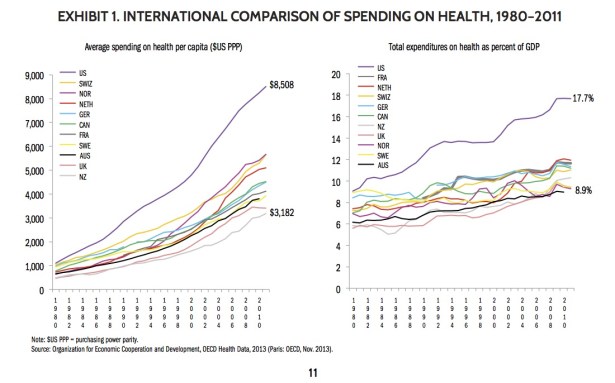
Is it right that Americans pay more than the rest of the world for poor health outcomes?

A more righteous beginning would be asking: how we can improve the health of the most people affordably, simply, and with minimal government intrusion into our private lives?

Let’s start  by considering the most obviously cost-effective measures that improve quality of life. We have evidence to show which interventions these are! It isn’t a political opinion, but a matter of observed fact.

We might include approaches currently covered in various forms by insurance: teeth cleanings are known to manage bacteria that trigger heart attacks and strokes, plus they spare one’s ability to eat; vaccinations for both children and adults have shown their value in improving lives.

But shouldn’t we also look at wildly effective interventions such as regular exercise? Here is the health-promoting miracle everyone would clamor for if it were a drug, but your insurance won’t consider helping you pay for it today unless you’re obese. Being sedentary diminishes health at any weight; the insurance overlords have decreed that’s not their problem because their business is earning money by taking a cut of medical interventions, not improving health.

Maybe a fair, universal approach could include giving each of us the option earn more health care choices by putting in time working out in a gym? I’d say that gives the patient skin in the game.

Prevention is cheap, but it doesn’t rile up the extremist political base, so we ignore what could be a boon to our entire nation. Straightforward programs like easily accessed routine preventative care and school meals for hungry children tend to be cost effective.

I would argue that health-promoting endeavors serve us all as more Americans live healthy lives of purpose. Too bad there are no immediate headlines in that to reward pandering politicians.