
Blessings by the minute, from the playground into sleep

By school pick up time—around 2:30pm, so hours before many people even think of finishing their days—my reservoirs of energy are nearly empty. What used to be an afternoon lull is more often, now, my afternoon collapse. It’s the most persistent and insidious symptom of my autoimmune condition.

Afternoon delight? Fugeddaboutdit!

The work of a stay-at-home mom may include some flexible hours, but school pick up time is not among them. The kids are done when they’re done; someone needs to go get them. There are a few dads driving up in the daily rotation, but most chromosomes in the car pool lane are XX.

Add me to that list of who’s who.
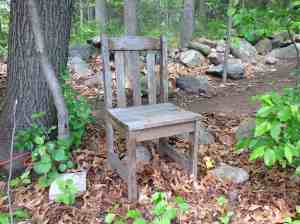
playing outside - 3

Outdoor “play equipment” doesn’t have to be expensive or complex

One of the things I like best about my son’s school is the emphasis placed on time spent playing and learning outdoors. They aren’t quite as adamant about it as our preschool was—there, kids went out, rain or shine, unless there was a truly bitter freeze or risk of lightening strikes—but the value of free time, active play, and exposure to fresh air and sunshine is respected.

So, while I’m often running on fumes by 2:30pm, I bring a book, I pack a thermos of tea or an appealing snack, and I just generally prepare myself for a comfortable wait so my little guy can stay longer with his friends and play even more after school. It may only be a half an hour, but what a precious 30 minutes for a kid.

I’ve read that child’s play is currently endangered. I tend to agree that this is a grave loss for the kids in question and society overall.

On a beautiful spring day, it isn’t much of a sacrifice to allow this time for my child to release some of that seemingly boundless energy. My arthritis doesn’t flare as often on moderate days, lessening the cost of pain. In the absence of rain, I can move around and avoid getting stiff from sitting in the car. I get to socialize today, too, with other moms and some lingering members of the school staff, all of whom take advantage of the beautiful weather to linger outside.

DS2 and his knot of friends are involved in a complex dance of running, falling down, enacting simulated agonies, then jumping up to do it all over again. Some of the girls join in at times, weaving themselves into the game, then drifting away to huddle under a different tree, whispering their own solemn secrets. They start a new adventure by climbing a large, horizontal tree.
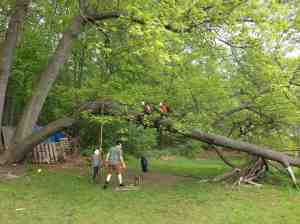
playing outside - 2

An admittedly awesome tree, some string, and a lot of imagination sparked this adventure

“Watch out for that poison ivy,” they advise me when I come closer to take a picture. After confirming I’m not there to take my son away, they quickly re-submerge in their play. They stop only when a preponderance of mothers appear, all ready to go home.

There seems no possible sweeter moment for me, as a mother, than this one, until later, after a tick check and bath, after dinner, after fun, when the little guy is lying asleep nearby and I’m restless and reflective. His breathing is deep and even with no sign of the nocturnal asthma that sometimes harries our nights.

No doubt the fresh air and tree climbing contributed to his deep, peaceful slumber, even as the memories of the same disrupt mine.

He’s so big, now, my little boy, but still so very small. My love for him swells in my breast like a wild thing rearing up to escape its confinement in a cage. It is ridiculous how much I adore this child. I’ve always found it easier to really notice this while he’s quietly sleeping.sleeping - 1
The night air drifting in the window is still soft and smells of spring. Many hours remain for slumber, and there’s more play in store for tomorrow. It’s time to tuck this unbridled passion for a silly little boy and his winsome ways away, and attend to my own dreams.

A cold shoulder was my shorthand for “I hate it when you leave”

We all have behaviors that we’ve not so much chosen as assumed. One of mine was pointed out to me years ago by my beloved spouse.

DH observed:

“You always pick a fight with me before I travel.”

He was completely right.

Once this behavior was drawn to my attention, I gained a measure of control over it. Now, on the evening before DH leaves for a business trip, I don’t pick a fight about how one ought to load the dishwasher or the correct position for the lid of a toilet not in use.

Instead, I cling to him almost desperately, and whisper sadly:

“I hate when you go. I want to punch you. I love you.”

Note: These are just words of frustration. Families should not hit each other.*  If your family hits you, please get help. Call the police.

Even wallowing in awareness of my reluctance to part, and fully cognizant of my tendency toward easing the transition through verbal aggression, I still need to express it.

At least now, this expression has joined the ranks of our commonly understood, odd, humor-filled scripted interactions.

“I’ll miss you, too,” DH says. “I wish I didn’t have to go.”

He hugs me tight and gives me the reassurance I’m tacitly requesting.

DH doesn’t always speak my language, but he’s gotten pretty good at interpreting it.

Someday, perhaps I will evolve even further. I may yet grow into a kinder, gentler person who doesn’t feel angry—and find a need to express that anger through nitpicking fights or unpleasant words—when confronted by the temporary loss of my love.

He’s my best friend. I hate it when he goes away for even one night.

That’s probably what I should learn to say instead.


*There is some physical contact that is perhaps best described as martial arts practice in our family. That requires the explicit, stated participation of all parties, and is only supposed to occur in our exercise room. None of the men in the household seem capable of confining their wrestling to the gym, but it is the rule, for the benefit of the furniture as well as the safety of the combatants.

Books by my bedside 2017/05/23

I’ve noticed that I often bring up in conversation one or more of the fascinating books I’ve been reading lately, only to fail utterly at recalling titles or authors’ names. I’ll take this opportunity to at least have a handy reference available for anyone who cares to follow up on something I’ve said.

Just check my blog!

Non-Fiction

Economics, history & politics

Why Nations Fail : the origins of power, prosperity, and poverty by Daron Acemoglu

Gaming

Dungeons & Dragons Starter Set Rule Book

Dungeons & Dragons Starter Set: The Lost Mine of Phandelver adventure book

Language

German I by Pimsleur (audio CD)

Math & technology

Gödel, Escher, Bach : an eternal golden braid by Douglas R. Hofstadter

Fiction

The Great Passage written by Shion Miura, translated by Juliet Winters Carpenter (note: this was a freebie from Amazon for being a Prime member)

My Kind of Crazy by Robin Reul (Young Adult title)

Thirteen Reasons Why by Jay Asher (Young Adult title)

Reading Notes:

Preparing for a role playing game is all consuming

I found a few sleepy moments to finish the latest installment in my before bed brain candy mystery habit (J.D. Robb’s futuristic series about Eve Dallas), but managed very little additional pleasure reading this week.

I haven’t found the motivation to finish Thirteen Reasons Why, but I started My Kind of Crazy. I was hoping it would be a little more cheerful. Young Adult and Children’s titles can be very relaxing, but these both tend more into “youth at risk” territory. It takes more energy for me to read something distressing.

My Kind of Crazy feels like it could get amusing, but it isn’t yet. It also read like a book about a boy written by a woman. I checked the author’s bio, and, yup, Robin is a woman. I’ll keep reading and see if my opinion shifts.

Starter SetMost of my free time last week was spent prepping for running a Dungeons & Dragons game session that morphed into two evenings of play. It’s not strictly reading, though there are about 100 pages of information with which the leader (DM) should be familiar. So I read through it, then made some notes, then read some parts again. After the first few hours of game play, I also printed out some cards to help me keep track of every individual character.

Thus far, my experience as a D&D DM feels like an exercise in office supply logistics.

Mom is my Dungeon Master: D&D role playing games as family hobby

Full-time Mom, new blogger; add Dungeon Master to my illustrious titles

I avoided doing any housework this weekend. I also missed making a daily post to this blog for the first time in nearly two months. Why? I am now the Dungeon Master (DM) for the D&D (Dungeons & Dragons) Starter Set adventureLost Mine of Phandelver.”

Most of my free—and some rather expensive—minutes for a week and a half have been spent on this endeavor. Even with a ready made campaign, being a DM doesn’t come cheap in terms of time. I hadn’t even played a game of D&D since the 1990’s. The learning curve was steep!

Phandelver game DM view of cave Wolf room 3

Spoiler Alert: Don’t look too closely if you’re planning to play Lost Mine of Phandelver as a PC

What’s a Role Playing Game (RPG)?

Not sure what a role playing game (RPG) is, exactly? Wikipedia and others can explain them in greater detail, but start by imagining a shared group storytelling experience that follows a set of rules to impose some structure and some interesting randomness on the proceedings.

The person conducting the story and acting as “referee” is the Dungeon Master (DM); every player contributes to the overall story by describing what their player character (PC) does in the context of that story. The DM can use a “campaign” (story) written by someone else like I did this weekend, or she can create a scenario, world, or universe uniquely her own.

If you are imaginative and enjoy other table games, RPGs could prove a similar source of fun for you and yours. It is time consuming, though. I spent ten hours this weekend around a table—during two evening sessions—with my family and some good friends. That’s in addition to the hours I spent preparing earlier in the week.

Everyone was fully engaged and having fun, including a pair of middle school aged kids playing with their parents. That’s a coup according to this mom. Aside from getting to bed late on a school night (oops!), this first family foray into RPGs proved a great success.

I can’t really take the credit for initiating the game, though. I do, however, emphatically accept the kudos for working my butt off to give everyone a good time.

Read on to find out what got us started. Continue reading

Mending: sustainability, minimalism, and one likely repercussion

Recently, I’ve been enjoying a few interesting blogs, including one by a young woman who writes primarily about minimalism in her wardrobe, and another that tends to focus more on sustainability in overall lifestyle and particularly her finances (though she blogs on many topics.)

I found myself musing about a less than obvious relationship between these two sets of writing as I was ensconced on the couch the past few evenings working on a necessary repair project. If your lifestyle and values dictate buying fewer items of better quality, you are going to have to learn how to mend (or employ someone to do it for you.)

linen-duvet-mending-1.jpg

Linen is strong, but brittle when dry. Here’s what can happen in the dryer when someone else launders the bedding and doesn’t know when to be extra careful with the linen duvet. Linen sheets can easily outlast cotton ones, but they require proper care.

Mending is a skill that was once ubiquitous. Before the Industrial Revolution, things (man-made objects) were quite costly and labor—especially that of women in the home—tended to be cheap. Even after the advent of affordable and readily available machine-sewn, purchased clothing, many people retained the sewing skills to make repairs and simple alterations.

Today, a t-shirt is so cheap, we treat it as disposable. We don’t own just a few outfits; even the poor in a developed country can own a wardrobe rich in variety. When we stain a garment, or it rips, it “costs less” to buy a new one than to spend time remedying the problem.

Yes, we launder our clothing, but often with little care, because individual garments have very little intrinsic value.

This ceases to be true when one invests in sustainable products. Organic, locally-sourced, fair trade, and high quality typically equate to expensive. If I’m willing to pay someone of my social class in my rich nation to produce my clothing or housewares, I’m going to pay more than I would for equivalent items made by impoverished factory workers under exploitative conditions.

I’m going to have to do some work to make these products last longer, because I can’t afford to replace them frequently.

My values also dictate that I shouldn’t be replacing, I should be repairing, re-purposing, and, at the very least, recycling my no-longer-useful-to-me discards.

Fortunately, an artisan-made product is likely to be better constructed of higher quality materials than the mass market equivalent. Sturdy trousers in a sensible fabric with a full lining will neither wear out nor require cleaning as often as thin, cheap cotton pants. Worn or soiled linings are quickly replaced. Good construction techniques mean the possibility to let out or take in a waistband that no longer fits.

Unfortunately, the world at large doesn’t always make it easy to act anachronistically. I am the only person in my household who understands the details, and importance, of my rather sophisticated laundry sorting process. When someone helps with the laundry, invariably, a delicate (expensive!) item ends up going through the “wrong” wash.

There have been tragic losses: a darling pair of organic wool overalls that went from size 6 to a toddler 2/3 after a trip through the dryer. Sigh. Luckily, we had a young friend who got to enjoy those for another year.

There have also been signs of remarkable resilience. I don’t recommend repeating this test, but, if your child throws his good trousers in the big hamper of regular wash and dry laundry, they might come out of the dryer just fine. These wool blend dress pants from Nordstrom held up to a full cycle of warm water wash and hot dry. They didn’t even shrink! The child was allowed to live.

The example I opened with is my Linoto linen comforter cover  (a.k.a., duvet.) If you want gorgeous, 100% flax linen bedding made in the USA by people who will go above and beyond to make you happy, I recommend Jason at Linoto as your source.

I also own flax linen bedding sold by Coyuchi and cotton/flax blends and hemp linen sheets from Rawganique in Canada. I’ve even sewn some specialty sized linen pillowcases myself using fabric purchased here or here.

If you follow the care instructions, you probably won’t need to do the kind of repair I’m undertaking right now.

linen duvet on bed - 1

Linoto duvets (two twins) with Coyuchi linen sham and skirt

Then again, if you live in a busy household with a family that is sincerely helpful but not particularly educated or enthusiastic about specialized laundering, I can also reassure you that your expensive linen sheets will still survive for years, and probably not tear like mine, if you just keep them out of the dryer, especially with other, heavy linens.

Mine were in constant use for five years before tearing. Here’s what happened:

If you’ve ever had a load of sheets in the dryer with a comforter cover, you’ve probably experienced the “giant wad of linens balled up inside the duvet” phenomenon. I can’t explain the physics, but it always seems to occur. Maybe its related to the knotting of agitated strings.

When I’m feeling well and managing the laundry myself, I carefully redistribute the linens midway through the drying cycle to separate these and the pillowcases that get wedged inside the elastic corners of fitted sheets. If I’m feeling really well, I hang up my linen items after a few minutes in the dryer to soften them up.*

None of my helpers remember—or bother—to do either of these additional steps.

More than once, a heavy ball of wet cotton has been caught inside my delicate when dry linen cover. More than once, someone has helped me empty the dryer and yanked on this heavy mass without supporting the linen piece from the strain. Eventually, the fabric wore near the top seam that always caught this weight.

Instead of fixing it immediately when I saw the signs of wear, I put off reinforcing this area… and, recently, that’s where the fabric tore.

I am not at all expert in mending, but I do have rudimentary sewing skills. I have needles and thread in the house, and I’m not afraid to use them. My cover won’t look perfect when its repaired, but the tearing and fraying will stop, and it will still be usable as bedding. Luckily, a duvet has two sides, so I’ll put it on the bed mended side down.

Minimizing your possessions to just what you need and buying sustainable, ethically sourced goods are great ideas, but you may have to adjust your lifestyle to fit. If you can’t get every household member on board with these adjustments, prepare to learn some new skills.

Today, mending! Tomorrow… darning socks?

Good thing I know someone who knows how to darn. Maybe she’ll teach me.

This is how we all take part to make the world a little better than we found it.


*My husband dislikes the texture of line dried laundry, so, when it comes to longevity vs. softness, I’m going to choose marital accord over more sustainable laundry practices. Personally, I love the crisp, dry hand of air dried linen.