Books by my bedside 2017/08/12

I’ve noticed that I often bring up in conversation one or more of the fascinating books I’ve been reading lately, only to fail utterly at recalling titles or authors’ names. I’ll take this opportunity to at least have a handy reference available for anyone who cares to follow up on something I’ve said.

Just check my blog!

Non-Fiction

History

The Bad-ass Librarians of Timbuktu : and their race to save the world’s most precious manuscripts by Hammer, Joshua

White Trash : the 400-year untold history of class in America by Isenberg, Nancy

Language

Pimsleur German I (audio CD)

Mathematics

Life of Fred: Kidneys by Schmidt, Stanley F.

Life of Fred: Liver by Schmidt, Stanley F.

Life of Fred: Mineshaft by Schmidt, Stanley F.

Life of Fred: Fractions by Schmidt, Stanley F.

Life of Fred: Decimals and Percents by Schmidt, Stanley F.

Memoir

Casting Lots : creating a family in a beautiful, broken world by Silverman, Susan

Fiction

My Grandmother Asked Me to Tell You She’s Sorry by Backman, Fredrik

Books 2017.08.12 fiction - 1

Reading Notes:

I haven’t been feeling very well for a week or so (not interesting to talk about), but one happy consequence of spending hours on the couch is that I’ve had more time for casual reading.

US History of White Trash

After two weeks of grumpy interactions with Isenberg’s White Trash, I let it go when my digital library loan expired and I don’t intend to finish it. There’s some interesting history here, but I found myself annoyed by what felt like intentional misunderstandings by the author more often than I gained insight into America’s past.

Typical example: stating that Thomas Jefferson was failing to enact political change while describing an episode of gradual political change. I think the author meant that Jefferson should have done more, and more quickly, but I quickly tired of watching the author grind her axe.

The Bad-ass Librarians of Timbuktu

Now here’s a book I couldn’t return to the library before completion.

To me, Timbuktu means “the ends of the Earth.” Timbuktu is synonymous with exotic foreign locales. Timbuktu is a place I knew by name before this book but with little understanding of its unique place in the history of learning and culture.

Bad-ass Librarians was written by a journalist, and it sometimes reads like a series of articles glued together to make a book. It’s worth reading anyway.

The provocative title aside, this is the story of ordinary (and extraordinary) people in Mali fighting back against a jihadist invasion of the region around Timbuktu. This book celebrates the thinking person’s ability to triumph over willful ignorance and wanton violence.

Here’s a rare celebration of centuries of African scholarship as glimpsed by the West. The threat to its tangible artifacts—a treasure trove of rare, priceless manuscripts—by Islamist extremists made my heart pound. I’m left with a yearning to see some of these documents for myself, and a renewed interest in learning some Arabic.

I can think of no better way for me, personally, to express my wish for peace in this world than through the cross-cultural sharing of books.

Adoption & Jewish motherhood in Casting Lots

Casting Lots came to me by way of a philanthropical organization that sends free books to Jewish families. Usually, it’s the kids who get the loot, but this month, there was a gift for me.

I am familiar with comedienne Sarah Silverman. I was intrigued to read that the author—her sister, Rabbi Susan Silverman—is considered “the funny sister.” There’s certainly a family resemblance, including some of the crude punchlines that I most associate with Sarah.

In spite of that (because I get why potty humor is funny, but it’s not my first choice for entertainment), I enjoyed most of the time I spent with Casting Lots. It is, at its core, an engaging personal story. Silverman would be someone interesting to have a cup of coffee with.

The subject of international adoption is one I’ve considered for myself and observed through friends and family, and it is genuinely moving to follow her along this path to parenthood.

Her take on Judaism in general resonates less with me, and I see this story as a readable tale that happens to be written by a Jewish woman, not a Jewish parenting book, per se.

Mathematics textbooks, specifically, the Life of Fred

I wrote about this the other day, but I’m brushing up on my pre-algebra terms and presentation in preparation for working with the child* of a friend as a math tutor.

Life of Fred is a nontraditional approach to teaching math. Author Stanley F. Schmidt, PhD, presents the subject from elementary arithmetic up through college level courses in Linear Algebra and Real Analysis, all told through the lens of a 5 ½ year old professor named Fred at fictional KITTENS University.

Yeah, most of it really is as wacky as it sounds.

And yet: my younger son has read many of these books for fun, and more than once. He’s begging me to buy the Life of Fred: Calculus textbook so he can finally learn Fred’s origin story.

I’m in no rush to get my elementary schooler into calculus, but I’m impressed by a math book that promotes such a devoted following in a child who regularly declares himself averse to “being taught” anything.

We’ve had the elementary and intermediate arithmetic series for years, but I’ve just ordered the three volume pre-algebra series (Pre-Algebra 0 with PhysicsPre-Algebra 1 with Biology, and Pre-Algebra 2 with Economics) and Life of Fred: Beginning Algebra Expanded Edition.

I can’t speak to using this collection as a stand-alone mathematics curriculum, because that isn’t how I chose to use these books with my home educated child.

I do think that the method employed—every math problem to be solved is presented in the context of a character’s real life and search for solutions—might be exactly the right remediation for a child who has internalized the notion that learning math means memorizing occult procedures.

I spent the better part of two days perusing all of my current mathematics texts, then more hours compiling lists and ordering next year’s curricula in this and other subjects for DS1 and The Scholar.

The math curriculum I did use extensively with DS1 is also pictured above. (Beast Academy, by Art of Problem Solving.) Because I’m so familiar with them, I only picked out chapters and exercises for The Scholar to begin with; I didn’t read extensively from any of these. I mention them now because I can wholeheartedly recommend BA as a complete home school curriculum. They are also suitable as enrichment for a weak classroom program, or a student who needs a challenge.

*I’ve dubbed her The Scholar

Hedy Lamarr, Hollywood beauty and… inventor of secret military technology?

Hedy Lamarr was one of the great leading ladies of Hollywood in the 1930’s and 40’s. Some regard her as the most beautiful woman who ever graced the silver screen. Her heyday began almost 80 years ago, but her name is still well-known, certainly to movie buffs.

Even with a passing acquaintance from film studies, I, with an interest in both classic cinema and novel technologies, missed the fact that Hedy Lamarr was also an inventor.

She was inducted into the National Inventors Hall of Fame in 2014.

Together with a friend, she patented technology in 1941 to prevent interception of military radio signals by the enemy. Their innovation used spread spectrum and frequency hopping to obscure information. If that sounds vaguely familiar, it’s because your wifi relies upon Lamarr’s idea, as do cell phones.

Who knew?

But, then again, why are we surprised?

Perhaps Lamarr, herself, provides a clue with this quote:

“Any girl can be glamorous. All you have to do is stand still and look stupid.”

She certainly was glamorous. Equally obvious: she wasn’t stupid.

Young women should not avoid STEM careers for fear of appearing unfeminine. Here’s a great example of a beautiful lady whose brain was as impressive as her countenance.

Another Lamarr quote provides a hint to the secret of her many successes:

“I win because I learned years ago that scared money always loses. I never care, so I win.”

Worry less about what others think, and more about what you can do. This is particularly compelling advice for women, who are likely to be judged less capable before they even begin.

You can’t win if you’re afraid to enter the race.

Smart women know what they have to offer. They should also feel free to remain attractive while they’re proving it. If that’s a distraction to the men in the room, use the advantage to move on past them while they’re addled. They can’t help it; they were born with this biological disadvantage.*

The reverse is equally true, of course. You don’t have to look like Hedy Lamarr to be a kick ass engineer, but I don’t think the internet needs an essay from me to assume a technological wunderkind looks more like Velma than Daphne.**

Apologies to Hedy Lamarr, Velma, Daphne, and the field of art in general for the quality of my sketches. No actual character, living or dead, real or fictional, is indicated by the drawings above. I was looking to illustrate stereotypes in 60 seconds with a Sharpie.


*I’m tired of hearing bad science spouted about biological differences. I think it’s stupid to shut down discussion of the topic. All reasonable debate of possibilities is valid and can lead to gains in knowledge. However, is an area in which theories are constantly conflated with facts. Nonsense cuts both ways.

**Scooby Doo reference; original 1969 animated series, naturally

Poring over pre-algebra textbooks to appease my non-math anxiety

I read six math textbooks yesterday from cover to cover, and I perused at least half a dozen more.

Math books textbook Laundry

Observe that the clean laundry was folded onto one of the stacks of textbooks, because it had to be done, but there was no energy left to move any of these objects elsewhere around the house

Why would I do such a thing? It’s because I’m feeling unprepared for pre-algebra. That’s making me anxious.

Wait, what?!?

I’ve said it before, but I’ve also learned that I must repeat it: I’m a lady who is good at math.

And, I’m going on about that again because I’m undertaking something new.  My current anxiety hinges on my ability to impart my knowledge of, and suitable appreciation for, the application of math… to someone else’s child.

A friend and her daughter are going to learn at home this year, like DS1 and I (and millions of other American kids) do. In addition to offering general advice, and pointing my friend toward excellent textbooks and home school collaboratives, I’ve agreed to help the girl by teaching Pre-Algebra.

As usual, when my friend floated this idea a year ago, I enthusiastically agreed. I offered encouragement, pointed out the pitfalls of which I’m aware, and sent her a steady stream of supporting research for whatever it was we talked about while all of this was theoretical.

It’s pretty fair to call me an enthusiast. In what area of interest? Well, whatever might be my fascination of the moment. I’m a serial enthusiast, and my intellectual appetite often exceeds my physical stamina.

Also, I work a project until I’m thoroughly exhausted; then I walk away* depleted. And I do walk away. It’s common for me to return to areas of interest after these desertions, but I don’t take them all up again.

My interest in a subject rarely subsides, but my activity in that given area rarely draws a shallow curve or a sensible straight line of steady progress. Jagged peaks and desolate valleys do a better job of depicting my levels of effort over time.

You can see it on my blog. I’ve considered composing posts and spacing them out on a sensible schedule of distributed areas of interest, but… I don’t really want to. Because, when I’m obsessed with camping equipment, or studying German, or maximizing minivan efficiency for a road trip, or the vital importance of true mastery of algebraic concepts, that is what I want to talk about, almost exclusively

until the next month, when I move on to the next thing. It’s fair to describe me as somewhat obsessive. I also accept the label of dilettante.

Which brings me back around to what I’ve done. I’ve hitched a young lady’s wagon to my erratic star, and it’s making me nervous.

I’m not a math teacher. I’m only marginally reliable. What have I done?

And yet…

…my young friend, whom I’ll call The Scholar, is exhibiting patterns I expected from the story I heard about her school experience. I gave her a series of pre- and post-tests from my various textbooks, and here’s what I uncovered:

  • She sees a novel problem, and she’s inclined to shut down. She sees each one as an opportunity to be judged a failure, not a chance to learn a new way to answer her own questions in the future.
  • She was given rules to memorize for calculating answers, but no explanation for why such rules work (or has no recollection of the explanations.) Math is a set of magical black boxes she’s supposed to carry around forever, weighing her down instead of providing tools she can use to accomplish much more with less effort.
  • She asks me if her answer is “bad.” She means, “incorrect,” but her feelings are out of alignment with the scale of the mistake.

When The Scholar asked if her math was “bad,” I pointed out that she wasn’t spitting on babies and kicking puppies. Making a mistake means she didn’t know what to do, or she didn’t do it right all the way to the logical conclusion. Incorrect? Yes. In pre-algebra, we are actively seeking convergent answers! But this is not a moral failing.

Life is full of emotionally fraught situations that put us through a wringer. Math isn’t one of them. Either we know how to proceed, or we learn—or look up—what to do. This should actually be a carefree process in the realm of feelings. This is purely intellectual.

The bad feelings here are a result of prior training. I think this is what happens when math is taught by someone with a phobia who doesn’t love, or at least appreciate, the subject.

So I’m not a math teacher, but I’m going to take a swing at this. Based upon the evidence I’ve gathered from my sheaf of pre-tests, my influence is likely improve the situation. It’s possible that it already has.

You see, one instruction I’d given The Scholar was to please indicate near each test section any strong reactions provoked by the content. A lot of those she recorded were negative. But a few problems were annotated, “fun!” That’s heartening to see, and it surprised her mom.

It’s been a long time since The Scholar enjoyed any element of her math education. We’re definitely going to include some of these “fun” puzzles in her upcoming assignments. All computational skills practice will benefit her. Puzzles and well-designed apps can offer her skills practice with less pain.

I could go on at even greater length about the positive qualities of the math curricula I’ve been perusing. As you can see from my photos, we own more than one set of elementary texts. I couldn’t even lay hands upon DS1‘s pre-algebra book (publisher Art of Problem Solving‘s Prealgebra) for my photo shoot. He and his grandfather were still busy with it and couldn’t be bothered to give it up on my (frivolous) account.

Math books textbook Life of Fred

Life of Fred

For a child who’s learned to hate math, I can’t recommend strongly enough a perusal of Life of Fred (Stanley Schmidt’s utterly unconventional collection) and/or the comic-book formatted Beast Academy series (another contribution from Art of Problem Solving.)

Math books textbook BA

Beast Academy

It doesn’t matter if the stated age range is “beneath you.” These books are fun to read, and I’d guess even most educated adults would learn something new about a subject they consider mastered by spending time with them. I did.

Upon reflection, I’m really grateful that my latest project will give me another turn through the workaday skills of pre-algebraic math, and in the company of a bright and unconventional kid like The Scholar.

I think we’re going to have a lot of fun.


*Perhaps sometimes better described as: I fall down and lie at rest and let the subject move away on its own.

Sleep beneath the stars while frustrating the mosquitos

On a warm summer night, it’s tempting to sleep outside and beat the heat, but how can you avoid being eaten alive by mosquitoes?

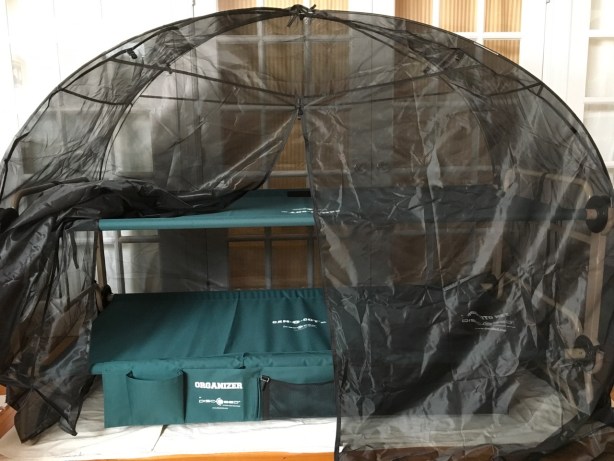
Cam-O-Bunk accessory Mosquito Net open - 1

Rock-a-bye baby, on Cam-O-Bunk, Mozzies won’t bite you, under this… junk?   (I really like the Mosquito Net, I’m just compelled to spout execrable poetry.)

Add a Mosquito Net and Frame to your Disc-O-Bed Cam-O-Bunk—it fits the L or XL model—and you can enjoy a comfortable, flat bed while sleeping out of doors in the almost open air. You’ll even be able to see the stars through the mesh, light pollution permitting.

My little guy tells me that the full moon sprouts beautiful rays of green and gold light when viewed through the Mosquito Net’s mesh at night.

I was going to skip this accessory since we typically camp as a family in our perfectly mid-sized tent. I appreciate nature—even crave the acres of evergreen forests of my native region—but I’m far from a rugged outdoorswoman.

I prefer a bit of tarpaulin between me and the savage beasts raccoons who fight over the wrapper my kid left on the picnic table.


Fast forward to a muggy night and our currently out-of-commission air conditioning unit for the third floor bedroom. Remember, heat rises.

I’d love to sleep out on the deck,” said DH, “but would you believe the mosquitoes make it up this high?

“Me, too!” chimed in the little guy. “Let’s do it, Pop!”

But the plan was scrapped for want of a mosquito net.

I remembered having seen such an accessory when I was researching my Cam-O-Bunk prior to purchase. I went back to have a look. Sold as a set, there it was:

Continue reading

Inspired by Math with Bad Drawings: “I’m not going to tell you what to call your cat’s mustache.”

Usually, I’m admiring Ben Orlin’s mathematics-oriented comic sketches for making his point-of-the-moment. Today, however, I was so tickled by a phrase therein (a quote from his wife) that I am re-blogging just to continue poking around in my fascination with these few words.

It’s right at the top of his post, and you needn’t follow any of the math to appreciate the sentence with which I’m enamored.* My interest is in the words and the absurd.

Math. Cats.

via A Mathematician Looks at a Cat — Math with Bad Drawings

Now, for the bit I love:

[Ben Orlin’s] WIFE: … I’m not going to tell you what to call your cat’s mustache.

I love this sentence: the absurdity of a cat’s mustache; the interplay between husband and wife when an argument can’t—or needn’t—be won. It’s perfect.

And all of it came nestled in the excelsior of math humor—a fascinating subject, frequently misunderstood, most especially by those who could benefit the most from plumbing its depths.

Excelsior - 1I’m in my weirdest, wordiest, quantitatively nerdiest happy place with this one.

I’m pretty sure I’m going to start repeating this to my family at moments they will find annoying. Previously, they had to suffer primarily through Christopher Durang quotes from The Nature & Purpose of the Universe.

If you’re curious, read more about this one act play on the playwright’s site. It is decidedly dark and wouldn’t be palatable to all audiences.

If someone refers to me as “she,” I quote the play and quip, “She is the cat’s mother. I am the Pope!”

Now, I can follow up with: “I’m not going to tell you what to call your cat’s mustache!”

Perhaps I only spout absurdist quotes about cats. Then again, cats might represent the ultimate expression of the absurd.

What is “the nature and purpose of the Universe,” really?

I think it has something to do with cats.

Batman lego fairy

*But we should talk later about finding your own personal entrée into a love of mathematics. Math is for everyone! And, no, that’s not a threat. It’s more like an invitation to join a cult.