Books by my bedside 2017/08/12

I’ve noticed that I often bring up in conversation one or more of the fascinating books I’ve been reading lately, only to fail utterly at recalling titles or authors’ names. I’ll take this opportunity to at least have a handy reference available for anyone who cares to follow up on something I’ve said.

Just check my blog!

Non-Fiction

History

The Bad-ass Librarians of Timbuktu : and their race to save the world’s most precious manuscripts by Hammer, Joshua

White Trash : the 400-year untold history of class in America by Isenberg, Nancy

Language

Pimsleur German I (audio CD)

Mathematics

Life of Fred: Kidneys by Schmidt, Stanley F.

Life of Fred: Liver by Schmidt, Stanley F.

Life of Fred: Mineshaft by Schmidt, Stanley F.

Life of Fred: Fractions by Schmidt, Stanley F.

Life of Fred: Decimals and Percents by Schmidt, Stanley F.

Memoir

Casting Lots : creating a family in a beautiful, broken world by Silverman, Susan

Fiction

My Grandmother Asked Me to Tell You She’s Sorry by Backman, Fredrik

Books 2017.08.12 fiction - 1

Reading Notes:

I haven’t been feeling very well for a week or so (not interesting to talk about), but one happy consequence of spending hours on the couch is that I’ve had more time for casual reading.

US History of White Trash

After two weeks of grumpy interactions with Isenberg’s White Trash, I let it go when my digital library loan expired and I don’t intend to finish it. There’s some interesting history here, but I found myself annoyed by what felt like intentional misunderstandings by the author more often than I gained insight into America’s past.

Typical example: stating that Thomas Jefferson was failing to enact political change while describing an episode of gradual political change. I think the author meant that Jefferson should have done more, and more quickly, but I quickly tired of watching the author grind her axe.

The Bad-ass Librarians of Timbuktu

Now here’s a book I couldn’t return to the library before completion.

To me, Timbuktu means “the ends of the Earth.” Timbuktu is synonymous with exotic foreign locales. Timbuktu is a place I knew by name before this book but with little understanding of its unique place in the history of learning and culture.

Bad-ass Librarians was written by a journalist, and it sometimes reads like a series of articles glued together to make a book. It’s worth reading anyway.

The provocative title aside, this is the story of ordinary (and extraordinary) people in Mali fighting back against a jihadist invasion of the region around Timbuktu. This book celebrates the thinking person’s ability to triumph over willful ignorance and wanton violence.

Here’s a rare celebration of centuries of African scholarship as glimpsed by the West. The threat to its tangible artifacts—a treasure trove of rare, priceless manuscripts—by Islamist extremists made my heart pound. I’m left with a yearning to see some of these documents for myself, and a renewed interest in learning some Arabic.

I can think of no better way for me, personally, to express my wish for peace in this world than through the cross-cultural sharing of books.

Adoption & Jewish motherhood in Casting Lots

Casting Lots came to me by way of a philanthropical organization that sends free books to Jewish families. Usually, it’s the kids who get the loot, but this month, there was a gift for me.

I am familiar with comedienne Sarah Silverman. I was intrigued to read that the author—her sister, Rabbi Susan Silverman—is considered “the funny sister.” There’s certainly a family resemblance, including some of the crude punchlines that I most associate with Sarah.

In spite of that (because I get why potty humor is funny, but it’s not my first choice for entertainment), I enjoyed most of the time I spent with Casting Lots. It is, at its core, an engaging personal story. Silverman would be someone interesting to have a cup of coffee with.

The subject of international adoption is one I’ve considered for myself and observed through friends and family, and it is genuinely moving to follow her along this path to parenthood.

Her take on Judaism in general resonates less with me, and I see this story as a readable tale that happens to be written by a Jewish woman, not a Jewish parenting book, per se.

Mathematics textbooks, specifically, the Life of Fred

I wrote about this the other day, but I’m brushing up on my pre-algebra terms and presentation in preparation for working with the child* of a friend as a math tutor.

Life of Fred is a nontraditional approach to teaching math. Author Stanley F. Schmidt, PhD, presents the subject from elementary arithmetic up through college level courses in Linear Algebra and Real Analysis, all told through the lens of a 5 ½ year old professor named Fred at fictional KITTENS University.

Yeah, most of it really is as wacky as it sounds.

And yet: my younger son has read many of these books for fun, and more than once. He’s begging me to buy the Life of Fred: Calculus textbook so he can finally learn Fred’s origin story.

I’m in no rush to get my elementary schooler into calculus, but I’m impressed by a math book that promotes such a devoted following in a child who regularly declares himself averse to “being taught” anything.

We’ve had the elementary and intermediate arithmetic series for years, but I’ve just ordered the three volume pre-algebra series (Pre-Algebra 0 with PhysicsPre-Algebra 1 with Biology, and Pre-Algebra 2 with Economics) and Life of Fred: Beginning Algebra Expanded Edition.

I can’t speak to using this collection as a stand-alone mathematics curriculum, because that isn’t how I chose to use these books with my home educated child.

I do think that the method employed—every math problem to be solved is presented in the context of a character’s real life and search for solutions—might be exactly the right remediation for a child who has internalized the notion that learning math means memorizing occult procedures.

I spent the better part of two days perusing all of my current mathematics texts, then more hours compiling lists and ordering next year’s curricula in this and other subjects for DS1 and The Scholar.

The math curriculum I did use extensively with DS1 is also pictured above. (Beast Academy, by Art of Problem Solving.) Because I’m so familiar with them, I only picked out chapters and exercises for The Scholar to begin with; I didn’t read extensively from any of these. I mention them now because I can wholeheartedly recommend BA as a complete home school curriculum. They are also suitable as enrichment for a weak classroom program, or a student who needs a challenge.

*I’ve dubbed her The Scholar

Hedy Lamarr, Hollywood beauty and… inventor of secret military technology?

Hedy Lamarr was one of the great leading ladies of Hollywood in the 1930’s and 40’s. Some regard her as the most beautiful woman who ever graced the silver screen. Her heyday began almost 80 years ago, but her name is still well-known, certainly to movie buffs.

Even with a passing acquaintance from film studies, I, with an interest in both classic cinema and novel technologies, missed the fact that Hedy Lamarr was also an inventor.

She was inducted into the National Inventors Hall of Fame in 2014.

Together with a friend, she patented technology in 1941 to prevent interception of military radio signals by the enemy. Their innovation used spread spectrum and frequency hopping to obscure information. If that sounds vaguely familiar, it’s because your wifi relies upon Lamarr’s idea, as do cell phones.

Who knew?

But, then again, why are we surprised?

Perhaps Lamarr, herself, provides a clue with this quote:

“Any girl can be glamorous. All you have to do is stand still and look stupid.”

She certainly was glamorous. Equally obvious: she wasn’t stupid.

Young women should not avoid STEM careers for fear of appearing unfeminine. Here’s a great example of a beautiful lady whose brain was as impressive as her countenance.

Another Lamarr quote provides a hint to the secret of her many successes:

“I win because I learned years ago that scared money always loses. I never care, so I win.”

Worry less about what others think, and more about what you can do. This is particularly compelling advice for women, who are likely to be judged less capable before they even begin.

You can’t win if you’re afraid to enter the race.

Smart women know what they have to offer. They should also feel free to remain attractive while they’re proving it. If that’s a distraction to the men in the room, use the advantage to move on past them while they’re addled. They can’t help it; they were born with this biological disadvantage.*

The reverse is equally true, of course. You don’t have to look like Hedy Lamarr to be a kick ass engineer, but I don’t think the internet needs an essay from me to assume a technological wunderkind looks more like Velma than Daphne.**

Apologies to Hedy Lamarr, Velma, Daphne, and the field of art in general for the quality of my sketches. No actual character, living or dead, real or fictional, is indicated by the drawings above. I was looking to illustrate stereotypes in 60 seconds with a Sharpie.


*I’m tired of hearing bad science spouted about biological differences. I think it’s stupid to shut down discussion of the topic. All reasonable debate of possibilities is valid and can lead to gains in knowledge. However, is an area in which theories are constantly conflated with facts. Nonsense cuts both ways.

**Scooby Doo reference; original 1969 animated series, naturally

Inspired by Math with Bad Drawings: “I’m not going to tell you what to call your cat’s mustache.”

Usually, I’m admiring Ben Orlin’s mathematics-oriented comic sketches for making his point-of-the-moment. Today, however, I was so tickled by a phrase therein (a quote from his wife) that I am re-blogging just to continue poking around in my fascination with these few words.

It’s right at the top of his post, and you needn’t follow any of the math to appreciate the sentence with which I’m enamored.* My interest is in the words and the absurd.

Math. Cats.

via A Mathematician Looks at a Cat — Math with Bad Drawings

Now, for the bit I love:

[Ben Orlin’s] WIFE: … I’m not going to tell you what to call your cat’s mustache.

I love this sentence: the absurdity of a cat’s mustache; the interplay between husband and wife when an argument can’t—or needn’t—be won. It’s perfect.

And all of it came nestled in the excelsior of math humor—a fascinating subject, frequently misunderstood, most especially by those who could benefit the most from plumbing its depths.

Excelsior - 1I’m in my weirdest, wordiest, quantitatively nerdiest happy place with this one.

I’m pretty sure I’m going to start repeating this to my family at moments they will find annoying. Previously, they had to suffer primarily through Christopher Durang quotes from The Nature & Purpose of the Universe.

If you’re curious, read more about this one act play on the playwright’s site. It is decidedly dark and wouldn’t be palatable to all audiences.

If someone refers to me as “she,” I quote the play and quip, “She is the cat’s mother. I am the Pope!”

Now, I can follow up with: “I’m not going to tell you what to call your cat’s mustache!”

Perhaps I only spout absurdist quotes about cats. Then again, cats might represent the ultimate expression of the absurd.

What is “the nature and purpose of the Universe,” really?

I think it has something to do with cats.

Batman lego fairy

*But we should talk later about finding your own personal entrée into a love of mathematics. Math is for everyone! And, no, that’s not a threat. It’s more like an invitation to join a cult.

Sharing much-adapted recipes while giving credit where it is due

Since I'm a rather reluctant cook—producing meals because I or my family need to eat, not from a sense of creative purpose—I have a lopsided relationship to recipes, whether found in a cookbook or online.

Those few recipes that hit the sweet spot of "easy to prepare" yet "delicious to eat" while simultaneously "nutritious and healthful" are, almost literally, treasures. I cherish them. I wouldn't want to live without them.

If I share a recipe on this blog, it's because I find it life altering in its perfection for these needs/wants. I probably won't do this very often.

cookbooks-on-shelf-1.jpg

On the other hand, the search for appropriate recipes is a frustration to a non-cook like me who's just trying to get a meal on the table.

"Easy" and "simple" are often slapped upon a series of steps that I find arduous (lots of chopping), painful (washing lots of vegetables under cold water), disgusting (slimy hands-on handling of meat), or terrifying (flaming cooktop vs. the safety of my nicely enclosed slow cooker or oven.)*

Even seemingly more straightforward tags like "gluten free" are often attached to recipes that abound in other taboo ingredients or inclusions I can't conscientiously allow in my family's diet.

As a parent whose kids have always benefited digestively by avoiding dairy, the addition of a celiac diagnosis for another much-loved family member has compounded the difficulty of satisfying everyone without almost literally poisoning someone else.

Which is to say, I almost never find a recipe that doesn't require a little modification for my purposes. More often, recipes require a lot of changes before I can even attempt them.

All of which brings me, at long last, to my point today.

Bear with me. Really, I'm getting there.

There's a fair amount of angst amongst internet recipe creators about ownership and giving credit where credit is due.

I get it. Attribution is important. It's a laudable goal. I completely support the rights of those who create content to be acknowledged for, and compensated for, their work. I don't steal music. I only post my own mediocre photos (or my husband's much better ones) to this blog.

On the other hand, I also totally get why recipes are not protected by copyright law in the same manner as many other written works.

Here is a really nice explanation of how US copyright law applies to recipes.

A list of ingredients and the basic steps to combine them are too far removed from the tangible reality of what a recipe really is. It's like protecting the rights to a complete assembly instruction manual vs. declaring you own the act of rotating a screwdriver to drive in a screw…

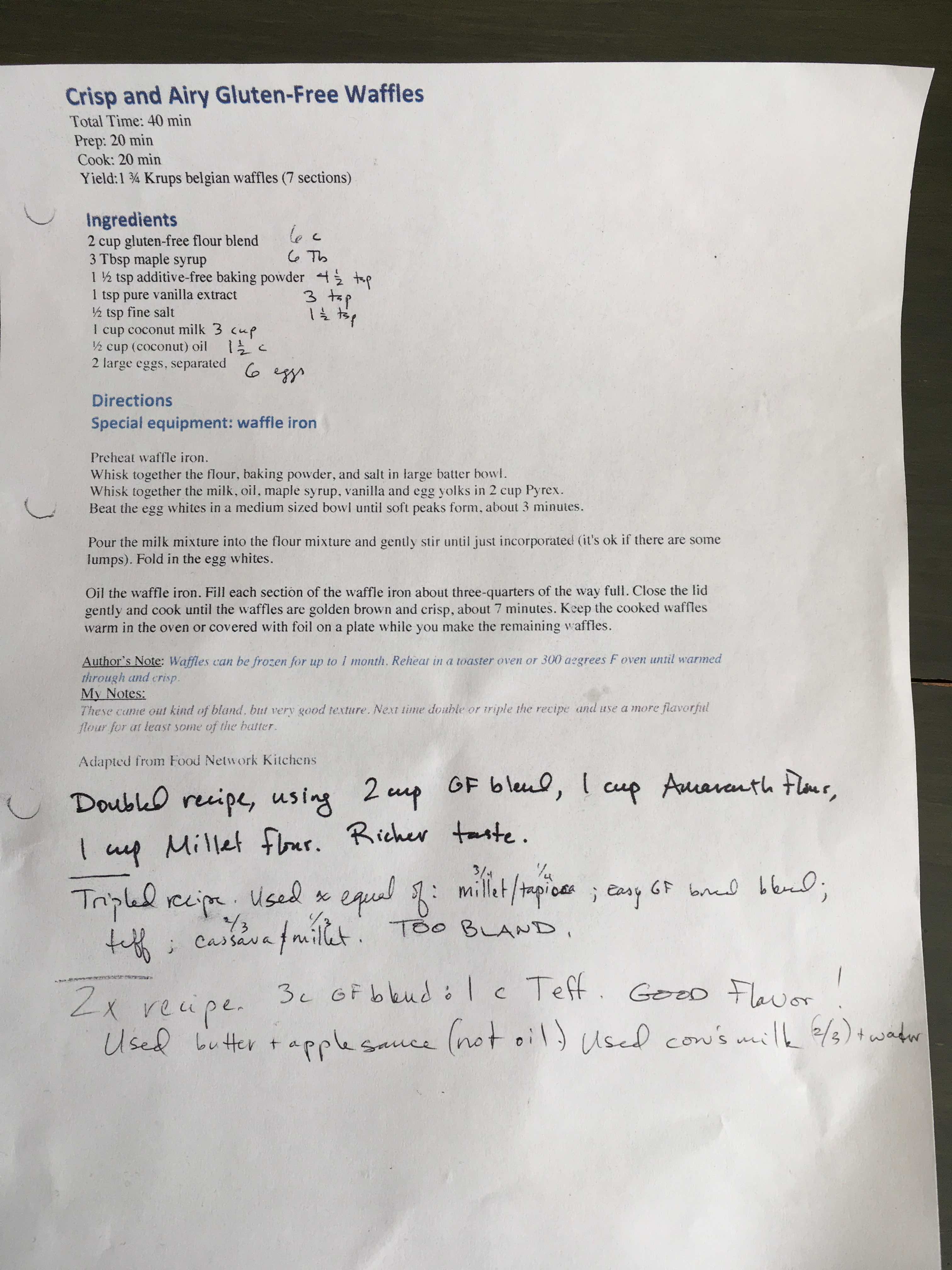
When I use a recipe, it ends up looking like this after a few attempts:

recipe Waffle Gluten Free

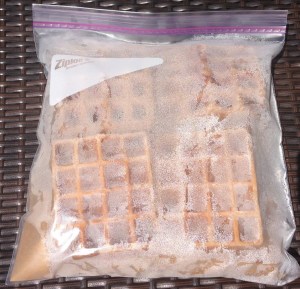
Gluten Free Waffle frozen - 1

Resulting waffles, frozen, because I hear people like to look at pictures of food

If I find a recipe online that I'm going to try, I print it out. I'll use it "as is" if it will print on one page. If I'm using a cookbook from the library, I photocopy the required pages for a given recipe.

I need a print out to use while cooking—I've come far too close to destroying my iPad trying to skip this step and use a virtual recipe in the actual kitchen. I've tried for decades to switch to a digital recipe collection, and failed completely at every attempt. I would never subject a library book to my kitchen shenanigans.

Cookbook binder - 1

If I use a recipe and like it, or if it's going to print out on multiple pages or with multiple photos illuminating nothing confusing, I cut and paste the text into an editor.

I'm bound and determined to create a document that formats a recipe how I like to read it.

I'm very text-oriented. I only want a photo if it clarifies a step. Best example: bread dough stages.I find photos of completed dishes superfluous, not inspirational. For my use, pictures are routinely discarded.

I also strip away narrative content because it's a distraction. It might have led me to try a recipe, but I don't need to read that again. I've already been convinced to make the dish. If something seems important, I might move it to the end and add an Author's Note section.

For the past year or so, I've started appending the link to my document when I find a recipe online. It never occurred to me to do that even a few years ago. I wasn't publishing anything, and I'm not the friend people ask for culinary inspiration.

Odds are, if a recipe becomes a part of my life, I'll never want to reference the original source again. Eventually, I will have the essentials of the original recipe as text in my computer, and I will have added many notes, and adjusted many ingredients. I will have made the dish dozens of times, optimizing the process for my skills in my kitchen.

It's a tricky thing to say when the recipe stopped being "the originator's" and became "mine," but I believe that does happen eventually. How would you quantify that shift? Any change at all? 10% changed? 25%? Or in years that have passed? Or oceans and continents crossed?

If I'm this free and loose with a recipe, I can't imagine how much more innovation is introduced by serious cooks.

All of which is to say, excluding acts of outright theft perpetrated by scoundrels who copy and paste content wholesale to their own sites, I think there is room for interpretation about where your content ends and another's begins.

If I post a recipe here, I will make every attempt to accurately state its origins, but I may make mistakes. I may not remember my own source, but I might recall the story of how a dish grew to prominence in my own humble kitchen.

My personal stake in this subject is simply feeding my family nourishing food at a level of effort I can afford to undertake, and keeping track of how I did it.

Sharing a recipe represents my sincere wish to save another person a little effort, perhaps making his or her life better in that moment.

I'm curious to know how this topic resonates with others. Is there more that should be said? Am I wrong if I share a recipe whose origin I don't know?


*We can talk about my weird fear of the stove top some other time. My husband assumes I was burned at the stake in a former life. But, seriously, the gas stove is ON FIRE, INSIDE MY HOUSE. How can that be right? Someone should EXTINGUISH that!

Exposé: Footpads in our midst

I purchased a useful accessory for my new favorite piece of camping equipment, my Disc-O-Bed Cam-O-Bunk XL bunk bed cots.

Read more about how the Cam-O-Bunk makes camping comfortable again for a camper with arthritis.

Disc-O-Bed Cam-O-Bunk foot pads - 1

In spite of my familiarity with the product and my thorough knowledge of their intended use, the pedant in me read the label on the box and shouted:

“Oh no! We’ve got footpads in our midst!”

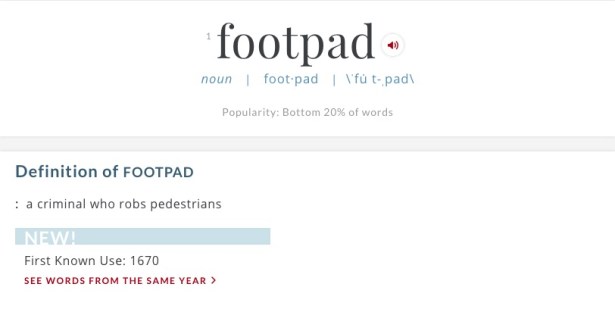
Define footpad 1

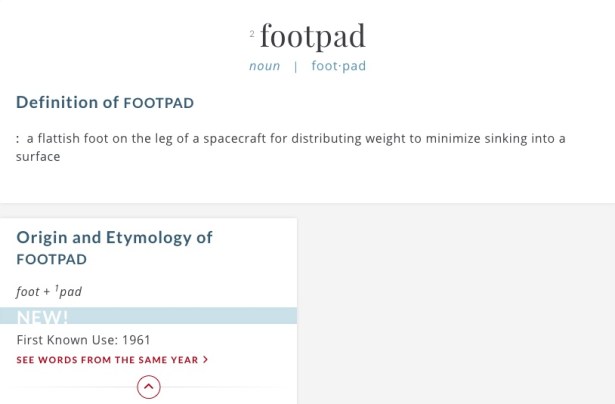
Merriam Webster clarifies my little joke, though also proves that clever Disc-O-Bed carefully spelled their product’s name “foot pad” instead of “footpad.”

I’d say the second definition would allow for the former in all correctness.

Define footpad 2

While I’m unlikely to have the opportunity to take my Cam-O-Bunk XL as far afield as outer space, the purpose of its foot pads is precisely that of NASA’s footpads. Neither of which poses too much risk to passing pedestrians.