24 hours in twenty years: marriage, discovery, and a matter of time

Do we ever really know another person? How long might that take? Twenty years can’t possibly be enough if my example is any indication of the scope of the discovery.

My husband took note recently of the fact that I opt to have the time displayed in 24 hour format when possible. He noticed this as the evening grew dark and visiting friends wondered about the prudence of getting their kids home to bed. I woke up my phone first as it was sitting rather rudely before me on the dining room table.

“20:12?” DH asked. “Your phone is set to military time?

Keep in mind that we’ve known each other for almost 20 years, and been married for most of those.

This becomes rather more amusing if you’ve ever visited my home, ridden in my car, or viewed any of my electronics. All of these conditions have been met by my husband, with most of them occurring on a daily basis.

Both of my children have had noisy arguments with me within DH’s earshot about my insistence that they learn to read a 24-hour clock and an analog one before I will buy them the digital watches they oddly covet.

In our kitchen, the microwave oven and a digital clock give the time in 24 hour format. Come to think of it, DH has always complained about being unable to find the time in our new house. Perhaps he thought those were kitchen timers in constant use?

time 24 hr clock face - 1

In the communal study the kids and I call the “workroom,” there is a digital clock set to 24 hour time displayed prominently on DS’s desk. You can’t walk through the room—which DH must do to reach his own office—without seeing its face.

The clock in my minivan displays 24 hour time and it has since I set it on the day I drove it home.

The sunrise clock on my side of our shared marital bed shows military time, too. To be fair, though, DH has his own clock on his side so he needn’t read mine with any regularity.

Are you sensing the pattern? I don’t think this is a subtle one.

I prefer the efficient notation of written time in fewer characters. I like the frequent tiny mental math problem of subtracting twelve. I don’t like the look of the abbreviations for ante- and post meridiem unless they are in small caps, and those can be annoying to implement (in WordPress, for example.)

None of these reasons matter in the least, of course, though it’s amusing that the same husband who teases me for clinging to the archaic Imperial system of measurement seems to have a similarly irrational preference for a less concise system for measuring time.

I pronounce the time in the standard twelve hour format, so, without his ears to help with the heavy lifting of comprehension, DH can be excused for never noticing what was right before his eyes.

It’s easy, after a decade and a half, to assume we know it all about a partner and a constant presence. It is very often true that I can predict exactly what DH will say, or choose, or prefer.

But, then again, human beings are awesome in their complexity, and my mate is no exception. Every day, each of us goes out into the world, changes it, and is changed by it. We grow. We evolve. Hopefully, we learn a little, too.

We aren’t the same young people who met online, like proper nerds, dated, and fell in love. We’re older, saggier, and otherwise more time-worn.

One of us prefers miles and military time; one of us is all metric, but goes to bed at 8 o’clock instead of 20:00.

The joy of it is being tickled by discovery this far in. The wonder is that we still have so much to discover, and so much desire to do so.

Does poetry offer the best analogy for humanity’s greatest scientific breakthroughs?

In the novel The Robots of Dawn, third in Isaac Asimov’s Robot trilogy, a preeminent scientist, the best on his or any other world in his field, says:

“You know it always bothers some of my colleagues when I tell them that, if a conclusion is not poetically balanced, it cannot be scientifically true. They tell me they don’t know what that means.”

Baley said, “I’m afraid I don’t, either.”book Asimov Robot novels - 1

“But I know what it means, I can’t explain it, but I feel the explanation without being able to put it into words, which may be why I have achieved results my colleagues have not. …”

I made note of the quote as I re-read this classic novel last week because it echoes so closely something I myself have struggled to put into words for my entire adult life.

As a teenager, I chose the identical comparison for explaining my delight with certain physics experiments:

[The experiment’s demonstration of the concept] is so perfect. It just sings. It’s like poetry.

I know I’ve repeated the phrase, “it’s like poetry,” many times in conversation about great ideas. I have yet to find a better expression for “the intuitive sense of the rightness” of a theory. It’s definitely something to do with harmony and balance.

Having devoured Asimov’s Robot novels in middle school*, it is now obvious to me that I’d read the quote with which I began this post well before I myself used the poetry simile. I’m now begging the question, did I get this idea from Asimov, leaving it to quietly percolate for another half dozen or so years before I re-expressed it, taking a distant memory for my own idea?

Or is this notion a truth, existing in the intellectual universe, waiting to be uncovered by one likely mind after another?

Does anyone else find herself using this expression to express a certain balanced perfection in knowledge?**

If you do, did you also read Asimov at a formative age?

Is poetry as distillation of language from the prosaic to the artistic a fundamentally apt metaphor for great leaps in scientific discovery and the expression thereof, or does the comparison only resonate with creative writers? Pardon me, please, for lumping my humble efforts with the greatness of Asimov in this respect!

Finally, as an aside, I want to shout to the world that the Robot series holds up well for revisiting decades after their impressive effect on a young reader. Asimov was a genius, and these books remain a fantastic diversion.

*roughly age 12

**Here’s a person writing about science and poetry in a literary journal. She maintains that the disciplines aren’t mutually exclusive, though they might seem so to less perceptive thinkers. A search also shows me that someone once had an e-zine at poetryandscience.com, but the link appears to be broken so I can only wonder at what took place there.

Does every family camping trip end with, “We need a bigger tent?”

We went car camping as a family in August. There are four of us. We’ve enjoyed our affordable, easy to erect Coleman Instant Cabin six person tent for a little over six years now. It has never let us down.*

Camp Coleman Instant Tent 6

Tent

Upon arriving home, one of the first things I did (after a long shower and donning fresh clothes without the scent of smoke) was to begin researching new tents.

According to the reviews I found, “Honey, we need a bigger tent!” is a pretty common refrain.

I find myself asking:

Does every family camping trip end with a wish for a larger tent?

I’ve posted before about my new favorite car camping accessory: a set of Disc-O-Bed Cam-O-Bunk XL stacking bunk bed cots. Lifting two of our four sleeping positions up off the floor allowed for a vastly improved storage situation, and a much more comfortable path to the door. Not to mention improved sleep quality for those of us lucky enough to rest on them!

The cots do fit in our Coleman tent, but only just. If used as a pair un-stacked for twin beds, the cots wouldn’t touch the tent walls. Due to the inward slope of the walls heading up toward the roof, the top bunk, when stacked, does press against the fabric and produce small about 1″ protrusions visible outside.

If you’ve never camped in a tent, you may not be aware that touching its side walls when it rains sometimes causes moisture to migrate through the fabric from outside in. The classic blunder is a child reaching up to touch the tent immediately above her face. For the rest of the night, drip! drip! drip!

Most kids learn the “why we don’t poke the tent” lesson via natural consequences.

It’s true that modern tent materials are much better at preventing such leaks, but it is also my opinion that it is always better to be safe than sorry about staying dry when sleeping outdoors. For this reason—and to avoid added wear and tear on my tent’s sidewalls—I would be happier if my tent were at least six inches longer in the door-to-back-wall direction.

Camp Disc-O-Bed Cam-O-Cot XL in tent by door

End view, seen through the tent door

We have yet to find ourselves in a campsite that wouldn’t accommodate a modestly longer tent than the one we have, especially since I don’t see any need for it to be simultaneously wider. Our current tent is 9′ x 10′. I think my ideal tent size is 9′ x 12′ for a family of four.

On the other hand, as you can see in the photo of the cot visible through the Coleman tent’s door, we could also make do with the exact size we already own… if the door were centered instead of set to one side. You see, in my ideal world, I would have two sets of Cam-O-Bunk cots stacked to sleep our family of four. A pair would sit on either side of the tent with a clear aisle in front of the door.

Two bunk beds would allow all of us to sleep off the ground, but, more importantly, also get all of our clothing and personal gear under a bunk, out of the way, yet not touching the potentially damp side walls of the tent.**

The newer Coleman model with the same name as ours seems to have been updated in precisely this way. I bet I’m not the only adult who wanted to walk right into the open full height center of their tent, leaving beds snugged against either side wall. You can see from my photograph that the XL Cam-O-Bunk blocks the majority of the tent’s doorway, and at the least convenient side of the door.

It would be possible to enter our tent with the cot there, but it would be constantly annoying. Even shaving off 7 ¼” of width by choosing the narrower Cam-O-Bunk L set for the kids would leave the door about halfway blocked, on the side with the zipper, no less.

Am I going to buy an almost identical tent to replace the one we have to solve this problem? No, almost definitely not, unless our old tent is actually destroyed.

We will probably buy an additional, larger tent to use for longer trips or those with greater probability of rain. We’ll keep our trusty Coleman Instant Cabin – 6 person for quick trips and fair weather. I’ve yet to see another tent as easy to erect as the one we own.

REI Kingdom 8 tentI’m leaning toward the Kingdom 8 from REI. It’s 8.3′ x 12.5′ which is almost exactly the size I seek. Its centered door means the narrower width should suit us well. The available floor-less garage sounds like a dream come true for soggy trips or sandy*** areas assuming a combined 27.5′ length would fit the site. Side walls of approximately 57″ would allow for the bunk bed cots (36″ high) to stand quite close to the edges of the space.

At 104 sq. ft., the Kingdom 8 isn’t that much larger than our Coleman Instant Cabin – 6 which measures about 90 sq. ft, but the extra square footage appears to be exactly where I need it.

There’s a Coleman Instant Cabin – 8/10 (retail $310) widely available for less than half the REI tent’s price, but its 140 sq. ft. are still arranged in a more square-ish 10′ x 14′. These dimensions just don’t strike me as more helpful to my ideal layout. It is also worth noting for new campers that having more volume inside your tent means it is less likely to feel cozy due to the warmth of your family’s bodies. This could be great in very hot or humid weather, but is a negative for climates with cool/cold summer nights.

With a retail price of $529, I wouldn’t suggest the Kingdom 8 tent to a first time camper with limited funds. I paid only $136 (retail $180) for our Coleman, and I have a strong hunch that it would prove easier to use for most beginning campers. For reasons of quality and comfort, you don’t want the very cheapest tent you can find for your first camping trip, either. Try to find a balance between reasonable price and features/ease of use.

When my family camped during my childhood, we had an heirloom (old!) canvas and wood tent that absolutely, definitely leaked in the rain when a kid poked it with a finger. Do you need to ask me how I know? It took my dad a long time to set up with much cursing and he needed my mother’s help to manage that beast. Before I reached my teens, newer materials arrived that gave us the option to buy a spacious family tent one person could put up on his own. These new tents kept us drier, too.

Some research is warranted on a purchase of this size for most middle class families. A tent can be seen as a reasonable investment in many years of affordable family vacations. If you aren’t comfortable, you won’t end up camping as often, and your money could be wasted.

You might want to ponder how you think you will use the interior space before selecting your first tent. At home, do your kids climb into your big bed, or do some (or all) of you prefer more defined personal sleeping space?
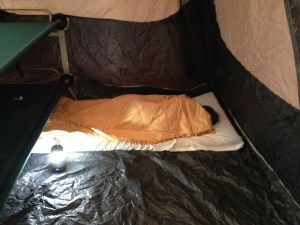
sleeping in tent - 1Families who share queen size air mattresses will enjoy the more rectangular tents such as Coleman’s Instant Cabin line.

Those of us who are using individual foam or air pads (or cots!) may prefer a longer, narrower rectangular arrangement—or not. Taller individuals, too, may be grateful for reserving open space in the tallest, middle area of a family tent.

*FYI for new campers: tents usually fail by collapsing or leaking. Most often this is a result of user error, but better designs lessen the odds of a failure.

**Aside from rain water migrating through the walls of the tent, it is also common for condensation to form inside a tent, especially when the air outside is cooler than your little fabric shelter full of warm, breathing bodies. Condensation is cured by ventilation, such as leaving the mesh windows somewhat open at night instead of zipping everything up tight.

***Unless you take off your shoes every time you step into the tent, the floor will end up very gritty. If you have kids, it’s pretty much a guarantee. Keeping a mini broom and dustpan by the door helps manage this, but it is a fact of life of tent camping.

Baltasar Gracián’s 17th C “Art of Worldly Wisdom” offers sound guidance today

§80     TAKE care when you get information. We live by information, not by sight. We exist by faith in others. The ear is the sidedoor of truth but the frontdoor of lies. The truth is generally seen, rarely heard. She seldom comes in elemental purity, especially from afar—there is always some admixture of the moods of those through whom she has passed. The passions tinge her with their colors wherever they touch her, sometimes favorably, sometimes odiously. She always brings out people’s disposition, therefore receive her with caution from him that praises, with more caution from him that blames. Pay attention to the intention of the speaker; you should know beforehand on what footing he comes. Let reflection test for falsity and exaggeration.

Emphasis is mine.

Written in the 17th Century, Gracián’s thoughts in The Art of Worldly Wisdom* seem equally apropos today; perhaps even more so.

Replace “the ear” with “the internet” in sentence four:

The internet is the side door of truth but the front door of lies.

I’d say that fits.

What a powerful tool for crowdsourcing information and bypassing traditional nodes of centralized power.

What an easy way to disseminate propaganda, falsehoods, and forgeries, enticingly wrapped up with all of our cognitive biases.

It behooves us all to think critically about our sources of “truth.”

Let reflection test for falsity and exaggeration.

Humans are uniquely blessed with critical faculties. We live in an era uniquely abundant in sources to which we may—and must!—apply our highest powers of thought.

If we fail to do so, our technology may prove to be our undoing, calling to mind the soft, feeble Eloi in H.G. Wells’ The Time Machine.

Think! Or prepare for your descendants to be fed to the Morlocks.**

*I’m reading Joseph Jacob’s translation on my Kindle

**Metaphor!  Follow the link about Eloi or pick up a copy of The Time Machine and find out for yourself.

Books by my bedside 2017/09/14

I’ve noticed that I often bring up in conversation one or more of the fascinating books I’ve been reading lately, only to fail utterly at recalling titles or authors’ names. I’ll take this opportunity to at least have a handy reference available for anyone who cares to follow up on something I’ve said.

Just check my blog!

books-2017-08-2x-1-e1503620159745.jpg

Non-Fiction

History, Politics & Social Science

Anti-Education by Nietzsche, Friedrich

The Art of Worldly Wisdom by Gracián, Baltasar

Churchill & Orwell: The fight for freedom by Ricks, Thomas E.

College Disrupted:The great unbundling of higher education by Craig , Ryan

Eighty Days: Nellie Bly and Elizabeth Bisland’s history-making race around the world by Goodman, Matthew

Grand Hotel Abyss: The lives of the Frankfurt School by Jeffries, Stuart

Margaret Fuller: Bluestocking, romantic, revolutionary by Wilson, Ellen

Walden by Thoreau, Henry D.

Language

Pimsleur German I (audio CD)

Pimsleur Spanish I (audio CD)

Mathematics

Life of Fred: Pre-Algebra 0 with Physics by Schmidt, Stanley F.

 Books Math Life of Fred Prealgebra

Fiction

Anecdotes of Destiny by Isak Dinesen

Edge of Evil by Jance, J.A.

Finding Her Way (YA title) by Faigen, Anne

M.C. Higgins the Great by (YA title) by Hamilton, Virginia

The Odds of Loving Grover Cleveland (YA title) by Rebekah Crane*

Reading Notes:

I’ve been reading a fair amount for two disparate reasons. Continue reading