
Where is the line between infrastructure and socialism?

Where do you, personally, draw the line between infrastructure and socialism?
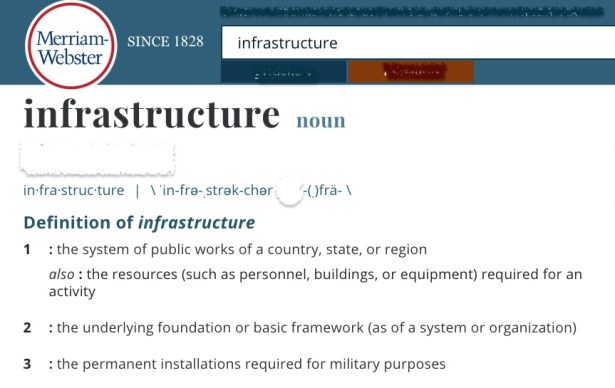
Merriam Webster dictionary definition of infrasctructure, the system of public works of a country, etc.I ask this sincerely, with no desire to engage in polarized internet snipe-fests, but in the spirit of attentiveness to what government services various individuals might deem “necessary” and which are “overreach.”

Even more interesting than the what, is the why.

Only deep ignorance of history allows one to pretend there’s anything universal about this question. Our republican forebears in Rome—whose architecture we aped in the United States capitol in part due to the Founding Fathers’ lionization of that civilization—prioritized very different governmental interventions than we do today.

Proving myself, as always, a true dilettante and no real scholar, I’ll begin by pointing to a series of mystery novelsthat I read years ago. They turned me on to a startling fact: the ancient Romans had no police force.

police car parked at justice centerRome, civilization par excellence, did not feel that it owed average citizens the protection of civil police. The military kept order to an extent that suited the needs of the state, but there was no one to call when your silver was stolen. It wasn’t until the great republic became an empire that Augustus formed the Praetorian Guard in 27 BCE… to protect himself.

And all this in spite of the fact that the Ancient Greek city of Athens had seen the nascent formation of a police force (c. 400 BCE) to keep order and arrest and manage prisoners using publicly owned Scythian slaves. Investigating and detecting crime, in the ancient world, was the responsibility of individual free citizens.

So, is a police force a basic piece of infrastructure, a right that should be available to all, or is investigation and detection by paid government agents an imposition against individual freedoms as the Romans seemed to believe?

In spite of our turbulent times and the fraught political environment, I’ll admit it: I think this is a fascinating question. In a democracy, it is, in fact, the duty of every citizen to ponder these essential assumptions.

Do modern American people on the right and on the left really have such different ideas about what a government ought to do, or are our differences more about degree and descriptive nomenclature?

Continue reading

“Of Human Bondage” and its trove of… parenting wisdom?

One reads the classics because

Actually, I won’t presume to know why anyone else reads a classic novel.*

Having long since passed the stage of life wherein, to quote the Indigo Girls song “Closer to Fine:”

…I went to see the doctor of philosophy
With a poster of Rasputin and a beard down to his knee
He never did marry or see a B-grade movie
He graded my performance, he said he could see through me
I spent four years prostrate to the higher mind
Got my paper and I was free

Very much in spite of much of the bureaucratic process we call schooling, but with deep regard for the great investment of time and energy—of inestimable value!—into the bettering of my mind by more than my fair share of gifted teachers, I remain a student, if not a scholar, and a committed autodidact.

For this reason—and because I suffer from an oscillation between stultifying malaise and desperate, yearning agitation when I don’t have a good book at hand, preferably with a few more queued upI read and re-read the classics.

book novel Of Human Bondage coverLast month, I embarked upon the reading of W. Somerset Maugham‘s hefty tome, Of Human Bondage.

The wholly inadequate summary of the novel in the library catalogue says:

“The story of a deformed youth whose handicap causes loneliness.”

I would laugh if such a shallow skimming over of the depth of this story didn’t leave me wanting to sob. It’s almost a caricature of the isolation and lack of understanding that torments Phillip, Of Human Bondage‘s orphaned protagonist, during his youth.

With little interest in literary criticism, let me come directly to what moved me so deeply as I worked my way—slowly, because it deserved thorough attention—through this weighty novel:

Phillip needed a caregiver.

He really could have used a mother. He flailed because being orphaned left him to learn for himself what most of us are taught by even mediocre parents.

He was born with a less than stellar internal compass for interpreting the giving and receiving of any kind of love. He wasn’t what we might call today a “people person.” He was one of those kids who most need explicit help to interpret the social world, and take a full role within it.

Reading Of Human Bondage made the importance of the part I can play in my sons’ lives more unequivocal to me than ever before. I should be mature enough not to doubt it; I remain insecure enough that I do.

I’m grateful that I didn’t read Maugham’s masterpiece as a student.

Continue reading

Health care system makes me sick: negotiating bureaucracy through a haze of pain

In April, I wrote a post about my doctor’s departure from the American health insurance system.

In short, he now operates his practice as “direct primary medical care.” You sign up for his service, pay a set monthly cost, and come in, call, email, or text when you have a health issue. It’s so simple, and yet the experience feels revolutionary.

Urgent need? He’ll respond to your text right away.

Wondering if a symptoms requires an office visit (and time off work, fighting traffic across town, etc.)? You can spend as much time as you need explaining your concerns on the phone. There’s no push to make every question an office visit, unlike with providers who are only reimbursed by insurance for in person consultations that correspond to specific codes.

There’s also no bureaucracy, and no paperwork. Unless you have labs, there’s no need to take out your wallet. Remember, you’ve paid up front for whatever care you need. You pay cash for lab work done in the office, but, without insurance markups, these costs are reasonable—perhaps a few dollars.

I almost forget how wasteful, time consuming, and inefficient it is to get care elsewhere. I forget, that is, until I’m not feeling well, and I visit a specialist’s office or a local hospital. That’s what I did the other day, and it all came rushing back to me. Continue reading