Capsule wardrobe: quick, casual August escape

Here’s a capsule wardrobe for a short trip to a casual destination with a predictable summer climate. I can expect daytime temperatures around 80º F and cool nights (≈55º F.)

wardrobe-quick-august-escape-add-accessories.jpg

I’m visiting family so I can borrow a jacket in a pinch.

It’s almost killing me to stick to such a boring palette. I keep wanting to sneak in more bright pieces in peachy coral and acid green. I. Will. Resist. Temptation!

This is all that I need, however, and I haven’t been feeling very well. I need to keep my bag to a manageable weight to avoid exacerbating my arthritis pain. Ruthless curation is the best way I know of to do so.

As is often the case due to my foot problems (more arthritis, plus a broken sesamoid bone), I began by choosing a summery pair of my favorite Ahnu Sugarpine sneakers. These are the lightweight, cooler mesh version.

Wardrobe quick August escape shoes - 1

Teva bought Ahnu, and now I’m afraid for the future of my favorite footwear

The soft colors get dingy fast, and this is my newest pair. That set my color palette to “baby blue.”

For summer, I wear a lot of UV protective clothing. I’m sensitive to chemical sunscreen (painful red rash) and mineral sunscreen (breakouts from the carrier cream, I assume.) I protect my skin instead with high UPF clothing and broad-brimmed hats.

All of the bottoms for this capsule are made by Coolibar. They are equivalent to a topical SPF of 50+.

The matching powder blue hoodie is also Coolibar; the tank is a coordinate from the same set.

My go to white, v-neck, faux wrap, kimono style tunic was made by ExOfficio. I liked it so much after wearing it for a season, I bought four more when they went on clearance. May I never live without this summer staple.

The other white woven top is a simple rayon tank sold by Dharma Trading Co as a blank canvas for fiber artisans. Once again, I bought these in bulk. They are long enough to cover my bum as a tunic with lightweight summer trousers, and they double up as minimalist nightgowns. It’s rare for me to travel without at least one of these, regardless of the season.

To these summer specific basics, I’m adding four cotton/Lycra layering tanks. My favorites remain the Duluth Trading Co No Yank Tanks. They are opaque enough to wear alone, but, more often, I add one under another top to keep warm (dawn and dusk), for more modesty, or to extend wears between washings of the more fashionable tops.

I could easily skip accessories for a summer trip. The truth is, when the temperature climbs above about 75º F, I start to remove necklaces, scarves, and sometimes even earrings. I’m really sensitive to hot weather, and every extra item annoys me.

With so little color in this capsule, and for very little extra weight, I went ahead and added a polka dot skinny scarf, one gold necklace, and two pairs of earrings—gold hoops, and light blue dangles.

I’m also bringing my summer “sandal alternatives”—a pair of lightweight grey mesh Mary Janes by Propet.

Grey propet shoes

Two pairs of shoes is an extravagance, but these weigh very little, and I am sometimes undone by the immense weight of my own feet in tennis shoes when I’m feeling unwell, so I’m not willing to go without.

Add socks (7 pairs, mostly tiny anklets), undergarments, and one more rayon tank for nightwear, and I have plenty of options for a six day trip. Unless I spill on myself (not unlikely *ahem*), I won’t need to do laundry, either.

Packing it all in my Rolo bag weighs in at a whopping 5 lb 4 oz. I can manage that over my shoulder, and it will be easy to stow overhead.

I will also carry my Western Flyer in backpack mode loaded with everything else: handbag, Bluetooth keyboard, medication, toiletries, and a slew of comfort items. Fully packed, the Tom Bihn Western Flyer should top out around 10 lbs. I’ll keep that by my feet on the plane for easy access.

These are the moments when one is grateful to be only 5′ 3″ tall. Most of those moments seem to occur in cramped aircraft seats.

airplane feet - 1

Poring over pre-algebra textbooks to appease my non-math anxiety

I read six math textbooks yesterday from cover to cover, and I perused at least half a dozen more.

Math books textbook Laundry

Observe that the clean laundry was folded onto one of the stacks of textbooks, because it had to be done, but there was no energy left to move any of these objects elsewhere around the house

Why would I do such a thing? It’s because I’m feeling unprepared for pre-algebra. That’s making me anxious.

Wait, what?!?

I’ve said it before, but I’ve also learned that I must repeat it: I’m a lady who is good at math.

And, I’m going on about that again because I’m undertaking something new.  My current anxiety hinges on my ability to impart my knowledge of, and suitable appreciation for, the application of math… to someone else’s child.

A friend and her daughter are going to learn at home this year, like DS1 and I (and millions of other American kids) do. In addition to offering general advice, and pointing my friend toward excellent textbooks and home school collaboratives, I’ve agreed to help the girl by teaching Pre-Algebra.

As usual, when my friend floated this idea a year ago, I enthusiastically agreed. I offered encouragement, pointed out the pitfalls of which I’m aware, and sent her a steady stream of supporting research for whatever it was we talked about while all of this was theoretical.

It’s pretty fair to call me an enthusiast. In what area of interest? Well, whatever might be my fascination of the moment. I’m a serial enthusiast, and my intellectual appetite often exceeds my physical stamina.

Also, I work a project until I’m thoroughly exhausted; then I walk away* depleted. And I do walk away. It’s common for me to return to areas of interest after these desertions, but I don’t take them all up again.

My interest in a subject rarely subsides, but my activity in that given area rarely draws a shallow curve or a sensible straight line of steady progress. Jagged peaks and desolate valleys do a better job of depicting my levels of effort over time.

You can see it on my blog. I’ve considered composing posts and spacing them out on a sensible schedule of distributed areas of interest, but… I don’t really want to. Because, when I’m obsessed with camping equipment, or studying German, or maximizing minivan efficiency for a road trip, or the vital importance of true mastery of algebraic concepts, that is what I want to talk about, almost exclusively

until the next month, when I move on to the next thing. It’s fair to describe me as somewhat obsessive. I also accept the label of dilettante.

Which brings me back around to what I’ve done. I’ve hitched a young lady’s wagon to my erratic star, and it’s making me nervous.

I’m not a math teacher. I’m only marginally reliable. What have I done?

And yet…

…my young friend, whom I’ll call The Scholar, is exhibiting patterns I expected from the story I heard about her school experience. I gave her a series of pre- and post-tests from my various textbooks, and here’s what I uncovered:

  • She sees a novel problem, and she’s inclined to shut down. She sees each one as an opportunity to be judged a failure, not a chance to learn a new way to answer her own questions in the future.
  • She was given rules to memorize for calculating answers, but no explanation for why such rules work (or has no recollection of the explanations.) Math is a set of magical black boxes she’s supposed to carry around forever, weighing her down instead of providing tools she can use to accomplish much more with less effort.
  • She asks me if her answer is “bad.” She means, “incorrect,” but her feelings are out of alignment with the scale of the mistake.

When The Scholar asked if her math was “bad,” I pointed out that she wasn’t spitting on babies and kicking puppies. Making a mistake means she didn’t know what to do, or she didn’t do it right all the way to the logical conclusion. Incorrect? Yes. In pre-algebra, we are actively seeking convergent answers! But this is not a moral failing.

Life is full of emotionally fraught situations that put us through a wringer. Math isn’t one of them. Either we know how to proceed, or we learn—or look up—what to do. This should actually be a carefree process in the realm of feelings. This is purely intellectual.

The bad feelings here are a result of prior training. I think this is what happens when math is taught by someone with a phobia who doesn’t love, or at least appreciate, the subject.

So I’m not a math teacher, but I’m going to take a swing at this. Based upon the evidence I’ve gathered from my sheaf of pre-tests, my influence is likely improve the situation. It’s possible that it already has.

You see, one instruction I’d given The Scholar was to please indicate near each test section any strong reactions provoked by the content. A lot of those she recorded were negative. But a few problems were annotated, “fun!” That’s heartening to see, and it surprised her mom.

It’s been a long time since The Scholar enjoyed any element of her math education. We’re definitely going to include some of these “fun” puzzles in her upcoming assignments. All computational skills practice will benefit her. Puzzles and well-designed apps can offer her skills practice with less pain.

I could go on at even greater length about the positive qualities of the math curricula I’ve been perusing. As you can see from my photos, we own more than one set of elementary texts. I couldn’t even lay hands upon DS1‘s pre-algebra book (publisher Art of Problem Solving‘s Prealgebra) for my photo shoot. He and his grandfather were still busy with it and couldn’t be bothered to give it up on my (frivolous) account.

Math books textbook Life of Fred

Life of Fred

For a child who’s learned to hate math, I can’t recommend strongly enough a perusal of Life of Fred (Stanley Schmidt’s utterly unconventional collection) and/or the comic-book formatted Beast Academy series (another contribution from Art of Problem Solving.)

Math books textbook BA

Beast Academy

It doesn’t matter if the stated age range is “beneath you.” These books are fun to read, and I’d guess even most educated adults would learn something new about a subject they consider mastered by spending time with them. I did.

Upon reflection, I’m really grateful that my latest project will give me another turn through the workaday skills of pre-algebraic math, and in the company of a bright and unconventional kid like The Scholar.

I think we’re going to have a lot of fun.


*Perhaps sometimes better described as: I fall down and lie at rest and let the subject move away on its own.

Packing for summer camp so a messy boy can keep it together

Say you have a son of middle school age. He’s smart, funny, and fascinating, but keeping his things organized isn’t his strong suit. Let’s call it a struggle.

How do you help a kid like this enjoy his first week away from home, and ensure that his belongings make it back with him?

Two things made our summer camp packing successful: a carefully conceived plan, and straightforward access to what he needed when he needed it with hanging organizers that provided great visibility and a primary suitcase with strategic compartments.

Rolo in bathroom - 1

Rolo bag: one solid solution for summer camp organization

First, I checked in with my son. Did he have any thoughts on how he wanted his stuff to be packed? Did he want to do this job? Did he want or need help?

Response: mostly crickets. He was happy to let me plan, and he agreed to cooperate with whatever system I devised.

Using a packing list

I adapted the camp packing list by cross-checking it with my usual travel list for DS. I also reprinted it in a format that I thought my child could reference more easily when he re-packed to come home.

The major improvements I made to the generic camp list were specifying garment colors (e.g., he knew to look for dark blue fabric if he wanted pants) and item location within the bag‘s various pockets.

DS’s jobs included:

  • check that everything he wanted to bring was listed
  • select items from his wardrobe that reflected personal expression (graphic tees, mostly)
  • carry the clothing from his wardrobe to where I was packing
  • try on everything I asked him to (he just keeps growing!) without complaint so I could confirm fit and appropriateness of individual items
  • pay attention to the walk-through I gave him about where he could find each type of stuff (information I also added to the packing list)

One large suitcase with strategic compartments

My first decision was to try to get everything into one large rolling duffel bag. Arriving at camp is fairly chaotic. Having only one item to keep track of would be best.

I opted for a bag with a flat bottom compartment beneath the more voluminous main section. All of his sheets and blankets (three warm ones suggested for northern Minnesota) could be compressed into the base of the bag. I made sure DS understood that he could unzip this one compartment and make his bed completely.

The boy can live in the same stinky outfit for a week if he wants to, but his parents can’t bear the idea that he might lie awake shivering every night for that long.

Providing trivially easy access to his bedding, his bug spray, and his toothbrush was my top priority.

Don’t sweat the small stuff: organize it!

Toiletries were organized in a large hanging kit bag made by Eagle Creek.

Eagle Creek kit toiletries - 1In addition to hygiene items, I opted to pack his flashlight, extra batteries, and pencils in this case. I thought he was more likely to find them here than to rummage through the exterior pockets of his large bag. Also, a boy his age doesn’t need many toiletries.
Small items are much easier to find against the Eagle Creek kit’s neon green and grey interior than in the duffel’s black nylon depths.

After those basics of health and hygiene, my next mission was to ensure he changed at least his socks and underwear every day. It’s camp. He can (and should) get dirty. My parenting job here was to help him understand the limits of how dirty (within socially acceptable limits), and how to keep track of it for himself in the woods.

Visibility and easy access to key items of clothing

Solution: our Rolo bag.

I’ve written about the Rolo bag before, specifically, for use in the limited confines of an Amtrak train sleeper compartment.

Camp has a couple of similarities. Space is limited with kids filling bunk beds in small cabins. Stuff spilling out onto the floor can be easily lost, though it will be obscured by others’ possessions instead of mechanical equipment at camp.

Rolo rolled - 1

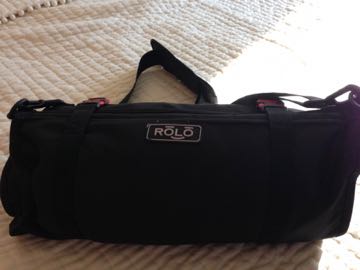
The Rolo bag isn’t large. Packed and rolled, it will fit within my usual carry on travel bag, a Tom Bihn Aeronaut 45.

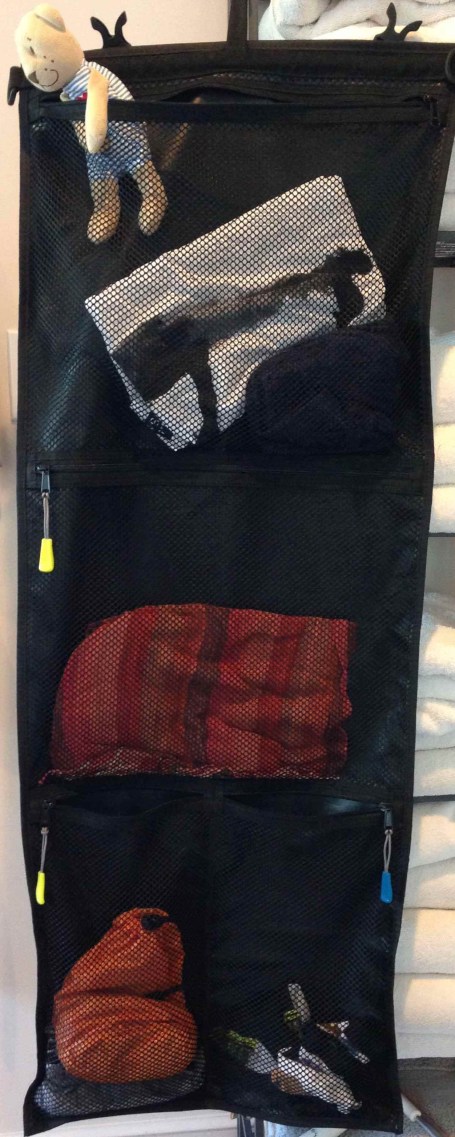
I used the Rolo as an interior organizer within the big duffel. Trousers in my son’s size don’t fit efficiently, but it was ideal for separating socks and underwear (the two narrow bottom sections) from t-shirts (middle) and camp-appropriate insect repellent/UV blocking shirts (top section.)

Once his cabin was assigned and found, DS only needed to unzip the duffel, take out and unroll the Rolo bag, and hang it in the locker-sized cubby assigned to him. He could easily find fresh next-to-the-body clothes each day. Visible through the mesh fronts of the pockets, he also had a reminder of the most important items to change.

Packing cubes keep clean clothes at the ready

I used packing cubes for the rest of his things: trousers and shorts, warm layers, accessories. He never took out his swimwear or “dress up” outfit, but he did wear the rest of his clean pants. He found his rainwear when he needed it.

From a mother’s perspective, the way that we planned and packed worked very well.

After camp, I asked my son how this system worked for him.

Putting plans to the test in the field

It turned out that his bunk was reassigned an hour after I’d dropped him off. I had helped him make his bed and unpack in the first room, so he had to re-pack everything. He didn’t find it hard to get his things back into the duffel and moved across the campus on his own.

That was a great test of how well we packed, if annoying for my son.

My son felt the Rolo bag was the single most helpful item for keeping him organized. He would prefer to have all of his clothing packed using this (or similar) bags next time he’s on his own.

Since I also really like the way the Rolo bag packs, I’ve ordered a similar Red Oxx product to expand our hanging/rolling packing options in the future. The Red Oxx Big Bull Roll-up looks like it will excel at organizing smaller items, but I expect it to create a larger roll at a heavier weight due to the Red Oxx philosophy of seriously overbuilt products.

I’m looking forward to testing the Big Bull Roll-up, comparing it to the Rolo bag, and reviewing it here in the next few weeks.

Need vs. nostalgia: what do I really want to carry?

While the topic of downsizing, “right” sizing, or minimizing one’s possessions is a vast and multi-faceted one, it is also something that constantly surprises me by inserting itself into my life, unbidden. It isn’t always obvious where these questions will pop up.

I am not aiming for minimalism. I do recognize that I struggle with some types of possessions. Who owns whom? I also believe firmly in frequent self-reflection about assumptions, and modern consumer culture offers so many “necessary” items to question.

I examine my life. It keeps it worth living. (Apologies to Socrates. Sometimes I can’t resist the low hanging fruit.)

Today, we pulled the tent out of storage. We are prepping for upcoming camping trips, and I wanted a dry run, test-fitting the packing of some new equipment with the old. Don’t be surprised when I write about tents and sleeping comfort in coming weeks.

Amongst the random outdoors items on the camping shelf was a plastic shaving mirror with a hanging hook. Not tiny, but sized to view one’s face, I bought this mirror before my first overnight in a New England campground. If memory serves, DH and I were merely dating, and we went to a Connecticut state campground with some of my work friends. This would be about 20 years ago.

At that stage of my life, I owned a sleeping bag, but no other camping equipment. DH had a tent, I think, and we went to a liquidation/warehouse store to buy some outdoorsy odds and ends. We didn’t go with much more than a minimal structure (tent), sleeping pads and bags, and a scant few dishes and items for cooking meat directly over flame.

I didn’t want to have very much camping “stuff.” I had a notion that time outdoors could be spent with more joy and less unloading, and I wanted to do the experiment.

You see, I grew up going camping by my parents’ rules. Let’s just describe them as people who like their stuff. We went camping in our Volkswagen bus, and it would be stuffed to the roof with equipment for every eventuality. After my dad bought his boat, that, too, would be loaded to the gills.

Arriving at a campground meant being late (due to lengthy loading times), suffering whisper-yelling in the dark about holding the flashlight still while Dad attempted to erect a tent he couldn’t see, and discovering it is possible to put things in the “wrong” place on a tiny patch of land on which you’ve never before set foot. Setting up camp was stressful!

It seemed like there was probably a more enjoyable way to start an otherwise wonderful vacation, and I am happy to report that my way does work better for me.

Most of my simplifications involved ditching kitchen equipment, but, then, I don’t cook for pleasure. I didn’t even attempt to replicate most of the specialized equipment deemed vital for the camping trips of my childhood, but I did buy this plastic mirror. I’m not sure I’ve ever used it, but I’ve diligently hung it near the tent in every campsite since.

Today, I’m wondering why? Why the mirror, in particular?

Mirror camp - 1Because we always brought a certain plastic mirror on my childhood camping trips. It would be unthinkable to leave it behind (it would need to be replaced locally if it weren’t present.) That was (and is) my parents’ approach to their various habits of stuff. I think my dad used their mirror for shaving, but my husband has a beard, so no similar need exists.

Why did I buy a mirror, when I didn’t buy a small table, folding chairs, a Coleman stove, or so many other things? Why does the mirror still get packed, even appearing on my camping packing checklist? Why, holding it in my hands today, contemplating it long and hard enough to prompt the effort of a blog post, do I still think a mirror belongs in my camping kit?

I sincerely do not know, but, upon reflection (ahem!), it will probably continue to join us on all of our family car camping trips. It feels right, somehow, to include it, and I can’t see any harm in having it along.

When I approach minimalism, realize that I am coming from an upbringing better described as “maximalism.” There are some comforts gained by having everything at hand, just in case, and there are costs to that habit. I try to be aware of both, and weigh them appropriately for different situations.

Sometimes, some items are more accurately analyzed by feeling than thinking. That’s a problem when it leads to hoarding garbage and living amongst impassable piles of stuff, but it’s usually fine when it refers to a personal treasure providing a sense of abundance, or preparation, or even simple nostalgia for the beholder.

I’m going to claim my little mirror as the latter.

Do you have any “magical” items that you routinely pack for certain kinds of travel? I’d love to hear from anyone else who’s found such an unlikely talisman in their otherwise sensible packing list!

The ideal souvenir: evocative, a little frivolous, but not useless

Is a souvenir always a mass produced tchotchke made in China, probably being sold by a franchised gift shop sending its profits out of the community?

That’s common today, but it’s not the only form a memento can take.

Should I bring anything tangible home from my travels, or are memories sufficient?

I don’t have to; I don’t always!

Nevertheless, a well-chosen souvenir can whisk me from daily life back to vacation bliss in an instant, for an instant, if it’s something I wear or use.

Bring a piece of your travels home with you

The ideal souvenir for me is very probably different than yours. That’s okay—great, actually! I’m always ready to advocate for people to assess their own needs and wants and try to ignore cultural noise arguing for random consumption without self-reflection.

Know thyself, and consume accordingly.

I’m not a minimalist, however. I admire austere spaces with their stark beauty, but I revel in a home built up with layer after layer of color, texture, and conversation-provoking oddities around every corner.

I do strive to purge what I don’t need or love, but my heart is large and my love knows few bounds. My tolerance for stuff is high, so long as the resultant collection reads “joyful exuberance.”

But I travel often, and usually with my kids.

If you’ve ever been to a store with children, you’ve probably observed their magpie like attraction to anything for sale.

In a kitchen store, they want tongs for squeezing a sibling’s ear from across the room. In a pharmacy, requests roll in for pill boxes with bright colors or a folding cane because… how cool is that? You can pretend to be infirm, and then hit your sibling from even farther across the room!

My kids have lots of nice stuff, but I’m not a parent who regularly gives in to this kind of begging. We don’t impulse buy toys. If we like something, we make a note, go home to consider it, and return to make a purchase. I’m trying to help them ignore the modern siren call of instant gratification.

From their toddlerhood, I’ve made and enforced strict rules about how one behaves in stores. This includes the rule that we will abandon a shopping trip, immediately, if behavior crosses a line that negatively impacts others, no matter how inconvenient to me and my agenda. Asking once is allowed; begging is against the rules.

Still, they will sidle up and ask—usually politely, often bubbling with enthusiasm—at every shopping opportunity. Souvenir shops are places I try to avoid.

Souvenirs for the kids

My approach to family souvenirs is to find something that we can enjoy now (during the trip) and continue to use at home. In Hilton Head, we bought a folding kite to fly on the wind-swept beach. Now, the kite lives in our beach bag.

Travel board games or small toys that meet my usual criteria for quality have been picked up on other vacations. Ideally, it will be something tied in to the location we’re visiting, but sometimes it’s enough to recall a trip when we take out a game to play:

“Remember, we got this on that rainy day in Seattle. We played in the hotel lobby by the fireplace and ordered the pizza with the spicy sauce…”

Even a Lego set or mass produced kit can evoke a special place or time. The Lego Space Needle set was purchased at… Seattle’s landmark building, the Space Needle. A Lego set with a camper was bought, and built, during our stay at a rustic fishing cabin.

More often than I would expect, my kids remember clearly when and where a toy came from. Taking this approach has worked pretty well for me thus far.

It’s not a given that a new toy will show up on a trip, but it isn’t out of the question if a rainy day or a need for quiet time presents itself in combination with a fascinating kit or object.

Souvenirs for myself

If I’m strictly honest, I’ll admit to the occasional toy bought for Mommy, too. We might have picked up another modular building to add to our family Lego display during our recent road trip. It’s entirely possible that I assembled a Parisian Restaurant as soon as the vacation laundry was done.

Lego Parisian Restaurant - 1

Much more often, I’m looking to avoid extra stuff to carry home from a trip. Usually, I acquire an inch or more of paper memories. Brochures, maps, and books are weaknesses I won’t deny. But, unless we’re on a road trip and there’s lots of room to store things in the back, I find shopping bags and bulky souvenirs stressful.

I plan what I carry on a trip. It feels wrong—even dangerous—to add items willy-nilly whilst en route.

My most successful strategy has been to purchase accessories as souvenirs, or, less often, items of clothing. These are things I can wear (i.e., use), and, when I do, I’m reminded of where they came from. It’s like a self-powered generator for joy.

A linen scarf, sewn by a bearded man

linen scarf from Ohio - 1Wear the scarf? Now my neck is warm, my outfit is complete, and my heart recalls a wonderful shop run by two bearded brothers who don’t offer wi-fi but do offer a hand-crafted, multi-level indoor tree fort in the back of their cafe to entertain the kids.

The Well Lancaster OH - 1

Lancaster, Ohio eatery, The Well

The brother with the shorter beard? He made the linen scarf himself. Oh yeah, and they serve a kale salad that my children agreed tasted good!

I think those guys are wizards…

A purple leather bag proudly bearing Roots Canada’s beaver logo

My purple handbag? Made in Canada, near the urban Toronto Roots location where I purchased it. I only own two nice leather bags. I’m not a purse junkie. This one, however, was the perfect dark purple color, just the right size, and had exactly the arrangement of pockets I’d been looking for.

I saw it in the window as I wandered around Toronto’s snazzy shopping district, finding my way to a theatre for a matinee. I paused. I yearned. I went to my show, but came back and entered the shop before returning to my hotel.

It felt like fate. My memory of the acquisition plays in my mind like a slow motion falling-in-love montage from a sappy film.

I’ve never regretted buying this bag.

I don’t shop recreationally in my everyday life, so purchases like these become vivid memories. The tangible results? They’re wearable triggers to enjoy them again.

If I find myself stopping by Target for clean socks while traveling, that’s a failure. I’ll need to plan better next time.

But, coming home with an accessory, or a hand-knit sweater, preferably locally made?

That’s my ideal souvenir.