Misspelled name tag: this failure represents fundamental ignorance in use of modern tools

When considering large events manned by many dedicated planners, is there ever an excuse for failing to copy and paste a user’s digital registration information for the production of printed physical name tags?

In the second decade of the 21st Century, why am I still walking into events to find my name misspelled on a slip of paper? This is ostensibly my introduction to a crowd of strangers. I think it is fairly important to get this right.

I registered electronically for an event at a major institution. My name was entered into a database via my own keystrokes.

Is it possible that I made a mistake, either in spelling or in accurately hitting the keys?

Yes.

Is that likely?

No.

Most probable is the scenario wherein a clerk was given a list of names from which to generate the event’s badges.

Maybe someone else printed out the list of names from that database that resided on an internet connected computer. That can only be regarded as a waste of paper, unless those names were going to be cut apart by hand(!) and physically glued onto cardstock or labels.

The names were not adhered onto tags for this event.

I can’t even imagine a scenario in which a printed list would be superior to an electronically transmitted or digitally shared copy when the end result is to be printed out by machine onto cards as was the case here.

The computer is a tool, and a powerful one. Reference is often made to digital natives with the implication that familiarity has bred competence.

Though computer use is now ubiquitous by all segments of society, it is clear that many people remain fundamentally ignorant as to how best to make use of one. A shocking number seem unable to even make good use of these familiar devices.

This may be acceptable when a fast food cashier taps at pictographs representing burgers and fries and mindlessly gives change in amounts calculated by the computerized register, but is this level of abstraction from functionality acceptable in professional office staff?

Comfort does not equal competence.

Pacing yourself: good advice for chronic illness, and everyone else, too!

It’s been so long since my last post, subscribers and regular readers may have wondered if I fell off the face of the Earth. Fret no more! I’m alive, but I have hosted a major holiday party and traversed a healthy arc around our little blue planet.

Between the trip–which I’ll write about soon–and the annual marathon that is serving Thanksgiving dinner to 19 people, I have been running right at the edge of my available pool of energy.

I have been writing, but I haven’t finished anythin…*

If you can believe it, I have over 50 draft posts in various stages of completion. What I haven’t had is any stamina left at the end of these busy days to polish up a given post for presentation to my readers.

I think I’ve mentioned it before: I’m not a real-time writer. Or, at least, I’m not even attempting to keep up with the pace of life since this blog is a hobby for me. I’m writing about Really Wonderful Things because I enjoy it. I’m trying to keep it that way.

I feel bad when I fail to post regularly. I cherish the sharing aspect of my own blog and those I follow. Slacking off on my posting schedule of a mere two pieces per week leaves me feeling guilty, and even a little anxious.

What if I lose a lot of followers? What if I lose a favorite frequent commenter?

And this is where I have to remind myself of the reality of my situation. I’ve written about accepting my limitations in the context of travel, and I think I give myself plenty of permission to do so when away from home.

What’s much harder is to take my expectations down a notch at home. Real life is a marathon, not a sprint, but there are so few obvious places to let things slide when it comes to parenthood and caring for your family.

The thoughts sound like this:

“If I don’t make this one birthday count, it is gone forever. My child won’t have good memories of turning X years old.”

Or this:

“Extended family and a dozen friends are coming for Thanksgiving. If I don’t make it a good one, I’ve ruined a holiday for 20 people.”

There’s a kernel of truth here, but most of it is anxiety talking. I don’t invite over the kind of “friend” who would blame me for a Thanksgiving catastrophe. If I had family members who actively tried to lay down that kind of guilt trip, I would consciously reject it as nonsense.

Beneath my conscious mind, however, is the deeply ingrained message I’ve been internalizing since infancy that 1) opening my messy house to people as is tells them I don’t care that they’ve come, and 2) any failings in our family’s hospitality belong to me, the wife and mother.

I’ve put a lot of effort into inviting people over “in spite of” the usual state of our home. Life can be so hectic, and it is hard to find a time that works to see good friends; an unwashed load of towels or a project-in-progress in front of the TV can’t be allowed to block a chance to socialize with companionable souls. Those moments are too precious.

And all of that was before an autoimmune condition reduced my available store of energy from less-than-average to downright-low. At this point in my life, there are days where I choose between cleaning up the kitchen at the end of the day or eating dinner; some days, I fail to do either because I’m too tired to accomplish even one “trivial” task.

So when it comes to hosting Thanksgiving, for example, I had to choose between planning the menu and buying ingredients for the dinner (the main point of the event), or preparing a more comfortable guest room for out of town visitors. And did I mention that I was leaving town for an international trip 48 hours after Thanksgiving dinner?

Tidying the great room where we hold the party was such a distant last on my list of priorities, it was hard to even see it at the horizon.

Without a doubt, I get some flak about these failings from people who truly don’t understand how I can be taking a break on the couch when people are coming over within hours and my house “looks like this.” I know that I need that break or I won’t be able to stand on my bad foot to prepare a meal; not everyone can or will understand that point.

Honestly, I hope they never come to a point of realizing how hard simple things can be for someone with chronic illness. It really stinks. I wouldn’t wish is on my worst enemy.

Add to my list of “the hard work” of hosting a large party the effort to reject others’ unrealistic expectations for me. It may be the hardest thing I deal with at some events!

We welcome others into our homes to share time, experiences, and the very real products of our hearts. We cook for each other and care for each other because we can, and because we want to.

When I take whatever energy I have and translate that into action in real terms, it is a gift to those I love. I choose to believe it will be received that way, whether I make a fancy shape of it or hand it over in a messy bundle.

This holiday season, I hope we can all focus on why we invite others to share with us. Spend a little less effort on worrying about how you measure up! If you find yourself leaning toward the latter, back up a step and take a breath.

It’s a privilege to be free to celebrate as we see fit.

It’s an honor to host friends and loved ones in our homes, and to have more than we need to share.

Try not to go down the rabbit hole of should have and could be; be grateful to enjoy what is, here and now, and those who’ve graced you with their presence.

And, if someone makes you feel less than great for what you have to offer, leave them to their negativity and add it to your list of blessings. At least you are glad for what you have, and who you are!

I will try to do a little better about piping up twice a week and staying in touch with my followers. I sincerely wish for a season of peace, abundance, and joy to everyone reading, and everyone else besides.

Cheers!

*Quoting a cute, hand-drawn postcard I had pinned outside my college dorm room. I wonder where that card has gone…

Childhood sweets: Russian karovka & Greek pasteli induce circular rumination on parental love

What were the sweetest flavors of your childhood?

Candy Moo Korovka - 1

Pictured here is my husband’s favorite sweet. It’s a Russian candy our family calls “Moo.” Yes, like the sound a cow makes. My husband only likes the brands with polka dots on the wrappers.

It appears he isn’t the only one who yearns for cow candy to bring back memories of childhood and the act of chewing his cud?

I took this pretty picture of candy he received on Halloween because I knew it would be consumed immediately. While I don’t like the stuff at all, my sons have inherited their father’s fondness for this “milk caramel” or “gentle fudge” as I’ve found it translated online.

The candy is called “karovka,” which is the Russian word for cow. More specifically, it’s the diminutive word for “cow” in the Russian language. The Russians are masters of the diminutive!

Like Smurf-ette from Smurf, “karovka” implies a cute, dainty cow, not a regular old karova (корова), which might be a common dairy cow, or, God forbid!, a karovisha (коровище) which would be a gross, overwhelming cow-ishness!*

I knew a girl in college who was called Mary Moo.

When I met her as a wide-eyed froshling, I thought people were calling her “Mary μ,” with μ (mu) being a lowercase letter in the Greek alphabet. Its uppercase corollary, Μ, should be very familiar to all of us Westerners using a Roman alphabet. This casual use of Greek letters seemed very collegiate to my naive self.

Having just done the section in our Physics book about friction**, I felt very cool to have a new friend with a μ in her name. It turns out she was merely a vegetarian with rather bad manners who had often quite literally moo-ed at people while they ate meat in the dining hall the year before.

I learned the first of many lessons about the true nature of intellectual life at even a highly rated liberal arts college that day.

Now, as for candy, I’ll return to my starting point: the sweet memories of childhood. My husband loved karovka; I find myself reminiscing about the taste of sesame-honey candy.

One of my earliest memories of sweets is a sesame confection my mother would allow me to buy at our local, small city grocery store. A search online today tells me it was almost definitely a Greek delicacy, pasteli (παστέλι.)

I’m not sure I knew any Greek people as a child in our city. I wonder if the candy was there at the supermarket because its simple ingredients appealed to hippies (who lingered in Oregon long after they’d been supplanted by yuppies elsewhere), or if this is yet another Greek creation co-opted by the rest of the civilized world?

I’m almost positive that my mother was attempting to give me the most nutritious sweet possible without actually denying me a treat. In the 1970’s, when I was a tot, honey would have seemed a far cry from sugar. And with all those sesame seeds in the recipe? Pasteli is practically health food!

When Halloween comes around, I’m confronted in the sweetest possible way with all that’s different for my kids, here and now, and all that’s the same. My birthplace may be nearer than their father’s, but it’s still thousands of miles away.

The kids said, “Neener, neener, neener” to mock each other where I grew up; here, they tease each other with “Nana nana boo boo!” Don’t even get me started on how silly that taunt sounds to my West Coast ears.

People shop with carriages instead of carts. We get a driver’s license from the Registry of Motor Vehicles instead of the DMV (Department of Motor Vehicles.) My kids are growing up in a Commonwealth, not a State.

Harrumph.

But here’s the sweeter side of these differences.

When I was a girl in the 1980’s, I sincerely believed that the USA and the USSR would destroy each other in a nuclear Armageddon. I worried about this. I lost sleep over it.

Sting released his song “Russians” in 1985. The lyrics always haunted me. They include these lines:

“We share the same biology/
Regardless of ideology/
What might save us, me and you/
Is if the Russians love their children too”

Politics are more polarized than ever. Our fears may have shifted from the Communists to the Terrorists, but it is still fear being peddled.

What has changed for my personal understanding of the scenario is the now constant awareness of the fact that, yes, the Russians did love their children, too.

They still do, and they always will. Just like we Americans love our kids, as do the Greeks, together with every other healthy human parent on the planet.

How sweet that is!

*Note that a native speaker of Russian says this would be a highly unusual word to encounter under normal circumstances. If it isn’t obvious to you yet, you should not be looking to me for guidance in correct use of the Russian language. I really enjoy this notion of turning words from diminutives into… what’s the opposite of a diminutive? I’ll go with grotesqueries.†I find them great fun.

†And now even my footnotes have footnotes. I had to look it up. The opposite of a diminutive is, naturally, an augmentative. Read more on Wikipedia if, like me, you must.

**μ is commonly used to symbolize the coefficient of friction.

Parking lot rescue: prepared citizens can help themselves and others

Picture a silver sedan in a bustling Trader Joe’s parking lot.* Two ladies—perhaps a mother and her adult daughter?—are huddled to one side of the closed trunk, but at the hinge end of the lid instead of the part that opens.

I walked right past them to unload groceries into my van. I was parked in an adjacent space. When I finished putting my things away, I noticed that the ladies hadn’t moved. Their heads were together. It looked like they were trying to solve a problem.

I asked if they needed any help.

Rescue scenario: a trapped set of keys

Here’s what they told me: the younger lady dropped her keys as she pushed down on the lid to close her trunk. The falling keys became trapped between the trunk and its lid. Without the keys, she couldn’t unlock and release the lid in order to free… the keys!

This sedan didn’t have a button inside to release the trunk. It didn’t have a fold down rear seat that opened into the trunk. Even a lady’s slim fingers were too thick to reach fully into the space where the keys were trapped.

It turned out that more was required than simply fishing them out. The keys were actually being pinched between two different parts of the car.

While I was hearing this explanation, another passer-by asked if he could assist.

An aside: This is my America! We help each other in times of crisis.

The ladies filled him in on the scenario while I grabbed the first vaguely tool-shaped object in the back of the van: a 12″ ice scraper. The flat edge could slide between the lid and trunk. They went to work trying to dislodge the keys.

While the original pair and the new helper made this attempt, I delved deeper into the array of equipment I keep in the van for emergencies.

Ammo can in the van: a tool box

Here’s a peek at a collection of useful tools in my vehicle at all times. It’s part of my personal ethos to be prepared. Some gear is switched out seasonally—like the larger SnoBrum† and a full size shovel—but these items never leave the van. Continue reading

Capsule wardrobe for San Francisco in October: nary a neutral in sight

My capsule wardrobes reflect my needs and values. I’m less about fashion for its own sake, and more about function that avoids exacerbating my chronic health condition.

That said, I like to express myself with my wardrobe. I feel better when surrounded by beautiful things, including the clothes I wear.

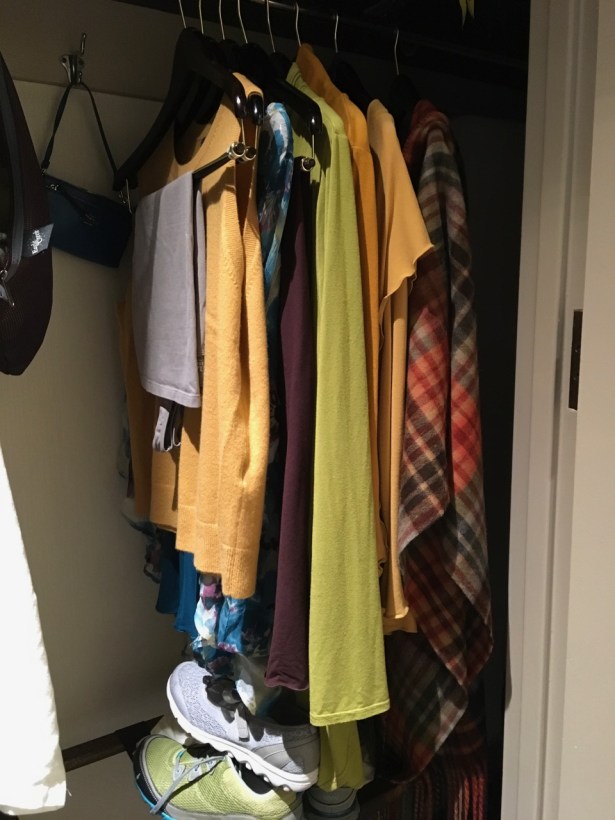
SF wardrobe in closet - 1

I’m particularly fond of today’s capsule wardrobe because it involves almost no neutral colors. Instead, it’s built around coordinating shades of rich gold, acid green, and deep purple. This is my favorite autumnal palette.

I love wearing these vibrant colors, and I even enjoyed the way they looked hanging together in the closet at the hotel. No neutral-based travel wardrobe would offer me that side benefit!

Compact capsule wardrobe saves precious vacation time

Packing an effective combination of pieces in a capsule wardrobe means I can dress for any occasion that arises during my trip without wondering whether I will be:

  1.  suitably attired, and
  2. sufficiently comfortable.

I care about both of these points, even more so when I’m joining my high profile* husband on a work-related trip. I had no role to play at the event DH was attending, but other participants were staying in the same hotel. It wasn’t out of the question to bump into someone who knows me by sight.

Dressing appropriately while maintaining health & function

My autoimmune condition involves widespread joint pain. I suffer particularly from foot problems. My wardrobe is constrained by the limiting factors of shoes that accommodate bulky, rigid orthotic inserts and clothes that don’t squeeze or pinch even when inflamed joints swell.

My symptoms flare when I’m tired. Travel, no matter how wonderful, comes with physical and sometimes mental stress. Traveling light is one way to reduce symptoms of my condition: I’m less likely to wear myself out, physically, with a lighter weight bag.

Continue reading