“Of Human Bondage” and its trove of… parenting wisdom?

One reads the classics because

Actually, I won’t presume to know why anyone else reads a classic novel.*

Having long since passed the stage of life wherein, to quote the Indigo Girls song “Closer to Fine:”

…I went to see the doctor of philosophy
With a poster of Rasputin and a beard down to his knee
He never did marry or see a B-grade movie
He graded my performance, he said he could see through me
I spent four years prostrate to the higher mind
Got my paper and I was free

Very much in spite of much of the bureaucratic process we call schooling, but with deep regard for the great investment of time and energy—of inestimable value!—into the bettering of my mind by more than my fair share of gifted teachers, I remain a student, if not a scholar, and a committed autodidact.

For this reason—and because I suffer from an oscillation between stultifying malaise and desperate, yearning agitation when I don’t have a good book at hand, preferably with a few more queued upI read and re-read the classics.

book novel Of Human Bondage coverLast month, I embarked upon the reading of W. Somerset Maugham‘s hefty tome, Of Human Bondage.

The wholly inadequate summary of the novel in the library catalogue says:

“The story of a deformed youth whose handicap causes loneliness.”

I would laugh if such a shallow skimming over of the depth of this story didn’t leave me wanting to sob. It’s almost a caricature of the isolation and lack of understanding that torments Phillip, Of Human Bondage‘s orphaned protagonist, during his youth.

With little interest in literary criticism, let me come directly to what moved me so deeply as I worked my way—slowly, because it deserved thorough attention—through this weighty novel:

Phillip needed a caregiver.

He really could have used a mother. He flailed because being orphaned left him to learn for himself what most of us are taught by even mediocre parents.

He was born with a less than stellar internal compass for interpreting the giving and receiving of any kind of love. He wasn’t what we might call today a “people person.” He was one of those kids who most need explicit help to interpret the social world, and take a full role within it.

Reading Of Human Bondage made the importance of the part I can play in my sons’ lives more unequivocal to me than ever before. I should be mature enough not to doubt it; I remain insecure enough that I do.

I’m grateful that I didn’t read Maugham’s masterpiece as a student.

Continue reading

Hanukkah family fun, night 8: Find the fun & SNAP, the job’s a game

Click here if you missed Night 7.

Mary Poppins* fans may have caught the quote in the title for this post. In the “Spoonful of Sugar” song from the movie, she makes the point that one can lighten a chore by adding a little fun.

Our boys aren’t working graveyard shifts in a factory, but we do see practical applications for teaching them about electronics. Tonight’s gifts come from the series of educational toys from Elenco, Snap Circuits

Hanukkah 8 gifts Snap Circuits 300Snap Circuits do great job of easing a task that some would categorize as work. They are packaged sets of pieces that allow kids“from 8 to 108” per the boxto do experiments with real, working circuits without any messy, skin-singeing soldering.

Go on: ask me why I’m concerned about singeing oneself with solder. No, don’t, because I’m clumsy and easily distracted, and burning flesh is gross. I loved my electrical engineering classes, but lived in fear of implementing what I learned. I would’ve enjoyed these Snap Circuit sets in college!

Instead of soldering wires, the connections are made with oversized snaps like you would find on common garments. They’re as easy to click together as Lego bricks. Unlike a simple Lego connection, however, one must develop an understanding of how electricity flows in order to create working circuits that make electronic projects work.

Never studied electronics? Don’t worry! There’s a very specific manual to walk kids through the different projects.

The boys have had a Snap Circuits starter set for years, and the SC-100 Junior Starter Set is a fine place to begin at any age. Once you have your kid has a grasp on the basic working of the components, you can add on additional kits that either continue with a general education in electronics, or follow a particular theme that might appeal to the user.

For the eighth night of Hanukkah, my older son and possible future game designer received the SCA-200 Snap Circuits Arcade kit. His brother opened up the UC-30 Upgrade Kit SC100 to SC300.

Hanukkah 8 gifts Snap Circuits AAs a parent, one of my favorite things about this company and these kits is the commitment to keeping the sets modular and re-combinable to extend their value. I really appreciate having the choice to buy just the additions I need to move from a beginner’s set to one with more advanced experiments and projects.

Unlike some other company’s products, I’m not forced to either:

  • pay extra for parts I don’t need, or
  • carefully work through lists in tiny print on the back of the box for multiple, similar sets to determine whether or not I’ve missing anything that sounds fun and/or important.

And it isn’t all work with no play! The kids genuinely enjoy fooling around with Snap Circuits kits because they can make real, working models that do stuff. Lights will light up and buzzers will sound, and they will do so more reliably than most kids can manage with regular electronic components even in an educator supported environment.

Naturally, the stuff my boys want to do usually includes “make a loud, obnoxious buzzer in Mom’s ear” or “try to launch the spinner into my brother’s face,” but Elenco isn’t selling magic beans or the promise of more perfect kids. With Snap Circuits, they are selling appealing sets that let children experiment with—and learn about—real electronics without too much muss or fuss.

A supportive adult could be helpful for a total novice or a younger child, but no supervision is necessary to make these kits diverting for kids who like to take stuff apart and/or build things.

Our Eight Nights of Hanukkah Gifts are generally things that we can enjoy as a family. These fit the bill because they give the kids something to play with that leads naturally to learning experiences we like sharing with our boys.

How does that project work? Why did it fail before? What else can you do with those elements? What does that inspire you to try next time? What’s the correlation between this toy and the circuits you can see in household electronics?

I worried a little about ending eight days of holiday giving with the “educational” present, but I shouldn’t have. Snap Circuits are too good. The boys were genuinely pleased to expand their collection.

Happy Hanukkah!

Hanukkah 8 hanukkiah extinguishing itself - 1

חגחנוכהשמח

*If you’ve never read P.L. Travers’ novels about Mary Poppins, which served as inspiration for the popular 1964 Disney film, please consider doing so. The books were much darker and weirder than the film version, and I loved them as a little girl. This is a case where I think the film is a real classic, but almost a completely different creature from the original work.

Some people on GoodReads seem to find old-fashioned child rearing methods so inappropriate, they can’t even enjoy the books. All I can say is that none of it bothered me as a girl. I would gladly put up with an imperious guardian to enjoy magical adventures; why not let today’s children make that choice for themselves, too?

Hanukkah family fun, night 6: Volumes for our library

Revisit Night 5, here.

Whether you’ve read my posts or visited my house, it should be fairly obvious that I love to read.

Books are a vital ingredient in my happiness, and I think I’ve successfully passed that addiction preference along to my children with plenty of assistance from my equally bibliophilic husband and both of our families.

I doubt that a single gift-giving occasion has passed in our household without someone giving or receiving a new book.

For the sixth night of Hanukkah, I gave each of my boys something interesting to read.

The younger one got an audiobook about his latest obsession: D&D*.

Hanukkah 6 gift graphic novel - 1For the older one, there was one book of comedic philosophy by a pair of authors we’d enjoyed together in audio form, and one graphic novel set in a video game universe he likes that was on his wish list. It hardly seemed fair to make a gift of something to which I’d introduced him as schoolwork, though the philosophy book was a really fun read/listen.

Both had a book that tied in to the game night theme from night five, and all volumes were graciously received, even the educational one.

I like to make our Eight Nights of Hanukkah Gifts things that we can enjoy as a family. We still read together, though even our youngest child is himself now admirably literate.

I think it’s a shame when parents believe ability to read means the kids no longer benefit from reading aloud together. Language was meant for communication, and stories were created to be told and shared.

Audiobooks make a great shortcut when Mom and Dad are tired; having a kid with young eyes become the nighttime storyteller works great, too.

Wishing everyone a sweet bedtime story on this winter’s evening.

Happy Hanukkah!

חגחנוכהשמח

Hanukkah 6 hanukkiah lighting - 1

Click on for night seven.

*The role playing game Dungeons & Dragons.

Thomas Cathcart and Daniel Klein, whose other books include Heidegger and a Hippo Walk through those Pearly Gates: Using philosophy (and jokes!) to explain life, death, the afterlife, and everything in betweenand Aristotle and an Aardvark go to Washington: Understanding political doublespeak through philosophy and jokes.

That unforgettable Sci Fi story about a man who rediscovers how to perform calculations by hand

One of those works of fiction that I read innumerable years ago but I’ve never been able to forget was Isaac Asimov’s 1957 short story, “The Feeling of Power.” Set in the distant future when computers perform all calculations and design new technology without further input from man, it is the story of a humble technician who rediscovers the process of doing math on paper, by hand.

I had forgotten its author and the title, and was delighted to come across it in an old Science Fiction anthology I packed for pleasure reading on a trip.

While the narrative gist of a handful of stories and novels linger on in my memory, very few titles do the same. I’m one of those annoying people who says:
“You know, it’s that book about the guy who…”

Sometimes I follow up that gem with:

“I think the cover might have been blue?”

I may intrigue you, but I’m unlikely to be an efficient resource for putting the work into your hands. Unlikely, that is, unless I still own the hard copy, and the cover is, in fact, blue! If I find it (probably while you’re sitting at my dinner table), I’ll send it home with you, then promptly forget to whom I’ve loaned the book.

Returning to “The Feeling of Power,” I recommend it. It’s a short ten pages, and a quick read. I can see why it stuck in my mind so many years ago, but I also found much more to appreciate this time around. I remembered very strongly the tone of the ending, but had forgotten many details of the narrative.

It should be particularly appealing to anyone who loves math–or perhaps to those who find it hateful who would like to imagine it forgotten!–and to anyone who likes Sci Fi in general and Asimov in particular.

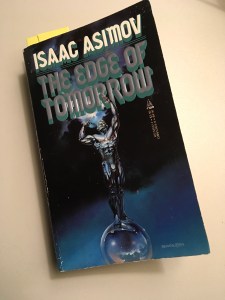
Here’s the particular anthology I brought on vacation. It was published in 1985.

Asimov was a prolific writer, and I’m certain “The Feeling of Power” appeared elsewhere in print. I actually thought I’d originally read this story in one of those elementary school reading textbooks full of disjointed works by a variety of authors. If anyone knows whether Asimov ever published in such volumes, I’d love to hear about it!

Does poetry offer the best analogy for humanity’s greatest scientific breakthroughs?

In the novel The Robots of Dawn, third in Isaac Asimov’s Robot trilogy, a preeminent scientist, the best on his or any other world in his field, says:

“You know it always bothers some of my colleagues when I tell them that, if a conclusion is not poetically balanced, it cannot be scientifically true. They tell me they don’t know what that means.”

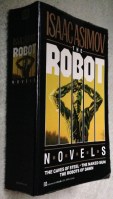
Baley said, “I’m afraid I don’t, either.”book Asimov Robot novels - 1

“But I know what it means, I can’t explain it, but I feel the explanation without being able to put it into words, which may be why I have achieved results my colleagues have not. …”

I made note of the quote as I re-read this classic novel last week because it echoes so closely something I myself have struggled to put into words for my entire adult life.

As a teenager, I chose the identical comparison for explaining my delight with certain physics experiments:

[The experiment’s demonstration of the concept] is so perfect. It just sings. It’s like poetry.

I know I’ve repeated the phrase, “it’s like poetry,” many times in conversation about great ideas. I have yet to find a better expression for “the intuitive sense of the rightness” of a theory. It’s definitely something to do with harmony and balance.

Having devoured Asimov’s Robot novels in middle school*, it is now obvious to me that I’d read the quote with which I began this post well before I myself used the poetry simile. I’m now begging the question, did I get this idea from Asimov, leaving it to quietly percolate for another half dozen or so years before I re-expressed it, taking a distant memory for my own idea?

Or is this notion a truth, existing in the intellectual universe, waiting to be uncovered by one likely mind after another?

Does anyone else find herself using this expression to express a certain balanced perfection in knowledge?**

If you do, did you also read Asimov at a formative age?

Is poetry as distillation of language from the prosaic to the artistic a fundamentally apt metaphor for great leaps in scientific discovery and the expression thereof, or does the comparison only resonate with creative writers? Pardon me, please, for lumping my humble efforts with the greatness of Asimov in this respect!

Finally, as an aside, I want to shout to the world that the Robot series holds up well for revisiting decades after their impressive effect on a young reader. Asimov was a genius, and these books remain a fantastic diversion.

*roughly age 12

**Here’s a person writing about science and poetry in a literary journal. She maintains that the disciplines aren’t mutually exclusive, though they might seem so to less perceptive thinkers. A search also shows me that someone once had an e-zine at poetryandscience.com, but the link appears to be broken so I can only wonder at what took place there.