
Considering antidepressant medication? Try vitamin B-12 first.

This isn’t medical advice. I’m not qualified* to offer that.

Vitamin bottle B12 - 1I am simply a self-educated consumer who lives with a chronic health condition. I’ve drawn my own conclusions from research done as an intelligent lay person, tempering it with common sense. I invite you to do the same.

Many of us diagnosed with autoimmune conditions, degenerative neurological diseases, and chronic pain will be prescribed antidepressants. There are fine reasons for this.

Some chronic pain responds positively to antidepressant medications. Given in lower doses than those prescribed for psychological reasons, side effects are often less as well.

Here’s a link to a (long, almost 2 hrs!) YouTube presentation by Dr. Dan Clauw, M.D. that offers a great explanation for the current understanding of why these drugs may help certain types of pain.

Depression is also a normal human response to learning you can expect to spend the rest of your life with constant pain or in a rapidly degenerating physical condition.

That is a depressing situation for any rational person to contemplate. Treating mental health problems is important, and I do not sit in judgement of anyone who takes pharmacological steps toward better self care.

If you are a danger to yourself, please seek immediate, aggressive care. Do whatever it takes to get well. Your life matters.

That said, I’ve recently learned that the major physical symptoms of depression mirror almost exactly those of a vitamin B-12 deficiency. Hmm…

Even patients with valid diagnoses of other conditions—here’s a study about multiple sclerosis, for example—often have other stuff going on in the body that can make symptoms worse. Large numbers of hospitalized, depressed patients have measurable Vitamin B-12 deficiencies.

It isn’t known yet whether B vitamin deficiencies help create conditions that allow us to develop disease, result from lifestyle responses to living with chronic illness, or are direct side effects/symptoms of disease processes.

I’d argue that the underlying mechanism doesn’t matter so much when we’re talking about supplementing with vitamin B-12.

Why? There is no known upper tolerable limit for safety for supplemental B-12. Say that in plain English? No one ever “overdosed” on this vitamin.

Here’s a link to a more reputable (than me) resource, a state university, for detailed mainstream medical information on the subject of Vitamin B-12. And another to a US government fact sheet on the vitamin for American consumers.

B-12 is water soluble. If you take too much to be used by your body, it will leave your system naturally via your urine. You might “waste” the vitamins you’ve bought and paid for, but odds are tiny** that they will hurt you in any appreciable way.

If someone is ready to prescribe antidepressants to a patient, that patient must have at least one medical doctor who could also be consulted about taking vitamin supplements. Ask your doctor before starting a new treatment, including Vitamin B-12, but, odds are, you will be told this is safe to try.

You may also hear that vitamin B-12 won’t help you. But, then again, antidepressants aren’t a guarantee either. They include a long list of side effects, some of which are very unpleasant. Those prescription pills can also be expensive.

Also, it’s just as unscientific to assume the vitamins won’t help you as to assume that they will.

I’ve come to realize that no one cares as much about my health outcomes as I myself do. With good insurance and caring doctors, I’m still left with unanswered questions and a merely tentative diagnosis for what causes my chronic pain and fatigue. Where stakes are low and scientific certainty is lacking, I choose to perform nutritional experiments upon myself.

If it is highly unlikely to hurt you, and it could help you, why not take some extra vitamins for a while and see if you feel better, too?

Assuming your doctor said such a trial is safe, the only possible barrier is cost.

I picked up a bottle of store brand vitamin B-12 at wholesale giant Costco with 300 pills for $19. Each offered thousands of percent (20,833%) of the RDA***, making a bottle good for the better part of a year taking one per day.

That works out to $23.12 annually. Costco typically offers very good value.

At an expensive local vitamin specialty retailer, a three month supply (of 16,667% RDA pills) cost $16, coming out to about $64 per year. I suspect it would be hard to spend much more than this for these vitamins.
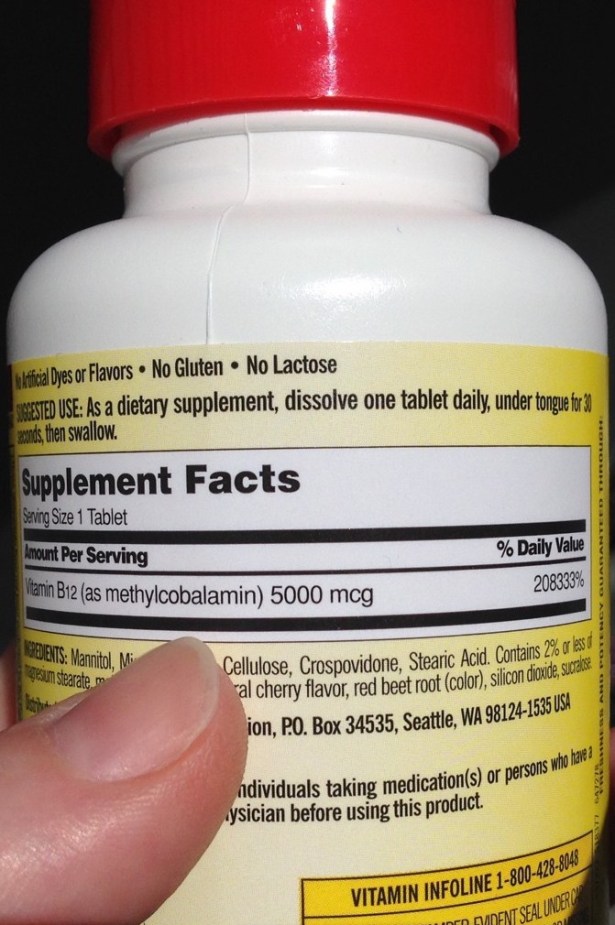
vitamin-bottle-b12-2.jpgThere are several forms of B-12 available, and both of these offerings are for the most expensive type, Methylcobalamin.

Some users have reported that the most common, cheaper form, Cyanocobalamin, doesn’t resolve their symptoms, but the Methylcobalamin form does. At less than $20 per bottle, it seems within financial reach of most Americans to do this self experiment with the potentially most effective version of the supplement.

My two sample bottles also both contain dissolving lozenges to be held under the tongue rather than swallowed and processed through the digestive system. Again, some argue that a sublingual or injected B-12 is more effective than a swallowed dose. I went out of my way to test this type of supplement, just in case, though science tends to think it is irrelevant for most.

In all of this, note that my primary interest is in clinical results, i.e., how I feel. It will be great if research comes to understand why and how B-12 or any other supplement improves patient outcomes. But I am not a working scientist.

The bottom line for how I make a decision about self-treatment comes down to whether or not I feel better, and at what risk.

The “clinically small” improvement of a group of MS study participants quoted above may be of only slight statistical significance, but when your function or your sense of well being has descended to, say, 25% of your old normal, well, then, 27% or 30% represents a win.

I don’t know what you should do to help yourself live a healthier life. I do have some opinions about which alternative health practices represent good risks worth a try for a person in pain. Perhaps this little experiment can ease some of yours, too.

Your body; your choices. Make them in good health.

*My education in both Biology and Chemistry ended in high school as my college science classes were limited to Physics courses. My major was Mathematical & Physical Sciences with a concentration in Computer Science.

Make no mistake that the side effects can be significant, however. They are also likely to affect your offspring, not just yourself. There are studies showing this in very obvious and less direct ways.

Powerful drugs are appropriate to treat significant illness, but I’d argue that they should be employed after milder alternatives have been tried and found insufficient.

Other sources, regarding. depression.and .neurological and psychiatric disorders

**There are some instances of allergic reactions to vitamin B-12, but I only read of such response to injections (shots), not over the counter vitamin pills. Reports of acne or skin rash in response to large dose vitamin pills do occur with some regularity.

You decide whether temporary skin issues are something that would stop you trying a larger dose of this vitamin for yourself.

***In most cases, we do NOT know the “optimal” level of vitamin intake. Vitamin B-12 reference ranges vary from 180-914 ng/L in the USA, 135-650 pmol/L (183-881 pg/mL) in Australia, and 500 – 1300 pg/mL. (ng/L=pg/mL, so no conversion necessary there.)

If you think this is an important thing for people to know, write to your government representatives and tell them you support basic nutrition research. Private companies have very little motivation to pay for this kind of work; there’s no resulting drug patent to fund the endeavor.

There’s a reason some public services, like infrastructure and basic research, are paid for by taxation. Otherwise, they simply aren’t available to all of us.

My doctor won’t take my insurance, and I’m thrilled

I liked my doctor, but I never got to see him

I’ve had the same primary care physician—the health care professional we used to simply call “my doctor”—for about a decade. I’ve always liked him, both professionally and as a human being.

A few years ago, I started looking around for a new doctor. I didn’t like my physician any less, but I hadn’t seen him face-to-face in years. Instead, every time I made an appointment, I saw a different nurse practitioner or physician’s assistant. I liked some of them; others, I didn’t spend enough time with to form an opinion. Even when I made an appointment for a physical eighteen (18!) months in advance, I could only see random members of my chosen doctor’s group practice staff.

The final straw came when that physical with the nurse practitioner that I’d scheduled one and a half years ahead was canceled one week before it was due to happen. My kids were younger then, and I’m their primary caregiver. It’s a role I take seriously. Parenting is my job, so I organize my life in order to do that job well.

I had scheduled all of my own “routine maintenance” appointments for the same summer week: eye doctor, physical, well woman exam, teeth cleaning. If I had oil, that’s the week I would’ve changed it. I enrolled the children in summer day camp so all my “business hours” were free for one week. I wanted to take care of my health needs without distraction or discomfort from discussing sensitive topics in front of little ears.

Modern group medical practice didn’t prioritize patient needs

The disinterested office staffer who called and blithely informed me that I must reschedule my physical for a date a few weeks later—after the school year had started, after my full slate of mommy responsibilities had resumed, at a time that absolutely did not work for me—clearly did not understand my frustration with her message. She certainly had no power to fix my problem, and she didn’t seem to care. That’s when I resigned myself to finding another health care provider.

Considering the current shortage of plain old family doctors in the United States, none of this is surprising. Having “good” health insurance seems like an oxymoron. If I can’t see a doctor, how is my health “insured”?

I did some research on the Internet. I’d read an article about doctors foregoing insurance to simplify their finances by accepting only cash payments, and I looked for one of those. None appeared to be practicing in my physician rich corner of New England, though specialists who can take advantage of my “good insurance” abound.

There were no good alternatives for straightforward routine care

I had reached the uncomfortable position of interviewing “concierge doctors” by late 2013 as I tried to find a solution I’d be happy with. I’m okay with the idea that some people want to pay large sums to have a doctor available at their convenience, but my needs seemed much simpler and very… common.

I’m willing to make an appointment. I’m willing to wait my turn. I don’t care if the office is luxurious, or exclusive, or much more than conveniently located and hygienic. I just wanted to see my doctor when I had a scheduled appointment, and have at least a chance of seeing him or her when I had an urgent need. I wanted my doctor to be familiar with me and my health history.

I didn’t think I was asking for the moon, but alternatives were lacking.

After six weeks of frustration and having selected the concierge doctor I liked best after interviewing the few available candidates in my price range, I happened to Google my old doc’s name one more time. You see, when I’d called his old practice to inform them I wouldn’t be showing up to see the nurse practitioner I barely knew at the inconveniently rescheduled time, they told me Dr. So-and-so had left the practice. They “couldn’t” give me a forwarding address. (Later, Dr. So-and-so himself told me that the practice was well aware of his new office, but they appeared unwilling to lose patients by sharing that information.)

My doctor was as frustrated with the system as I was.

Guess what I discovered when I Googled Dr. So-and-so? He had left his old physicians group practice because he didn’t want to practice medicine that way anymore. He was sick of being rushed through 20 appointments every day during which he couldn’t take enough time to hear out a patient. He was tired of being an insurance-appeaser when he had set out to practice medicine. He was leaving the system. He was as frustrated with it as I was.

I knew I liked Dr. So-and-so for a reason!

I’d stumbled onto an article in the local paper about my good old primary care doctor’s foray into the everything-old-is-new-again “direct primary care” provision of medicine. I could pay cash directly to my preferred doctor to receive medical care when I needed it.

Revolutionary? It strikes me as obvious. And let me add cost effective, convenient, and finally!

The simple analogy used in the direct primary care model is that it’s like routine maintenance on your car vs. getting repairs after a major accident you couldn’t predict.

You know you need oil changes and the occasional new tires for the car, so you factor that into your budget and carry on. That’s the stuff my doctor handles. I see him for an annual physical, when I’ve caught a cold, or if I sprain my ankle. I have his cell phone number; he answers it himself. I can email him or send a text message and I hear right back. He can fit me in today. He has time to talk to me until I have said everything I have to say about my problem.

Monthly payments to the doctor cost half as much as a cable bill

I pay my doctor a monthly fee that covers as much medical care as I need. It costs less per month for me than my cable bill, or my husband’s data heavy cell phone bill. That’s or, not and. If you can afford to spend $4 per day at Starbucks buying coffee, you can afford this caliber of medical care for one adult and one child at my doctor’s practice. This is a manageable bill for a middle class family.

I still have health insurance. It’s that <cough> good kind. I use it to see my specialist care providers, or when I need an expensive test like an MRI or a bone scan. My doctor can still order tests for me at the same local hospitals, and he can still submit the forms for those big ticket tests to my insurance provider, but he also tells me what the cash price would be. Thousands of dollars out of pocket? Yes, let’s do paperwork.

Cash prices for simple tests can be just a few dollars ($3)

But many simple blood tests done in the doctor’s office cost just a few dollars, so I pay the bill and skip the forms. A cholesterol test costs less than a latté when it hasn’t been marked up for the rigmarole of insurance reimbursement. It becomes fairly obvious why insurance rates are so high when you compare these prices for yourself in the context of your own care. It turns out that there’s a huge cost created by the complexity of the insurance system itself.

When you use your insurance, you’re paying for extra billing staff in every medical office, the insurance company’s offices, the army of employees at said offices, and even profits distributed to investors in those private insurance companies. You aren’t just paying for your blood test, so the cost of your lab work goes up.

I’m still insured against a catastrophe

If the big stuff hits, that’s when my health insurance will kick in, like the major bodywork you’d seek after a car crash. God forbid I ever need it, but, of course, I will use my insurance if I require expensive hospitalization or ongoing care for a major illness or injury.

The insurance company keeps sending me letters encouraging me to find a PCP and get a physical. Their closed loop system doesn’t have any way to acknowledge that I’m receiving preventative care without asking their permission or sending them bills. It’s eerily hard to get the records at my specialist’s office updated with my doctor’s details because they can’t match him to an insurance provider ID in the computer system. It’s like he doesn’t exist. I think they literally put a sticky note in my paper file in case they need to reach Dr. So-and-so.

That’s a little frightening considering the push toward electronic record keeping. Is the insurance model so entrenched that it is inconceivable for a legitimate doctor to be working outside its bounds?

Frankly, it offends my sensibilities that something as personal as health care is becoming the exclusive territory of monolithic institutions that provide no additional expertise when it comes to medicine, instead introducing financial complexity and bureaucratic overhead to what was once a straightforward relationship between medical provider and patient/recipient.

Direct primary care works well for my family

My experience with direct primary care medicine has been wholly positive. It has removed obstacles to my receiving prompt care, and it has enhanced the care I get by providing the time and access necessary for excellent communication with my physician. The closest thing I’ve got to a complaint is how hard the insurance industry red tape makes it to integrate my direct care doctor with everything else.

Direct primary care won’t solve America’s health care crisis, but it is a sound model that could go a long way toward alleviating the pain of accessing routine medical care for many average families. That seems like a good solution to one pretty big problem to me.

Do you have convenient access to your preferred doctor? Are his or her costs reasonable? Do you get enough time with him/her at every visit?

Would you consider following a doctor you like to a fee-for-service or direct primary care practice if you were given a choice?