Elite public schools SHOULD consider zip code + academic performance

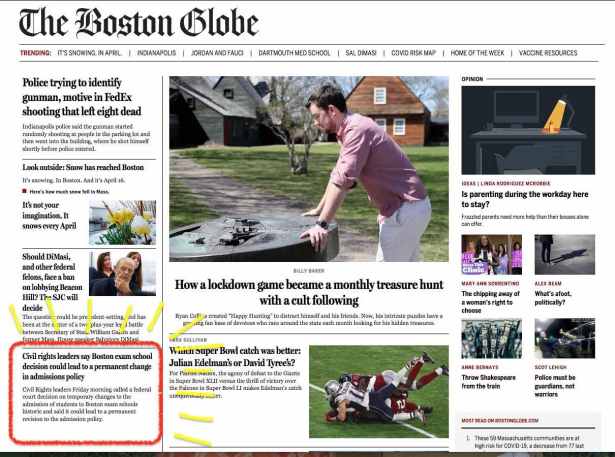
Fourteen families in Boston recently brought suit against the Boston Public School district, alleging that the COVID-19 era adoption of zip code as a determining factor for admission to the city’s elite “exam schools” was a proxy for race.

I’m delighted that these parents lost their suit in federal court, though I’m sorry that the young scholars represented fear for their futures due to the state’s failure to supply appropriate educational opportunities.Boston Globe online edition with Civil Rights suit article circled
My reasoning? Human beings may tend to sort themselves by distinguishing characteristics—skin color or “race” amongst them—but, in spite of its history as a racist city, there are no formal color-based barriers to residence in any Boston neighborhood today. People who would like to improve their children’s odds of admission to the exam schools are free to live in neighborhoods with larger quotas assigned to them.

Even at the height of segregation, I’m not aware of any rule that ever prevented wealthier, more powerful groups from moving to areas with lower median income. Most efforts prevented the richest “undesirables” from inhabiting homes viewed as the exclusive domain of the then current “better classes” such as White Anglo-Saxon Protestants (WASPs.)NZ Botanic Garden Curator's House - 1

According to the Boston Globe, when the traditional entrance examinations were deemed unsafe due to the pandemic, BPS adopted the following policy for admission to its three elite institutions including the storied Boston Latin:

“…students will be admitted to the exam schools based largely on their grades and in some cases MCAS scores. Seats will also be allocated by ZIP code, giving top priority to areas with the lowest median household income. The number of seats per ZIP code will be proportionate to the share of school-age children living there.”

Quoted from article by James Vaznis updated April 15, 2021, 10:21 p.m. (emphasis mine)

Pardon me for pointing out the obvious, but nothing prevents families from moving to the suddenly more advantageous zip codes. Given that these people must live somewhere with a higher median income, affordability—by definition—can’t be a barrier. Preferring to live in a racially, ethnically, or fiscally homogeneous enclave is a choice; sometimes our choices have consequences we may not enjoy.

Richer families can afford private schools. The least well off families in higher income zip codes have the most reason to dislike the change in admissions criteria. Frankly, though, the truly objectionable reality of this case is that all students aren’t equally able to access high quality classrooms. Now that’s a worthy reason to bring a lawsuit. Backpack with textbooks and school supplies spilling out

But because of the tight link in the United States between home-ownership and wealth, those lower-middle income families are more likely to be renters. Renters can move more readily than people who own their own home. I’d call that yet another benefit to factoring zip code into BPS’ admissions criteria.

The fact that lower median household wealth correlates directly with skin color in America is an embarrassment to our nation. There is no evidence save the easily debunked rantings of white supremacists for any rational basis to this truth; it’s wholly a byproduct of long-standing cronyism and widespread, systemic bias on the part of both individuals and institutions.

In spite of the fairly obvious reality of systemic racism, the BPS admissions policy in question does not in any explicit way prefer to admit children with more, larger, and more pigmented melanosomes* over those with less. It does explicitly tie income to admission, but offering enhanced opportunities to the brightest, hardest working children in a city because they were born with the extra burden of poverty seems eminently reasonable to me.

According to the Census.gov analysis I pointed to earlier regarding household wealth, education is firmly linked to better financial outcomes.

“Higher education is associated with more wealth. Households in which the most educated member held a bachelor’s degree had a median wealth of $163,700, compared with $38,900 for households where the most educated member had a high school diploma.”

—2019 analysis of U.S. Census Bureau report and detailed tables on household wealth in 2015

I say, let’s give more children from our poorest districts the chance to prove their mettle. Let’s offer better tools to help our least advantaged young people outgrow poverty, for their own benefit, and for the benefit of our society as whole. There’s no evidence that education is a zero sum game though admission to Harvard may be.

This new—and, remember, temporary!—policy is admitting the best students from Boston’s public elementary schools into their best public high schools at a rate proportionate to how many children live in given neighborhoods. Those kids may not perform better than the second or third best students at another school in more expensive zones of the district, but so what? They remain kids who show up to class, work hard to please their teachers, and follow the rules. Great students are gaining those coveted admission slots.Binder page listing high school courses for grade 10
BPS is hardly admitting disinterested, failing students from poor schools at the expense of dutiful scholars from richer ones. The real issue is that a few kids enjoy exceptionally excellent free public education while the rest are left to endure in lower quality institutions due to the vagaries of circumstance.

Without extra household funds, the poorest kids in Boston can’t afford private tutoring. Their parents—the financial data from the Census suggests—are less likely to have been highly educated; they’re likely less able to assist their kids with their toughest assignments. In spite of that, these children excel academically at the school their limited circumstances proscribed prescribed for them. I’d argue that their success is the most deserving of acknowledgement and reward on the part of the school system because of how hard won it is.

Policies such as this one finally offer an incentive to encourage our cities to integrate. Integration benefits all of us, not just poor children or students of color. The wildly uneven quality of public schools has driven real estate bubbles and worsened multiple types of segregation, directly leading to many of the upheavals and protests that roiled America over the past year.

I applaud Boston Public Schools for taking this step toward becoming an agent of change in this dynamic. Now they—and the rest of us—should work on offering an equivalent caliber of education to those rarefied, elite “exam schools” to every child who wants it.

* Melanin is responsible for pigmentation of human skin, hair, and eyes; melanosomes are the cells in the body that synthesize the melanin responsible for darker skin tones
COVID vaccination: appointment & liberation

Add me to the ranks of the partially vaccinated in America. Today, I received dose one of two of the COVID-19 vaccine available at a location convenient to my suburban home. Within three miles, which is “reasonably close” even by my auto-phobic standards.

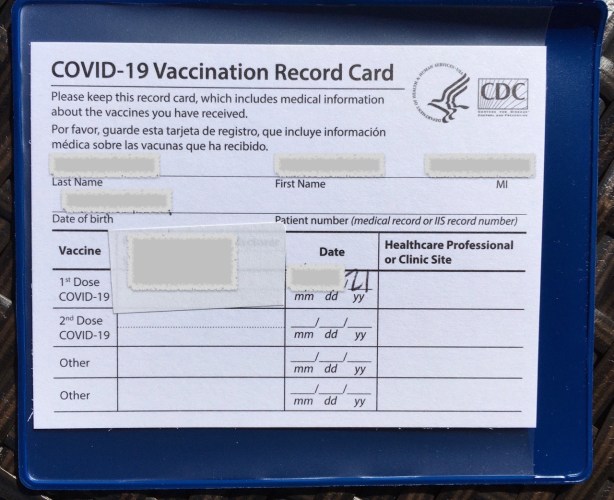
Redacted official CDC COVID-19 Vaccination Record CardMy state redefined its list of eligible health conditions the day before my turn would have been due anyway. I don’t believe that the state knew* I went from one to two eligible conditions overnight—the system asked one to confirm only from the original list of “certain medical conditions” as I pre-registered—but that change moved me up one “priority group” within the current phase of eligible citizens.

I pre-registered with the state’s mass vaccination system on Sunday, receiving notification three days later that my chance at snagging an appointment would open up within 24 hours. I was offered a turn to register for a mass vaccination site appointment at 09:49 on Thursday. I had until Friday at noon to take advantage of the option.

As it turns out, the state system only offered me appointments over 20 miles away. Given my continuing ability to shelter at home, I almost left it at that, planning to wait for my next invitation and hope it would be for a local site. Our state doesn’t have truly centralizing vaccination booking, however; the state system only books one in to seven major centers churning out thousands of doses per day.

I tried “the other way” of booking Thursday evening, i.e., last night. A local physician’s group had three appointments open for this morning. I took that as a sign that it really was my turn to book. Screen shot of COVID vaccine appointments confirmed at CVS PharmacySomeone else I know with one underlying medical condition was able to book via the CVS Pharmacy website. That screen grab makes a prettier picture than the black and white, all text shot from the doctor’s office where I went, so here is a CVS vaccine jab appointment confirmation. In both cases, the second, follow up appointment was automatically scheduled by the computer for the correct (3-4 week) wait after dose one, but the doctor’s office only shared my next appointment time with me after I’d arrived in person.

To be honest, I agonized a bit over whether it was really fair for me to take my place in line for the shot. There are many people who are more exposed than I am due to their working or living conditions. There are many people older, sicker, and at greater risk of dying from COVID-19 than I am. Those realities were reflected, however—if, perhaps imperfectly—by the state’s eligibility phase system.

I did not wangle, finagle, lie, cheat, or even fudge to make my appointment. I read and re-read the eligibility criteria, looking for any reason to find against the evidence that my government thinks I’m at higher than average risk from COVID.

I’m grateful to the reporting I’ve read in a variety of newspapers and magazines about the ethical considerations of “taking a shot from someone who needs it more.” The consensus is: if you meet the qualifications for the shot for which you’re signing up, it is your turn, and it is just and right to take it. To date, about a quarter of adults in my state have had their first shot, and closer to one third are fully immunized, similar to the national average.

No amount of logic erases the tendency to worry from those of us who are anxious, but I do fret less when I can ease the factual side of the equation. My worries on this issue are also alleviated by living with my frail, elderly mother-in-law. Her history of reacting to multiple vaccines and medications combined with a specific diagnosis she’s dealing with now makes her vaccination perhaps more risky than doing nothing.

It helps that my father-in-law has been fully vaccinated for awhile, reducing the threat that her closest companion could unwittingly expose her to the virus, but the kids’ gradual return to public life is already beginning. We’re scheduling dental cleanings again after a year of neglect, and some of DS1’s summer courses seem likely to include in person labs. We hope that DS2 will be get to finish out the year back with his friends at school.

With case rates coming down and vaccination ramping up, it no longer feels fully fair to expect my kids to give up all outside activities due to the adults’ choice to live in a multi-generational household. Even my introvert has confessed to missing the act of going somewhere to attend a class; my extrovert seems quite eager to start at a bigger, busier, fully “in person” school next fall.

Alaska Air account view showing trips in December 2021It may have been premature, but one of the first things I did, after booking my vaccine appointment, was to jump right onto Alaska Airlines’ website. I booked tickets—based upon DS2’s new school calendar—for us to spend Christmas 2021 with my dad in the state where I grew up.
Dad’s latest favorite joke is that he’ll “be immortal in just x more days,” where x stands for his distance from reaching a full two weeks after his second dose of the Moderna vaccine.

“I’m not sure that’s quite the right word, Dad,” I tease him. “Maybe don’t take up skydiving.”

“I-m-m… something!” he responds. “I’m pretty sure they said immortal.”

Somehow, he didn’t appreciate it when I suggested the word he was looking for could be “immature!” Not at his age, he retorts.

God and the pandemic willing, we will be heading west to see Dad over the summer, but I’m not quite ready to book an airline ticket for June just yet.

December, though?

I’ve got high hopes for December. And now I’ve got some airline tickets to go with them.

* I did add a comment to my submission stating that I was unclear whether to use their provided list vs. the new one the governor had just announced. It is possible that a human “corrected” my data after the fact, nudging me closer to the head of the line. I suspect that this comment box exists primarily to help the software developers improve the system, however. A newspaper article I read today suggests to me that availability is simply opening up across my state.

Here I must acknowledging that those rates have remained stubbornly higher than everyone had hoped due to the emerging COVID-19 variants, and that cases are currently kind of level in our own community. I speak more to the overall trend from the winter peak. We remain a “more cautious than average” household, I believe, even with 1/6 of our number fully immunized and 1/6 of us partially so.

The fact that many airlines have moved to discontinue the practice of charging exorbitant change fees to modify tickets helped tremendously in my decision to book now.

Exposé: He doesn’t want a collard shirt

One of my kids just had a growth spurt. With both babies and teens, it’s amazing how they can seem to change form when you look away for a mere moment. I’ve been helping him go through his wardrobe and purge those garments that no longer fit.

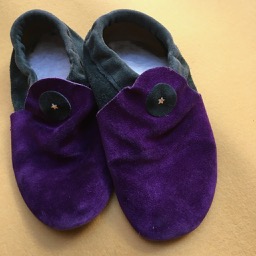
Though I often purchase almost every type of item—even fitted clothing—online, add to my list of pandemic anomalies not going to a shoe store to get a son’s feet measured when he’s obviously grown more than just one size. This fact was easier to miss than usual with everyone working remotely, wearing slippers more often than outerwear. SF wardrobe slippers Soft Star

FYI: I was very successful using the printable sizing template from the Oregon company, Soft Star Shoes. The “elves” there make most of our leather slippers. My son ended up with new footwear from two different brands that fit well thanks to that tool.

As it happens, this child is considering a school with a more formal dress code for next year. Collared shirts, dress trousers or khakis, and leather shoes would be a daily requirement. Looking ahead to that possibility, I plan to replace some of his outgrown t-shirts with button front oxfords and a second pair of hiking sneakers with more formal brown or black shoes.plaid collar of shirt visible above jacket neckline

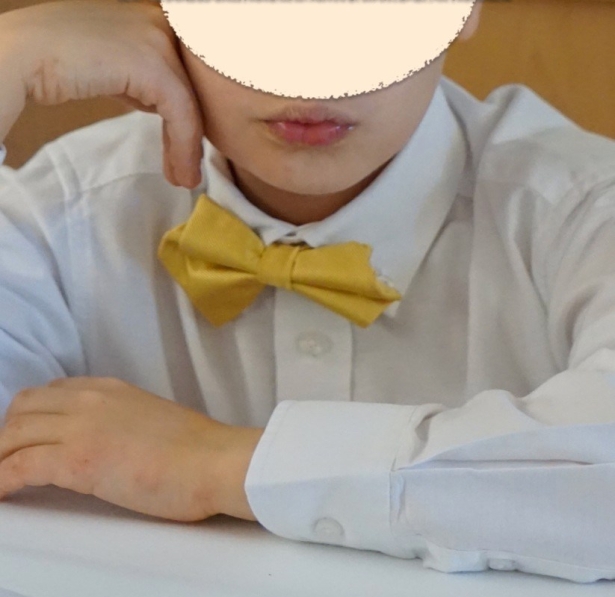
Fortunately, this is a kid who enjoys dressing up. He’s been a bow tie guy since he was little and has a nifty collection of them now mostly silk, but pre-tied. I haven’t had the heart to tell him yet that men wear a larger tie to suit their broader faces, and these will soon be outgrown, too.

Pro Travel Tip for Bow Tie Aficionados: a jumbo, hard-sided eyeglass case makes the perfect protective “suitcase” to keep spiffy pre-tied neckwear from being crushed in transit.

7 colorful bow ties in acrylic storage case next to yellow tie in a protective eyeglass case

Just for fun, here’s a particularly sentimental bow tie of the skinny, Colonel Sanders variety that’s now in my son’s collection. It was my maternal grandfather’s originally, from the Oregon Centennial celebration in 1959, and we found it amongst my mother’s treasures when I emptied her closet after her death.

There was no dissent in the family about which of Mom’s grandsons would be most likely to wear this commemorative novelty neckwear! I don’t recall my grandfather ever wearing it in my presence, though he was a bolo tie guy when he would join us at church in my youth. Come to think of it, Grandpa rocked a bow tie on special occasions, too, so my kid is in good company.

My son prefers suspenders to belts with his suits, striking that distinctive old-school lawyer-in-the-courtroom pose as soon as he’s dressed à la Gregory Peck as Atticus Finch. As early as the elementary grades, he was sincerely delighted to receive clothes as gifts… if they were flashy items like a velvet blazer, a mini tuxedo, or a new fedora.

Suffice to say, this is a child who likes to wear clothes that garner attention. It’s a skill he developed well before learning to tie his own shoes.young child in white oxford, yellow bow tie, and top hat

It was in this context that I brought up clothes shopping over lunch with the kids. I was nagging them to sort through the shoes strewn about the mudroom, refusing to buy new boots for the one whose feet were getting wet in sneakers on every slushy February walk until this dull but necessary task was done.

With the outgrown ones underfoot, there was no room to put away new shoes. Also, someone will be grateful for hand-me-down boots in excellent condition. One side effect of growing so fast is that few items are worn out before they need a new home.

I want to see everything that currently fits you before I start shopping for anything new,” I explained to my reluctant young assistant in the endeavor.

I think I need to get you some more collared shirts, too,” I added to my sharp-dresser. “You might need them for school next year and it’s not like you can’t wear one instead of a t-shirt working from home this spring.”

His response?

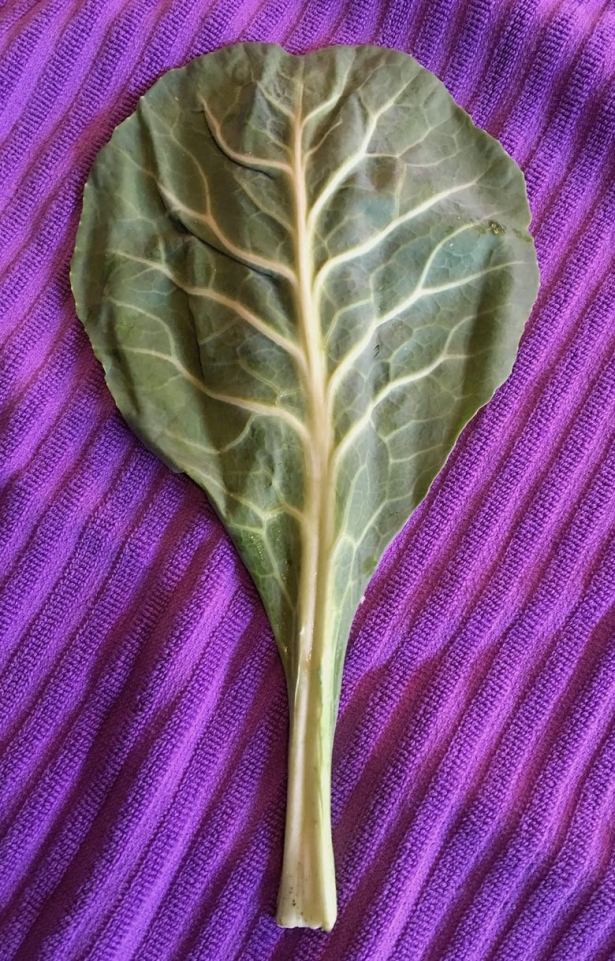
Collard shirts? Heck no, I want bok choi shirts!”

Green leaf of collard laid out on a purple towel

Collard shirts? Heck, no, I want bok choi shirts!

Amidst thunderous eye rolling, loss of my appetite, and a chorus of groans, DS1 tried to flee the room, but I kinda sorta got them to agree to work on the clothing sorting project before anyone enjoyed any video games over the weekend.

And you got to enjoy my dear child’s most dreadful pun yet of the pandemic.

O frabjous day! I’ve got sprouts on my windowsill

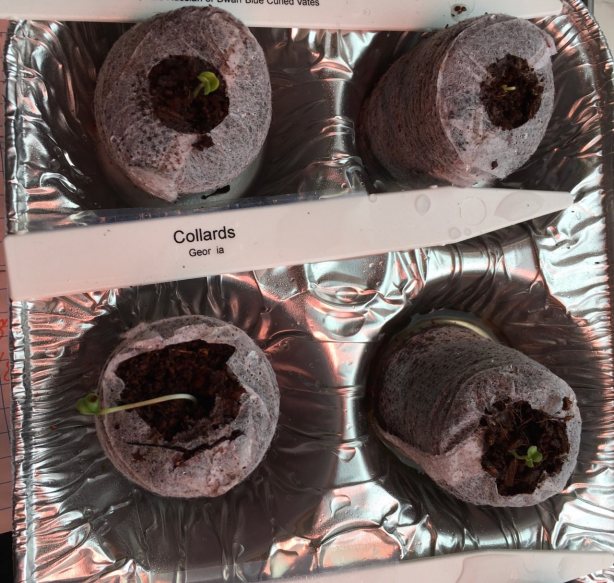
Because harbingers of spring seem like the most Wonderful Thing to share these days, allow me to present the first shoots of my nascent 2021 garden.Kale and Collard sprouts grown in peat pucks in disposable aluminum muffin tin

I feel like the preening mother of debutantes. Stand up straight, my darlings! Never fear; the one in the front on the left is tall and proud now.

I’m not really much of a gardener, so my delight is no doubt outsized. Add my family to the ranks of pandemic plant-tenders, motivated by grocery deficits in 2020 to expand from a handful of pots to a balcony-full. My pride in such a minuscule accomplishment certainly feels weightier than four spindly seedlings gracing a disposable aluminum muffin tin full of peat pellets.

Here’s a close up of my first born sprout. Though I do feel a bit guilty contributing yet more photos of kale to the internet. At least it isn’t on a plate…

Kale sprout one inch tall

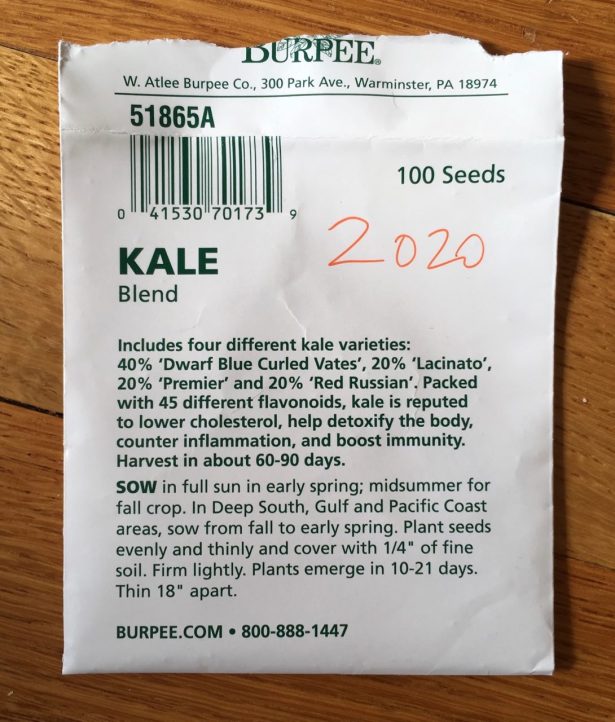
I’m particularly happy that these seeds germinated since they were left over from DH’s burst of gardening enthusiasm at the beginning of the pandemic last year. The little beauty above could be any of four types included in Burpee’s Kale Blend, though, statistically, I suppose she’s most likely to be Dwarf Blue Curled Vates.

Lest any hapless would-be gardener look to me for inspiration, be aware that I took the earliest possible seed starting dates for my zip code from an online calculator offered by A Way to Garden. Being a true nerd, I also added a sheet to record my seed starting results to the Excel spreadsheet* where I track my annual purchases of plant and seed varietals.

Early planting reflects both my enthusiasm to welcome the coming season in a year where indoor socializing has been so sharply curtailed, and also the high probability that I will kill some of these poor plants and need one or more subsequent sowing to end up with any healthy seedlings to transplant by the time our last frost actually passes.

Open Burpee Kale Blend seed packed with 2020 scrawled on it

Kale and collards both—according to my online sources—are better sown outdoors directly and left to grow in peace. I started a few anyway. The seeds were here and I was curious to know if they were still viable. At a cost of less than 4 ¢ apiece, this form of experimentation is cheap.

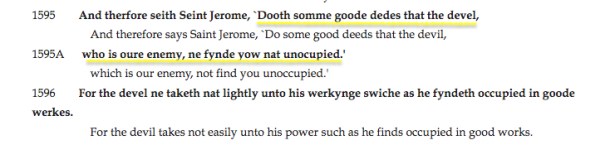
Also, I’m itching for spring, so why not engage in anticipatory activity? Heaven forbid my idle hand become the devil’s workshop!Popular origin of saying about idle hands and the devilNot strictly Biblical, this phrase comes to us mostly thanks to Chaucer and Saint Jerome. See line 1595 of the former’s “The Tale of Melibee.”
“And hast thou slain the Jabberwock?
   Come to my arms, my beamish boy!
O frabjous day! Callooh! Callay!
   He chortled in his joy.

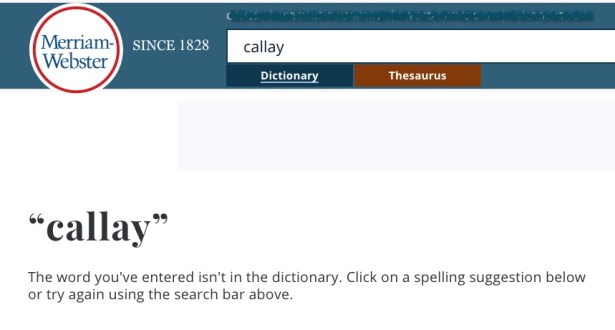
And in another utterly non sequitur-ious aside, how does anyone else feel about the fact that the Merriam-Webster dictionary offers a definition for frabjous, but the next two exclamations from the poem—callooh and callay—don’t merit inclusion?

My understanding is that Lewis Carroll coined frabjous in Jabberwocky, and a quick internet browse and articles like this one seems to support that supposition.Merriam-Webster screen shot states callay is not found

My question for the rest of you is: Do you ever describe a thing as frabjous,” or, like me, do you mostly quote the entire line from the poem if using the term?

Literary diversions aside, new life merits the frabjous, a callooh, and a callay, in my opinion. How can one help but marvel at the super powers contained in a single tiny seed? Thank heavens for the wisdom of nature, because sometimes it’s sufficient to keep even me from wreaking havoc on my best efforts at nurturing vegetables.

Don’t tell me there are people who can pull off cultivation of more than a few vegetables, herbs, and flowers without benefit of software-enhanced data analysis!

But, of course, I’m well aware that my habitual tendency to gather and play with data is anomalous. I doubt I’m the *only* one with spreadsheets for her wardrobe, recording drive times for various routes to frequent destinations, and prices by source for the family’s usual grocery purchases, but I suspect that there aren’t too many of us who dwell more easily in the realm of information vs. the actual world.

I geek, therefore I am.

Phone a friend, if only to confess “I have no energy to talk”

An article* in the newspaper prompted me to reach out to a friend yesterday. It reminded me that we are all hopefully not sick but tired of the pandemic, and that perhaps our loved ones with small children are even more drained and hungry for a moment of adult contact.

It’s okay to reach out—a great idea, actually—even if your message is merely a confession that you’re too exhausted for a big, meaningful talk. What really matters is letting people know that you care. A text, a ping, a postcard: any of these is a whole lot better than nothing at all.

The article reminded me that my low energy might still be higher than someone else’s emotional charge.

Contact phoneLike many others, I’ve found the pandemic to be paradoxically physically isolating, yet discouraging to my tendency to reach out in other ways, even electronically. I may be the only person in America who has yet to join a Zoom meeting.

Perhaps because I’m an introvert, I’ve realized that stress tends to shut me up.

Though I never lack for opinions or the desire to share them, my mother’s death in 2019 made it very hard for me to post to Really Wonderful Things for a period of months. Similarly, while I think of many friends, often many times per day, the oppressive weight of living in a COVID-19 limited world often keeps me from calling or texting or even answering my phone when it rings with a call from someone I really miss.

I have no doubt that surviving a pandemic induces grief. As one bereaved just a year earlier, the parallels are plain to me.

Chatting with my friend—okay, it was texting—was a nice break from my current reality. She was the last person I saw socially before everyone sequestered at home. I met her still tiny baby that 2020 day over coffee at a shop near her house. NZ espresso Wildlife Refuge cafe

Already aware there was a mysterious virus swirling about the Earth, I didn’t ask to hold her little bundle of joy, but I did briefly get my freshly washed hands on one irresistible, itty bitty foot. Consider it the elbow bump version of appreciating a newborn as a pandemic loomed.

About a year has gone by since then. My friend’s baby is now a toddler with hair long enough to style in an up-do for a windy walk around a reservoir. I got to see a picture. I noted how the wee one’s hair favors the younger of her big brothers; my friend pointed out that her face is more like the elder sibling’s was in early childhood. Her eldest was about the age her baby is now when she and I first met!Woman hugs child

While joyful, the conversation was also full of pining for a return to our old kind of visits. I want hug her youngest urchin for the first time. She wishes she could help me fix what I’ve done to my poor sewing machine. We both miss those hours, here or there, that we used to steal for a cup of something and a chat while our kids were at school.

No wonder it’s so hard to catch up in the virtual realm. The act is such a stark reminder of all the real visiting that’s missing!

But we wandered, too, through the tentative plans our respective families are finally feeling free enough to make for the future. They’re thinking of moving for more yard space, or perhaps she’ll take a community garden plot to get her hands into the soil. I’m expecting that—come Hell or high water—I will find a way to get cross-country to see my father this summer. Both of us have begun pondering passports and international travel, but neither of us wants to board a long flight any time soon.

Her husband has always wanted to show their kids Niagara Falls; my family hopes to do a round trip cruise from Canada that circumnavigates Iceland from a port within driving distance in 2022.

It’s a bit like ordering seeds in January. It’s a lot like those longer, brighter New England days in early March when you can feel that spring really is a-comin’… while also remaining fully aware it would be unwise to put away the snow shovel just yet.purple and gold flowers blooming in Hafnarfjörður, Iceland

Reaching out and making contact—in even the tiniest way—plants another tiny grain of hope that we may all soon put this period of illness and extreme loneliness behind us. So phone a friend; nurture a bloom of camaraderie. They’ll understand if the best you’ve got to offer is, “I miss you, but I have no energy to talk.”

* “The parenting crisis without a vaccine: loneliness” by Boston Globe Correspondent Kara Baskin