Road Trip! New England to Minnesota Part I: a minivan, a mom, and four kids.

Why am I rushing from New England to Minnesota the day after school lets out for summer? (Cue Alice Cooper: School’s Out!)

And how does one rush to Minnesota from here, anyway? Why, by minivan, of course.

MinivanRegular readers may have noticed another oddity already: the title of this post says there are four kids in my minivan. Two of them are mine. Where did the other two joyriders come from?

I’ve posted before about the rare domestic opportunity for immersive study of foreign languages that exists in Bemidji, MN. I read about it for years before taking the plunge and attending Family Week with DS1 at Concordia Language Village‘s German language site, Waldsee. That was two years ago.

We’re heading back to Family Week at Waldsee this summer. Due to an abundance (some might say surfeit) of enthusiasm on my part, I wasn’t content to return with just DS1. He is a middle schooler who has been learning German since 1st grade.

His younger brother, DS2—who keeps reminding me that they don’t study German at his school, they do Spanish!—has also been drafted into our party. I remain convinced that DS2 will be a full convert to the joys of Waldsee after his first bite of Kuchen from the Café. He also loves to sing and dance and generally make a spectacle of himself. He’s going to fit in just fine.

Our party is completed by the addition of a pair of friends—brothers, and, in fact, twins. They are making the transition from school to home education for next year, and German is one of their areas of interest.

The seed of this idea was planted when I discussed with the twins’ mother the difficulty in finding local home school classes in less popular languages. It clearly grew into her acceptance of my offer to act in loco parentis for the twins during Family Week.

OSV 2 yellow flowersIf CLV is willing to define a family as any group of at least one adult and at least one child who wish to be counted as family, so, apparently, am I. Let’s see if my crazy idea flowers.

I’ve known the twins for several years, and, by all available evidence, they are very nice boys. Ask me in July if I’ve revised my opinion.

Our route from New England to Bemidji, MN will take two and a half days (25 road hours) of driving. God bless America, but it sure takes an effort to cross it.

The plan is to complete two ∼10-hour days on the weekend, then complete the final five hour stretch on Monday morning, arriving in Bemidji around check-in time for camp. That’s 2:30-4 pm.

If I survive, I then immediately begin an intensive language learning program while supervising my four charges.

Or maybe I will smile beatifically, let it all roll over me, and eat lots of Kuchen. We’ll see how my energy holds up.

We’ve got our Pimsleur German lessons loaded in the car‘s hard drive, headphones for all the kids, and enough distracting electronic devices for a small army. I’ve packed water bottles, snacks, and a Tupperware bowl with tight-fitting lid in case motion sickness* strikes.

Embarking on an epic road trip a few hours after school ends with no alternate driver and a van full of kids might be counted as one of my more… optimistic endeavors.

Remember, that which does not kill us, or any of the children, makes us stronger. (So we can kill them better at a later time?)

I’ll accept any prayers, well-wishes, or cones of silence from whomever cares to offer. Ah, those carefree summer days… (Cue Beach Boys: I Get Around)

Continued in Road Trip! New England to Minnesota Part II.
*Add ginger candies, mints, Sea Bands, and an eye mask to the list of offerings to the god of seasickness. DS2 is a risk. No screens allowed for him during motion. He’s got hours of audio books on his iPad.

Summer vacation isn’t the enemy of modern parents, but it reveals social boundaries

Last week, I saw an ad predicated upon the idea that summer vacation is a nightmare for parents. It wasn’t even Memorial Day yet, and, already, they’d infected the airwaves.

Do parents really bemoan summer break?

I despise commercials that attempt to advertise products based upon the perverse notion that I loathe spending time with my children.

The Back to School ads are even worse than the End of the School Year set. Parents dance in the streets because they are unable to contain their joy at giving up the burden of spending entire days in the company of their own kids.

Are these the same kids Americans were so desperate to have that more than 10% of US women of childbearing age have used infertility services? Bah, humbug!

My kids are cool, and I enjoy their company. Summer means no alarm clocks and more opportunities to say yes to their (admittedly, sometimes goofy) requests. Summertime equates to free time.

Or are parents with limited resources desperate for better solutions?

I’m crying foul. I think this is primarily a lame advertising trope.

But, of course, there is added stress for families where all available caregivers work outside the home. Finding appropriate summer camps or childcare is a pain. That’s true 365 days a year in America for kids too young for public school.

This isn’t a summer problem, or a parenting problem. It’s a political problem, and an economic one. This is not proof that parents want their kids to stay locked up indoors year ’round.

Instead, we see a sign of a childcare problem in a society expecting high rates of worker participation from able bodied adults. (Those would be the same adults who most frequently produce offspring!)

Really, how many of us resent watching the kids pour out of the schools and into the home, onto the beaches, and into the parks?

Most parents work their butts off attempting to earn the best for their kids, and that includes fresh air, exercise, and time and space to dream the biggest dreams. That’s where summer vacation can really shine, but only for those with the time and resources to let it happen.

My family’s summers include travel, museums, hours poring over books of our own choosing, and lots of time with extended family. I don’t even have to question whether or not this is a good use of my kids’ time. Of course it is!

I can barely express how grateful I am for this privilege.

We supplement our lazy summer days with hours of Khan Academy and specialty family camps, not because we feel compelled to keep up, but because learning new things is awesome and we want to share the joy with our kids.

I don’t believe for one minute that there are legions of caring parents in America who want more testing, more trivial comparisons, and more common core for their beloved children.

Parents want their kids to have access to opportunities. Parents want their kids to learn useful stuff. Parents want their kids to grow up well and be successful and happy.

I can’t even say how much I wish summer vacation was an equal opportunity benefit for all children.

Who really hates summer break?

Parents today—like most people today—struggle under a burden of technology and schedules seemingly designed to detract from a fulfilling life.

Theoretically, we live in an era of reduced physical effort and greater access to information, leading inexorably to an easier life. In practice, maybe not so much.

These commercials are lazy work on the part of advertisers, but they do reveal a modern day American tragedy.

Some of us have to get a little desperate when school lets out for summer.

Some of us get to enjoy our kids’ company in the same situation.

Blessings by the minute, from the playground into sleep

By school pick up time—around 2:30pm, so hours before many people even think of finishing their days—my reservoirs of energy are nearly empty. What used to be an afternoon lull is more often, now, my afternoon collapse. It’s the most persistent and insidious symptom of my autoimmune condition.

Afternoon delight? Fugeddaboutdit!

The work of a stay-at-home mom may include some flexible hours, but school pick up time is not among them. The kids are done when they’re done; someone needs to go get them. There are a few dads driving up in the daily rotation, but most chromosomes in the car pool lane are XX.

Add me to that list of who’s who.

playing outside - 3

Outdoor “play equipment” doesn’t have to be expensive or complex

One of the things I like best about my son’s school is the emphasis placed on time spent playing and learning outdoors. They aren’t quite as adamant about it as our preschool was—there, kids went out, rain or shine, unless there was a truly bitter freeze or risk of lightening strikes—but the value of free time, active play, and exposure to fresh air and sunshine is respected.

So, while I’m often running on fumes by 2:30pm, I bring a book, I pack a thermos of tea or an appealing snack, and I just generally prepare myself for a comfortable wait so my little guy can stay longer with his friends and play even more after school. It may only be a half an hour, but what a precious 30 minutes for a kid.

I’ve read that child’s play is currently endangered. I tend to agree that this is a grave loss for the kids in question and society overall.

On a beautiful spring day, it isn’t much of a sacrifice to allow this time for my child to release some of that seemingly boundless energy. My arthritis doesn’t flare as often on moderate days, lessening the cost of pain. In the absence of rain, I can move around and avoid getting stiff from sitting in the car. I get to socialize today, too, with other moms and some lingering members of the school staff, all of whom take advantage of the beautiful weather to linger outside.

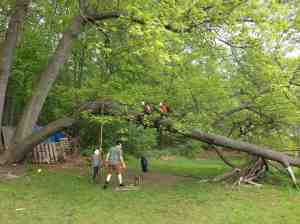
DS2 and his knot of friends are involved in a complex dance of running, falling down, enacting simulated agonies, then jumping up to do it all over again. Some of the girls join in at times, weaving themselves into the game, then drifting away to huddle under a different tree, whispering their own solemn secrets. They start a new adventure by climbing a large, horizontal tree.

playing outside - 2

An admittedly awesome tree, some string, and a lot of imagination sparked this adventure

“Watch out for that poison ivy,” they advise me when I come closer to take a picture. After confirming I’m not there to take my son away, they quickly re-submerge in their play. They stop only when a preponderance of mothers appear, all ready to go home.

There seems no possible sweeter moment for me, as a mother, than this one, until later, after a tick check and bath, after dinner, after fun, when the little guy is lying asleep nearby and I’m restless and reflective. His breathing is deep and even with no sign of the nocturnal asthma that sometimes harries our nights.

No doubt the fresh air and tree climbing contributed to his deep, peaceful slumber, even as the memories of the same disrupt mine.

He’s so big, now, my little boy, but still so very small. My love for him swells in my breast like a wild thing rearing up to escape its confinement in a cage. It is ridiculous how much I adore this child. I’ve always found it easier to really notice this while he’s quietly sleeping.sleeping - 1

The night air drifting in the window is still soft and smells of spring. Many hours remain for slumber, and there’s more play in store for tomorrow. It’s time to tuck this unbridled passion for a silly little boy and his winsome ways away, and attend to my own dreams.

“Teenagers, Kick Our Butts” is my parenting anthem

I’d like to talk about a song that I consider my parenting anthem:

Teenagers, Kick Our Butts by Dar Williams

If you enjoy indie folk music, you should definitely give it a listen. For those with different musical tastes, just read the lyrics and follow along.

Dar Williams End of the Summer

“Teenagers, Kick Our Butts” is track 6 on Dar Williams’ album End of the Summer

Some of the song’s lessons apply to raising kids well before the teenage years. I’ve been playing it in the car since my boys were little, and I’ve always pointed out certain lyrics, making clear these were sentiments with which I agree.

…I’m sure you know there’s lots to learn
But that’s not your fault, that’s just your turn, yeah, yeah…

…Find your voice, do what it takes
Make sure you make lots of mistakes…

Beginning this conversation when they were young was meant to pave the way for the impending struggles of adolescence. I wanted them to know that I was aware of the future when they would reject my authority, and that some of that was not just tolerated, but to be celebrated.

…Teenagers, kick our butts, tell us what the future will bring
Teenagers look at us, we have not solved everything

We drink and smoke to numb our pain
We read junk novels on the plane
We use authority for show so we can be a little smarter
We still can grow, and many do
It’s when we stop we can’t reach you
We feel the loss, you feel the blame
We’re scared to lose, don’t be the same, hey hey…

I talked to my little boys about the older kids they knew: young teens from school, older cousins, and family friends. I tried to point out gallant gestures made by gentle young men, and raise questions about the motivations of more rowdyish examples.

…Some felt afraid and undefended, so they got mean
And they pretended what they knew made them belong more than you….

…I’m here today because I fought for what I felt and what I thought
They put me down they, were just wrong
And now it’s they who don’t belong, oh, oh…

Lately, as I’ve discussed with my own teen the popularity and value of a contentious novel revolving around a girl’s tragic suicide, I’ve been able to point back at a well-known verse from the same old favorite:

…And when the media tries to act your age
Don’t be seduced, they’re full of rage…

I adore seeing this pointed out so succinctly.

New Media can be a legitimate forum for the formerly disenfranchised (e.g., youth), but it’s equally true that most of what achieves popularity gets bought out by the same old media cartels. Consumers of media must learn to be exceedingly critical of every source lest they inadvertently find themselves dancing to the tune of an unknown, objectionable master.

And what’s the alternative to blindly consuming pap that’s been prepared for you? Some people never learn to peek behind the curtain and discover the humbug working distracting magic tricks in the name of the Wizard. Here’s an answer by way of my favorite lyric again, this time expanded for the audience approaching maturity:

…Find your voice, do what it takes
Make sure you make lots of mistakes
And find the future that redeems
Give us hell, give us dreams
And grow and grow and grow

And someday when some teenagers come to kick your butts
Well then like I do try to
Love…

The funny thing is, I’ve always heard that final lyric differently. Williams sings it in a set of long, drawn out syllables rising up and down the octave, obscuring the simple word “love.” When I sing it, I’ve always twisted those same notes into the word:

“Learn”

I’d like my kids to discover the value in both lessons.

Are land line phones as archaic as the nuclear family?

My husband and I have a long-running joke that goes back, I think, to our first experience traveling together. Our shorthand for this very long discussion is:

“It’s all about the sharing, and the commitment.”

It began with a difference of opinion (ongoing!) about combining both of our belongings, intermixed, into two shared suitcases vs. packing individual bags. I prefer the former; he prefers the latter.

DH believes this is an entirely biological imperative: I am the female who needs full relationship participation from my mate and maximal expression thereof so I can ensure the successful maturation of our offspring. I’m putting my eggs (wardrobe) in his nest (suitcase), so to speak.

My argument on the subject is that suitcases are regularly lost, and the distribution of at least one full outfit per person in the other bag means less chance of radical inconvenience if a bag goes missing. It is also nice for my loving feelings that we are sharing, which corroborates the commitment.

I’m right about this, of course*, and I follow the same strategy when traveling with my children, so it isn’t all about co-opting DH’s suitcase real estate, but that’s not my main point today.

Moving beyond the travel example, this sort of discussion arises over other daily actions like asking for a bite of his meal (the sharing), or asking him to weigh in on a household decision he might not really care about (the commitment.)

Sharing and commitment are the very nexus of healthy relationships. It’s hard to imagine a family thriving without them.

So what does any of this have to do with the great 19th century innovation of the land line telephone?

For the first time since phones became ubiquitous in the USA, cellular only households now outnumber those with a traditional land line. This is hardly surprising, and there are a number of downsides to this trend that have been covered by major news outlets. The most obvious relate to dispatching emergency services, power outages, and rural or elderly populations who depend heavily on wired phone lines.

Nowhere have I seen mentioned what I’ve found the most personally disruptive feature of a cell phone only culture: it is no longer possible to call a family as a unit. I have to choose an individual to contact, even when my business is with the whole group.

Sometimes, that’s inconvenient: “Hello, neighbors, your garage door is open and the sun’s going down,” or, “I’m driving by and want to drop something off to whomever is at home.”

No, it’s not the end of the world to spray a series of texts or voicemail messages, but it fundamentally ignores the shared nature of a household and its tangible collective purpose.

Sometimes, that’s kind of sad.

Is a family home anything like a collaboration of tenants in common? Should it be?

For individuals who choose co-housing for financial or other reasons, the personal cell phone is a great innovation. Anyone who’s lived in a dorm or otherwise shared a public hall phone knows the benefits of a private device. But is there any advantage gained by a family in the same scenario?

It’s positively quaint to watch an old TV show set at home and see teens racing to answer the communal family phone, or demanding that a sibling conclude a conversation quickly lest an important incoming call be missed. I showed my kids Family Ties last summer, and I marveled at the repetition of that once common scene—now inconceivable—every time.

I don’t mean to romanticize the inconveniences of sharing, but I do question what role the act of frequent sharing has on members of a family. Might these regular points of casual contact mean a more regular chance to check in? I’d guess that it would act in much the same way that sharing any habitual activity leads to better communication between teens and parents simply by providing a low stress opportunity for it to happen.

And then there’s the effect of sharing itself. Parents spend an awful lot of time and energy teaching this vital skill to their young children. Why? Because we want them to grow up into caring adults who treat others well. Participating in a shared family mode of communication means taking part in the functioning of the family itself.

To be clear, I wouldn’t advocate spending twice to have both a cell phone and land line in a scenario where every penny counts. If you have to choose between buying vegetables and having two phones, I vote for the healthy green stuff. If only one phone is in the budget, a mobile phone provides the most flexibility and would be my choice, too.

But for families more like mine—having the privilege to elect music lessons and summer camp, organic food and restaurant meals—the move away from a family phone seems short-sighted. We are constantly bemoaning how hard it is to communicate with our kids while literally cutting the copper lines we used to share.

Shifting more and more experiences from public to private space—personal iPad viewing vs. negotiating the channel of the family room TV, meals on the run vs. around the family table, and, yes, a social life conducted primarily through a tiny handheld computer instead of in the yard or the living room, or even at the mall or the movie theater—every one of these is a vote, intentional or not, for the primacy of the individual experience over a commitment to the family.

These are choices, conscious or not. They are every individual family’s to make, and I don’t presume to know what’s best for yours.

I do, however, hope that I’ve made my point that these are choices best made based upon one’s values, and not by default. It is easy to convince oneself that a situation is made by circumstances and not by choice. Sometimes, its harder to live with the consequences.


*This is a joke. I respect my husband’s opinions as he respects mine. We both think we’re right, obviously. But, probably, I am, which is a joke that’s become recursive…