Disposable paper coffee cups aren’t good enough for a 4 star hotel like San Francisco’s Westin St. Francis

Due to my husband’s travel schedule and a favorable fare war over the flight path involved, I had the great pleasure of spending five (5!) nights in the heart of San Francisco. His professional obligation put us up at the Westin St. Francis on Union Square.

I would be unlikely to pay for a 4 star hotel in this location—unless, perhaps, it was in an historic building I admired—but I’m eminently capable of enjoying it.*

My husband in particular dislikes a hotel which increases the fussiness or snootiness of the service at the expense of obvious value added to his straightforward tastes.**

Overall, the Westin St. Francis did a great job providing the unpretentious service we prefer at a level above what we demand to be satisfied. It was a very comfortable and gracious place to stay in a bustling San Francisco neighborhood.

Housekeeping gracious manners - 1

It’s my habit to leave a brief thank you with the tip for Housekeeping. A first for me: Westin Housekeepers thanked me back!

Though not quite to the level of get-it-before-you-ask intuition shown at five star properties, we found Room Service to be quick and attentive to detailaspicky eaters on a weird schedule. Housekeeping was very thorough, friendly, and, like Room Service, paid careful attention to special requests.

I can’t fault any of the service personnel at the Westin St. Francis, though the Front Desk was often busy or otherwise slow to serve.***

There was one item both Housekeeping and Room Service failed to providefor us when asked, and I did make requests of both. I asked Housekeeping in a note, and DH asked Room Service on the phone. I was told they could not provide a reusable mug for the in room coffee service.

Even when ordering espresso via Room Serviceor seated in the lobby cafe, it was provided in a tall 12 oz paper cup with Starbucks branding. Yuck!

My complaint here is twofold:

  • I love my coffee, and it tastes better from a ceramic cup.
  • Throwing away a paper cup for a beverage I’m drinking seated and indoors is needlessly wasteful.

I prefer a paper cup to styrofoam, but we all know there’s got to be a coating on that paper to make it waterproof, right? Coffee is hot. Wax and plastic coatings melt. Plastic, even without BPA, still contains chemicals that probably impact human health.

No, I don’t think the paper cup’s interior coating enhances the flavor of my organic medium roast.

And as for the unnecessary creation of garbage for drinks I’m consuming in the comfort of my hotel room? No, just no!

I think it is tolerable—if not my personal preference—for the Westin or any other hotel chain to choose to default to paper cups for in room coffee services. I don’t know the statistics on hotel behavior, but it’s absolutely possible that most guests most of the time are preparing, then carrying out, their room-brewed morning beverage. I understand that the glass carafes on the old 4-cup coffee makers broke regularly, creating headaches and hazards for Housekeeping and guests.

In this Tower room at this Westin hotel, the location of the coffee service near the tiled bathroom, but outside of its perils on a carpeted floor, would seem to reduce the risk of broken service items. A ceramic mug also seems less likely to crack than the thinner glass of a drip coffee machine’s carafe.

Most emphatically, if guests can be trusted to eat from ceramic dinnerware and glass cups delivered via room service, there can be no increased risk from coffee mugs of the same materials!

I suspect that the partnership with Starbucks is a part of this equation. Lots of people love Starbucks. It’s viewed as a premium brand. It probably “means something” to use that mermaid logo on your in room coffee service.

Perhaps Westin has an agreement to serve all coffee in Starbucks branded cups? Provide a ceramic mug with the iconic green logo, then, but please do have one available when I request a less wasteful coffee cup. If Starbucks is forcing the use of its branded paper cups, they need to be called to account for it or change their stated intent to reduce their environmental impact to a more honest one.

In Starbucks stores, I can always get my beverage in a ceramic cup by asking for it when I order. My estimation of the company would skyrocket if they made this policy a requirement for third parties displaying the Starbucks logo for marketing purposes. That would show a real commitment to the environment.

In a hotel with several bars and restaurants, a full menu of room service, and a complete kitchen that must include commercial dishwashing equipment, it is simply unacceptable to tell me that you don’t have a ceramic cup for me. I find it repellent, walking through the beautiful, marbled lobby, seeing a cafe full of guests settled in to drink from cups that are, essentially, garbage. I expect much better in an environmentally aware city like San Francisco.

Since 2012, the municipality of San Francisco has demanded that consumers pay for every paper shopping bag procured from a retailer. Plastic bags were banned outright in 2007. Even luxury boutique Hermès must ask if you want to pay 10¢ for a bag to carry home your new $12,000+ Birkin handbag.

How does this align with a hotel advertising rooms available “from $620 per night” during my stay that wouldn’t provide a washable, reusable mug for my use in the hotel?

My solution was to purchase a new glass “to go” cup from local roaster Blue Bottle Coffee. Theirs was manufactured by KeepCup. Trying Blue Bottle’s single origin espresso was on my list of adventures for the City by the Bay, so I got a meaningful souvenir and solved my cup problem in one fell swoop.

Blue Bottle espresso - 1 (1)

Yes, Blue Bottle Coffee’s single origin espresso was worth seeking out in its own right.

For someone like my husbandadmittedly, not a coffee drinker, like many most traveling professionals are—whose free time in the hotel is strictly limited by the rigors of his work schedule, this wouldn’t have been an option. As it was, when I offered him a soothing cup of chamomile tea in the evening, I had to clarify that he’d be getting it only after I finished my own cup of Darjeeling. We only had my one glass mug, of course.

Travel dish soap - 1

I often travel with my own refillable coffee cup† and I always carry a tiny 0.5 oz Nalgene drop dispenser bottle of dish detergent in my toiletry kit, but I left the travel mug at home this time. We were staying in a full service, four star hotel, so I assumed there would be proper drinkware on offer. I also knew that I’d have lots of free time while DH worked. I planned to savor my beverage of choice—espresso, straight up—seated in cafes and not on the go.

A recent sale flier by U-Konserve, the company that makes most of my reusable lunchbox components, pointed out the following from this study by ScienceAdvances:

“There is now one ton of plastic garbage for every person on Earth.”

U-Konserve also gives this fact in their Environmental FAQs:

“About 25 billion single-use coffee cups end up in landfills every year. If you buy just one cup of coffee or tea in a disposable cup every day, you’ll end up creating about 23 pounds of waste in one year.”

KeepCup estimates the environmental breakeven point of my reusable glass cup vs disposables to be as low as 15 uses. Put another way, if I use my new Blue Bottle travel mug 16 times instead of a paper cup, washing it between uses, I will have made the more environmentally sound choice.

Paper cups aren’t plastic bottles, but, seriously, are we still debating the wisdom of the throwaway society?

And I’m not even particularly militant on this topic. It strikes me as possible that disposables are more convenient to many business travelers, and I’m not prepared to insist that my opinions dictate what ends up in other users’ hands.

I am, however, quite wedded to my position that a hotel of the caliber of the Westin St. Francis has an obligation to provide environmentally friendlier options to guests like me who want them.

If not, it is greenwashing of the highest order by a company highlighting its sustainability mission and asking customers to “Make a Green Choice” to defer housekeeping that happens to be labor/cost saving for the hotel in addition to water-wise.

*My personal valuation of hotel class often boils down to: if the location is what I want, clean and simple will serve my needs. I prefer to pay extra for more space (i.e., two bedroom vacation rental with kitchen when traveling as a family) over luxury finishes or a more extensive range of services.

**He raved about the Philadelphia Four Seasons, mostly because room service recognized almost immediately that he prefers exactly the same menu every day. They came to answer his afternoon call with, “Are you ready for your berries now, sir?”

***When the shower knob fell off in my hand, the front desk forgot to send maintenance after my first call; I had to ring them again after 45 minutes of waiting. The service technician, once summoned, fixed the problem quickly, thoroughly, and with a total commitment to disturbing me as little as possible while he worked.

†My favorite is an unbreakable stainless steel-lined model by Liquid Solution. It has a non-slip, textured exterior, a simple lid, and holds up to machine dish washing.Coffee cup travel mug - 1

Luggage brands & bag styles I’m traveling with regularly in 2017

Here’s my recent luggage use pattern:

Rolo, when carried, ends up crammed inside Tom Bihn or Red Oxx, however. It has been used as a carry-on in conjunction with a Tom Bihn Aeronaut 45, a Red Oxx Small Aviator Bag, and even a Tom Bihn Shop Bag tote.

I haven’t posted about the brand before, but my one set of wheeled luggage is Sherpani. We need to talk about them, too.

Yes, I’m on the record railing against wheeled “roll-aboard” bags here and in real life, but my Sherpani wheels are on a larger, checked-luggage sized suitcase. I never lift them over my head, and I don’t try to carry them on. Large wheeled bags are the best for trips involving a lot of stuff.

It is possible that I bought my Sherpani wheeled suitcase primarily because it came in a really fetching brown and purple color scheme. Highly unusual for luggage carousel spotting! Coordinated with clothes I wore frequently for travel! The presence of cute little daisies in charming spots could also have been a factor.

The more similar your trips, and the more similar your needs during travel, the less likely it is that you need a variety of pieces of luggage. If, on the other hand, you sometimes fly carry on only in basic economy, but other times enjoy extended voyages with extensive wardrobe requirements, you might appreciate having a range of bags that can exactly suit the given style of travel.

If I didn’t have the budget or the storage space for all four types of luggage, I would rank their order of importance to me exactly as I introduced them above:

  1. Ultra-lightweight carry on,
  2. Sturdy check-able duffle in a moderate size that could also be carried on,
  3. Specialized bag optimized for organization,
  4. Specialized larger bag for extra long trips with more specific requirements.

For someone who flies rarely or has the strength to find all carry on luggage of trivial weight, I would prioritize item #2 above all else in most cases. A sturdy rectangular bag is the most versatile option available, by far.

Some people can make do with everyday items (shopping bags or school day packs) in lieu of travel gear; some people are willing to spend more on luggage than they do on the trip itself. Most of us fall somewhere in between.

A good brand will only produce bags of high quality, but that won’t matter if you buy the wrong bag for your needs.

The rain in the plane falls mainly… in my Tom Bihn Cafe Bag

Some people carry expensive designer bags onto a flight. Me? Not so much.

If I haven’t heaped enough praise on Tom Bihn bags before, let me reiterate a powerful selling point: their water resistance.

Flying in the cramped confines of cattle coach class, if you set down your improperly-capped refillable water bottle on the top flap of your Cafe Bag, your iPad, Kindle, cell phone, and important papers might survive in spite of the aftermath of your arthritic fingers’ failure to twist.

Must you ask me how I know?

Sigh.

Some water dribbled down into the open back slit pocket, but, as luck would have it, I only keep a shopping bag and my baggies full of wipes* there during travel.

The front zip pocket and merely flap-covered main compartment stayed dry through about four ounces of slow leaking. My chocolate chip cookie and spare napkins fared less well, but I could weather their loss. I also packed a brownie!

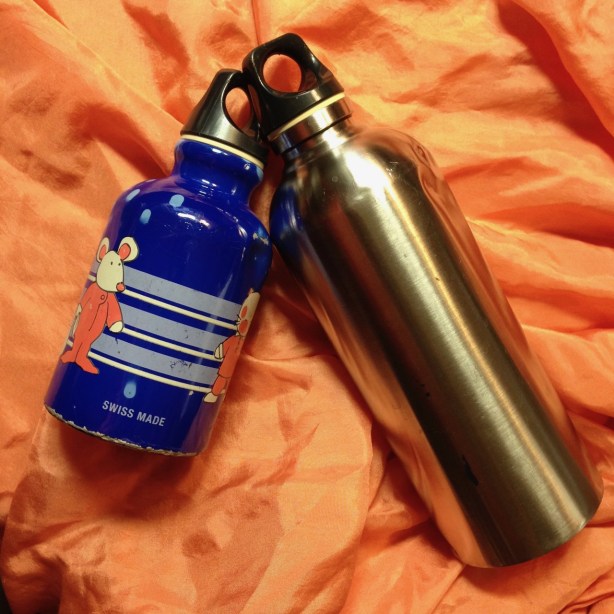
I had chosen one of our smallest water bottles to lighten my load, and I’m so glad I did. Mine was a child’s 0.3 L aluminum Sigg bottle. There was less volume of liquid available to inundate my Cafe Bag.

This is also another opportunity to tout the advantages of heeding Douglas Adams’ advice**: always travel with a towel.Mine is a small, personal sized Pack Towl. I like to blame the kids for it being constantly in use, but any person with a water bottle and electronics in the same bag should consider such an absorbent accessory cheap insurance.

Buy Tom Bihn bags because they are designed–nay, engineered!–for real-world travel. They’re also made in Seattle, Washington USA and ultra light yet super strong. Also, you’re going to be at least as prone to wayward dribbles in flight as you are in mid-adventure. Pack like it!

Tom Bihn gear is tough enough for everyday people who scoop up the cheap fares in crappy seats to travel more often; Tom Bihn luggage is for folks who carry their own bags.***

By the way, the bags hold up equally well to containing pickle juice when traveling by automobile. Ahem.


*
Might amuse the audience to know that DH requests that, if I must travel so often, I at least commit to wiping down my seating area with disinfecting wipes every time. I carry the kind for hands, such as Wet Ones, when I travel, too. And also alcohol swabs and lens cleaning wipes. If there’s a wipe for it, I’ve probably got one in my bag, or at least in my car. We’ve established that I’m a messy person and a mom, right?

** Hitchhiker’s Guide to the Galaxy, a very funny novel

***Full disclosure: I’d actually prefer to have someone else carry my bag, but I endeavor to pack such that this is a delightful luxury, not a physical requirement.

Such a simple solution: cold feet cured with a double duty metal water bottle

A hot water bottle by one’s frigid feet is a classic winter comfort. If you suffer from ice cubes for toes and haven’t yet discovered the joy of this simple but effective warmer, do try one as the nights regain their chill.*

Here’s a so-simple-it’s-silly solution to the same problem in an overly air conditioned hotel room or when encountering unseasonably cold weather camping:

Use a refillable/reusable metal drink bottle full of hot water as a bed- and foot-warmer. Consider it a more petite cousin of the old-fashioned rubber hot water bottle you could pick up at a pharmacy.

Sigg water bottles - 1

Swiss made aluminum bottles by Sigg, well used for almost a decade; dented, but still leak-free

Fill your bottle from the coffee machine (run it without coffee in the basket), the hot tap in the bathroom, or even use water you’ve heated over a campfire. I’ve tapped all of these for fuel to fight freezing feet. Just pour carefully as your source water gets hotter.

Esbit stove hot water - 1

If you have to heat your water this way, allow lots of extra time before bed…

Make sure your bottle has a tight-fitting, secure lid that won’t come loose inadvertently and soak your bed! I like flip top lids for daily use, but I only travel with bottles that include sturdy screw caps. I also routinely carry a small but super absorbent PackTowl in the same pocket of my pack to catch small leaks and drips before they threaten my papers and electronics.

Sigg metal water bottle in PackTowl - 1

PackTowl Personal model in Face size 10×14″ 0.7oz (25×35 cm, 21g)

Consider slipping the warm bottle into a sock (or a spare pillowcase) for insulation. This is vital if you’ve used scalding hot water. You want to avoid burns. Also, as the bottle cools, it will become a less cozy object to encounter. Don’t startle yourself awake by kicking a hard metal tube in the middle of the night.

You could just carry a traditional rubber hot water bottle while globe trotting. From my perspective, though, they are too large to include in a carry on travel bag. At around 12 oz, they’re also fairly heavy.rubber hot water bottle - 1

A rubber hot water bottle is a single task item. Those of us who enjoy traveling with fewer encumbrances often seek out smaller, lighter, and multi-functional gear for trips. I take no small measure of pleasure in the coup of finding tremendous extra benefit from something I was already carrying.

I always bring my own drinking water bottle to fill post-security at the airport to avoid both disposable plastic bottles and the exorbitant prices at the gate area kiosks. At home and on road trips, we have a water bottle in the car for every family member. Now, I’m simply specifying a particular bottle that can serve an additional function, and I’m a lot more comfortable for the effort.

Gentle heat, thoughtfully applied, can also provide soothing pain relief for some conditions, like my joint pain. It’s hard to overstate the value of something like that to anyone with a chronic condition that’s exacerbated by travel.

There’s just one problem that I’ve discovered with this clever solution: my family has caught on to how I’m using my bottle to warm my bed. The kids give me sad eyed looks and tell me their feet are cold! If you’re traveling as a family, it might be best to upgrade everyone’s drink bottle to a sturdy stainless steel model with an excellent lid.

Your cold feet will thank you, even if the kids don’t.


*If you’re like me, your cold feet may recur regardless of season or outdoor temperature, which is what prompted me to begin writing this post in August!

Go camping with less commitment: 3 steps to get started without spending a fortune

Let’s say you’ve heard of this camping thing, but you haven’t tried it. Perhaps your family camped when you were young, but you didn’t take notes while your parents pitched the tent, and didn’t their stuff fill half the garage? Maybe you’re interested in the benefits of forest bathing, but you don’t have any gear.

Do you have to spend a month’s salary at REI to make a foray into the wilderness experience?

No.

Camp Coleman Instant Tent 6

Tent

Here’s some really simple advice for taking a relatively comfortable first camping trip.

Begin with the basics:

  • Shelter,

  • sleep,

  • food.

You’ll be miserable if you miss any of these big three, but they needn’t be complicated or expensive to manage.

Find a campground that will serve your needs

Before anything else, choose the season and location where you like nature best. If you can’t get enough of hot weather, go at summer’s peak to a sunny site; if you prefer shade and moderate temperatures, aim for a wooded site early or late in the camping season.

You already know what kind of climate you prefer. Let that information inform your decisions about when and where to camp.

If you’ve never camped before, you may be surprised to learn that there exist very rustic campgrounds with almost no facilities at all. That means pit toilets or burying (or carrying out!) your own human waste, and bringing every drop of water you’ll require with you from civilization (or treating water you find on site to sterilize it.)

On the other hand, some may be equally surprised to realize that many campgrounds provide amenities like electrical power, water, and cable TV right at individual sites for compatible trailers and RVs.

It is relatively easy to find campgrounds with hot running water in the communal bath houses. Note that you may have to insert quarters every few minutes for a hot shower.

Most public and commercial campgrounds have shared (cold) water spigots and basic toilet facilities, all within an easy walk of your picnic table. Almost all sell firewood on site since this prevents the spread of woodborne insects that infest local trees. Some have a convenience store or a coffee shop.

It pays to carefully read the description of your chosen campground’s amenities. Most have a ranger or manager who will be happy to talk to you about what to expect before you make your first reservation. Make use of this free resource, because these are usually people who love camping and can’t wait to share the great outdoors with a newbie.

You don’t have to hike for miles carrying everything on your back in order to enjoy nature. That’s a great experience to try, but not one I’d recommend undertaking alone or without some practice car camping.

Car camping means driving right to your campground—and often into your own dedicated campsite—with your own vehicle hauling as much as you want of your own stuff.

Shelter

If you’ve never camped before, I’d advise looking into state campgrounds that offer rustic shelters in addition to tent sites. Some private campgrounds may have these, too, but my experience veers toward public lands.

These vary from log cabins to semi-permanent tents, but they do almost guarantee protection from sun and rain.

Don’t expect a bathroom or kitchen or any running water at your site. More often, you’re reserving a glorified tent, possibly one with rustic bunk beds. Read the site description carefully so you aren’t surprised, and expect to do your cooking outdoors and your toileting and bathing in communal facilities nearby.

You may (or may not?) be surprised to learn that reservations are made much like those for hotels or flights. These days, that means online as well as by phone. Check out Reserve America to see what’s available in your area. Some states may use their own proprietary reservation systems; if you’re interested in a particular park, find its website and follow the links.

Costs are higher to reserve a shelter instead of a nearly empty tent site with just a picnic table and a fire pit, but you will still spend much less than you would for hotel rooms. A yurt at one Oregon state campground costs $44 per night; a tent site is $21 per night. At a Vermont state park, a lean-to starts at $25 per night while a tent site is $18+.

Erecting a shelter that will stand up to wind or rain is probably the trickiest step involved in camping. Skip it entirely for your first trip, and you can get a good sense of whether you enjoy the basic experience, especially if mother nature throws any “interesting” weather your way. You also won’t have the expense—or storage issue—of a bulky tent you might not use again.

I think there’s value in learning new things, but there are others you can concentrate on right out of the gate. Properly siting a tent involves evaluating the ground, remembering a number of steps, and tying clever knots. If you’re willing to invest your time in these skills, renting a tent is an affordable option.

Sleep, don’t suffer

Some people will sleep undisturbed on the bare ground with a simple bedroll; most of us won’t!

It’s absolutely possible to bring regular bedding camping, but sleeping bags are the gold standard for a few reasons. They are compact and easy to re-roll and pack. They keep you warmer because they your body heat gets trapped within their enclosed confines. They are sold with easy to compare temperature ratings printed right on the tags giving you a vital clue as to which one best suits your trip.

Borrow, buy, or rent an appropriate sleeping bag for your climate. It is unwise to skimp on this vital piece of kit. Err on the side of a somewhat warmer (lower printed temperature rating) bag because you can unzip it if you get too warm, but getting too cold in the wilderness is a real safety threat.

The threat is less in a campground with facilities, your vehicle, and many people nearby, but it’s best to respect nature’s power from the get go. Never leave civilization unprepared for keeping yourself warm in the given climate! Maintaining your body temperature can be a matter of life or death.

This is another time to know thyself. If you tend turn off the heat at night in winter and sleep with your feet sticking out, you may want a less insulated sleeping bag. If you’re the one who puts freezing cold footsicles on your partner in July, buy a warmer one.

In addition to one sleeping bag per person, bring a sleeping pad or air mattress for everyone, too. You might be the rare soul who doesn’t feel the rocks and twigs. Go ahead and try stretching out on the ground one night, but have at least a little cushioning available in case you want it.

If you’re over forty, consider investing in a “deluxe” level of padding. Many people prefer a softer nest as their joints age.

For car camping, where bulk and weight don’t matter too much, I always include at least one extra foam pad with my camping supplies, even when we intend to use self-inflating or standard air mattresses. Air mattresses spring leaks at the most inopportune moments. Without a backup mat, I would probably choose sleeping in my car over directly on the ground. Foam mats are cheap, often less than $10. I can’t think of a single serious downside to layering an extra piece of foam beneath any and all other mattresses.

Bring at least one old blanket (or a new one that’s sturdy, thick, and washable.) Wool is the classic material; fleece is a cheaper, less allergenic modern equivalent in all ways except flame resistance. Layer it under you if the ground is too hard, over you if your sleeping bag isn’t warm enough, and fold it to cushion the picnic table bench if you get tired of rustic seating. Curl up in it while you stargaze around the fire after dark.

If you enjoy a throw blanket on the couch at home, you’ll absolutely adore it when the temps drop at night in your campsite.

Eating—and cooking and washing up—alfresco

A camp kitchen can be extraordinarily elaborate, or incredibly simple.

Chuck box deployed state with equipmentS

My camp kitchen gear, assembled over more than a decade of trial & error

For a first timer, even one who loves to cook at home, I would recommend starting with a minimal investment in specialty gear.

If you’re bringing perishable food, you will require a cooler. Hard-sided coolers keep ice longer than soft-sided. Larger coolers are more efficient than small ones. If you can buy ice locally near your campground, these concerns are less vital.

One good tip is to eat your most perishable foods at the beginning of the trip. Food poisoning will ruin any experience. If you’re unsure how to keep fresh food at a safe temperature, bring only commercially packaged, shelf-stable items. There are plenty of options.

Consider pre-packaged backpacking meals that are reconstituted with boiling water, or dead simple preparations like meat cooked directly over the campfire. Baked potatoes wrapped in foil are a great accompaniment, can be eaten right from their wrappers, and need very little clean up. All campsites I’ve visited have had at least a fire ring, and most of those also included a grate for cooking or supporting a (fire safe, such as cast iron) pot over the fire.

Remember that if you are bringing reusable dishes or utensils, you will also require a basin in which to wash them and a means of heating a large quantity of water. That’s fine, but it may not be obvious when you’re used to hot and cold running water. You should also make sure the dish soap you plan to use is biodegradable so it doesn’t damage the natural environment you’ve come to enjoy.

A brief camping trip may be the time to be less environmentally conscious and use some disposable items. I like a balance of washable items where they count (sturdy flatware and sporks, plus rigid handled mugs for hot drinks) with paper plates for eating sticky or greasy meals (going into the fire as tinder the next day.)

I’m lazy, so I try to wash dishes only once per day while camping. Carrying and heating water can be a really big chore. Don’t underestimate the effort required for this one.

On the flip side of this issue, never leave dirty dishes or food outside overnight. You’ll wake up to a huge mess made by the nocturnal creatures who enjoyed the “buffet.” Pack food and garbage away in your car overnight (or into provided receptacles if so advised by the campground.) This is both a hygiene and safety issue. It’s also harmful to wildlife.

Esbit stove in front of fire - 1

Esbit stove with folding-handle cup heating water

I wouldn’t plan more than a few hours in the wild without at least the means to boil water. My most basic method is a very inexpensive folding stove that takes small cubes of fuel ($11 on Amazon today, or $13 at REI.) This would fit in any backpack, and many pockets. I bought this and the folding-handle metal cup (~$10) before I had a family to feed, but I still use it to boil the water for my morning cup of tea if I’m the first person awake at a campsite.

There are many other small, simple backpacking and car camping stoves for sale with various learning curves, features, and downsides. I begin with the Esbit because I think it is foolproof and a bargain. I also own and like a JetBoil backpacking model (around $100) that uses fuel cans, and a Kelly “Storm” Kettle (~$90) that burns twigs and locally sourced brush. The Kelly Kettle is my favorite to use when multiple adults want hot beverages and there’s no call for a full campfire.

Taking the plunge ~ how many nights in camp?

The final consideration is how many nights to spend on your first outdoor overnight. Though I advocate moderation in most things, I would recommend at least a weekend (2 nights😉 a three day weekend (preferably not on a holiday) is even better.

Arrive relaxed on a weekday—or by midday Friday. This is much, much better than setting up camp while tired with the sun going down.

Give yourself the benefit of lots of time, energy, and daylight to prepare your first campsite. This holds even more true for families with kids!

Don’t arrive starving unless you picked up a prepared meal to go. If you plan to cook over a fire, it will need time to burn down from high flames to useful, glowing coals.

Even a simple campsite can feel like it requires a lot of setup. New equipment requires a learning curve, adding to the perceived effort.

I’ve heard this from friends, and I feel the same myself: you might as well set up camp for a week as for a weekend. It’s the same amount of work. You just bring more food.

If you manage a successful and enjoyable camping weekend, try a longer trip the next time. You’ll probably agree that the rewards for the effort feel much more substantial.

Don’t forget to invite your friends. Sitting around a campfire in great company under the stars is one of my greatest pleasures. I hope you find the same to be true for you.

Camping friends - 1