Lunchbox life saver: Weck glass storage jars paired with Thermos insulated containers

Some small tweaks in behavior can eliminate daily annoyances. One of those, for me, was the switch from storing leftovers in miscellaneous containers to using glass canning jars with narrow necks made by Weck.

What makes a glass jar revolutionary?

The mouth of a Weck ¼ L Cylindrical Jar (neck opening) nestles perfectly inside the rim of a Thermos insulated jar. It also holds just the right quantity of food to completely fill a 10 ounce Thermos.

I can microwave leftovers in their storage container (Weck jar), then simply invert the jar over the Thermos to quickly and neatly transfer the warmed food.

My old method was messy & inefficient

Before, I would transfer a serving size portion of leftovers—judged by eyeballing the quantity—from a larger Pyrex storage container to a plate. I’d re-heat the food, then fill the Thermos from the plate. Unless I took the extra step to measure out the serving of food, I routinely over- or under-estimated how much mass on a plate would precisely fill an insulated jar.

Or, I would store single servings in plastic containers, but then I would need to dump the food onto a microwave safe dish before re-heating.

We don’t heat food in plastic because of the potential health risk of leaching toxins. I prefer not to store food in plastic for the same reason, though I’m not zealous enough about the subject to avoid it when there’s a real danger of broken glass.

In either case, I also had to spoon the food into the Thermos after heating. That usually resulted in at least a little spilled food and a greasy mess on the outside of the lunch container. Remember, hand-eye coordination is not a particular strength of mine. My arthritis also means morning stiffness in my fingers, further reducing my competence in the kitchen, especially during the before school rush.

Objective improvements thanks to Weck jars

Here’s a list of functional improvements I can attribute to my switch to storing individual servings of leftovers in Weck jars:

  • less wasted food
  • no dirty measuring cup and/or
  • no dirty plate used for re-heating
  • no dirty spoon used to transfer
  • no dirty kitchen counter from spills
  • less frequent cleaning of lunchbox interior from carrying greasy Thermos

More subjective benefits

Though I tend to put function first, the intangible benefits of this new storage and food transfer solution have also made a big impression on me.

Glass jars are beautiful

I debated whether this should be reason number one, but it’s too easy to overlook little changes that bring a lot of joy to everyday life. Beauty is one of those.
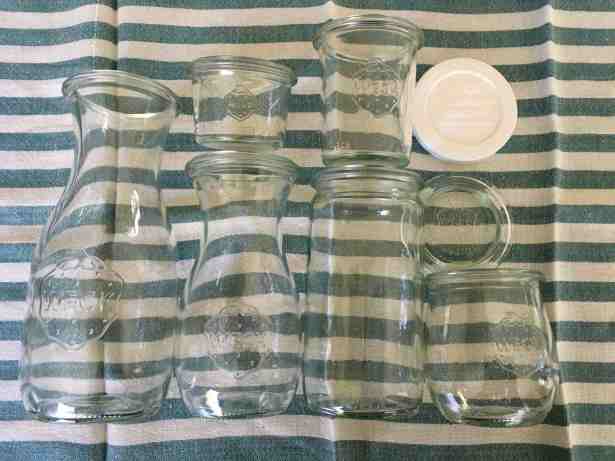
Weck jars lids narrow neck - 1

L to R: ½ L Juice Jar; 080 Mini Mold Jar over ¼ L Juice Jar; 760 Mini Mold jar over 975 ¼ L Cylindrical Jar; plastic storage lid, glass canning lid, 762 1/5 Jelly Jar

Even with my lackluster photography, Weck jars make a pretty picture.

I originally bought a set of three of the ½ L Juice Jars from a fancy kitchen store at an exorbitant price. I had a functional use for them, but I also just loved them. Aside from looking nice, the juice jars, in particular, are sized to feel great in the hand while you hold them.

Compare these two views:

Though both cupboards store functional kitchen equipment I use every day, it should be obvious which items I store in a closed cupboard, and which are stored in plain sight.

Made in Germany, meant to last

Americans who aren’t familiar with the German manufacturer, Weck, should know that these are canning jars. Consider this a European equivalent to our Ball or Kerr canning jars.

The difference, and, again, what makes these so perfect for use with a Thermos, is the size of the mouth of the jar. You want a jar with a 2-3/8 inch opening to mate with a Thermos. Weck also makes wider mouthed jars more similar in diameter to the mason jars used in the USA, so check the size carefully before you place an order.

Because these are canning jars, they are made of thick, strong tempered glass. They were designed to be immersed in boiling water as part of the canning process, then stored for long periods to keep food fresh. They are sturdy.

They are microwave and freezer safe, and I routinely use them for both.

Avoid sudden temperature changes when using glass, and allow room for expansion when freezing liquids. Weck jars are sturdy glass, but any glass has the potential to break if mishandled.

Standardized sizes for sensible accessory storage

I realized years ago that buying a set of containers with interchangeable lids works much better for me than a bunch of disparate sizes. I am reasonably good about tossing a container that’s lost its lid, but why run that risk in the first place?

To keep up with the packed meal demands of my family of four, I own six Thermos insulated jars in two sizes, all of which use interchangeable lids.

Though I’ve now expanded my Weck jar collection to include both 2-3/8 inch and 3-7/8 inch diameter sizes, in both cases I can always order extra lids to replace any that are lost or mangled. The jars are somewhat expensive, but the plastic lids are very reasonably priced.

One less thing to worry about

A canning jar won’t change your life, but, if your family carries packed lunches, it might remove a moment of stress from typical mornings. In our household, that’s one of the busiest—and most stressful—stretches of the day.

And, after all, is there any more beautiful way to store your jelly beans?
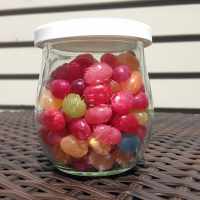
Weck jelly beans

Spit it out! Memorizing phrases & the parroting process for improving foreign language fluency

Rote memorization won’t make you a fluent speaker of a new language, but it can be a powerful tool for increasing your foreign language fluency.Pimsleur

You often resort to routine phrases in your native language

Imagine this common scenario.

You’re hurrying into a familiar place, surrounded by people you know. Someone asks casually, “Hi! How are you today?

Most likely, you answer without a thought:

Fine, thanks.”

You answered with a learned response. You weren’t engaging the higher functions of your complex brain and its multiple intelligences. You went by instinct. That’s rote.

This kind of verbalization isn’t going to make you a master public speaker. It isn’t the rich, nuanced stuff of great oratory or literature. But words and phrases like these make up a huge proportion of the words spoken every day.

If you cultivate your knowledge of simple, canned responses to common questions and scenarios in a target language, you can really accelerate your comfort with speaking and your eventual progress toward fluency.

Fluency only comes if you actively use the language

I’ve always been a good student. The strength of my short term memory and my classroom skills made it fairly easy for me to get good grades in high school and university classes in Spanish and German. In spite of this, even after years of study, I was nowhere near fluent in Spanish, though I could read written materials fairly well.

By contrast, in only one semester of purely spoken Japanese taught by an immersion method, I learned a handful of phrases that stick with me in their entirety (and at full speed) to this day.

After that course, I never studied a language the same way again.

Do you intend to read, write, or converse in your target language?

Before Japanese, I improved primarily in the area of language my classes tested: reading and writing.

Sure, the students in my classes engaged in dialogues, but these were a small fraction of the time spent, and conversational skills were almost never on the test. With 15 pairs of high schools students talking to each other simultaneously, ostensibly in Spanish, there was no way for the lone teacher to notice—let alone correct—errors, omissions, or even a total failure to complete the assigned dialogue.

If your interest in acquiring a new language is to read, say, Descartes in his native French, or Don Quixote in the original Spanish, the American classroom experience may serve you well. For everyone else, read on! Continue reading

Blessings by the minute, from the playground into sleep

By school pick up time—around 2:30pm, so hours before many people even think of finishing their days—my reservoirs of energy are nearly empty. What used to be an afternoon lull is more often, now, my afternoon collapse. It’s the most persistent and insidious symptom of my autoimmune condition.

Afternoon delight? Fugeddaboutdit!

The work of a stay-at-home mom may include some flexible hours, but school pick up time is not among them. The kids are done when they’re done; someone needs to go get them. There are a few dads driving up in the daily rotation, but most chromosomes in the car pool lane are XX.

Add me to that list of who’s who.

playing outside - 3

Outdoor “play equipment” doesn’t have to be expensive or complex

One of the things I like best about my son’s school is the emphasis placed on time spent playing and learning outdoors. They aren’t quite as adamant about it as our preschool was—there, kids went out, rain or shine, unless there was a truly bitter freeze or risk of lightening strikes—but the value of free time, active play, and exposure to fresh air and sunshine is respected.

So, while I’m often running on fumes by 2:30pm, I bring a book, I pack a thermos of tea or an appealing snack, and I just generally prepare myself for a comfortable wait so my little guy can stay longer with his friends and play even more after school. It may only be a half an hour, but what a precious 30 minutes for a kid.

I’ve read that child’s play is currently endangered. I tend to agree that this is a grave loss for the kids in question and society overall.

On a beautiful spring day, it isn’t much of a sacrifice to allow this time for my child to release some of that seemingly boundless energy. My arthritis doesn’t flare as often on moderate days, lessening the cost of pain. In the absence of rain, I can move around and avoid getting stiff from sitting in the car. I get to socialize today, too, with other moms and some lingering members of the school staff, all of whom take advantage of the beautiful weather to linger outside.

DS2 and his knot of friends are involved in a complex dance of running, falling down, enacting simulated agonies, then jumping up to do it all over again. Some of the girls join in at times, weaving themselves into the game, then drifting away to huddle under a different tree, whispering their own solemn secrets. They start a new adventure by climbing a large, horizontal tree.

playing outside - 2

An admittedly awesome tree, some string, and a lot of imagination sparked this adventure

“Watch out for that poison ivy,” they advise me when I come closer to take a picture. After confirming I’m not there to take my son away, they quickly re-submerge in their play. They stop only when a preponderance of mothers appear, all ready to go home.

There seems no possible sweeter moment for me, as a mother, than this one, until later, after a tick check and bath, after dinner, after fun, when the little guy is lying asleep nearby and I’m restless and reflective. His breathing is deep and even with no sign of the nocturnal asthma that sometimes harries our nights.

No doubt the fresh air and tree climbing contributed to his deep, peaceful slumber, even as the memories of the same disrupt mine.

He’s so big, now, my little boy, but still so very small. My love for him swells in my breast like a wild thing rearing up to escape its confinement in a cage. It is ridiculous how much I adore this child. I’ve always found it easier to really notice this while he’s quietly sleeping.sleeping - 1

The night air drifting in the window is still soft and smells of spring. Many hours remain for slumber, and there’s more play in store for tomorrow. It’s time to tuck this unbridled passion for a silly little boy and his winsome ways away, and attend to my own dreams.

A cold shoulder was my shorthand for “I hate it when you leave”

We all have behaviors that we’ve not so much chosen as assumed. One of mine was pointed out to me years ago by my beloved spouse.

DH observed:

“You always pick a fight with me before I travel.”

He was completely right.

Once this behavior was drawn to my attention, I gained a measure of control over it. Now, on the evening before DH leaves for a business trip, I don’t pick a fight about how one ought to load the dishwasher or the correct position for the lid of a toilet not in use.

Instead, I cling to him almost desperately, and whisper sadly:

“I hate when you go. I want to punch you. I love you.”

Note: These are just words of frustration. Families should not hit each other.*  If your family hits you, please get help. Call the police.

Even wallowing in awareness of my reluctance to part, and fully cognizant of my tendency toward easing the transition through verbal aggression, I still need to express it.

At least now, this expression has joined the ranks of our commonly understood, odd, humor-filled scripted interactions.

“I’ll miss you, too,” DH says. “I wish I didn’t have to go.”

He hugs me tight and gives me the reassurance I’m tacitly requesting.

DH doesn’t always speak my language, but he’s gotten pretty good at interpreting it.

Someday, perhaps I will evolve even further. I may yet grow into a kinder, gentler person who doesn’t feel angry—and find a need to express that anger through nitpicking fights or unpleasant words—when confronted by the temporary loss of my love.

He’s my best friend. I hate it when he goes away for even one night.

That’s probably what I should learn to say instead.


*There is some physical contact that is perhaps best described as martial arts practice in our family. That requires the explicit, stated participation of all parties, and is only supposed to occur in our exercise room. None of the men in the household seem capable of confining their wrestling to the gym, but it is the rule, for the benefit of the furniture as well as the safety of the combatants.

Books by my bedside 2017/05/23

I’ve noticed that I often bring up in conversation one or more of the fascinating books I’ve been reading lately, only to fail utterly at recalling titles or authors’ names. I’ll take this opportunity to at least have a handy reference available for anyone who cares to follow up on something I’ve said.

Just check my blog!

Non-Fiction

Economics, history & politics

Why Nations Fail : the origins of power, prosperity, and poverty by Daron Acemoglu

Gaming

Dungeons & Dragons Starter Set Rule Book

Dungeons & Dragons Starter Set: The Lost Mine of Phandelver adventure book

Language

German I by Pimsleur (audio CD)

Math & technology

Gödel, Escher, Bach : an eternal golden braid by Douglas R. Hofstadter

Fiction

The Great Passage written by Shion Miura, translated by Juliet Winters Carpenter (note: this was a freebie from Amazon for being a Prime member)

My Kind of Crazy by Robin Reul (Young Adult title)

Thirteen Reasons Why by Jay Asher (Young Adult title)

Reading Notes:

Preparing for a role playing game is all consuming

I found a few sleepy moments to finish the latest installment in my before bed brain candy mystery habit (J.D. Robb’s futuristic series about Eve Dallas), but managed very little additional pleasure reading this week.

I haven’t found the motivation to finish Thirteen Reasons Why, but I started My Kind of Crazy. I was hoping it would be a little more cheerful. Young Adult and Children’s titles can be very relaxing, but these both tend more into “youth at risk” territory. It takes more energy for me to read something distressing.

My Kind of Crazy feels like it could get amusing, but it isn’t yet. It also read like a book about a boy written by a woman. I checked the author’s bio, and, yup, Robin is a woman. I’ll keep reading and see if my opinion shifts.

Starter SetMost of my free time last week was spent prepping for running a Dungeons & Dragons game session that morphed into two evenings of play. It’s not strictly reading, though there are about 100 pages of information with which the leader (DM) should be familiar. So I read through it, then made some notes, then read some parts again. After the first few hours of game play, I also printed out some cards to help me keep track of every individual character.

Thus far, my experience as a D&D DM feels like an exercise in office supply logistics.