
Assessments used to measure the progression of autoimmune disease—like the one I live with—often include questions about how symptoms interfere with daily life. When arthritis afflicts the small joints of the hands, sufferers like myself experience the perils of managing common fragile objects.
Case in point: the demise of a demitasse cup I used every day.
This cup was a gift from my mother who passed away in 2019. Today, I fumbled it while loading the dishwasher. It cracked when it hit the counter, one corner crumbling to bits, then continued on to finish shattering against the tile floor.


R.I.P. Starbucks “You Are Here: Oregon” demitasse cup!

My favorite vessel for my daily shot of espresso joy is hardly the first victim of my less-than-nimble MCP and PIP joints.
There’s a particular glass pitcher I use to refill my beloved Zojirushi countertop hot water boiler.
Because my hand slipped perfectly between the pitcher’s handle and body when my joints weren’t swollen, it was my yardstick for physical manifestations of arthritic flares. Swollen, the knuckles—where the base of my fingers meet my hand, or, less often, even the middle joints of my fingers—were too thick to slide into that same space. It made me feel less crazy to have confirmation that my symptoms were real,* physical, and not “all in my head.”
One clumsy morning, I bashed the handle off the pitcher as I maneuvered it between faucet and kettle. Somehow, I managed to rap the fragile handle against the edge of the counter as I lifted it out of the sink.
The result is a far less useful, slightly sharp nub on an otherwise pretty jug: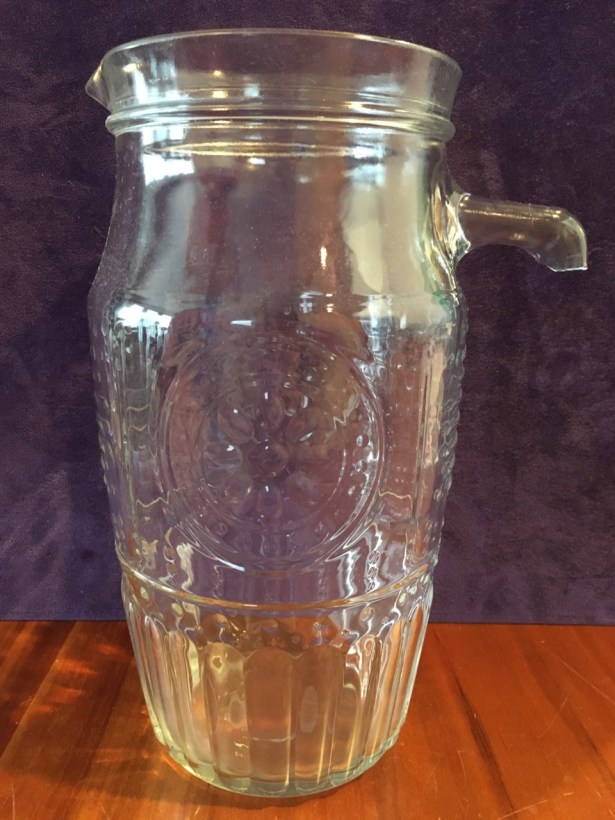
It was such a lovely pitcher, I still use it—though with even more care—for the same task. The vessel just can’t serve its secondary medical alert function anymore. Also, it is rather trickier to keep a hold of, so I tend not to fill it full to keep the weight manageable.
In the grand scheme of things, these are trivial losses. My hope in sharing this story of small failures is to illuminate—for those fortunate enough to enjoy fully able bodies—another of the small daily battles waged by someone living with even minor infirmities.
They take a toll. They have a cost.
Living in a world designed and built to be adequate to your needs—which is the happy reality healthy people inhabit—is extraordinarily convenient, yet easy to overlook until some change in one’s own status lays bare every discrepancy.
♦
* For many patients with conditions that can’t be definitively diagnosed by simple tests like blood work—especially when the complainant is a woman or a person of color—it is common to feel, if not to be, dismissed as a mental patient instead of acknowledged as the unlucky sufferer of a valid physical ailment. A recent BBC story describes how even physicians with disabilities are greeted with suspicion by the medical establishment.

 I’m extolling the virtues of the Segway today because I live with chronic pain as part and parcel of an autoimmune condition. Aside from arthritis, I also broke a bone in the sole of one foot many years ago… and now it feels like I’m always walking with a pebble in my shoe. I.e., annoying
 Some people think Segways are goofy looking toys for nerds; others consider them a sidewalk nuisance that should be banned. I’d guess most of those people are fully physically able and have no idea how poor the options are for those who aren’t.
 Really Wonderful Things