
Where do you, personally, draw the line between infrastructure and socialism?
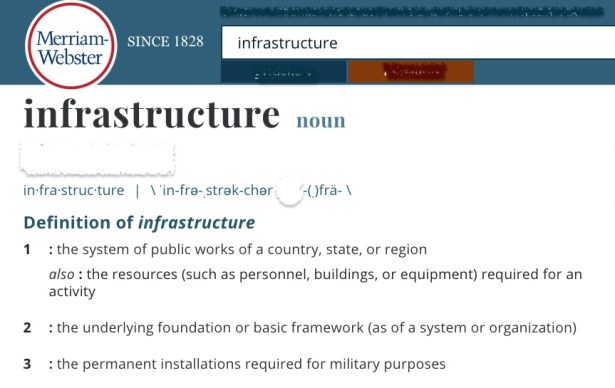 I ask this sincerely, with no desire to engage in polarized internet snipe-fests, but in the spirit of attentiveness to what government services various individuals might deem “necessary” and which are “overreach.”
Even more interesting than the what, is the why.
Only deep ignorance of history allows one to pretend there’s anything universal about this question. Our republican forebears in Rome—whose architecture we aped in the United States capitol in part due to the Founding Fathers’ lionization of that civilization—prioritized very different governmental interventions than we do today.
Proving myself, as always, a true dilettante and no real scholar, I’ll begin by pointing to a series of mystery novels† that I read years ago. They turned me on to a startling fact: the ancient Romans had no police force.
 Rome, civilization par excellence, did not feel that it owed average citizens the protection of civil police. The military kept order to an extent that suited the needs of the state, but there was no one to call when your silver was stolen. It wasn’t until the great republic became an empire that Augustus formed the Praetorian Guard in 27 BCE… to protect himself.
And all this in spite of the fact that the Ancient Greek city of Athens had seen the nascent formation of a police force (c. 400 BCE) to keep order and arrest and manage prisoners using publicly owned Scythian slaves. Investigating and detecting crime, in the ancient world, was the responsibility of individual free citizens.
So, is a police force a basic piece of infrastructure, a right that should be available to all, or is investigation and detection by paid government agents an imposition against individual freedoms as the Romans seemed to believe?
In spite of our turbulent times and the fraught political environment, I’ll admit it: I think this is a fascinating question. In a democracy, it is, in fact, the duty of every citizen to ponder these essential assumptions.
Do modern American people on the right and on the left really have such different ideas about what a government ought to do, or are our differences more about degree and descriptive nomenclature?
 Rich kids will continue to stumble into lucrative careers because they have the right connections. Average kids, and
  Earning a college degree has held, thus far, as a predictor of higher pay, but for how long? When students are enrolled only because “college is the next step after high school” vs. following an interest in deeper, more focused study of something specific, the
  Really Wonderful Things