Are dreams our final visits with the dead?

Within a few days of my mother’s death, I dreamt she was was puttering about in the room where my children slept. We stayed with my father for almost a month after her passing.

“Shh… Mom!” I told her, “the kids are sleeping. Don’t wake them up.”

I was fussing helplessly, impotently, about the orbit of her flurry of productive activity, unable to deter her from her appointed rounds.

And though she finished putting away their laundry—in this dream, so keenly reflecting the fastidious, caring life my mother lived—those sleeping cherubs did not wake up… until one did.

But the sleep-confused boy, even in the dream, could not see my mother there. He reacted only to me, and with mild confusion.

“What’s the matter, Mommy?” asked my baby-almost-grown-to-manhood, before drifting back to sleep, unaware that Grandma was calmly finishing her work within an arm’s reach.

Even in my dream, the truth remained evident. My mother was gone from this mortal coil. No matter how high the heaps of unwashed clothes, nor the number of days that beds remained un-made, Grandma would not be back to re-affirm the self-defined borders of appropriateness within her last home.

We were on our own with our mess, and the loss of her. My mother was dead and gone, and I knew that…

And yet!

My Mom saw me at least once in her last living days, her sight clearing for a moment while she looked straight at me, telling me, “I love you!” She said my name. She saw me.

The fog of cancer lifted for a minute; her gaze was clear. She seemed purely coherent then, contrary to recent history. My mother said good-bye when she got the chance.

I believe that was her last full day drawing breath, but I don’t really trust my memory for the time. In my recollection, I was the little girl, the smallest in her class, headed off to Kindergarten with her Snoopy lunchbox in the white dress Mom had picked out, red-tipped, with red leather shoes to match.

That’s what I thought Mom saw.

One moment took me back that far.

She’d been mostly not-quite-present for awhile, by that point, but I knew she was fully aware when she said farewell. I believe she was knew it was time to say a final goodbye, though I resisted that knowledge in the moment.

A few days ago, my mother again visited my dreams. It’s been about two years and eight months since she died.

In the dream, Mom was driving a large SUV.

While not her favorite vehicle—that would be a powder blue, late model Chrysler New Yorker sedan dubbed Gwendolyn, by me with navy blue leather upholstery, of course!—going somewhere by automobile suits my mother perfectly. In this, she was like other Baby Boomers.

Cars were a symbol of freedom and status for her generation!

In my recent dream, Mom had her head out the window as she navigated much too closely up to the window of an imaginary fast food restaurant. The part where Mom leaned out the window is wildly out of character, while the rest fits.

Though never explicitly stated, it was pretty evident she was there for ice cream. I don’t for the life of me believe she’d venture back for a burger, but for vanilla ice cream with chocolate sauce, and maybe a few sliced bananas?

“Watch your head, Mom!” I called. I was sure she’d knock herself senseless against the window boxes—standing like escarpments—surrounding the drive-up window of my dreams.

As in real life, Mom barely seemed to register my concern, carrying on according to her own plan. I’m not really joking when I describe my mother as a force of nature in her polite, petite way.

I woke up in the morning reassured by this “visit” with my mother.

A few days—maybe a week—onward, all I can say is, “my mother came to visit. She was checking in on me.”

It was probably just a dream.

There’s likely nothing more to it.

And yet…

And yet.

If you’ve lost someone, I pray that you find them again, if only in your dreams.

Playground rhymes for our troubled times

Do you remember that little song from the playground game, “Ring around the Rosie” from your childhood?

Ring around the rosie,

A pocket full of posies.

Ashes, ashes:

We all fall down!

Now, I wonder if you learned– even as a child, like I did–that this nonsensical-sounding ditty dated back to the bubonic plague decimating Europe’s population in the Middle Ages.

It turns out, the Black Death explanation is apocryphal and didn’t appear until the mid-20th century. Even so, the notion of kids taking notice when the world seems on its way to Hell with an oversized hand basket strikes me as accurate.

I haven’t got a COVID-19 rhyme composed for you today, though I’m now tempted to try my hand at one.Map of Mariupol, Ukraine generated by cell phone GPS app

I did, however, have a politically motivated stab at nasty name-calling in verse! come together in my mind over the past few days. While imperfect–and my apologies to the masterful teacher Michael Clay Thompson, whose MCT Langugage Arts curriculum I used with my home educated child in very recent years, so that I now have the vocabulary to describe how weak my doggerel truly is in form and meter–my not-quite-best self still prompts me to post it here.

I’d also like to ask if others can do better. Please, post your own rhyme in the comments, or tweet away!

I feel as if every child in the free world should have such poems on their lips these days. With luck, the wind will carry them across borders to those less fortunate youngsters growing up under dictators.

The literal future of human freedom lay presently with democratic nations around the world who must confront the warmongering by Russia’s “elected” leader and would-be-czar.

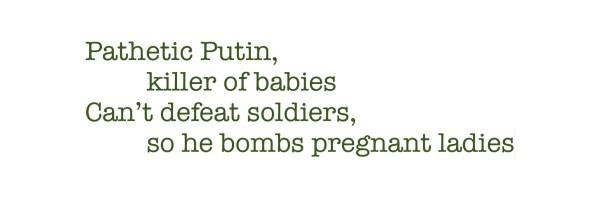
Upon seeing the news report of the bombed maternity hospital in Mariupol, Ukraine, on March 9th, 2022, I brought these words together.

Printed text of verse in historical typewriter font: Pathetic Putin, killer of babies. Can’t defeat soldiers so he bombs ladies

I debated posting something so mean-spirited. It goes against the very nature of this blog. Really Wonderful Things tries hard to be a bringer of light, and a force for good, human and wildly imperfect as its author is.

“Pathetic Putin…

What is Really Wonderful, however, is my right to comment on politics and politicians. God bless America, and hurrah for my freedom of speech! We are not perfect, yet I don’t hesitate to write these words or share them with the world. I am safe, though I express a controversial opinion, and in strident tones.

…killer of babies…

A miracle, frankly, if you know much of history.

How grateful I am that this is so… for me. How deeply I wish everyone shared in this good fortune.

…can’t defeat soldiers…

What I hope to accomplish by encouraging innocents to chant insults aimed at distant autocrats is the absolute, utter celebration of democracy and representation for the common individual.

…so he bombs pregnant ladies!”

Every school kid should know that such a system exists, God-willing, right on his or her doorstep. Every free person alive should be teaching those children the rights and responsibilities of an empowered electorate.

We the people of free nations owe every other human being, potential and living, our efforts toward sharing our ultimate luxury.

The people of Ukraine have made clear their disinterest in being re-shackled to their former Soviet masters. The bravery of those defending their homes should serve as a stern reminder for all who hear the news.

Representation is an inalienable right, but it is ultimately a privilege that must be constantly protected from jealous usurpers. The world will never lack for tyrants, in temperament if not in fact.

I stand with Ukraine.

Books by my bedside 2022/February

I’ve noticed that I often bring up in conversation one or more of the fascinating books I’ve been reading lately, only to fail utterly at recalling titles or authors’ names. I’ll take this opportunity to at least make a handy reference available for anyone who cares to follow up on something I’ve said.

Just check my blog!

Non-Fiction

Open copy of unusually wide but short hardcover book Anathema! Medieval scribes and the history of book curses

Autobiography of Janet Frame, To the Is-land (Volume 1) and An Angel at My Table (Volume 2)

Anathema!: Medieval Scribes and the History of Book Curses by Drogin, Marc

Nine Nasty Words: English in the Gutter: Then, Now, and Forever by McWhorter, John

On Tyranny Graphic Edition: Twenty Lessons from the Twentieth Century by Snyder, Timothy

Fiction

Young Adult

Black Enough: Stories of Being Young & Black in America edited by Zoboi, Ibi

Horten’s Miraculous Mechanisms: Magic, Mystery, and a Very Strange Adventure by Evans, Lissa

New Kid by Craft, Jerry

Mystery/Thriller

The Crossing Places (Ruth Galloway #1) by Griffiths, Elly

Maisie Dobbs mysteries The American Agent (#15) and To Die But Once (#14) by Winspear, Jacqueline

Thrice the Brinded Cat Hath Mew’d (Flavia De Luce #8) by Bradley, Alan

Fantasy

A Darker Shade of Magic by Schwab, V.E.

Library paperbacks Darker Shade of Magic and Autobiography of Janet Frame stacked on bedside table with Kindle reader displaying Black Enough book cover

Reading Notes:

Making democracy great again: modern tyranny & WWII’s British endurance of the Blitz

Pardon me while I tie together my candy floss consumption of mystery novels (here, two of the more recent titles in the Maisie Dobbs series) with Snyder‘s On Tyranny. Ms. Winspear, Dobbs’ creator, has shepherded this particular character from the period just after The Great War to World War II and the Blitz. Invasions and bombings in the 1940’s segue tragically well to a slim, topical volume about tyranny released in 2021.

On Tyranny is the first “graphic novel” I’ve read that isn’t… um… a novel. I’d say “graphic non-fiction” would be a better if unwieldy label. These “twenty lessons from the Twentieth Century” present as a collection of illustrated brief essays.

There’s a whiff of Eric Hoffer‘s The True Believer to it.

Artist Nora Krug absolutely enhances Snyder’s message with her colorful yet slightly creepy style. I find such illustrations particularly haunting when a child-like medium communicates such portentous  messages.

Immersing myself in the fictional experience of Maisie Dobbs enduring the Blitz somehow prepared the fallow field of my mind for open conflict in Europe and the new Cold War dawning along with 2022. Perhaps oddly, I’m made hopeful by the reminder that our grandparents fought similar enemies—and won—in an earlier generation. This awareness sharpens my passion to work against fascism in every way I personally can.

The Maisie Dobbs stories—The American Agent in particular—draw in sharp relief that period when Great Britain stood alone against a fierce onslaught of illiberal governments on the continent. Personal sacrifices by individual English people were many, and the costs were high. It’s easy to forget that “America First” was a slogan used then by U.S. citizens who preferred to let the U.K. sink or swim under Hitler’s assaults alone.

Much of On Tyranny is difficult and distressing to read, but the author’s fundamental argument is against defeatist resignation and capitulation to lassitude. Snyder’s point is that we all must do our bit as citizens if we want to enjoy life in a free, democratic society.

I’m glad I requested this volume from the library when I did, because it was there on my shelf as my news feed filled with oligarchical Russian aggression against Ukrainian democracy.

I Buy Banned Books

Another graphic work I read this month—this one is actually a graphic novel!—was Jerry Craft’s New Kid. My thanks to the reactionary racist snowflake parents in Texas who tried to get it banned: I enjoyed it a lot. Any kid struggling to fit in as “the new kid” will identify with this protagonist. It would be the perfect gift for an artsy kid moving to a new neighborhood or school.

While I disagree totally with those who would ban Maus for children old enough to handle content as tough as genocide, I can at least understand why a depiction of nudity or inclusion of a few bad words frightens school board members in rural America.

This blog post considers a much more realistic reason McMinn County, Tennessee removed Maus from its Holocaust unit.

With New Kid, however? Frankly, unless you object to the very existence of brown people experiencing their own feelings in white spaces, there is nothing ban-worthy in the book. It does not, in any way, shape, or form, teach Critical Race Theory as some parent claimed in an article I read; CRT is never mentioned in the book, which mostly covers typical young teen “fitting in” anxieties at a new school.

New Kid does address how characters from different backgrounds respond to being a minority in a setting with a clear majority, it just does so by telling a normal kid’s story in a perfectly realistic way.

No conceptual legal framework required.

That book you can’t recall the title of…

Now I have to mention Horten’s Miraculous Mechanisms. This is a bit of a younger kid’s book than most of the Young Adult stuff I’ve read lately. Why? Because it is a book my older teen read many years ago, then misplaced in our messy house, then couldn’t ever find again. He kept looking for it, though.

“What’s the name of that book…?”

It became one of his, “What’s the name of that book…?” novels.

Horten’s Miraculous Mechanisms turned up way at the back of the bottom drawer of the younger sibling’s desk. Said sibling has never read the book so has perhaps just been hiding it like a wee punk these past few years. The desk in question was a mess of mighty proportions that got cleaned out during February school vacation week.

I’m glad to know I’m not the only one who does this “What’s the name of that book…?” thing. I’m a little sad that I’ve passed on my tendency to the habit to my eldest child.

Our best shared family example of this: The Valley of Secrets by Charmaine Hussey. My kid and I both found this story wildly unique and unforgettable, but neither author nor title sticks with us the way the moody atmosphere and lush descriptions did. We could both also ID it on the shelf by its distinctive leafy cover. Valley of Secrets will be appreciated by readers who relish a well-drawn world who can tolerate a slower pace to the “action” plot.

Horten’s Miraculous Mechanisms is not, as my teen will tell you, “that Hugo Cabret book.”

The Invention of Hugo Cabret by Brian Selznick is the one about the kid living in the walls of the Paris train station. When my teen searched for Horten’s Miraculous Mechanisms, people kept telling him he must be looking for Hugo Cabret.

There are, in fact, miraculous mechanisms—or, at least, magical ones—in this book about Horten, but, unlike Hugo, Horten himself is not the tinkerer-in-chief. Horten is a fairly average kid, kind of annoyed by his parents, and short for his age. He does move to a new to him town, discover an interesting family legacy that includes a bit of a treasure hunt, and meet new people. Some of those folks turn out to be friends, and others, foes.

Most of the magic in the novel is of the stage magician variety, but the story does dip into more mystical waters by the end.

Horten’s Miraculous Mechanisms was a quick read for adult me, but I enjoyed it, devouring it in a single sitting on a snowy afternoon, and I’d say it scores relatively high on the freshness scale. It did not feel like all the other child–has-adventure novels I’ve read.

Anathema ain’t what it used to be

Merriam Webster definition of anathema, 2a, circled: a ban or curse solemnly pronounced by ecclesiastical authority and accompanied by excommunicationFinally, allow me to end with the delightfully specific Anathema!, a semi-scholarly history of the curses often penned into hand-written books by medieval scribes. Though seriously researched, I’d describe this book as more for fun than academic in tone. It’s also printed in an unusual short/wide format that made it feel rather special to read.

Crafting a book entirely by hand was a heck of a lot of work, of course, so the threat of excommunication—literal anathema—was deemed a reasonable one against any who might dare to deface or steal a precious tome inked by a scrivener.

Interestingly, book curses continued to be included in early printed volumes as well, even after the printing press made production somewhat less tedious.

Perhaps my favorite thing about Anathema! is its concluding observation that the librarian no longer has quite so much to hold over the head of his or her wayward reader now that the average person doesn’t literally fear the fires of hell.

Quote from Anathema (book curse history) describing the lack of fear curses now incite, and ending with modern library threat that merely "a fine of 5 cents per day will be charged"

Drogin ends the book with these lovely lines:

“Where once echoed the fury of God now lies an insipid whimper:

A fine of 5¢ per day will be charged…”

Can I call Krug’s work “Beavis & Butthead in the Beatles’ Yellow Submarine” without giving a negative impression? I’d advise you to read the graphic edition of On Tyranny—or peruse the illustrator’s website—to judge for yourself if you’re baffled by my attempt to use my words to describe her pictures.

Art Spiegelman’s Maus is a multi-volume memoir that depicts the experiences of the author’s own family during the Holocaust. Spiegelman draws Jews as cartoon mice, Nazis as cats, Polish people as pigs, and Americans as dogs in the work. A school district in Tennessee removed the book from its eighth grade history curriculum purportedly due to one instance of cartoon “female nudity” and a handful of curse words.Detail from page 100 of Maus graphic novel of a palm-sized illustration that vaguely shows a female breast on a suicide victim

The nudity in question is a top-down view of bare breasts on a woman dead in a bathtub. It cannot by any stretch be viewed as erotic. The rough language in Maus doesn’t hold a candle to the obscenity which was Nazi behavior during the Holocaust.

I own a two volume, boxed Pantheon set of Maus I & II printed in 1986. My kid who home schools has Maus on his reading list.

Season’s Greetings to all people of goodwill

Season’s Greetings to All!

I’d like to offer a Merry Christmas to everyone celebrating today, but also Warm Winter Wishes to the rest.Mom's idea of a restrained Xmas with dozens of gifts piled high under tall tree

I believe we all win when we give others the benefit of the doubt: if I tell you Happy Holidays instead of Merry Christmas, I don’t intend to denigrate your savior. Instead, I hope you recognize that my own beliefs differ, but you have my respect for your Joyeux Noël.

My favorite Christmas lyric is “peace to men of goodwill!” May this message find every reader safe, secure, feeling cozy and full of joy.

A December 23rd article in the New York Times informed me that for many—especially women, people aged 18-44, and independents or Republican voters with modest incomes—2021 might be the source of even more stress over the holidays than 2020.

So many are exhausted and demoralized.

I immediately sent a text to my sister-in-law upon reading that story. I thanked her for all that she does, especially when I’m on the other side of the country, and told her how grateful I am that she married into our family. What a delight to enjoy—and like!—one’s relatives.

It’s easy to overlook kindness when life feels hectic. Extending a hand to someone else is a surprisingly effective way to find one’s own balance.

Let someone know they are appreciated today, and perhaps you can ease some of that holiday stress afflicting a loved one or yourself. If your home is beautifully decorated or you’re dining in relative splendor, make sure whoever provided such bounty to you knows it matters.

And offer to do the tidying up if someone else arranges most of your holiday cheer! A shout out to my kids who washed all the dishes after our festive dinner last night.

For all that I am firmly aware of the rising caseload of the Omicrom variant, and the lingering specter of inflation punishing our pocketbooks, December of 2021 offers good news that I feel compelled to acknowledge. Let’s look at those sunny spots on the horizon.

Without being totally divorced from reality, it is definitive that we are seeing some of the highest daily COVID-19 case rates of the entire pandemic. I agree that this sucks! Omicrom is a rip-roarin’ beast of infection; it’s many times more infectious than Delta, which superseded those original strains of SARS-CoV-2 from early 2020.

In spite of that ugly, hospital-cramming fact, the amazing step forward of mRNA vaccinations means that the novel coronavirus is now, finally, actually only approaching the flu in terms of order of magnitude of lethality.

According to David Leonhardt’s Dec. 23rd article in the New York Times, here’s some hard data on the current degree of risk from COVID-19:

The risks here for older people are frightening: A rate of 0.45 percent, for instance, translates into roughly a 1 in 220 chance of death for a vaccinated 75-year-old woman who contracts Covid.

You’ll want to view the article to see its excellent graphs to get the fullest picture.
That is frightening, but what about when we consider other common ailments? From the same article:

One reassuring comparison is to a normal seasonal flu. The average death rate among Americans over age 65 who contract the flu has ranged between 1 in 75 and 1 in 160 in recent years, according to the C.D.C.

Until I read this story, I wasn’t aware that COVID-19 has become, for a vaccinated senior citizen, less deadly than an average flu. What a powerfully reassuring data point! I find this a reason for great hope.

bandage on upper arm

Before I go on, allow me to make obvious this other point: the unvaccinated are not nearly so safe. COVID-19 is much deadlier for the unvaccinated than flu is.

The last flu outbreak to kill millions, plural, was the “Asian flu” of the mid-1950’s, with a total death count estimated around 2 million souls worldwide.

An otherwise similar unvaccinated elderly woman is 13 times more likely to die of COVID than the vaccinated hypothetical person above. There remains a much, much higher probability of death for that unvaccinated 75 year old woman than she would face in a typical flu season.

COVID-19 leaped onto the charts as the third leading cause of death for Americans in 2020, and the elderly bear the brunt of this burden. We lost 1.8 years of life expectancy last year; that’s the worst decline in over 70 years, since WWII saw so many killed between 1942-43.

It is wonderful that we’re moving toward taming the novel coronavirus from killer of millions to “only” fatal to hundreds of thousands. While not enough, that is good, and it should be appreciated…when it actually happens.

As of November 22, we’d lost more Americans in 2021 than we did in 2020. No one should ever forget that.

Yet savor the positive news as much as you dwell on the negative and your life will be better. If you are fortunate enough to have been vaccinated, your personal risk now pales compared to those who’ve mostly been tricked out of taking a life-saving inoculation

happy face smile
.

In addition to the lifesaving wonder of vaccines that measurably reduce deaths amongst our most vulnerable population, we’ve also seen two new drugs approved as treatment options for COVID-19 in the USA this week. Where the latest variant has rendered ineffective some of our most effective earlier therapies, these new treatments arrive just in time.

They could also save us a lot of money.

To have new treatments people can self-administer at home—thus sparing exhausted, overburdened hospital staff while our total case numbers reach record heights—is another blessing. It’s hard for me to quantify how much I would prefer to pick up a prescription from my local pharmacy for a few days’ worth of pills if I had COVID over making repeated visits to a hospital or clinic.

The antiviral COVID pills from Pfizer and Merck will initially cost the federal government around $700 per dose. This represents an enormous savings spread over millions of doses vs. pricier monoclonal antibody treatments all of which cost $1200 or more at the heavily discounted government bulk purchase rate.Pile of money
Patients will also be spared unpredictable fees for visiting those staffed locations necessary to administer IV therapies. In an era of high inflation—and personally facing a mandatory switch to a new health insurance plan from a different provider starting January 1st—I find this a great relief.

I’ve never had a confusing or even shocking bill after visiting a pharmacy, unlike every time I’ve been a patient at a hospital. Reflecting on the fact that I’m so incredibly privileged that I’ve never had a gap* in my insurance coverage, it seems likely that others fear surprise bills far more than I do.

The pandemic isn’t over. Thoughtful individuals should still be wearing masks and making efforts to improve ventilation while meeting with those outside their households. That said, we understand more than ever about how COVID-19 spreads. Many of us are vaccinated, thus protected against the worst outcomes of the disease. Available treatments have expanded from desperate guesses to multiple effective therapeutics.

This ugly, lonely, uncomfortable period in history will end, though those of us who’ve lived through it may well spend the rest of our lives processing the experience. For example, many of us grew up with grandparents whose behavior was permanently affected by surviving the Great Depression.

Right now, on Christmas Day, 2021, I encourage you to look for the positive anywhere you can. Experiencing terrible events isn’t the only predictor of future suffering; so is how one responds to those challenges, and what one makes with the memories.

Things could be better, but, of course, they could also be worse. Having made it to my father’s house and remained in good health in spite of the journey, I find so much to celebrate this year.

May all these little celebrations be less fraught in 2022.

Wishing every reader good health, good cheer, and a large measure of optimism for the year ahead!

It was a painfully frustrating message replete with disinformation from an old friend the other day that prompted me to research and think about these comparisons. For the vaccinated, COVID may now be similar to a “mere” flu; for the unvaccinated elderly, endemic COVID-19 is still a virulent threat to be taken seriously.

Publicly available data makes all of this very clear. In 2020, 3 million people died from COVID-19. In a usual year, flu kills between 290,000 and 650,000 around the world. No math degree is required to calculate that somewhere in the ballpark of four to 10 times as many deaths occurred in 2020 than we would have expected from “mere” influenza.

The two most commonly prescribed antibody treatments, those made by Eli Lilly and Regeneron, don’t work against the Omicrom variant. Only GlaxoSmithKline’s sotrovimab—the most recently approved monoclonal antibody therapy—offers protection from Omicrom. These therapies cost thousands of dollars per dose (retail of ~$3000-5000 according to this news story, though other sources state that the federal government bought in bulk for $2100 per Regeneron dose and $1250 each for Eli Lily’s) and are administered intravenously, requiring a trained health care professional’s presence for every dose.

*Though the Affordable Care Act has led to a major increase in how many Americans have health insurance at any given time, in 2020, 9.5% had some coverage but also experienced a “gap” in continuous care, whereas another 12.5% remained completely uninsured.

Happy Hanukkah 5782

Almost another full year of pandemic permutations, and the Gregorian calendar is wrapping up 2021. The Hebrew year 5782, however, is just entering its prime as we celebrate Hanukkah. Tonight, Sunday, December 5th, is the last night of this Jewish holiday.

What I love most about Hanukkah is its focus on the universal human need for light to triumph over darkness. On this, the eighth and final night of the Festival of Lights, my sputtering candles serve as a visual metaphor for a dream many of us share: may this be the final stand of COVID-19, too!Candles in Hanukkah menorah burning out

I hope that Omicron is a pathetic, last gasp of the no-longer-so-novel coronavirus; I pray for a future where we can resume our holidays, rituals, and everyday celebrations in each other’s company without fear.

I am personally blessed to be both vaccinated (Moderna) and boosted (Pfizer), and to have the freedom and means to travel this holiday season. My father, who got his first knee replacement last summer, was able to schedule his second side for the week after Thanksgiving. While elective surgeries like my father’s have been canceled in my home state*, hospitals in the Pacific Northwest, where he lives, remain open to patients like him.

Hanukkah is notable for its emphasis upon pirsumei nissa, or “publicizing the miracle.” This isn’t just a minority group’s attempt to hold a holiday up against the majority culture’s big day. Rather, the miracle of a single vial of oil burning far beyond its expected daily duration for an entire week instead (necessary to create new ritual fuel) was deemed worthy of public emphasis by Jewish sages in antiquity.

This year, as my youngest child embarks upon education in a new environment—but, again, a Christian one—I can’t help but draw his attention to the history of gambling over dreidels for this holiday. It matters, a lot, why Jews emphasize this particular act.

As I understand it, during Syrian-Greek rule of the Holy Land (c. 200 BCE), it was illegal for our people to study Torah. The punishment for a Jewish religious education was death. A form of hiding in plain sight was developed; if enemy soldiers approached, students would pull out their spinning tops (dreidels) and pretend they were just playing.

There is so much that I admire in my youngest’s Catholic education. A recent letter from his principal included the following statement that resonates powerfully with me:

You were created by the God of love

in God’s image and according to God’s likeness,

to be a unique expression of that love.

It is through you

that God desires to manifest Love

to the peoples of the world in these times,

and to offer them the freedom

of the children of God.

According to our school, this statement is one of the fundamental principles of the Xaverian Brothers.

For all the ways I identify with these notions, I also found myself admonishing my child to remember his own unique heritage in recent weeks.

We are blessed to live in a society where we may elect to join any school, but we mustn’t forget the lessons of our forebears. A Jewish child should know where he came from; he must recognize that there are people living in America today who wouldn’t acknowledge him as either fully human, equal, or a true patriot. It’s unfortunate, but plain fact.

I feel myself to be an American before any other categorization, yet I don’t have the luxury of assuming that all my compatriots would agree with that assessment. It’s a tragedy that I have to emphasize the same to my children; it would be negligent to fail to alert them to this truth as I understand it.

The scent of spent beeswax tapers lingers in my nostrils as I waver between gratitude for my abundance of blessings and acceptance of the ridiculous prejudices that seem to motivate vast swathes of the public today.

I’ll take my luck and be thankful. I have the light from my menorah piercing the darkness, my father’s great good fortune to have gotten the health care he needs, and the secure knowledge of the love of friends and family who surround me.

As we near the darkest days of December, 2021, my wish is for the blessing of illumination to all who seek light. Best wishes for warmth, safety, health, and goodness to everyone reading this.

L’ chaim! To life! And to everything good, holy, and beneficent as we huddle against the darkness.

*Due to a combination of COVID cases and staff shortages