Play your way to foreign language learning with puzzles and games

Even the most dedicated autodidact has an off day when she doesn’t feel like cracking a book or applying herself to her chosen course of study. These are days for a more creative approach. Consider it stealth education; it’s the scholarly equivalent of hiding puréed vegetables in the kids’ pasta sauce.
Equate it those school days when your teacher played a film instead of giving a lecture. You probably enjoyed the change of pace as much as he did.

To this day, when I hear the word superlative, my mind snaps right to The Superlative Horse. My class watched this movie in elementary school. I think it was based upon this book. I can’t recall the storyline, or whether we even read the book, but my memory clings fast to this particular title. I’ve relished the artful deployment of the vocabulary word ever since!

On a grumpy day—maybe due to too little sleep, aching joints, or a general case of the blahs—I could skip my scheduled 30 minutes of language practice. Sometimes, to be honest, I do. But, like most good habits, the trick is commitment, and the solution to malaise can be a lightening of the load without a free pass.

I’ve already posted about adding foreign language pop songs to my study routine. Typically, I read along with the lyrics while I listen to the songs. I sing along, too.

Is it a hardcore intellectual workout? No!

Is this a task I can fit into the busiest day, or prod myself into undertaking at my laziest? Yes!

Along similar lines, consider adding puzzles and games to your own self-guided study routine. It matters less what kind of material you introduce and more that you are tempted by the format.

I’m a fan of jigsaw puzzles. The trick is to find one that has legible text in your target language. A world map puzzle was a good choice to meet this condition, and also provided an introduction to vocabulary (country names) I might otherwise not see in German.

German world puzzle deutsch

I found this Schmidt Spiele jigsaw puzzle for $10 on Amazon

It helps that, culturally speaking, Germany is a country known for high quality games and puzzles. They are exported worldwide, and brands like Ravensburger are readily available in many countries and languages, including English for the US market.

The trickiest part, when choosing games, is finding one that uses enough of the target language to be a challenge, but not so much that there’s no fun in the playing. The difficulty of picking a suitable game increases exponentially when you introduce more players with differing levels of language acquisition.

For example, German Scrabble requires significantly more language skill than German Monopoly. In the former, you’re forced to dredge up and correctly spell words from memory. Allowing free access to a target language dictionary can bring the level of difficulty back to manageable for beginners.

As a parent educating my child at home, I go out of my way to provide varied learning resources for my son. Enjoyable activities that complement or duplicate subject matter increase the odds that knowledge will be retained. It seems obvious that, by reinforcing a subject through different media, the learning will also be deeper as we experience it through more of our senses and engage different parts of the brain.

Why not provide myself with the same advantages?

It’s easy for geographically isolated Americans to forget that there’s more to learning a foreign language than books and instructional CDs, videos and lessons. The reality of language acquisition is that it must reflect multiplicities of experience to be meaningful.

What else is our language ability for, if not for use as a tool in living a full life?

Have you used any less-conventional tools for learning a language? Please share in the comments.
Suburban food storage: no apocalypse required to stock your own stores

Shall we talk about what’s in my basement?

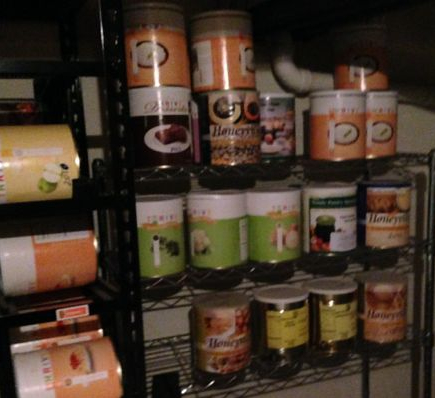
Basement food storageNo, it doesn’t compare with an episode of Criminal Minds, but the supply of food in my basement could feed my family for a couple of months. To someone who hasn’t seriously considered putting food aside for a rainy day, that can be pretty shocking.

You don’t have to be religious or paranoid to store food

  • 2012: “Superstorm” Sandy affects 24 states, including the whole eastern seaboard.
  • 2005: Hurricane Katrina and the levee and floodwall failures in New Orleans.
  • 2001: 9-11
  • 1994: Northridge earthquake in California’s San Fernando Valley
  • Flu pandemics several times every century

Disasters sometimes come with a little warning (hurricanes, winter storms) but they sometimes strike out of the blue (earthquakes, terrorism.) You can’t plan for every individual disaster. Storing food is the only solution I know of to provide insurance against hunger for your family should the unexpected occurs.

It’s true that you may never confront one of those sudden, one-off emergencies. I sincerely hope that you never do!

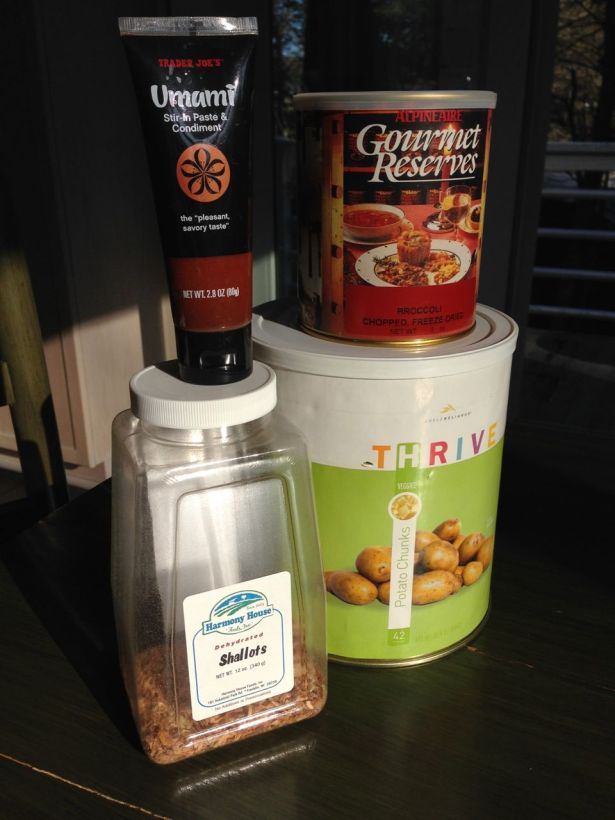
Dried food

Ever had to run to the store or switch recipes in the hour before dinner because you were out of one key ingredient? Dehydrated and freeze-dried veggies work great in many recipes.

But what about more predictable events? Anyone who lives in a region prone to intense weather is familiar with the crowds and long lines at every store when a major storm is forecast. Avoiding those lines is a good enough reason for me to store food, because I value my time very highly.

I never have an immediate need to go to the grocery store to feed my family.

No hyperbole this time. With total sincerity, I can state that, no matter what happens in the outside world, I can confidently meet my family’s immediate needs with what I have stored at home.

Can you say the same?

Milk

Milk doesn’t have to say, “Moo.” Every one of these is good for baking.

Keeping staples like dried eggs and powdered milk on hand—plus a few simple recipes that make them palatable!—makes us self-sufficient for the duration of a major storm and its aftermath.

I don’t bake traditional yeast bread completely by hand anymore (kneading + arthritis = misery), but I have a bread machine and several tasty quick bread recipes that can see my family through a crisis.

Eggs, bread, milk, bottled water, batteries

Eggs, bread, milk—these are the staples for which most people wait in long lines the evening before a storm. When a hurricane is due, add plywood and batteries to the list, but you could—perhaps should—plan ahead for those, too.

batteries

Eneloop batteries are the best; I buy them at Costco. Amazon Basics are another great option for rechargeables.

Your “probable” emergency needs will vary based upon your location, but your family needs to eat no matter where you live. Storing a three day supply of fresh water and a little extra food could mean the difference between comfort and crisis during an “extreme event.”

Our own government recommends basics actions for preparedness to every family. You’ll notice that food and water are the first items on the CDC list. Of course, they also have a page about the zombie apocalypse, but I’m pretty sure that one is tongue in cheek.

I’m going to go with the CDC on this question; whatever gets you thinking about taking care of your family is a good prompt to action. Hurricanes, snow storms, earthquakes, or zombies: are you prepared for an emergency that disrupts the food supply?

I love Lego, and I built a platform on an IKEA base to host a city where I can play with my growing kids

I love Lego

True confession time: I love Lego.

I don’t just mean love in that generic, parental, “I love to buy Lego for my kids so they will grow up to be engineers and support me in my old age” way. No, I love Lego in an “I won’t share my bricks with my kids” way.

Lego is one medium with which I still know how to play.

I had a few bricks as a child, but I really started collecting Lego sets when I  was a young professional. Living alone and working long hours as a software quality engineer, I sought a relaxing pastime to keep myself off the computer for a few hours a day. It started when I discovered ancient Egyptian themed Lego sets during a spontaneous trip to Toys “R” Us one evening after work…

I won’t share my Lego with my kids

I hoard my Lego bricks, and I store them separately from the children’s toys. They don’t sort their bricks properly the way I prefer. Also, I like to keep the parts for my favorite sets together, though I don’t keep the boxes or treat them as collectibles. I just enjoy the option of re-building without too much digging for specific pieces.

Family Lego city display MOC in progress

My modern office building MOC in progress. I need over $100 worth of grey and clear bricks to turn my vision into a reality, so it’s on hold. A construction site is a fun spot for creative play in Bricklyn

My spoiled little darlings own enough Lego to stock a store, but I could fill a large Rubbermaid tub with my own bricks. Actually, maybe two tubs. And, realistically, I wouldn’t desecrate my greatest builds by stuffing them unceremoniously into a bin.

I guess I’m a little spoiled, too.

I love model cities

I’m geeky enough to admire model train sets. I grew up thinking how cool it would be to build such a thing in my future home. I’d love to have a toy train running from room to room on a suspended track like I saw once in a small town Maine restaurant.

I love Lego builds on a grand scale, too. I not-so-secretly identify, just a little, with the dad (spoiler alert: a.k.a., Lord Business) in The Lego Movie. I would never glue my bricks together, but I would expect a cohesive vision to be respected by my family as a labor of love, at least for a while.

family-lego-city-display-front-e1493311369289.jpg

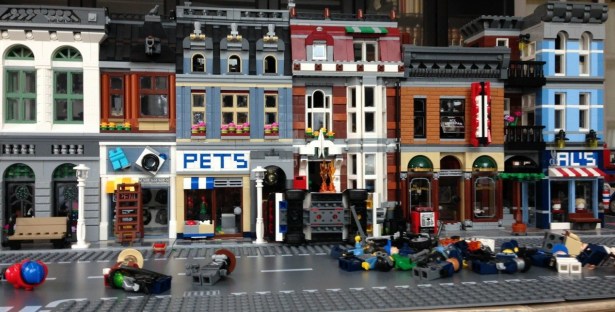
“Bricklyn” main street; battle carnage courtesy of DS2

I absolutely adore the modular Lego City Creator sets. They have an early 20th century downtown vibe that’s aesthetically pleasing to these adult eyes. I own a few now. I enjoyed building them, and I really wanted to display them instead of putting them away.

I’ve found that kids are drawn to the finished buildings in an adult space. They just cry out to be played with, but I didn’t want to be constantly policing children or tempting them with untouchable objects on a coffee table. That’s just mean.

Here’s how I found a way to keep my sets intact, for my own enjoyment, while also creating a fun, inter-generational play space for my family and friends.

I built an “open source” Lego “platform” for family sharing

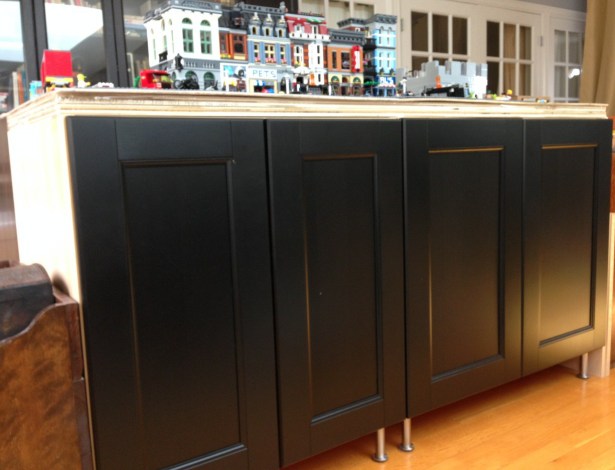
We set up a fairly large (48″ x 66″), counter height surface on the library side of our great room. I assembled four IKEA kitchen cabinets for a base, then used a sheet of plywood for a level platform. It isn’t beautiful, but it is tolerable in a space that also functions as our “formal” living room. Obviously, our lifestyle isn’t really very formal!

IKEA Lego display platform cabinets

I have the veneer to finish the ends of the cabinets to match, but that’s also waiting for “someday.” I’d rather play with my Lego sets than finish my home improvement projects…

Someday, I’ll get a proper counter top to replace the plywood we edged with packing tape to reduce splinters. Most of the surface is covered with base plates anyway, or will be when we’ve added a few more buildings. A simple edge treatment would improve the looks of this project more than anything else.

The IKEA cabinets below “Bricklyn”, as DS2 dubbed our little town, created storage space for all of our board games. Two cabinets each at 24″ x 30″ and 24″ x 36″ hold a lot of family clutter. I opted to use drawers on one side, and cupboards with doors on the other. The drawers are easier to keep organized, but much harder to assemble if you’re an IKEA novice.

To add stability and prevent dangerous tipping over of the heavy cabinets, we fastened the same-width units back-to-back. We also keep heavy objects on the lower shelves and in the bottom drawers so the unit isn’t top heavy. The plywood top extends across multiple cabinets to further cement the units together. Even with every drawer open on the back side, the unit doesn’t budge.

Three rules keep the peace during playtime

There are just three rules for our play table, and even visiting children have been willing to abide by them.

  1. Each family member “owns” some of the baseplate “lots” that cover the table; we each get to define our part of the neighborhood. We can build anything that fits the confines of our plate. Roads are public and may be used by everyone.
  2. Whoever built a structure or vehicle controls the rights to modify that structure or vehicle.
  3. Anyone may move vehicles and minifigs within the cityscape without fear of reprisal, but no one may remove vehicles or minifigs from the display unless s/he put them there.

It helps that my kids are old and mature enough to have some respect for private property. Each has a smaller table in his room set aside for personal building that is sacrosanct. Bringing something to Bricklyn is an agreement to share.

It also helps that the cabinets keep Bricklyn about 40 inches off the ground; our rare infant or toddler visitor can’t reach what s/he shouldn’t take! We keep a step stool handy for our small friends (usually around kindergarten age) to see the display and join in the play. So far, our youngest participants have shown a sort of reverential respect for what we’ve built, and they’ve played by the rules.

Mother’s Day is coming up, which is one of those holidays when I just might be lucky enough to receive a new Lego City building. If I do, I’ll build it in Bricklyn.

Short, bright tea-time in my room

My house has enough eccentricities to be worthy of a post in and of itself. The quirk prompting my musings today is the presence of not one, not two, but three built-in wet bars in our home. Presumably, the architect feared for the poor soul who had to climb even one flight of steps before having a mixed drink over ice. There is a bar on each of our three levels, each complete with a built-in fridge, bar sink, pull out glassware shelves, and a mirrored backsplash.

One of the wet bars is in my bedroom. Heaven forbid a homeowner be forced to make such a portentous choice: go downstairs to the second floor bar (or, horrors!, the kitchen), or go to bed sober.

I enjoy my red wine, but I’m not otherwise a big drinker. There isn’t much call for a wet bar anywhere in my social life, but especially in the bedroom. DH doesn’t drink, and I don’t often entertain in my boudoir.

I toyed with the idea of buying a beautiful set of bar ware for display, but that’s not really my style. I love the idea of a glamorous, sparkling setup, but then I’d have to dust it. More likely, I would fail to dust it, thus living with another constant reminder of my lackluster housekeeping and the resultant allergens. No, even antique cut crystal decanters weren’t the answer to my superfluous home “feature.”

Instead, I outfitted my bedroom wet bar as a tea station. A coffee setup would work equally well, but that doesn’t suit my routine. I really love my coffee, but I don’t drink it first thing in the morning. Coffee is a fortifying, sit down treat with second breakfast or elevenses. I don’t have time to enjoy that until both of my children are occupied with their academic work, one at home and one at school.

Ideally, before the three-ring circus day’s schedule begins, I like to have a mug of strong black tea to jumpstart my brain. Yorkshire Gold, please!

My typical weekday starts with waking up a little boy, getting him (to get himself) ready, then shuttling him off to school. I’m not one of those living-on-air types who won’t eat before noon. I need at at least a bite of something before operating heavy equipment (the minivan my children dubbed Pookie) but my first breakfast is often just a slice of toast or a piece of fruit on the run.

Morning stiffness is one of the characteristic symptoms of the autoimmune disease that I live with. With medication, this is much reduced, but I wake up something like the discovery of the Tin Man in the Wizard of Oz. While my kids sleep on, I creak my way out of bed, shuffle into the next room to commence my morning ablutions, then spend ten minutes or so reading, gently stretching, and just generally allowing my body to warm up to movement again.

Tin Man

Just like me with my morning tea, except I pour it down my gullet instead of applying it to my knee. Usually. <dribble>

Bringing a counter top water purifier and an electric kettle into my bedroom gave me the means to have my first cup of tea during these quiet minutes at the start of my day.

Our local water doesn’t flow from the tap with a pure, clean taste, so I filter what I consume; my electric WaterLogic purifier uses a removable water carafe instead of requiring new plumbing, and it was a good fit for my narrow space. An electric kettle works just like the stove top version, but it’s plugged into an electric socket to provide heat to boil the water.

I use two trays to keep the space organized. A stainless steel surgical instrument tray came in precisely the right dimensions to fit the space to the right of the bar sink while accommodating both electric devices. If I miss the mark while refilling the kettle with stiff fingers, the drips don’t mar the wooden counter. (Who bothers with a mirrored backsplash while neglecting to install a water-resistant counter top around a sink? Drunken architects, apparently.)

Tea Station right

I chose the black T-fal BF6138 electric kettle because it was small in size and it does NOT ding when the water boils. This makes a lot more sense in a shared bedroom than it would in a kitchen.

A more decorative, handled wooden tray sits on the other side of the sink. It holds mugs, teapots, and anything else I might want to carry en masse to the kitchen for mechanical dish washing. If I had designed my own tea station from the ground up, I’d have a mini dishwasher installed beneath the counter instead of the refrigerator. I don’t need milk for my tea, and I really don’t enjoy hand-washing, not even a few lightly soiled mugs.

I’d always appreciated similar setups in hotel rooms, but never thought to try fitting such a thing into our cramped upstairs floor of our previous, much smaller home. The electric kettle and having what you need laid out nearby is all that’s really necessary, though. Bonus points if you have a convenient sink, but carrying water in a carafe will suffice with a little forethought.

If I move house again (God forbid!), I think I will forevermore duplicate this set up in a corner of my room. A small table or cart placed near an electric socket and the habit of replacing the consumable tea things the night before is all that it would take to keep enjoying my favorite ritual. It’s only a little effort, and a tiny space.

Sometimes, at the end of a long day, imagining my morning cup of tea is the soothing balm that defeats my pestiferous insomnia. I look forward to those quiet few minutes. I savor them.  The morning light, the soothing warmth of the mug in sore hands, the fragrant steam rising up to my face… Carving out a little space is a small price for a great luxury to enjoy every single day.

Have you set aside space in your home for your own little sanctuary? What’s your most nurturing ritual?

Books by my bedside 2017/04/23

Here’s what I’m reading this week.

I’ve noticed that I often bring up in conversation one or more of the fascinating books I’ve been reading lately, only to fail utterly at recalling titles or authors’ names. I’ll take this opportunity to at least have a handy reference available for anyone who cares to follow up on something I’ve said.

Just check my blog!

Fiction

The Marvelous Misadventures of Ingrid Winter by J.S. Drangsholt
Mockingbird by Walter Tevis
The Shadow of the Wind by Carlos Ruiz Zafon

Non-Fiction

Economics, history & politics

The crisis of the middle-class constitution : why economic inequality threatens our republic by Sitaraman, Ganesh

The true believer : thoughts on the nature of mass movements by Hoffer, Eric

The white man’s burden : why the West’s efforts to aid the rest have done so much ill and so little good by Easterly, William

Language

Am I small? Bin ich klein? (Picture Book English-German Bilingual Edition) by Philipp Winterberg

German in 32 lessons by Adrienne

The little German notebook : a breakthrough in early speaking by Long, Charles Merlin

Starting out in German by Living Language (audio CD)

Math & technology

Gödel, Escher, Bach : an eternal golden braid by Hofstadter, Douglas R.

Biography & memoir

Tasting the sky : a Palestinian childhood by Barakat, Ibtisam