Is grief reflected in (un)polished silver?

One way I’m still processing my grief, two years and five months after my mother’s death, is by polishing her silver. Today, my hands are sore and chapped from completing that task last night.Tarnished silver showing a coppery glow instead of the whitish glint of sterling

Perhaps it was just the passing of more than the usual time while travel was ill-advised, but I think regional wildfires and their acidic smoke sped up the tarnishing of her sterling tea service. My irrational heart may also feel that these dark stains reflect the deprivations and loneliness of 2020.

If we couldn’t celebrate life’s occasions together, why shouldn’t our heirlooms wither and wilt in their own exile?

Silver heirlooms & family history

I was a girl, but old enough to notice, when my father bought Mom the silver tea set she’d coveted. I think I recall the particular room in the particular house we lived in at the time. I have memories of her excitement upon receiving it.

I’m not sure that Mom ever actually served tea or coffee from it, but it shone with pride of place in every dining room thereafter.Sterling silver tea service with heavy tray, coffee pot, tea pot, sugar bowl & creamer

Some families may own objects for generations; others build their own cache of keepsakes in the moment. It’s the memories that form mementos, not the artist or craftsman at a workbench or in a factory.

For myself, I take pains to use lovely things such as china and silver as often as possible. Regular readers may recall that I worked on my novel by candlelight last summer while sitting at my parents’ dining room table and keeping one ear open to Dad as he recovered from surgery. I know that five-branched candelabra was one of their Silver Anniversary gifts.

The use of three different styles of mismatched candles is entirely my own choice, and my mother, it must be noted, would be scandalized by such cacaphony.

5 branched candle holder with two gold beeswax tapers, two rust colored beeswax candles, and one smooth taperI use a silver tray to carry Dad’s post-surgical medications upstairs every night now* just as I did in August.**

It’s the right size to fit on his bedside table, lighter than wood, and less breakable than a plate would be. Some old-fashioned objects remain just as useful as their modern alternatives.

How to remove wax residue from silver

Before I polished all the silver, I had to pour hot water over the tray I placed beneath that 25th anniversary candelabra in order to remove all the wax I’d spilled thereupon.

Please note that, never, in Mom’s lifetime, could such a mess have been left for four months or more before being attended to! That, too, is entirely my responsiblity, and does not reflect the way Mom raised me.

If undertaking such a wax removal exercise, make sure you place a paper towel between the wax-stained item and your drain to avoid expensive plumbing repairs down the line. Very hot water does very effectively remove wax from even the most detailed metal surface.

I used water just off the boil, and the tray from which I was removing wax had no heavy, weighted areas to avoid heating. Be careful if treating candlesticks or other items which may contain meltable fillers as counterweight if you try the hot water method!

Amongst the almost innumerable blessings of my highly charmed life, I include the fact that my mother died in the summer of 2019, well before the pandemic. The children and I were able to spend the first holiday season after her passing with my father, accompanying him through what was a difficult time for all of us.

Frankly, anyone who knew my mother would recognize at least this irrefutable fact: she would have hated being locked down and isolated from society. Mom liked to be busy, and she reveled in the company of other people.

I don’t know if I could have survived such a loss in 2020 when travel took on new risks. The idea of Mom’s hospice care taking place while we were thousands of miles away is intolerable. I can’t even express the gratitude I have for the fact that I wasn’t challenged in such a way.

In spite of the mild miseries of my own experience of the pandemic, I know firsthand that heroic caregivers continued to minister to the dying in spite of the job’s personal risk. The long illness that plagued my mother-in-law came to an end in 2021. Hospice workers—and an investment in long term care insurance decades ago—gave her the dignity of dying at home, as she wished, though there can be no real respite from the ravages of grief.

It ranks high on the list of ways I consider myself luckier than I deserve that we six shared a household, thus having no question about our ability to be as involved as my father-in-law wished with her daily care at the end. Being there for a terminal loved one is difficult; knowing you can’t be must be excruciating.

How to polish silver without damaging it

While products abound, these days, promising quicker, less effortful removal of tarnish from cherished silver, experts universally decry the lazy man’s dips and hacks. Polishing silver isn’t particularly difficult, but it is best done with a bit of elbow grease and zero “quick fixes.”

Removing tarnish means, fundamentally, stripping away a thin layer of the valuable metal itself. It is best to tackle the job gently.

Apply a high quality silver polish using cotton balls, a sponge, or a rag. Rub until the dark stain of tarnish disappears, changing out your cotton or rag when it blackens. Finally, rinse or rub off the remaining polish, depending upon the type of object you are cleaning. A tray can be wiped dry or rinsed, then buffed; silverware or items you put in your mouth want washing after polishing.

Silverware as a shelf for memory

I have less memory of how this three-tiered silver tray came into my parents’ possession, but it does define the space for receiving Christmas cookies in my mind. Now that I’ve polished it, a bit of baking does seem to be called for.

When is it not better to confront a pleasing array of delicacies arranged on a silver platter? Or trois? When is a display not improved by height, texture, and depth?

While I wish my father weren’t recuperating from a painful operation, and I wish my mother were here, in her house, doing a better job of decorating, polishing silver, or tidying up than I every could…

Well, suffice to say that I am grateful for Dad’s recovery. I’m happy to spend the month of December surrounded by Mom’s things with at least the possibility of realizing a tiny fraction of her joy in the Advent season.

It’s a constant ache and awareness of loss to live amongst the remnants of my mother’s life, but such a gift that I have the luxury of time and access to process my feelings about everything she was, what she loved, and what she left behind.

The finer things in life only achieve that definition because we acknowledge how they add to our delight, or enhance our appreciation of the lives we lead. Even gold has only so much luster outside convention.

I would trade every precious metal for my mother’s presence if I could, but that’s not how living works, and that’s not a bargain anyone gets to make.

Grief is not the garland we expect for our holidays, but it is one most of us will hang one day. Whether personified by tinsel or a sterling silver tea service, holiday grief is a likely inheritance to everyone blessed by the chance to love and be loved.

It’s hard to make a family without generating holiday memories. Vanishingly few conduct an entire life without loss. Learning to live with grief throughout the holiday season is the burden—and the gift—of those who’ve been loved.

*For knee replacement number two

**When Dad became a cyborg, as he likes to say

Happy Hanukkah 5782

Almost another full year of pandemic permutations, and the Gregorian calendar is wrapping up 2021. The Hebrew year 5782, however, is just entering its prime as we celebrate Hanukkah. Tonight, Sunday, December 5th, is the last night of this Jewish holiday.

What I love most about Hanukkah is its focus on the universal human need for light to triumph over darkness. On this, the eighth and final night of the Festival of Lights, my sputtering candles serve as a visual metaphor for a dream many of us share: may this be the final stand of COVID-19, too!Candles in Hanukkah menorah burning out

I hope that Omicron is a pathetic, last gasp of the no-longer-so-novel coronavirus; I pray for a future where we can resume our holidays, rituals, and everyday celebrations in each other’s company without fear.

I am personally blessed to be both vaccinated (Moderna) and boosted (Pfizer), and to have the freedom and means to travel this holiday season. My father, who got his first knee replacement last summer, was able to schedule his second side for the week after Thanksgiving. While elective surgeries like my father’s have been canceled in my home state*, hospitals in the Pacific Northwest, where he lives, remain open to patients like him.

Hanukkah is notable for its emphasis upon pirsumei nissa, or “publicizing the miracle.” This isn’t just a minority group’s attempt to hold a holiday up against the majority culture’s big day. Rather, the miracle of a single vial of oil burning far beyond its expected daily duration for an entire week instead (necessary to create new ritual fuel) was deemed worthy of public emphasis by Jewish sages in antiquity.

This year, as my youngest child embarks upon education in a new environment—but, again, a Christian one—I can’t help but draw his attention to the history of gambling over dreidels for this holiday. It matters, a lot, why Jews emphasize this particular act.

As I understand it, during Syrian-Greek rule of the Holy Land (c. 200 BCE), it was illegal for our people to study Torah. The punishment for a Jewish religious education was death. A form of hiding in plain sight was developed; if enemy soldiers approached, students would pull out their spinning tops (dreidels) and pretend they were just playing.

There is so much that I admire in my youngest’s Catholic education. A recent letter from his principal included the following statement that resonates powerfully with me:

You were created by the God of love

in God’s image and according to God’s likeness,

to be a unique expression of that love.

It is through you

that God desires to manifest Love

to the peoples of the world in these times,

and to offer them the freedom

of the children of God.

According to our school, this statement is one of the fundamental principles of the Xaverian Brothers.

For all the ways I identify with these notions, I also found myself admonishing my child to remember his own unique heritage in recent weeks.

We are blessed to live in a society where we may elect to join any school, but we mustn’t forget the lessons of our forebears. A Jewish child should know where he came from; he must recognize that there are people living in America today who wouldn’t acknowledge him as either fully human, equal, or a true patriot. It’s unfortunate, but plain fact.

I feel myself to be an American before any other categorization, yet I don’t have the luxury of assuming that all my compatriots would agree with that assessment. It’s a tragedy that I have to emphasize the same to my children; it would be negligent to fail to alert them to this truth as I understand it.

The scent of spent beeswax tapers lingers in my nostrils as I waver between gratitude for my abundance of blessings and acceptance of the ridiculous prejudices that seem to motivate vast swathes of the public today.

I’ll take my luck and be thankful. I have the light from my menorah piercing the darkness, my father’s great good fortune to have gotten the health care he needs, and the secure knowledge of the love of friends and family who surround me.

As we near the darkest days of December, 2021, my wish is for the blessing of illumination to all who seek light. Best wishes for warmth, safety, health, and goodness to everyone reading this.

L’ chaim! To life! And to everything good, holy, and beneficent as we huddle against the darkness.

*Due to a combination of COVID cases and staff shortages

Satisfaction derived from one (novel) work in progress

Five weeks in, I’ve written 39,645 words. I’m working on a novel.

If I ever finish it, and then publish it, you should definitely read it.

39,645 ÷ 5 = 7929 words per week

7929 ÷ 7 ≅ 1133 words per day

Truthfully, I don’t know whether to crow about this rate of progress, or if I should be mildly—or wildly—embarrassed by my sloth. Remember, I’m a dilettante who hasn’t published much more than a blog.

Then again, the world can—and will—think what it wants. In the meantime, I shall carry on developing the imaginary universe I can’t help myself from inhabiting, trying to do justice to a scientific concept that my celebrated husband offered as a plot device.

I think it is working. The fact is ridiculously exciting.

On the evening of day 35, around page 170, I got to the good part. You know, that moment where a handful of threads are woven together, and one suddenly understands why we heard about this, then that, then the other thing… ?

Truthfully, I didn’t, myself, see all of it coming. My takeaway: writing fiction can be weird.

If I were a different kind of creature, perhaps I could keep up with regular installments for a diverting blog while crafting a novel clever people would feel compelled to read. My reality defies this notion. The same pool of energy feeds both projects.

Alas, poor readers! The novel wins.

Lately, the novel also encourages me to imbibe a glass of wine alongside the lighting of a five-armed, silver-plated candelabra from my parents’ 25th wedding anniversary, so it’s kind of a strange beast. Either that, or I am the odd one, but don’t you like knowing you are reading a work composed on a laptop by candlelight? That’s not just me, is it?

I’d love to share the recent story of “My First Flight in the Era of the Novel Coronavirus” (hint: uneventful) or “Flying vs. Amtrak Reality for Those Who Take Delta Variant Seriously” (hint: airlines impose mask regulations more seriously than train conductors), but I am forced to choose.

Happily, the kids and I have made it across the USA and back into the physical presence of my father. He needs an elective-yet-function-improving surgery, he was waiting to have family around to get the thing done, and it’s a Really Wonderful Thing that we are here to support him through the process.

Today we had to change the bed sheets prior to surgery and he started bathing with the special, sticky, infection-defying soap. Now, how do we keep the dog off his bed until the incisions heal?

It’s also downright bizarre to be anywhere other than where we’ve been for the past 17 months or so. How often are the rest of you realizing how definitely we are living through Interesting Times? How often do you give thanks for the fact that you’re still around to notice said fact?

My personal answer to that last one: at least once daily.

It’s almost definitely good for my family to have its paradigm shifted at this point. I know that I have become a creature who might just as well never leave the house at all, if left to my own devices. That could likely earn me some kind of diagnosis from the DSM if I were inclined to seek professional opinions on the subject.

I’m not.

Lacking that kind of openness to criticism, I still know I benefit from noticing what’s different here (time zone, state, county, population density) vs. what’s the same. The part where the kids and I are living with Dad’s pandemic puppy is a learning experience.

While I grew up with pets, the last time I lived full time with any was a pair of cats in the 1990’s.

I was really worried that Dad wasn’t training his dog, but the pup is much better behaved than Dad’s most comedic text messages suggested. Phew!

Fear not, blog-reading friends. I am alive, healthy, and grateful for both of these things to be true. Here’s hoping that soon I’ll be begging you, my favorite audience, for beta readers for a dys-/utopian novel. Is anyone game?

May you all remain healthier than the arborvitae my dad put in his yard right before temps topped 116º F here. He’ll be lucky if 2/5 survive the summer, I’d guess. God willing, the delta variant will remain less deadly than that ratio.

Good habits work where will power fails: “novel” evidence

Working on this site has been a hobby of mine since 2017. I’ve achieved goals I set for working on it regularly for two long stretches, but I also gave myself permission to scale back the effort during one particularly stressful period.

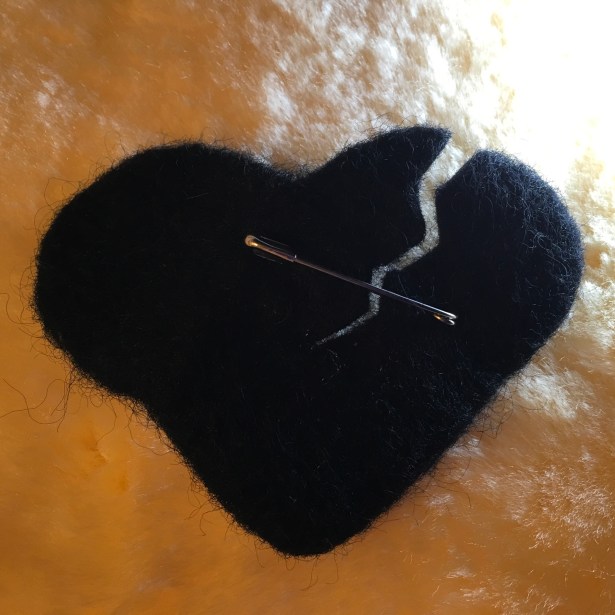
Two years ago this month, my mother died. I’m no easy creature to silence, yet grief holds the power to still my usual ruckus.Torn black felt heart pinned to garment to signify grief and k'riah

Mom thought very highly of my writing. She was an extraordinarily competent individual herself, but in arenas such as powering through concrete tasks and meticulous calculation. Mom never pushed me to study “X” or pursue a career as “Y,” instead trusting my ability to forge my own path.

I recall a few instances, however, when Mom spoke of my creative skills with a tone of particular respect—once, almost in awe. Those moments stay with you.

During the most isolating months of the pandemic, one of my exercises in self-soothing was to imagine ways in which the world could be designed to make people safer from future outbreaks of airborne disease. I bored my family by going on about these thoughts, sketching out alternate forms of housing and transportation. If implemented, I envisioned sparing at least some of the population from the prolonged agony of isolation or the need to trade free movement for good health.

Toward the end of last month, I started incorporating* these notions into a novel.

I’ve started many novels before, and I even approached the roughly 2/3 completed mark with one in the early aughts. That was after I left my professional career in technology but before I dedicated myself to the home education of one of my children. Historically, though, writing fiction was my hobby, and I tended to pursue the work when I “felt like it.”

I would get as far as the first burst of enthusiasm took me, but rarely pick up again after leaving off to work, sleep, or tend to the kids.Hand written and self-bound documents

Intriguingly, this time is very, very different. I have to credit the habit of consistent effort cultivated through work on Really Wonderful Things. Twenty days have passed, and I’ve met or exceeded my writing targets for this novel on all but two.

Authoring a novel is one of my oldest, longest-term goals. I never doubted I would get around to it, but it always lived in “future willo’s” inbox. This summer, it has advanced to the top of my priorities assuming the health and safety of my family don’t require sudden, absolute attention.

Blogging has markedly improved my self-discipline as a writer. That’s not why I started the site, but I’m delighted by the development.

“Will power” as a concept for self-improvement fails us, especially in the short-term. Popular understanding of how it works is often wrong. We blame ourselves for problems largely beyond our control while failing to make the sorts of small adjustments that can help us, offering long-term success at living the lives we want.

Will power may desert us when we need it most, but gradual, incremental change geared toward improving the situation of one’s future self is possible for most. Crafting a life which intentionally reinforces positive habits can, over time, improve one’s ability to approach difficult yet meaningful tasks, or, conversely, to coax one away from harmful behaviors.

My novel isn’t done yet, so take my experience with whatever size grain of salt you believe it deserves. I do have over 24,000 words down on 108 pages, though, and every expectation that this time, I’m going to finish this particular book.

I’m still in love with my concept, and, most evenings, I find myself shooing away my family—whom I generally enjoy!—because I’m itching to get back to work.

If I were to write a dedication for this novel right now, it might be to “past willo” for putting in the time working on Really Wonderful Things. “Current willo” has a lot to thank her for.

* Careful readers may have noted these additions to my mid-year update to my personal goals:

  • Write 3 pages per day of novel, —and—
  • Complete first draft of same.

Ironically, though my novel occurs in a world where pandemic illness never recedes, I still view the project as utopian rather than dystopian, and I find the work to be a projection of my fundamental optimism about human nature in spite of our ubiquitous foibles.

Once, I had a headache which precluded interaction with a screen, and the other—weekend—night, I opted to watch a movie with my family because they are important to me, too. It turns out that I struggle mightily to produce creative work before late afternoon, though I’m better at most analytical tasks earlier in the day. Who knew?

Then again, taking one day per week off from an otherwise daily goal could be a reasonable, even helpful adjustment to a work schedule. God herself commanded a routine sabbath rest!

Novels tend to be works of fiction longer than 50,000 words

Remote school works best for YOUR child? You have the RIGHT to continue!

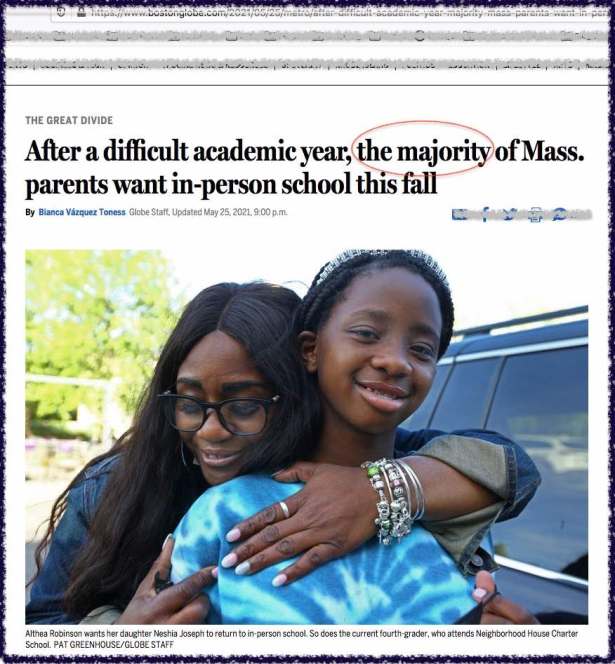
Late spring polls—and the blessed waning of the COVID-19 pandemic, in the USA, at leasthave prompted headlines like this one from the Boston Globe:

“After a difficult academic year, the majority of Mass. parents want in-person school this fall

Boston Globe article headline with "the majority" highlighted by this bloggerThat unambiguous headline hides the whopping 31% of parents who disagreed with the sentiment. Almost a third of the 1,619 parents polled by MassINC Polling Group are NOT eager for mandatory, full-time, in person education just a few short months from now.

That’s more than three out of every ten people. In my childhood classrooms that averaged around 30 kids, that would have meant nine or 10 were attending against their families’ best instincts. I don’t think numbers this significant can be dismissed as a “trivial” minority over whose preferences the majority can ride roughshod with impunity.

An earlier Gallup poll restricted to 14 to 18 year old high school students in the same state of Massachusetts showed similar dissonance with an equally head-scratching headline:

Few Massachusetts Students Prefer Remote Learning

The data in that case also shows that most people, shown a few narrow options, prefer to travel the path of least resistance and do what they’ve always done. Half (50%) of the kids polled, if given these three choices, would attend “in person full-time.” Only 16% would choose “remote school full-time.”

Then again, 34% in the Gallup poll selected the third option: a hybrid “in person/remote” approach. That third of the student body can’t necessarily be described as “preferring” in person education. A more accurate headline would have been: Half of Massachusetts Students Prefer Full-Time, In Person Learning.Backpack with textbooks and school supplies spilling out

Half of Massachusetts Students Prefer Full-Time, In Person Learning

Some of these students might’ve been reacting more to a lousy remote education experience—one they got stuck with during a worldwide crisis—rather than alternative learning in general. Even with widespread reports of low quality remote instruction in 2020, from this data, I see that half of the polled teens expressed an interest in at least some education outside of the traditional brick school building.

From yet another source, I offer a press release from National Parents Union including a third poll (poll data here) producing similar statistics. The NPU poll shows 56% of surveyed parents “value having a choice between in-person and remote” learning. Roughly half prefer in person classrooms, but 17-25% of parents depending upon geographic region would prefer a hybrid model.

As with the other polls, 20% of these respondents would prefer full-time remote learning in 2021-22.

The right to an education

Before I say anything more, let me be clear: I do believe that opening schools this fall looks likely to be safe enough for most. The decision to do so appears to be based upon a sound assessment of current conditions in the USA.

Families who want to send their children back to schools in person should absolutely have that option based upon currently available data.

American children have a right to an education. Maybe even a constitutional right to at least basic literacy. In no way am I looking to dictate the best way for other people’s children to learn.USA flag - 1

I grow frustrated by the outright dismissal of the reasonable preferences of a sizeable minority of parents and children who want continued access to remote learning options for those who prefer them.

If even “just” 16-20% of students would choose remote learning, that’s 4.8 to six students in my hypothetical classroom of 30. I find it interesting that 20% of respondents in the NPU poll (see question 14) also reported their pupils “learning more than they normally would” during remote classes than they felt they had attending school in person.

These are real outcomes from American students for whom remote education works well.

The 31% from the first poll of families who don’t want to send their kids back to traditional school buildings—for now, or perhaps forever—deserve to be heard and accommodated by the public system. They may not be the majority, but the group is large enough, and the stakes are high enough, that ignoring the needs of these families is a dereliction of a very reasonable duty of care.

Let’s face reality: it’s not as though our system has been offering an excellent education to every child who wants one up to this point. (An example: the fierce fighting over scarce seats at Boston’s best public schools.) We have a lot of room for innovation and improvement. The point at which 16-31% of participants in the system ask for an alternative seems like an ideal time to start.

Parents usually judge best what works for their own kids

Barring extreme dysfunction, parents know their own children best. While most moms and dads aren’t professional educators, they are experts on the subject of their offspring.

I have two kids, and only one of them was educated at home before the pandemic. 2020-21 was as much of a wild academic ride for us as it was for students everywhere!

I posted about my family’s educational choices here—Home education as a radical act—back in 2017. I was also grateful to take advantage of my son’s school’s outdoor classes during the pandemic.

I mention the different choices made on behalf of my two children because I’m not a rabid proponent of homeschooling at all costs. My sociable younger son is enrolled in school because he prefers learning in a group, and evidence suggests the system works… for him.

My other kid has definitely found his groove, but even my homeschooler didn’t love the shape of every part of learning through a pandemic. That child, too, is eager to return to some classrooms for some subjects; my kid can’t wait to have choices again.

Home education allows for remote learning

This rambling? preamble has served to get me to the following point:

Families who aren’t well-served by the public system are entitled to remove their kids from it. Aside from expensive private institutions, home education is a legal right in all 50 states. Remote classes—many taught by trained professional educators—can be a part of homeschooling.

The internet began offering amazing online opportunities to homeschooling families many years ago, and the pandemic actually increased and enhanced the quality of the choices found thereon.

  • You don’t have to be a trained teacher to do a fine job teaching your own child.
  • You can purchase ready-made curricula for a term or a year, by grade level, or for individual subjects.
  • If your kid excels in one area while struggling with another, you can tailor everything to his or her needs on your own, or with targeted help by hiring tutors or joining group classes.

Here’s a post about a particular online foreign language program that worked out well for my kids: YES! CLV’s Virtual Village is great remote language learning for kids. I’m also a fan of the affordable online courses offered by Royal Fireworks Press.

Roughly 2.5 million American students were learning from home before the pandemic; by March of 2021, that number doubled to 4.5 – 5 million. (Homeschool statistics from NHERI) Plenty of families rejected their schools’ responses to COVID-19 and took the plunge at the time; all of us can make that choice today based on what we’ve learned over the past year and a half of disruption.

If you know that returning full time to a classroom isn’t the best decision for your child, I encourage you to try home education… if you believe it might be a good fit. Making this choice now doesn’t commit you or your child to this course forever; many kids transition in and out of homeschooling every year.

The NHERI link I gave above offers more detail on the subject of the success of home educated students, but the short version I believe everyone deserves to know can be summarized thusly:

  • Homeschoolers as a group perform better on standardized tests than those educated in public schools— 65-80th percentile for the home educated vs. 50th percentile for public institutions (Ray, 2015)
  • Homeschoolers as a group “succeed and perform statistically significantly better than those who attended institutional schools (Ray, 2017)” as functioning adults
  • “87% of peer-reviewed studies on social, emotional, and psychological development show homeschool students perform statistically significantly better than those in conventional schools (Ray, 2017)”

Oh yes, and, add to those points: selective colleges are generally very accepting of well-prepared home educated applicants because they also tend to perform as well as institutionally-educated enrollees at the university level.

Beyond these general facts gathered prior to the ravages of the coronavirus over the 2020-21 school year, it is worth acknowledging that a child who doesn’t feel safe at school is less likely to learn well. A parent who fears for her offspring’s health and safety is likely to perform less well in her own work. These are not insignificant issues; these feelings deserve to be dealt with in a constructive way.

Where state governments or boards of education dismiss out of hand the wishes of 20-30% of their enrolled families, I offer the option of parent-led home education, not as a prescription, but as a valid choice available for those who want it.

Though I’m not a home education focused blogger, per se, I’m happy to answer any specific questions that I can, or to provide links to specific types of resources that have worked for my family, if asked. Ask away in the comments!

If one fifth of students learned more during the pandemic, it seems obvious to me that public schools have an obligation to understand why that happened, retain that advantage going forward, and incorporate remote options for that sizeable chunk of their constituents.