Considering antidepressant medication? Try vitamin B-12 first.

This isn’t medical advice. I’m not qualified* to offer that.

Vitamin bottle B12 - 1I am simply a self-educated consumer who lives with a chronic health condition. I’ve drawn my own conclusions from research done as an intelligent lay person, tempering it with common sense. I invite you to do the same.

Many of us diagnosed with autoimmune conditions, degenerative neurological diseases, and chronic pain will be prescribed antidepressants. There are fine reasons for this.

Some chronic pain responds positively to antidepressant medications. Given in lower doses than those prescribed for psychological reasons, side effects are often less as well.

Here’s a link to a (long, almost 2 hrs!) YouTube presentation by Dr. Dan Clauw, M.D. that offers a great explanation for the current understanding of why these drugs may help certain types of pain.

Depression is also a normal human response to learning you can expect to spend the rest of your life with constant pain or in a rapidly degenerating physical condition.

That is a depressing situation for any rational person to contemplate. Treating mental health problems is important, and I do not sit in judgement of anyone who takes pharmacological steps toward better self care.

If you are a danger to yourself, please seek immediate, aggressive care. Do whatever it takes to get well. Your life matters.

That said, I’ve recently learned that the major physical symptoms of depression mirror almost exactly those of a vitamin B-12 deficiency. Hmm…

Even patients with valid diagnoses of other conditions—here’s a study about multiple sclerosis, for example—often have other stuff going on in the body that can make symptoms worse. Large numbers of hospitalized, depressed patients have measurable Vitamin B-12 deficiencies.

It isn’t known yet whether B vitamin deficiencies help create conditions that allow us to develop disease, result from lifestyle responses to living with chronic illness, or are direct side effects/symptoms of disease processes.

I’d argue that the underlying mechanism doesn’t matter so much when we’re talking about supplementing with vitamin B-12.

Why? There is no known upper tolerable limit for safety for supplemental B-12. Say that in plain English? No one ever “overdosed” on this vitamin.

Here’s a link to a more reputable (than me) resource, a state university, for detailed mainstream medical information on the subject of Vitamin B-12. And another to a US government fact sheet on the vitamin for American consumers.

B-12 is water soluble. If you take too much to be used by your body, it will leave your system naturally via your urine. You might “waste” the vitamins you’ve bought and paid for, but odds are tiny** that they will hurt you in any appreciable way.

If someone is ready to prescribe antidepressants to a patient, that patient must have at least one medical doctor who could also be consulted about taking vitamin supplements. Ask your doctor before starting a new treatment, including Vitamin B-12, but, odds are, you will be told this is safe to try.

You may also hear that vitamin B-12 won’t help you. But, then again, antidepressants aren’t a guarantee either. They include a long list of side effects, some of which are very unpleasant. Those prescription pills can also be expensive.

Also, it’s just as unscientific to assume the vitamins won’t help you as to assume that they will.

I’ve come to realize that no one cares as much about my health outcomes as I myself do. With good insurance and caring doctors, I’m still left with unanswered questions and a merely tentative diagnosis for what causes my chronic pain and fatigue. Where stakes are low and scientific certainty is lacking, I choose to perform nutritional experiments upon myself.

If it is highly unlikely to hurt you, and it could help you, why not take some extra vitamins for a while and see if you feel better, too?

Assuming your doctor said such a trial is safe, the only possible barrier is cost.

I picked up a bottle of store brand vitamin B-12 at wholesale giant Costco with 300 pills for $19. Each offered thousands of percent (20,833%) of the RDA***, making a bottle good for the better part of a year taking one per day.

That works out to $23.12 annually. Costco typically offers very good value.

At an expensive local vitamin specialty retailer, a three month supply (of 16,667% RDA pills) cost $16, coming out to about $64 per year. I suspect it would be hard to spend much more than this for these vitamins.
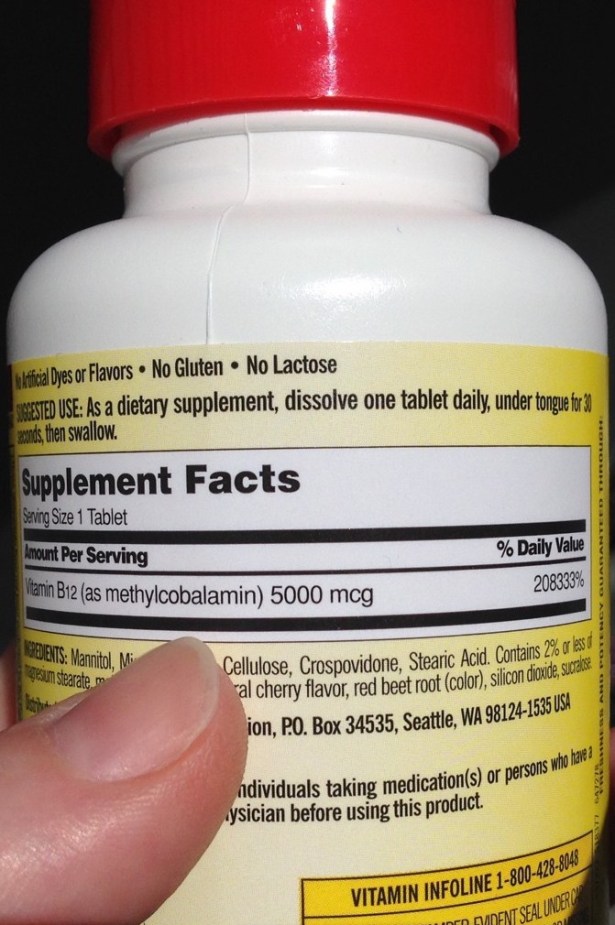
vitamin-bottle-b12-2.jpgThere are several forms of B-12 available, and both of these offerings are for the most expensive type, Methylcobalamin.

Some users have reported that the most common, cheaper form, Cyanocobalamin, doesn’t resolve their symptoms, but the Methylcobalamin form does. At less than $20 per bottle, it seems within financial reach of most Americans to do this self experiment with the potentially most effective version of the supplement.

My two sample bottles also both contain dissolving lozenges to be held under the tongue rather than swallowed and processed through the digestive system. Again, some argue that a sublingual or injected B-12 is more effective than a swallowed dose. I went out of my way to test this type of supplement, just in case, though science tends to think it is irrelevant for most.

In all of this, note that my primary interest is in clinical results, i.e., how I feel. It will be great if research comes to understand why and how B-12 or any other supplement improves patient outcomes. But I am not a working scientist.

The bottom line for how I make a decision about self-treatment comes down to whether or not I feel better, and at what risk.

The “clinically small” improvement of a group of MS study participants quoted above may be of only slight statistical significance, but when your function or your sense of well being has descended to, say, 25% of your old normal, well, then, 27% or 30% represents a win.

I don’t know what you should do to help yourself live a healthier life. I do have some opinions about which alternative health practices represent good risks worth a try for a person in pain. Perhaps this little experiment can ease some of yours, too.

Your body; your choices. Make them in good health.

*My education in both Biology and Chemistry ended in high school as my college science classes were limited to Physics courses. My major was Mathematical & Physical Sciences with a concentration in Computer Science.

Make no mistake that the side effects can be significant, however. They are also likely to affect your offspring, not just yourself. There are studies showing this in very obvious and less direct ways.

Powerful drugs are appropriate to treat significant illness, but I’d argue that they should be employed after milder alternatives have been tried and found insufficient.

Other sources, regarding. depression.and .neurological and psychiatric disorders

**There are some instances of allergic reactions to vitamin B-12, but I only read of such response to injections (shots), not over the counter vitamin pills. Reports of acne or skin rash in response to large dose vitamin pills do occur with some regularity.

You decide whether temporary skin issues are something that would stop you trying a larger dose of this vitamin for yourself.

***In most cases, we do NOT know the “optimal” level of vitamin intake. Vitamin B-12 reference ranges vary from 180-914 ng/L in the USA, 135-650 pmol/L (183-881 pg/mL) in Australia, and 500 – 1300 pg/mL. (ng/L=pg/mL, so no conversion necessary there.)

If you think this is an important thing for people to know, write to your government representatives and tell them you support basic nutrition research. Private companies have very little motivation to pay for this kind of work; there’s no resulting drug patent to fund the endeavor.

There’s a reason some public services, like infrastructure and basic research, are paid for by taxation. Otherwise, they simply aren’t available to all of us.

Fly or drive? Mode of travel and its impact on planet, wallet & joy

Are you a road tripper or a frequent flier?

I chose to drive from New England to northern Minnesota last month. Five of us were scheduled to attend summer camp there, so the endpoints were set: home, and Bemidji, MN.

I elected driving over flying for many reasons, but a consideration for my summer vacation’s environmental impact was on the list.

RoadTrip round trip mapYou can read the more conventional road trip story by clicking Part I or Part II if you want to know more about why and how we made this journey. You could also read about my carefully thought out wardrobe for the trip!

I live within reasonable driving distance of a major airport, so convenient flights abound. Minneapolis-Saint Paul (MSP) is four hours south of Bemidji, which also hosts a regional airport of its own (BJI.) The camp offers a fairly priced shuttle from BJI, and a costlier, less convenient bus all the way to MSP.

The particulars of this trip were not decided by availability of choices. We had our pick of several decent options, if we were willing to pay for them.

Environmental impact of flying vs. driving

Here’s an article from Yale Climate Connections that presents a pretty balanced picture of the complex question: is flying or driving better for the planet?

Similar discussions on the New York Times and at ThoughtCo draw similar conclusions: it depends, a lot, on how many bodies are in which type of car.

Calculators like those mentioned in the articles shine some light on how I assessed this aspect of my choice to drive, not fly.

For my van, with four to five average travelers on board, it’s pretty clear even before running the specific numbers that we opted a reasonably environmentally friendly mode of transport.

Passenger count varied from five (5) during the home to camp phase; four to six (4-6) headed from Minnesota to Ohio; and just my two kids and myself (3) for the final 750 miles from Ohio to New England.

Using the BeFrugal Fly or Drive Calculator for the first, best documented leg of my trip, I can estimate that I saved 4318 lbs of CO2, or, stated differently, that I generated only about 25% as much CO2.

A difference that great is likely to hold up in spite of the controversy about how some of the underlying statistics are generated.

Financial cost to drive vs. fly

As for cost in the traditional sense (dollars and cents!), it also appears probable that I made a better financial choice. That scenario could be very different for a trip involving only major airports where competition keeps prices down.

Bemidji (BJI) is by far the most convenient option when this camp is in session, especially for flights arriving the day of, or the day before, camp sessions begin. Availability is also quite limited for those popular flights.

I used airline miles to buy a rewards ticket the last time I visited Bemidji. The cash price was not one I would willingly pay to suffer in economy class.

The same BeFrugal calculations I showed above reflect as many of my actual costs as I could input into the tool—like actual airfare to BJI researched months ago during the planning process and my preference for a higher class of hotel than the calculator assumes—though some numbers were not user adjustable.

Once again, I’m confident that my actual cost savings were at least as good as the tool predicted. We made a few more frugal choices:

Coffee cup travel mug - 1

  • We carried healthy food with us and avoided overpriced “convenience” snacks.
  • We refilled our reusable water bottles (and my coffee cup!) at the hotel each morning.
  • Aside from one nice steak dinner, the kids actually voted for affordable stops like Subway for sandwiches.
  • I used Gas Buddy to plan fuel stops in the less expensive state when there was a choice, and I knew what a ballpark “good” price was for a given area.

Minivan as economical people mover

I checked the average MPG (as calculated by the van itself) after each of the three major stages of the trip. We averaged 26 MPG from New England to Bemidji, 28 MPG from Bemidji to Ohio, and 27 MPG from Ohio back home.

That’s spot on with published numbers for my van, and really admirable performance for a large vehicle that comfortably seats a crowd.

My typical MPG around town in the van is 18-19, but that’s driving in crowded suburb of a major city.

We needed to stop for gas about 1.5 times per day with that fuel economy. The human passengers required vastly more frequent stops to empty their “tanks” than the minivan required filling up with gasoline.

Gas prices ranged from a low of $1.98 per gallon to a high of around $2.50 per gallon at a toll road service plaza.

I didn’t leave my planned route to seek out the cheapest gas, but I did stop at Costco stations whenever they were well located. I prioritized convenient stops over price, but didn’t find any prices particularly onerous. They almost all hovered just above the $2 mark.

But, have I mentioned comfort?

Minivans are more comfortable than modern planes

We carried a full load of luggage in the back (up to the headrests, which you can read more about here), and each of us had at least a mid-sized “carry on” up front. We had a small cooler stocked with cold drinks and produce and a dry snack bag of equivalent size.

The kids were annoyed by my insistence that all electronics be invisibly stowed for every (shockingly frequent) rest break, but they didn’t have to struggle to climb out of the van due to cargo in the passenger area. Space in the vehicle was well utilized, not overstuffed.

No passenger was forced to sit with his body touching anyone else. Leg room could have been an issue with a similar load of tall adults, but it wasn’t a problem for a group composed of children and young teens.

Being kids, they often did touch each other, or sit with heads together, but that was voluntary.

All of this descriptive information is provided to make clear: all of us were seated more comfortably than we would be in a modern, coach class airline seat. Most of us had significantly more legroom and personal space than one gets in a domestic first class seat.

Convenience is another factor

I don’t want to give the impression that this was my only consideration when planning this trip. Modern life is complicated, and we all make trade offs between convenience, cost, and conscience.

In my case, every point I’ve made in this post up to now has been predicated on one simple reality: I had time to take this trip.

My primary work these days is caring for and educating my children. That means most of my time can be planned according to my own wants, needs, and preferences. Most of what I do, I can choose where I want to do it.

Even so, time was our biggest constraint for this road trip.

We couldn’t leave any earlier due to school schedules for some of the participants. We had to arrive at camp by the scheduled date and time. Without another driver in our crew, my health risked becoming a factor by limiting the number of hours in the day that could safely be spent on the road.

Family fun factor & reasons for sharing

Every time I write a post on Really Wonderful Things describing how I did something, it’s because I hope that information proves useful for a reader somewhere.

If I made a mistake, perhaps you can learn from it. If I came up with a clever idea, I hope it works for you, too.

This post is my attempt to break down how I decided to drive instead of fly to Minnesota with a group of four kids destined for summer camp. It also details why I think this was a good choice, environmentally, and economically.

The trip was also a lot of fun, almost all of the time, which is something about which I haven’t written much yet. That’s a factor—the family fun factor!—that really matters to me.

My kids are going to remember this trip. My temporary charges are now much better friends of mine as well as to my boys. We worked together and accomplished a goal. All of us learned something. We saw corners of America that were new to each and every one of us.

It’s hard to run the calculations for the value of the fun factor, but let’s just agree that it’s high.

Simple and cost effective are great starting points for enacting change

I love to argue theory. I stand on my principles often enough that they are constantly dusted with footprints. When it comes to a difficult issues, I think it prudent to begin by looking for the simplest solutions that eliminate the biggest obstacles. I seek to maximize efficiency in decision making.

It’s fairly obvious why there are so few engineers or scientists in Congress. To anyone who has been trained to methodically and logically solve problems or discover the truth, the political process appears positively deranged.

I am much aggrieved by childish Members of Congress throwing down gauntlets to gain media attention and avoid doing their real work. Why did our national healthcare debate during the Obama era begin with talk of murdering the eldery and infirm and the divisive issue of abortion? These are important, huge questions… but also a fairly pathetic political ploy to avoid the meat of the subject.

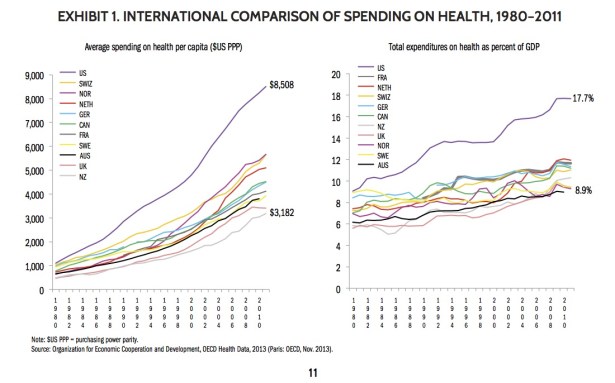
Is it right that Americans pay more than the rest of the world for poor health outcomes?

A more righteous beginning would be asking: how we can improve the health of the most people affordably, simply, and with minimal government intrusion into our private lives?

Let’s start  by considering the most obviously cost-effective measures that improve quality of life. We have evidence to show which interventions these are! It isn’t a political opinion, but a matter of observed fact.

We might include approaches currently covered in various forms by insurance: teeth cleanings are known to manage bacteria that trigger heart attacks and strokes, plus they spare one’s ability to eat; vaccinations for both children and adults have shown their value in improving lives.

But shouldn’t we also look at wildly effective interventions such as regular exercise? Here is the health-promoting miracle everyone would clamor for if it were a drug, but your insurance won’t consider helping you pay for it today unless you’re obese. Being sedentary diminishes health at any weight; the insurance overlords have decreed that’s not their problem because their business is earning money by taking a cut of medical interventions, not improving health.

Maybe a fair, universal approach could include giving each of us the option earn more health care choices by putting in time working out in a gym? I’d say that gives the patient skin in the game.

Prevention is cheap, but it doesn’t rile up the extremist political base, so we ignore what could be a boon to our entire nation. Straightforward programs like easily accessed routine preventative care and school meals for hungry children tend to be cost effective.

I would argue that health-promoting endeavors serve us all as more Americans live healthy lives of purpose. Too bad there are no immediate headlines in that to reward pandering politicians.