
DuoLingo rank in top 3% explains how I passed pandemic time

Perhaps because the pandemic gave me fewer distractions, I stuck with DuoLingo for most of 2020, primarily studying German and Spanish this time. I practiced there more than ever before, and I earned my longest continuing streaks.

I believe I created my DuoLingo account sometime during DS1‘s first year of home schooling, which would put that half a dozen years ago or so. My history with the platform is therefore fairly long, but my use has been sporadic. I come and go with all of my language studies, often in preparation for a trip, but I also use Pimsleur tapes and other resources, and I jump around between languages including those I started in school (Spanish, German, Japanese) but also occasionally French, Russian, or any other language I’ll be encountering in my travels.

Books foreign language learningI’ve tended to view DuoLingo as a game, a dabble, or a linguistic lark. I’m already on record on this point: I am a dilettante.

According to the 2020 Year in Review report Duo sent me this December, I ended up in this year’s top 3% of users. Who would’ve thought it? Yay, me!

DuoLingo 2020 Year in Review analysis

Whether these reports are a new feature, or if I’ve simply been “inactive” by winter in the past, this is the first time I remember receiving such a summary.

2597 minutes of language learning only averages out to about 7 minutes per day, roughly 50 minutes per week, so my minor obsession with the platform over the summer wasn’t too pathological. Nor is such a commitment sufficient, really, for anything except a nifty end-of-year ranking worthy of a self-congratulatory blog post.

Am I great at German now? Na ja, I’m afraid I still require subtitles to watch Nailed It! Germany or Dark on Netflix. Fluent, I ain’t!

Then again, the power of spaced repetition for retaining knowledge is undeniable. I’m hardly fluent in any language but my first, yet I have certainly cemented additional vocabulary in German and Spanish in 2020.

DuoLingo’s tag line is something like: “Learn a language in just 15 minutes per day.”

Analog wall clock showing 12:06The reality is that few will actually commit to the process, and almost no one can achieve fluency using any single tool. Even if you do commit 15 minutes per day to DuoLingo, you’ll be unlikely to be ready to address the United Nations without a whole lot of “something else” under your belt.

Also, the CEO is the person who invented CAPTCHAs, so there’s that working against DuoLingo’s place in my heart, too. I despise those stupid things.

Screen grab from DuoLingo showing 129-day streak achievementMany of us are susceptible to game-ification, however, so I encourage langauge learners to give DuoLingo a try. Extrinsic motivation isn’t such a bad thing for a necessary—yet repetitive—task like vocabulary study. I jealously guard my months’ long streak of continuous* days’ use of the platform. No stack of flash cards has ever kept me on track so continuously; not even the fear of low grades in college courses was as compelling as hoarding an imaginary currency called Lingots.

I’m 21 topics away from completing Level One of every available topic in German, the language I study most often on the platform. I’ll earn a completely meaningless Achievement dubbed “Conqueror” when I make it to that lofty(?) goal.

I’ve only topped out at Level Five on a single topic, Basics1 before the castle icon indicating Checkpoint One. It’s interesting, actually, recognizing from perusing the DuoLingo chat boards how some of us approach a language breadth-first, whilst others prefer a deeper dive, completing each topic up to its max in turn before moving on to the next.

I suppose the choice to do otherwise feels as obvious to other learners as mine does to me!

German has five Checkpoints or collections of topics, whereas Spanish has seven. Some languages are more popular than others, and the platform seems to offer more content for the languages users demand. Rational of them, I suppose.DuoLingo screen shot showing one more Topic to complete before Checkpoint 3 Castle is reached

I’m just shy of Checkpoint Three en español.

DuoLingo is free, so it is well worth its price. Ads are a significant annoyance when using the iOS app, but I don’t see any in the web version running on my desktop though I do employ multiple ad blockers.

The number of ads shown seemed to increase with total usage on the iOS app; I might not have kept up with it if I’d seen ads after every lesson from the beginning like I do now.

It’s worth noting that the ads in the app occur only at the end of each topic lesson, so I can and do cover my screen with my hand until the close button becomes available, and unwanted screeching video noise pollution can be silenced when it does occur. Moderately annoying still ads outnumber intensely annoying video ads on DuoLingo in my experience, but the ads to which you will be subjected are no doubt dictated by some algorithm outside my ability to predict on your behalf.Calculation of 41 weeks + 3 days times minutes per day = 417,600 minutes

I appreciate DuoLingo’s year end report for an accounting of how I spent 2597 minutes of pandemic isolation. Now if only I had such complete records for the other 415,003 minutes of it. I have some doubt that the balance was spent in so edifying a manner!

* Full disclosure: I have used a “Streak Freeze” save at least twice, so my current 129 day streak is somewhat less impressive than it looks.

FYI French has nine, Russian has five, and Hebrew has seven. You’ll have to do the resources yourself for any of the other 32 languages available to English speakers that are not in my DuoLingo queue.

Language learning gets silly: Duolingo and a love of mayo

I’ve read on the internet that some people think the worst part of Duolingo is its silly sentences.

Really? Wirklich?

Silly sentences are my very favorite part!

Screen shot of DuoLingo lesson about love and mayoA recent example?

Ich liebe dich nicht, ich liebe nur Mayo.

If you guessed that this sentence means:

I don’t love you, I only love mayonnaise,”

you would be correct.

Now the question becomes, do you love this sentence, or do you hate it?

It’s okay by me if you love this sentence and you love mayonnaise. This is a place for Really Wonderful Things, not judgement, at least so far as condiment choices go. Just don’t expect me to join you in tasting spicy hot sauces.

Condiment bottles: ketchup, mayo, mustard, harissaAt least one language learning blog complains that nonsense sentences do budding polyglots great harm. No one needs this sentence! Why study this?

And yet, for me, the process of practicing vocabulary can get a little dull. By the third repetition of the same phrase, I start to act out, if only in my mind.

Okay: more often than not, I act out outside of my mind, and by proclaiming dull stuff in loud, silly voices from my desk. My kids just adore this behavior while undertaking distance learning, as you can imagine…

Music iPod headphonesI suppose that there are dutiful users of Pimsleur and other audio language study programs who slog cheerlessly through the spaced repetition of those early, monotonous phrases.

My name is X.

I am from Y.

What is your name?

Do you come from Y?

I speak Z.

Do you speak Z?

For me, this inevitably leads to acting out these phrases in the most extreme accents and postures I can manage whilst attempting to approximate the correct “target” foreign accent in a Monty-Python-esque masquerade.

When I’m laughing, I’m learning. Rote repetition turns into a bit of fun. If I’m internalizing the correct grammatical construct, does it matter if my sample sentence borders on insanity? I expect there are lunatic speakers of every living language.

Duolingo loves to talk about ducks and what they do. It’s quirky, but I think it is actually one of the better aspects of the program. The weirder the sentence, the more attention I end up paying to an otherwise predictable practice question. Contrary to what the critics suggest, I can see differences between how the platform presents unique languages that reflect each diverse culture.

I have less loving things to say about the evolving intrusiveness of ads in the ecosystem. Duolingo is far from perfect, but very much worth its price: free.

With a little sprinkle of silly spice, Duolingo has recently kept me committed to a 58 day streak where I’m practicing two to four languages every day. There are worse ways to season one’s studies!

My level varies between 1 and 3 between each of the languages I study on Duolingo, so I’ve seen more than just the most basic introductory lessons for at least German and Spanish.

I would advise, however, that beginning a completely new language on Duolingo seems unlikely to be satisfying or particularly effective, especially where a new alphabet is required. I’ve had classroom exposure to both Russian and Hebrew, but my alphabetic weakness renders the lessons too hard on the mobile platform where you get five strikes (lose 5 ♥) and you’re cut off for the rest of the day. I only study non-Roman-alphabetized languages on my desktop computer with Duolingo for that reason: you don’t run out of hearts on the desktop! Even French stymies me in writing; silent letters are my kryptonite. Sigh.

“Misuse of the lavatories will be punished” heard on Deutsche Bahn train from Austria

Stuff you don’t want to hear as a visitor on a foreign train:

Misuse of the lavatories will be punished!

img_7012This was heard aboard the Intercity (IC 118) train from Austria to Germany.

Further statements by the conductor made it clear his admonition was regarding violations of the smoking policy on board the train (i.e., No Smoking, not even while hiding in the WC.)

img_1403

Intercity First Class compartment on IC118 train from Austria to Germany in 2018

I will admit that I was a bit nervous before he clarified. One assumes one’s restroom behavior is similar to that of others, but, after all, it isn’t something easily brought up in conversation with one’s compartment mates whose native language and culture differs from one’s own.

Though the finer nuances of European international relations are beyond me, it seemed clear that the German conductor, upon taking over after the border crossing, was speaking specifically to Austrians on board.

I’m guessing he did so because Austria’s national attitude toward public smoking lags so far behind that of most modern states, but it might just be because the Germans are more strict about rule enforcement than the smaller nation sharing its language and a border to the south. Or maybe Germans just have a thing about bossing Austrians around?
As a tourist, I simply followed every rule as carefully as I could and took special care not to get up to any hijinks in the lavatories. One thing I definitely don’t want to experience of another culture is how they punish people on trains!

Prevalent smoking should, perhaps, keep you from visiting Austria

Austria is a lovely place to visit. It has gorgeous scenery, world class art and architecture to enjoy, and a population that generally struck me as warm and welcoming.

img_0895Bilingual acquaintances from the German language learning camp in Minnesota we attended told us that we would be given more opportunity to practice our speaking skills in Austria when compared with Germany. I found this to be true.

Austrians were, as a rule, friendly and helpful. They really didn’t immediately switch to English when they heard my attempts to speak deutsch. (Germans generally do, in my experience. And, yes, their English is better than my German, almost to the man, and woman, and very small child...)


Perhaps the one overriding negative experienced by an American tourist in Österreich—if the language barrier is a benefit to you as it is to me, as opposed to a real barrier—is the constant exposure to second hand smoke.

img_1055.jpgI’m old enough to remember the bad old days of smoking sections in the closed compartment of an airplane, though, thankfully, those disappeared before I began flying several times per year to attend college. Smoky bars and restaurants where I wouldn’t go with my friends due to air pollution were a real issue well into my young adulthood.

Being in Austria is like being transported into the past in this regard. It took me several days to adjust. Young people in the USA today probably don’t have the adaptive response to scope out a cafe before taking a seat lest one inadvertently land in the stinking smoking section.

Though there was some Austrian legislation enacted in recent years to create separate smoking and non-smoking sections in restaurants, I still experienced unpleasantly smoky interiors several times during my trip.

Worse yet, it seems that Austrians don’t feel a need to segregate outdoor space for both smokers and non-smokers in any way. Some of us are sensitive enough that, no, even being seated the great outdoors is not enough to make it okay to sit at a table adjacent to or downwind from an active smoker.

My eyes water, and I start to cough. It’s not posturing; the smoke simply does affect me that quickly. My tearing eyes swelling shut and the irritation in my throat make me look around for the source, not the other way around.

Worse yet, because smoking is taken so much for granted in Austria, newcomers into a restaurant or onto a terrace who plan to smoke don’t think to take seats at a maximum distance from non-smokers who are already there. Try though I did to sit “far away” from all the smokers in otherwise lovely cafes, I was constantly being smoked out by new arrivals in Austria.

img_9405

These polite Austrian smokers sat at the stern of our pleasure cruise ship on the Danube, but the entire open top deck stank of cigar smoke from one man sitting forward at the bow

I gather that the xenophobic right wing government* currently in power is working to defend the rights of smokers even more violently valiantly in Austria. What a tragedy for the health of Austria’s citizens. Because, while I am easily swayed by libertarian arguments on many issues, smoking is simply not the same as free thought or speech.

The smoker has at least the option of a filter between himself and the known carcinogen he opts to ignite and inhale; standing nearby, my right to breathe freely is stolen from me.

Smoking in public places fundamentally infringes on the health and safety of others in the space. There are few other vices so directly malevolent to the public good.

Heavy drinker? While you could overindulge and vomit onto my shoes, you may be a quiet, maudlin drunk and not affect me at all. There is no equivalent for smokers. Anyone in the presence of a lit cigarette is being affected; the only remedy is to leave.

When someone invents the “smoker’s spacesuit” that operates with complete isolation of its user’s air supply and exhaust, there will be room to discuss the rights of smokers to light up in crowded public spaces.

I acknowledge your right to smoke, but I’d say the responsibility you shoulder when exercising that right is to maintain a great distance between yourself and others while you do so. The fact that you can no longer smell smoke from a few feet away is a part of the burden you’ve elected to carry with your habit; healthy people can be negatively affected at a dozen feet or more.

I was charmed by many kind, witty, thoughtful Austrians whom I encountered there. It was otherwise a wonderful place to visit, and there are many sights around the country I’d love to come back to see. Until a more modern and health-conscious public smoking policy has been enacted, however, I will probably stay away, and I would most certainly never take my asthmatic child to such a dangerous place.

Schade. What a shame.

*Self styled as the “Freedom Party,” though formed by former Nazi party members after WWII. Once again, do we see the same party harming others to grant themselves more freedom to enjoy their own lives?

A NY Times article I read while writing this post goes into more details of the political situation.

Just enough German to be paranoid: hören vs. gehören

Sometimes, a little knowledge is a dangerous thing.

I’ve “been studyingGerman for over 20 years!

But, of course, that misleading statement represents one academic year of university courses in the language, then a decade’s gap, and eventually picking it up again as an autodidactic hobby when one of my kids started to study German in school.

Ich verstehe nur ein biβchen Deutsch.I don’t know where I stand as far as the state sanctioned “level” of my ability to understand the language, but I am almost finished with the Pimsleur Level II audio course.

PimsleurI think my official designation is probably something like “rank amateur,” or “what’s lower than A1?”

Case in point: I was researching a future trip and using the Wiener Linien website to download a PDF map of the public transit system. I found this tag line printed on the bottom of each map:

Die Stadt gehört Dir.

Die Stadt gehoert DirThis gave me pause. The more learned amongst you can chuckle knowledgeably while reading through my thought processes in the rest of this post.

I’m quite clear on what “Die Stadt” means. Die Stadt*is “the city.”

FlashSticks German deployed1

Die Lego Stadt, or Lego City

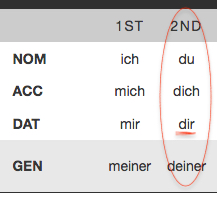
“Dir” is the second person informalpronoun for “you.” It’s used when the word “you” is the indirect object in a sentence.

I frequently make mistakes about when to use the accusative and dative cases as I create (i.e., speak) my own sentences, but I always know who we’re taking about when I hear du, dich, or dir.

German pronounsIt was the verb that confused my weak grasp of the German language.
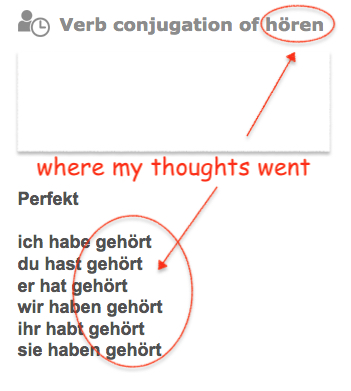
I know the verb hören pretty well. It means “to hear.”

verb conjugation hoeren

Naturally, I leapt to the conclusion that the Vienna transit authority was telling me:

The city hears you.

Or, giving it a creepier meaning, because I’m a bit paranoid:

The city is listening to you.

Even that might be a well-intentioned statement. My son also misread the sentencemaking the same mistake that I did. He thought Wiener Linien was indicating a customer service orientation with the same language I associated with eavesdropping.

Perhaps I’m the only one whose thoughts turn immediately to Big Brother in 1984 and “his” perpetual observation of the hapless citizens in that dystopian classic?

Google translateMy friend, Google translate, taught me the error of my ways. In fact, Wiener Linien would like me to know that:

The city belongs to you.

That’s so much better, right? Especially if I’m just visiting as a tourist. I mean, how generous, but, really, Vienna, you needn’t go to so much trouble!…

The verb that is actually being used in this sentence is gehören. I should probably learn it. “To belong to [someone]” is an incredibly helpful thing to be able to say when traveling.

I recognize that I am easily tricked by German verbs that begin, in the present tense, with “ge-“ because of how the past perfect (Perfekt) tense is formed. I.e., usually, by adding “ge—” and doing some other stuff to the end based upon rules I’ve read but not memorized.

Please consult someone who actually knows German instead of trying to learn any grammar specifics here. Otherwise, you, too, could frighten yourself as to the actually well meaning intentions of public transit authorities in German speaking countries.

A little knowledge clearly is a dangerous thing. Which somehow forces me to conclude with “the rest is commentarynow go study!

*Stadt being a false friend for the English word “state,” but clearly a related word in the sense of historical precedents such as the Greek “city-state” concept.

My apologies to Maimonides.