RIP memorial demitasse, or the perils of living with autoimmune arthritis

Assessments used to measure the progression of autoimmune disease—like the one I live with—often include questions about how symptoms interfere with daily life. When arthritis afflicts the small joints of the hands, sufferers like myself experience the perils of managing common fragile objects.Starbucks wish you were here ornament demitasse - 3

Case in point: the demise of a demitasse cup I used every day.

This cup was a gift from my mother who passed away in 2019. Today, I fumbled it while loading the dishwasher. It cracked when it hit the counter, one corner crumbling to bits, then continued on to finish shattering against the tile floor.

R.I.P. Starbucks “You Are Here: Oregon” demitasse cup!

Starbucks wish you were here ornament demitasse - 1

My favorite vessel for my daily shot of espresso joy is hardly the first victim of my less-than-nimble MCP and PIP joints.

There’s a particular glass pitcher I use to refill my beloved Zojirushi countertop hot water boiler.

Because my hand slipped perfectly between the pitcher’s handle and body when my joints weren’t swollen, it was my yardstick for physical manifestations of arthritic flares. Swollen, the knuckles—where the base of my fingers meet my hand, or, less often, even the middle joints of my fingers—were too thick to slide into that same space. It made me feel less crazy to have confirmation that my symptoms were real,* physical, and not “all in my head.”

One clumsy morning, I bashed the handle off the pitcher as I maneuvered it between faucet and kettle. Somehow, I managed to rap the fragile handle against the edge of the counter as I lifted it out of the sink.

The result is a far less useful, slightly sharp nub on an otherwise pretty jug:Patterned clear glass water pitcher with top stub only of broken off handle

It was such a lovely pitcher, I still use it—though with even more care—for the same task. The vessel just can’t serve its secondary medical alert function anymore. Also, it is rather trickier to keep a hold of, so I tend not to fill it full to keep the weight manageable.

In the grand scheme of things, these are trivial losses. My hope in sharing this story of small failures is to illuminate—for those fortunate enough to enjoy fully able bodies—another of the small daily battles waged by someone living with even minor infirmities.

They take a toll. They have a cost.

Living in a world designed and built to be adequate to your needs—which is the happy reality healthy people inhabit—is extraordinarily convenient, yet easy to overlook until some change in one’s own status lays bare every discrepancy.

* For many patients with conditions that can’t be definitively diagnosed by simple tests like blood work—especially when the complainant is a woman or a person of color—it is common to feel, if not to be, dismissed as a mental patient instead of acknowledged as the unlucky sufferer of a valid physical ailment. A recent BBC story describes how even physicians with disabilities are greeted with suspicion by the medical establishment.

Masks may be liberty-preserving alternative to mandatory vaccines or vax passports

There may be an alternative to mandatory vaccines and the inherent privacy and security concerns of either paper or electronic vaccine passports: allow people to opt out, but normalize the use of masks in densely populated, public, indoor settings when conditions suggest caution is demanded.

In the United States, this requirement should be tied directly to CDC reported rates of dangerous, communicable diseases with wastewater surveillance informing decisions. Medical research should be funded to track the effectiveness of masks against flu and anything else that’s feasible, not just COVID-19.

Ongoing investigation of the role aerosols—and inadequate ventilationplay in spreading common diseases demands equal attention and funding.

I, for one, would not return to an office as of May 2021 without a mask on my face if the space didn’t promise four to six air changes every hour or a fully vaccinated cohort of coworkers! This Wired story is a must read for those who’d like to understand the origins of medicine’s deeply flawed 5 μ myth defining “airborne” pathogens.

While our coronavirus memories are fresh, we owe it to future generations to prepare better for the next global outbreak. It is as inevitable as SARS-CoV-2 was. Fumbling our collective response, however, is not preordained.

We’ve learned a lot during the course of the coronavirus pandemic.

Ample real world evidence is now available suggesting that even simple homemade cloth coverings reduce the risk of infection from at least this one airborne virus. Flu also virtually disappeared during the 2020-21 season, though that could be as readily attributed to social distance and isolation as opposed to masks.

In the absence of the worldwide supply chain disruptions common early in this pandemic, more definitively effective surgical and N95 masks are easily obtained and affordable. Employers with public storefronts should have boxes of them deployed in the workplace in the same way food service companies provide gloves to their workers.

Unfolded ProGear N95 mask sitting in front box of 50 it came in

As with gloves and hairnets in restaurant kitchens, masks should be the immediate, hygienic response to entering the personal space of unknown persons with unknown vaccination status while any community is in the throes of an infectious agent.

Massachusetts’s governor is quoted in a May 7th Boston Globe opinion piece as saying, “some people have ‘very legitimate reasons to be nervous about a government-run program that’s going to put a shot in their arm.’” The same piece goes on to report, “Attorney General Maura Healey… this week repeated her call for public employees to be vaccinated as a condition of their jobs.”

Requiring every public employee in a customer facing position to wear a face mask at work unless s/he chooses to offer verifiable proof of vaccination seems like a cheap, simple, practical solution to me. As every scientifically literate, law-abiding citizen of the United States now knows, wearing a mask is no more difficult* than wearing pants.

Rome, the power house of the ancient world, believed trousers were ridiculous, barbaric garments. Quite literally, Romans, like the Greeks before them, saw pants as uncivilized clothing fit only for uncouth Goths and Vandals. The entire Western world, and most people around the globe, now don trousers without compunction. Masking one’s face requires no greater degree of adaptation!

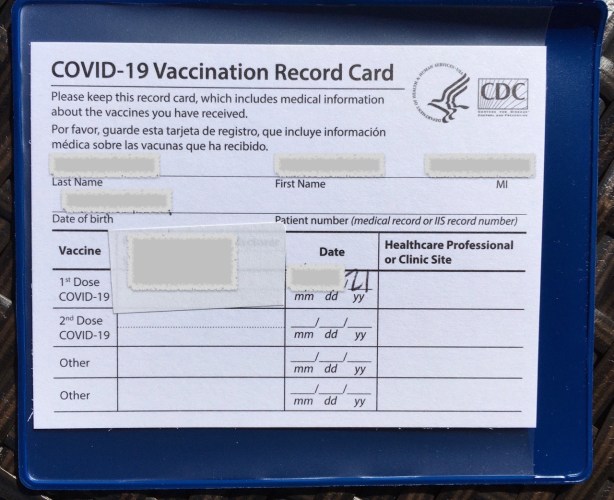
Most of us could decide which we prefer at work: to wear a mask, or to accept vaccination. Crucially, the public at large ends up protected either way.Redacted official CDC COVID-19 Vaccination Record Card

I think it is likely that I, personally, will never want to fly again without a face covering, if only because I’m so well aware of my own tendency to touch my face and even bite my nails when experiencing anxiety. It’s a terrible habit I’ve never been able to break, but a comfortable face shield or mask would remove almost all of that risk to my health.

There will always be liars and attempted cheats, of course. Responses to those caught committing public health fraud should be proportionate and focused on preventing harm to the community.

Perhaps being fitted with a device designed like the ankle bracelets employed for house arrest for a period of time would work, offering a visible warning to strangers while broadcasting via Bluetooth? a message alerting those in the vicinity of the need to increase social distance. This could be a system that works with individual’s cell phones, or a device required for public occupancy of spaces meeting certain size or density limits rather like the requirement to install smoke alarms and fire sprinklers before opening a hotel or nightclub for business.

The primary solution is to normalize the continued use of masks in dense situations where we crowd together with unknown persons. The secondary need is for public spaces to meet reasonable, updated standards for safety in light of our current understanding of risk in the post-COVID-19 world.

Once COVID-19 vaccines are fully approved by the FDA, I do believe that employees who work specifically with the most vulnerable population should be required to accept vaccination or leave those particular roles.

Aides in nursing homes should not be able to opt out of coronavirus vaccines, nor the flu vaccine in normal years, nor should nurses serving the immune-compromised. Prison guards—who work with populations literally unable to escape from unvaccinated sources of exposure—are another obvious group whose personal choices should not be allowed to endanger the lives or health of others.

The actual conditions of employment for such positions demand a workforce that doesn’t subject other people to unnecessary risk so easily mitigated by inoculation. Case in point: the unvaccinated Kentucky health care worker who caused the death of three elderly residents of the nursing home where s/he worked. To pretend otherwise makes a mockery of both human decency and common sense.

In another example: a recent study published in JAMA showed that 46% of organ transplant patients produced zero antibodies after a complete 2 shot course of SARS-CoV-2 mRNA vaccine. It’s unreasonable that such individuals should be unknowingly subjected to the ministrations—however well-intentioned—of unvaccinated health care workers, certainly not without the immune-compromised patient’s being informed of their relative risk and given the opportunity to offer fully informed consent to taking said risk.

Face masks could also offer an effective solution for the conflict between public school vaccination requirements and anti-vaxxer parents currently allowed in some states to claim religious or other non-medical exemptions for their children.

Further research might prove that masks are not effective against every disease against which we have mandatory childhood vaccinations, but face coverings could potentially eliminate the friction between parent choice and community health in the context of the vital public good which is free, universal education.

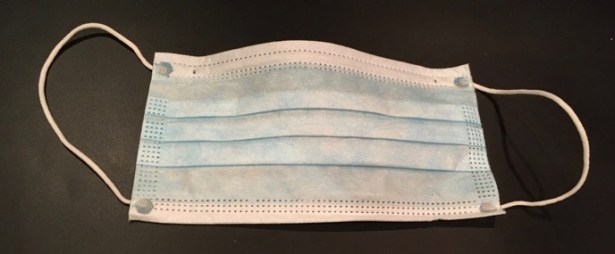
Where freedom is the prize—and outbreaks of vaccine-preventable childhood infectious disease remain rare in America—I’d argue that the value of face masks as an alternative to mandatory injections is well worth exploring.Disposable surgical mask

Western medical science was patently wrong, before COVID-19, when it declaimed that face coverings offered no protection from infectious disease. We still aren’t sure if they protect the wearer so much as those in the vicinity of a masked, sick individual, but we do have substantial evidence that widespread adoption of masks can protect populations during a deadly outbreak.

Perhaps most importantly, where even the most well-vetted, safest vaccine or medication carries some tiny risk of harm to its recipient, wearing an appropriate, well-fitting mask correctly has virtually zero chance of injuring anyone. Low cost interventions with few side effects are ideal public health measures.

Asian nations which had internalized the historical lessons of earlier epidemics had it right; many** normalized face coverings during flu season. Now we know better, too. Science proves its inherent value when we incorporate new data into our body of knowledge, especially when we recognize data challenging existing beliefs and ingrained patterns of behavior.

This BMJ editorial (PDF) highlights the danger of clinging to false understandings. This opinion piece by Dr. Zeynep Tufekci is well worth a read on the subject of organizations lurching only slowly toward acceptance of new information challenging medical and scientific preconceptions.

Before the next pandemic, we should take great pains to study when, where, and how cheap, medically risk-free facial coverings work to effectively control the spread of disease. How many thousands fewer would have died if we’d deployed masks as a solution worldwide in days instead of months in 2020?

This is not merely a political issue. It is a matter of public health. Where solutions exist that preserve both life and liberty, we owe it to democracy—and humanity—to explore every possible compromise.

Per the CDC, roughly 1000 flu cases were diagnosed during the pandemic 2020-21 season vs. more than 65,000 cases in the more typical 2019-20 season.

* As with trousers, some are the wrong size, and some are more comfortable on a particular body than others. Trial and error may be required to find the perfect fit for a given individual. Compared with the effort necessary to remediate infecting a susceptible individual with a life-threatening disease, this process is, at worst, a trivial inconvenience.

Per the Boston Globe: One of the major senior care operators in the state of Massachusetts came to a similar conclusion before COVID-19, though the quote perversely suggests that the organization was more interested in shaming staff members as opposed to protecting elderly residents:

“A year before the pandemic, Hebrew SeniorLife required flu shots for the first time for staff. Administrators achieved 100 percent compliance by imposing what seemed at the time an onerous condition: Holdouts would be required to wear masks 24/7 during flu season.

‘That was totally embarrassing then, but not now,” Woolf said. “We don’t have that hammer anymore.’”

In my opinion, after legitimate scientific studies were conducted to confirm that mask use by unvaccinated staff protects vulnerable patients to an equivalent level as vaccinated staff with faces uncovered, this could be a sufficient and highly appropriate alternative to mandatory shots in some cases.

Voluntary residential situations for children under age 18 should probably be held to a higher standard, in my opinion, and strictly require vaccinations for all but medically exempt participants. Absent direct parental supervision, it seems unreasonable to subject anyone else’s child to unnecessary risk due to personal choices that contradict the best current medical advice.

** Routine wearing of masks was imported to Japan from Western nations who’d adopted them as one response to the influenza pandemic of 1918-19. Unlike we Americans, Japanese culture never dropped them as a reasonable personal response to being contagious after the urgency of the Great Influenza subsided.

This Huffington Post article suggests that the Chinese adopted protective face coverings even earlier: “In 1910 and 1911, citizens were encouraged to wear masks to combat the pneumonic plague outbreak in Manchuria.”

The article goes on to point out that other Asian nations picked up the habit of covering faces during outbreaks due specifically to the SARS epidemic of 2002-2003. I’ve read that Koreans, in particular, actually viewed masks in a somewhat negative light as a foreign, Japanese import before the first SARS crisis.

Countertop mini dishwasher offers quick fix for dead appliance in pandemic-mode home

It is only with tongue firmly in cheek and a deep respect for the fact that I have enjoyed a relatively safe, comfortable, and very happy life that I state—cue swell of melodramatic music—the worst possible thing has happened:

My dishwasher died, mid-pandemic!
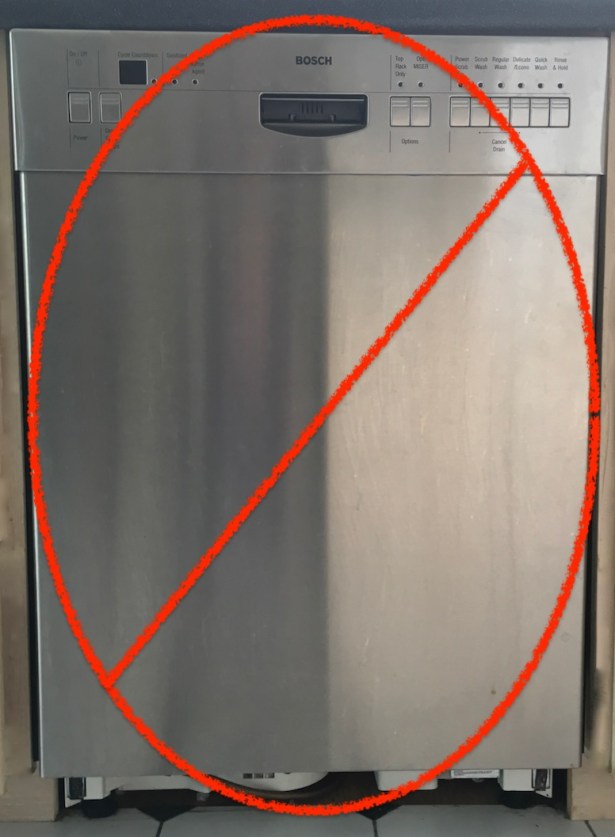
Red NO symbol crossing out broken stainless steel appliance

My dishwasher died, mid-pandemic!

This feels like a catastrophe because we run that appliance roughly four times most days with everyone working and/or learning remotely from home.

The Bosch dishwasher we got with this house no longer powers on following a few weeks of intermittent-but-increasing button-press failure. Our non-expert analysis of what was under the hood kick-plate didn’t reveal any obvious reset to try on our own. We have ordered a replacement.kickplate removed from stainless steel dishwasher showing hardwiring and soldered copper pipe instead of flexible tubing

For those who don’t already know me well, now is when I confess to being a thoroughly disinterested cook. The one time I directed a full kitchen remodel where my preferences reined over popular opinion, I bought almost literally the cheapest electric coil top! stove from Sears whilst splurging on a high end, German-made Miele dishwasher.

My priorities may not be common, but I’m quite clear on what they are.

The dishwasher is the most used appliance in our home excepting the stalwart, always-on refrigerator. It follows only central heating, running water, and refrigeration in my estimation of the crowning virtues of everyday technology.

Pandemic shortages & risks still affect appliance purchase, delivery & installation

Fortunately, more than half of our household of six is at least partially vaccinated, lessening the risk to us of having a plumber in to install a new machine. Risks to essential workers dealing with the public day in and day out remain much higher than those of their customers.

Since our atypical home includes a kitchen one story above ground level, we will also require delivery well inside the threshold. I imagine dishwasher delivery generally requires more than one single person. The model I chose weighs 107 lbs (48.5 kg.) That’s two more contacts outside our bubble.

Accomplishing this dishwasher replacement will mark the first time any tradesperson—let alone three outsiders—has entered our home since before the first shutdown began.

All of these health-preserving convolutions must also be viewed within the broader context of commerce in 2021. Plumbers were hard to book before COVID; getting one to show up now is beyond difficult.

Supply chains all over the world have been disrupted by the scourge of coronavirus infections. The Miele that I elected to replace my defunct Bosch SHU66C may have benefited in production from its maker’s domestic parts manufacturing, but getting the finished product from Germany to New England remains fraught with delays as of May 2021. The one I wanted due to arrive a few days after I contacted my favorite local appliance store is now back-ordered.

I’m not sure when I will get the new machine I’ve purchased, let alone how soon I can book professional installation by a qualified plumber.

I sought a short-term solution to maintaining household peace—and sanitation!—in the interim. A portable, countertop dishwasher is what I found.Aikoper countertop appliance on kitchen counter

Typical portable dishwasher requires standard faucets to accept adapter

I opted for an Aikoper Compact Portable Dishwasher with 6L Built-in Water Tank & Water Hose Inlet (Model KOP-DW2605A) ordered from Amazon.

Countertop dishwasher manual and warranty card

There were a few “portable” dishwashers available locally, but all were variations on the design I know well from my first apartment: full- or almost-full-size models that roll up to the sink and connect with a special “quick connect” adapter that screws onto a standard faucet. These adapters replace an aerator (i.e., a little mesh screen that twists off easily) and are widely available in hardware stores and online.

The issue with any of those models is that we installed a modern “pull out sprayer” faucet when we moved here.

Pull out spray heads are great for everyday use. I like the option for one fewer hard-to-clean protrusion from the countertop, eliminating the off-to-the-side sprayer I grew up with

Or, as we did in this home, integrating the spray function into the faucet itself frees up that existing counter cut out for installation of a plumbed in, multi-stage water filter. I find the tap water in our community distinctly unpalatable without filtration beyond a carbon block pitcher.

Either way, I didn’t want to change my self-selected faucet to accommodate short-term daily use of the countertop dishwasher.

My purchase of the Aikoper Compact Portable was also influenced by the fact that we have historically hosted at least one very large Thanksgiving banquet each year. I see this little machine as a way to more quickly zip through the multi-day process of cleaning multitudes of party dishes at holidays in the future.

For both cases, I would have to ditch the faucet design I prefer to accommodate use of most portable dishwashers. There’s no way I’m going to swap out my faucet in either scenario.

Tank based, compact dishwasher alternatives exist & solve common issues

On Amazon, I found a different portable dishwasher design.

Tank-based dishwashers like these seem to universally? include the option to connect via the adapter I’ve already described, yet they also incorporate a holding tank for the fresh, clean water that will be used to wash the dishes. A user can fill that tank via a pitcher or my preferred pull-out faucet, pouring water into the vented, screened hole on top after removing the loose-fitting white debris cap.

Once filled, tank-based machines complete their wash cycles without blocking access* to the kitchen sink throughout the run.

The included plastic pitcher and wide, flat funnel aren’t strictly necessary to manually fill the machine, but the funnel (marketed as the “pouring water assistant”) is particularly nice to have. Filling pitcher included with appliance, 1.8 L capacity

Since the pitcher is marked to have a 1.8 L capacity, you might expect that filling it just over three times and emptying into your dishwasher tank might be sufficient to prepare the appliance rated as having 6 L capacity. It seemed to require at least five pitchers-full the first time I ran the machine to test its functionality.

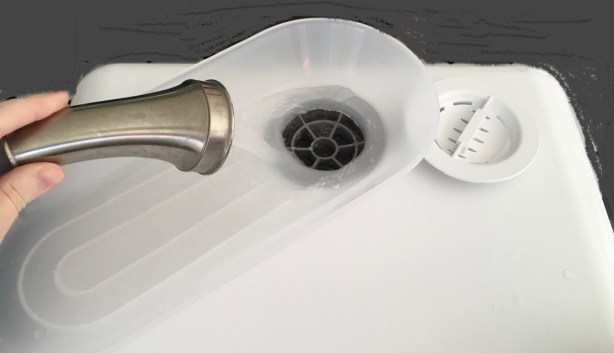
Filling with a pull out faucet sprayer is much more convenient, especially for those of us who lack hand strength and become exhausted easily lifting full pitchers of water. I found it annoying to fill the appliance via a pitcher.Filling funnel included with appliance
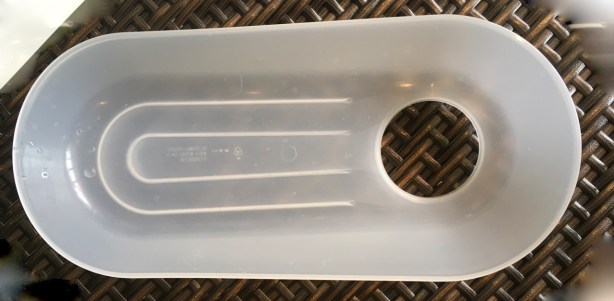
With the dishwasher sitting on a kitchen counter, it is a little bit high for me to reach over and fill, so I can’t see exactly where I’m aiming the water. The funnel helps channel every drop right into the receptacle where it belongs.Water flowing from pull out spray head into dishwasher filling hold
A 61 inch long water supply hose was included in the Aikoper box. The water supply hose has a right angle connection on one end which should help with keeping installation very close to a back wall. Remember that you will need a faucet adapter not included to install with this option.

If installing with the water supply hose option, your water pressure must be between 0.04 MPa and 1 MPa, per the Aikoper manual.

Because the water supply inlet and drain pipe outlet are set into an indented area at the back, bottom edge of the dishwasher and the supply hose has a right angle connection, the included hose should not require any additional clearance behind the appliance.

A side benefit of pre-filling the dishwasher with water, then letting it run without any connection to the household water supply, is that it eliminates that chilly scenario when a family member starts a built in model while someone else is showering.

In 2021, no one should live with plumbing that routinely scalds or runs cold, but that kind of annoyance remains common in many older homes.

Draining the used, dirty wastewater is also necessary. Tank-based dishwasher models like my Aikoper Compact Portable allow one to route the drainage hose into an adjacent sink or a large bucket.

The drain hose pictured was included in the Aikoper box. It’s about five feet long.

Because the water supply inlet and drain pipe outlet are set into an indented area at the back, bottom edge of the dishwasher but the drain hose has a straight connection, about one inch of additional clearance may be required behind the appliance if you’re trying to get it as close to a wall as possible. I have found replacement hoses with a right angle connection on Amazon, but I haven’t purchased one to confirm this gap could be eliminated.Ruler and cardboard showing gap between back of appliance and bent drain hose as if pushed back against a wall

A small suction cup on the hose is supposed to keep its end inside your grey water bucket, but mine does not stay fixed to even the smoothest plastic waste container I’ve tried. Happily, the exiting water does not seem to flow with enough force to cause the hose fly around spraying filth, as was my initial fear.

Obviously, if you drain your dishwasher into a bucket, remember that you’ll need to lift the receptacle for emptying. With the machine’s approximately two gallon (6 L) capacity, expect a weight of about 15 lbs (6.8 kg) of grey water to dispose of after running each load of dishes.

Those of us with arthritis or other physical limitations will benefit from emptying the waste bucket midway through a wash cycle. Doing so reduces the effort required vs. lifting a full bucket. I’m careful to keep a second, smaller dish handy to put the wastewater hose into while I do this, however, lest the machine discharge additional grey water at an inconvenient moment and flood my kitchen with filth!

dirty grey water in Rubbermaid Commercial square containerMost people probably have a sturdy office sized trash can, five gallon bucket, or other suitable container for catching wastewater in the quantity required. If looking to purchase a new, highly suitable receptacle, I’d suggest a Rubbermaid Commercial Crystal-Clear Square Storage Container in the 8 quart size which will accommodate more than 7.5 L, large enough to prevent splash-over messes.

The 6 qt size pictured above in the same product line is sufficient to the task, but only just, and mine ended up perilously full when I used it without taking care to empty mid-cycle. You could make this container work for the task if you have one on hand, but I wouldn’t recommend its purchase for this particular job.

A bucket with a handle or handles will be easier to lift and empty.rubber cap stuck on appliance with strapping tape

A small, black rubber cap stoppered the drain port on the back of this dishwasher. In order to avoid losing this small piece, I used the tape that had been employed for security during its shipment to adhere the cap to the back side of my appliance. It will be useful to avoid inconvenient drips when moving the Aikoper immediately after use. Small amounts of water are likely to remain inside the machine for hours or days after the last cycle.

Dishwashers save water vs. hand washing

This seems like the right time to point out an easily overlooked fact: full size, modern (post-1994) dishwashers clean an entire load with about 5 gallons of water. Hand washing a sink full of dishes consumes more than five times as much—up to 27 gallons of fresh, potable water—while not offering any improvement in results.

The mini sized Aikoper Compact Portable uses just 1.6 gallons (6 L) per load though, to be fair, an overflowing double sink full of dirty dishes might take two cycles to get through.compact dishwasher settings shown: Normal, Hygiene 162 F, Fruit
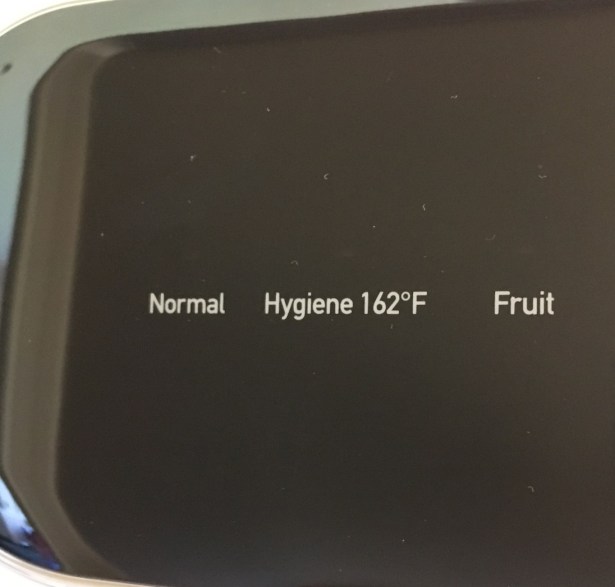
Typically, dish-washing machines increase water temperatures to a sanitizing 140-150 °F, well above suggested water heater settings designed to protect children from scalding while saving energy.

The U.S. EPA recommends setting hot water heaters to 120 °F.

My new Aikoper Compact Portable dishwasher uses 162 °F for its hottest cycle, well above the temperatures at my tap. In 2021, even a little appliance such as this one includes an internal heating element to optimize wash and rinse temperatures and improve hygiene.

Growing up in the American West, I was taught to wash dishes using two basins for soapy and clear water; we never let the faucet run throughout the task! My family appears unable or unwilling to internalize these habits, so my search for a backup dishwasher has an altruistic motive as well as supporting my hatred for manual household chores.

Energy use—according to the Energy Guide yellow card standard with all American appliances for almost as long as I can remember—compares as favorably as one would expect between my broken-down Bosch and my new portable.

The U.S. Government suggests the Aikoper Compact Portable will consume 150 kWh/year of electricity.

Keep in mind that compact and full size dishwashers are not directly comparable using this system. Also, due to the years that passed between issuance of the Bosch label and today’s Aikoper label, average electricity rates grew from 8.28¢/kWh to 13¢/kWh whereas natural gas averages went from 65.6¢/therm to $1.05/therm in the same period.

My broken, full size Bosch was expected to consume 430 kWh/year vs. 150 kWh/year for the much smaller Aikoper. By comparison, the new, full size Miele I’ve ordered is rated at 230 kWh/year according to the manufacturer’s website.

Aikoper Compact Portable: Do dishes come out clean?

More than any other fact or feature about the Aikoper Compact Portable Dishwasher, what most want to know first is, “Will my dishes come out clean?”

I always had to scrub or re-wash the spoons before. That doesn’t seem to be necessary with the new dishwasher.”

Continue reading

Service jobs were already underpaid & risky; no wonder workers don’t rush back

My family owned a small business that grew from two to eight stores during my adolescence. By the time I graduated from college, I had over a decade of work experience in retail sales, pulling orders in our small warehouse, and doing the office work supporting such an enterprise.

I grew up grateful for never having to take a job at McDonald’s to gain that first professional experience. My highly intelligent peers attending some of the best colleges in America took summer jobs as hotel maids and washers of cars on auto lots while I was already in high demand with data entry and database management skills by my late teens.

I had the great good fortune of being “the bosses’ daughter” when I took shifts behind the register in our stores, safe in the knowledge that no complaint from a customer would ever get me fired. That didn’t prevent me from seeing how precarious employment could be for minimum wage clerks and servers less favored by nepotism and auspicious birth.Pile of money

Extensive firsthand experience in retail has informed my behavior towards customer service employees ever since.

Throughout the pandemic, I’ve taken pains to tip well as we’ve ordered in our groceries and occasional meals—usually double what I would have paid before March 2020, but always more than any app’s minimum. When I read about the Trader Joe’s employee fired for asking management’s permission to deny service to customers who refused to wear masks indoors, I immediately wrote to the company in support of the worker’s position. I haven’t shopped at Trader Joe’s since.

Though the pandemic may finally be waning, I continue to go out of my way to patronize companies who’ve made firm commitments—and taken more visible steps—to protect vulnerable front line employees against COVID-19 itself and from abuse by customers who don’t believe in science or follow government mandates regarding public health.

Here’s a May 1st Globe article about restaurant employees exhausted by “enforcement fatigue” due to their role as the unofficial police of health mandates for diners.

Last week, after government figures were released showing a reluctance on the part of the unemployed to return to service jobs, every major paper* seemed to run op-eds and articles pondering why workers aren’t flocking back to staff restaurants and hotels. People whom I’m guessing have never worked in service seem to sincerely believe that overly generous unemployment benefits are a primary cause of this phenomenon.

The fact that these jobs pay low wages is usually mentioned, though, as is the reality that many working parents are still required at home due to school and day care closures.

Lower income parents are realistically facing the truth that their children, like themselves, face outsized risks at returning to in-person learning inside overcrowded schools with above average local case positivity rates for COVID-19. People of color are tending to keep their children home and continue remote learning at higher than average rates in my region, probably for this reason. I have yet to see this factor noted in news coverage of the unemployment issue.

What strikes me about almost every article is the near total lack of awareness of just how terrible service work can be. It isn’t just low pay keeping the unemployed away, but the enormous physical and mental costs associated with taking that work.

From the Washington Post:

“‘Employers are hungry for candidates, but job seekers don’t seem to have noticed that yet,’ said Julia Pollak, a labor economist at ZipRecruiter.

But workers are still hesitant to return, partly because they want to wait until they are vaccinated first and partly because they are discouraged after months of not getting any callbacks, says Pollak.”

I find this economist’s lack of insight into the rationale for the choices of these service workers baffling. They “haven’t noticed” job openings? I sincerely doubt that.

Realistically, the unemployed are weighing the risks of exposure to a dangerous virus which sickens them in greater proportion than it does their better-off managers vs. the paltry rewards of minimum wage in exchange for a constant barrage of abuse from the public.

The cost-benefit analysis seems obvious when the choice is below-sustenance wages vs. the risk of long term disability or even death from coronavirus. If I couldn’t afford to be out of work for weeks or months, I, too, would delay—as long as I possibly could—returning to service while persistent infirmity and death strike many thousands** of Americans every day.

Remember, these are the U.S. citizens least likely to have any paid sick time available to them. Only about one third of the lowest paid wage workers do, whereas the majority of those of us earning in the top 50%—sufficient to accrue an emergency fund—also enjoy the financial protection of paid time off.

Employers must face the fact that some of the lowest legal wages in America—a pathetic $2.13 per hour for tipped employees—are being offered to people with the highest odds of confronting unmasked customers with no recourse for self-defense: restaurant servers.

Best practices asks diners to cover their faces while staff is nearby; real world conditions never adhere perfectly to best practices. And then, a sizeable minority of Americans refuses to even acknowledge the risk they impose on servers through callous disregard of mask mandates where those rules are even still in force. Disposable surgical mask

Many COVID-19 believers themselves now act with selfish entitlement after receiving vaccines, ignoring the reality that no one knows if they could still infect people around them while basking, unmasked, in their own newfound protection.

Referencing the same Post article I mentioned above, at least one expert came closer to realizing the truth I find so obvious:

“Others say the reason workers without college degrees aren’t flooding back into restaurants and hospitality jobs is because the pay is too low.

‘We should be asking how we got to a place where service sector wages are so low and benefits are so nonexistent and workplaces are so unsafe and scheduling practices are so volatile that a mere $300 per week [on unemployment] may be better than the financial benefits and security of a job,’ tweeted Elizabeth Pancotti, a senior analyst on the Democratic-led Senate Budget Committee.”

(bolded emphasis on the coordinating conjunctions in this quote is mine)

Frankly, I’m gratified to see that an analyst for the Senate Budget Committee appears to have a better grasp on real world conditions for America’s working class clerks and servers than the labor economist at a recruiting company. I see that as evidence that someone in my government is doing her job.

Before the life-or-death threat of a pandemic, the reality was that a clerk in a shop or a server in a restaurant was treated as less than human during almost every shift.

When I last worked retail circa 2003, it was already common for customers to throw items onto the counter at my register, chatting on a cell phone and ignoring my presence except to shove a credit card or a handful of bills in my direction without any acknowledgement that I was there. I imagine the further proliferation of smart phones has made that kind of rudeness even more frequent.

I made the observation to co-workers at the time that these same people are probably the ones who complain if their calls are answered by machines when they try to contact large corporations.Contact phone

If the customers in a purely discretionary, higher end business like ours treated someone like me so poorly, it’s probable that conditions are abominable for those without my advantages.

As a teen selling beauty products, I was relatively well educated, mannerly, protected by a pale complexion and all the obvious signs of middle class economic status, never mind the confidence of being part of the ownership of our family business. At the bookstore, years later, my husband’s secure professional career sheltered me from any cost that could be incurred by protecting my dignity when customers behaved badly.

Let me add at this point that I sincerely enjoy working in customer service!

I get a charge out of delighting someone by finding what they want on my shelves. I like hearing the small stories behind someone’s search for an item in my inventory. I take pride in my ability to cope under the pressure of lines at my register, handling even a Christmas rush or malfunctioning equipment with aplomb.

For those of us who sincerely love people, there’s an instant dopamine hit of reward when you make someone happy, satisfying reasonable customers by furnishing them with what is needed or wanted. I’d always wished to work in a bookstore, and I joyfully recommended titles to interested shoppers while I did. I’ve known many healthcare workers and food service employees similarly delighted to nurture others via “caregiving” careers.

I was very good at front-facing customer service work, but, still, certain aspects of it were always dark and demoralizing.

About weekly, I would encounter a customer difficult enough that my heart would race and my body would enter an adrenaline-charged fight or flight state. And, again, I was a socially privileged person working in a well-staffed chain store in an upper middle class, suburban shopping center or a busy mall. I can’t speak to conditions in mom and pop establishments in rougher neighborhoods.

I was never robbed on the job thank God, but I did experience fear for my personal safety on numerous occasions. I faced decisions about flagrant theft, mentally ill repeat patrons, one of whom began to cross lines of appropriateness in a sexual manner in our store, and many, many customers who felt entitled to raise voices and use crude language, for example, in response to strict return policies though such policies were clearly posted and printed on receipts in accordance with state law.

It was in spite of the regular—though, admittedly, perpetrated by a small minority—dangers and degradation of dealing with the public that I opted to return to retail sales when I left my last engineering role after 9/11 but before I had my first child. Even occasional angry or violent agitators can wield outsize influence on an employee’s sense of well-being

Those of us who could step behind a counter to avoid grabby customers with wandering hands have always enjoyed more protection from unwanted sexual attention than waitresses required to come within arm’s-length of their patrons as they set down plates of food. When you’re close enough touch a diner’s tabletop, you are also within range of any airborne virus, not to mention those “Russian hands” and “Roman fingers” attempting to cop a feel.

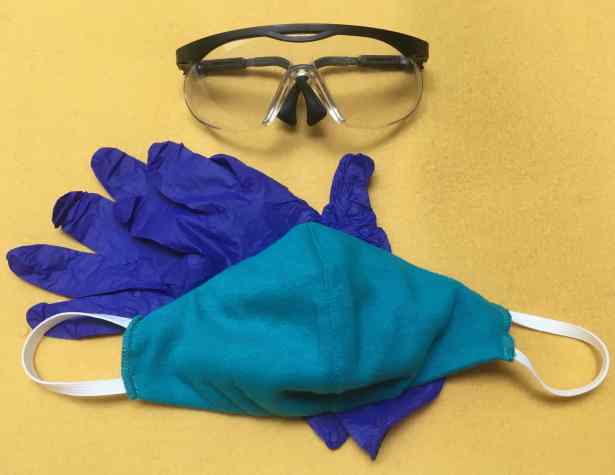
Safety goggles, cloth face mask, and disposable gloves

Reports abounded throughout 2020 of customers ignoring health restrictions such as mask mandates, berating and even becoming violent with service employees for asking them to comply with rules designed to protect everyone. These new insults must be added to the already poor working conditions that have always afflicted servers and clerks.

Partisan politics prevented some police departments from enforcing health mandates even when staffing levels did not, yet customer-facing service workers were already subject to dehumanization and harassment before health-related risk mitigation tactics became politicized. Even shoplifters and aggressive customers didn’t guarantee a timely visit from the authorities in my experience over a decade ago.

Employees will return to vacant jobs when the conditions and wages offered meet or exceed the risk of illness and harassment inherent to each role. There’s no mystery. Anyone who’s worked in service could explain the situation to those confused journalists and politicians, yet most of those would be amazed how rarely anyone thinks to lend an ear to the ubiquitous essential workers catering to us all.

Researching this post, I discovered a Business Insider article stating that the Trader Joe’s employee in question was rehired about a week later, possibly due to the furor on social media that ensued from his firing. I might shop there again in the future, but am personally unlikely to revisit this decision until pandemic restrictions have been lifted. As of April 27, hundreds of Americans per day are still dying of COVID-19, and tens of thousands are being diagnosed with it. Offering your employees safer working conditions only when public pressure forces you to do so does not speak to corporate values I want to support.

* Further examples from Boston Globe and the New York Times

** My reasoning for assuming thousands per day risk long term disability and death is as follows: For 29 April 2021, the New York Times reports 51,465 new COVID-19 cases and 697 deaths. A study reported in February 2021 that the percentage of coronavirus sufferers who go on to experience long term, debilitating symptoms is about 33%. One third of 51,465 new cases would suggest 17,154 “long COVID” (a.k.a., post-acute sequelae SARS-CoV-2 infection or PASC) are likely.

Screen shot of calculatorOne reason I’ve avoided working in food service—since a mandatory stint in my college dining hall as part of my financial aid package—or in health care is that those products are actually essential for life. The stakes, therefore, can be sky high, potentially justifying extreme behavior on the part of the guest. I’m unaware of anyone every dying due to a lack of professional brand shampoo.

Similarly, when I took a job at a bookstore, it helped me to keep my cool in the face of irate customers to acknowledge that their desire to buy a particular book was simply not a life or death situation… except, perhaps, if they sought a first aid manual!

Anglo-Saxon ideals aren’t the primary basis of U.S. government

As if her anti-Semitic claim that PG&E and Jewish bankers started California’s 2018 wildfires with space lasers wasn’t proof enough—whether due to mental illness or plain simple-mindedness—that Georgia’s elected Representative Marjorie Taylor Greene is unfit for office, her latest antics show that she lacks even basic education on the history of the government of the United States of America.

Together with Paul Gosar, R-AZ, the befuddled Congresswoman Greene was reported to be forming an “America First Caucus” to  promote nativist policies. Reps. Barry Moore, R-AL, Louie Gohmert, R-TX, and moral powerhouse Rep. Matt Gaetz, R-FL all publicly lent support to this morass of historical confusion.

In a quick search on the day this news broke, I failed to find the complete seven page document referenced, so I can speak only to public claims reported in several major American newspapers. Ms. Greene, it should be noted, backpedaled furiously after this news spread, joining colleagues in statements suggesting they hadn’t even read the mission statement in question before endorsing it.

I wonder how these lazy politicians justify cashing their paychecks? This isn’t a difference of opinion, but a dereliction of duty and evidence of a near total lack of qualification for their sworn duty to support and defend the U.S. Constitution.Reproduction of the oath of office by which new United States congresspeople are sworn in

Teaching U.S. history to my own home educated teen in recent years, I was reminded that our Founding Fathers were influenced by Native American forms of government when crafting the U.S. Constitution. Here’s an entire article on the subject from The History Channel’s website. The Founders obviously didn’t seek to duplicate any indigenous government, but remarks by Benjamin Franklin* amongst others prove they were aware of, and even relatively positively disposed toward, adopting the best notions they knew of—from any source—to form their “more perfect union.”

According to the Boston Globe, “the [“America First Caucus”] document describes the United States as a place with ‘uniquely Anglo-Saxon political traditions.’”

High school aged children are aware of the Iroquois Confederacy’s influence on the work of John Adams and Thomas Jefferson. Does the America First Caucus reject those former leaders as patriotic Americans, too? Is Trump the only man any of them will stand behind?USA flag - 1

I’m concerned by this new Caucus’ interest in Anglo-Saxon values in particular. The term Anglo-Saxon is out of date if meant as a reference to the British people, and the simple fact of the American Revolutionary War strongly implies to those of us with critical thinking skills that the Founding Fathers were not interested in maintaining an English form of government where colonies were taxed by the Crown without political representation.

Does the America First Caucus seek to emulate those tumultuous years in Britain between the end of Roman Empire and the Norman Conquest by William the Conqueror (a.k.a., William the Bastard)? Per the Encyclopedia Brittanica:

“[T]he various peoples commonly grouped together as Anglo-Saxons were not politically unified until the 9th century, and their reign over England was interrupted by 26 years of Danish rule that began in 1016 with the accession of Canute.”

Here’s a BBC overview explaining Anglo-Saxon Government written for children. Very little of it reminds me of American government with the exception of trials being conducted with community representation.

Speaking only for myself—but probably reflecting the will of most emotionally stable Americans—I would prefer not to live through centuries of incessant warring by disparate groups. I’m not really keen to be ruled over by Denmark, either, though I’d take orders from the current Danish government before submitting to the purported leadership of a reality-averse reactionary like Representative Greene.

Former U.S. Senator Rick Santorum of Pennsylvania appears to be cut from the same flawed cloth. On April 27th, The Boston Globe reported that he said the following though the emphasis is mine at a Young America’s Foundation event:

“We came here and created a blank slate. We birthed a nation from nothing. I mean, there was nothing here. I mean, yes, we have Native Americans but, candidly, there isn’t much Native American culture in American culture.

Former Pennsylvania senator Rick Santorum

Without a doubt, the forebears of most current American citizens arrived in the New World and did not find the trappings of European society to which they would have naturally deferred. The fact that those men could not, due to religious and cultural bigotry, recognize the humanity of those they encountered—let alone their technical and cultural achievements—was their own failing, not that of the indigenous peoples they subsequently massacred.

Modern scholarship now points toward the birth of human civilization in the central Andes (i.e., in the Americas) being of equal moment to the traditional European scholars’ foci of technological and social evolution: Mesopotamia, Egypt, the Indus Valley, and China’s Yellow River basin.

Being too shortsighted to notice the contributions of indigenous Americans is evidence of a lack of mental power—or intellectual rigor—on the part of the observer, not evidence of shortcomings on the part of the targeted society. Conservative culture warriors would do well to make a more careful study of the history they claim to venerate before blundering so ineptly into statements of rank ignorance.

I recognize the many contributions of Western Civilization to the formation of the United States of America. Disregarding great work—whether philosophy, art, or technical innovation—is folly, but so is ignoring the hybrid vigor of multiculturalism that led to the success that still brings scores of refugees from around the world here today in hopes of earning their own piece of our prosperity.

When I was a child, the “melting pot” analogy was falling out of favor due to a greater emphasis on appreciating diverse cultures over demands for cultural hegemony. I still recall a teacher offering the “tossed salad” metaphor to take its place. I reject that notion, too.

Tossed salad sees disparate ingredients jumbled together with no interaction between them until they’re masticated by an outside force. Shared governance and geography might be the salad dressing, then, but greens, carrots, and tomatoes have little influence over each other. They just happen to share a bowl. Separate but equal as policy failed America during that experiment in our past.

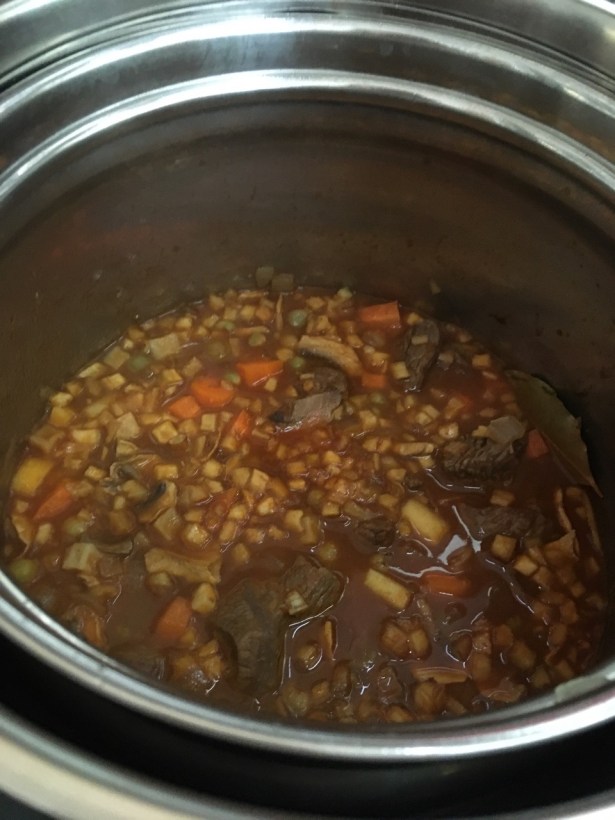
Thermal Cooker with stew-filled primary pot insertedHere’s my offering: America is more akin to a pot of stew than a melting pot or a tossed salad.

Every one of us goes into the pot—simmering required, it must be said, perhaps making my metaphor even more apt. Time and cohabitation rub our edges off, softening us from strict segregation and stark differences. Some chunks blur into pleasant similarity; others maintain more distinction, lending texture and complexity to the totality. The mass blends into richness and depth, and the whole ends up much greater than the sum of its parts.

There would be no gravy without every contribution; there could be no stew without admixture and synthesis.

When I consider the meaning of a term like America First, my mind goes to first principles. Our founders spelled out their impetus in splitting from the British Empire in the Declaration of Independence:

“We hold these truths to be self-evident, that all men are created equal, that they are endowed by their Creator with certain unalienable Rights, that among these are Life, Liberty and the pursuit of Happiness.”

Its 56 signatories did not specify that only American men, men of European descent, or Christian men exclusively were who counted; all men, they declared, are created equal, endowed by their creator with the unalienable rights for which patriots went to war, fought, and died. That foundational document should guide any America First Caucus crafted by people informed by the history of the United States.

Rep. Gaetz is currently under investigation for paying to have sex with underage girls, underscoring the lie that the Republican Party as a group in any way deserves its claim to the title of a “Moral” Majority.

* Letter From Benjamin Franklin to James Parker, 20 March 1751:

“It would be a very strange Thing, if six Nations of ignorant Savages should be capable of forming a Scheme for such an Union, and be able to execute it in such a Manner, as that it has subsisted Ages, and appears indissoluble; and yet that a like Union should be impracticable for ten or a Dozen English Colonies, to whom it is more necessary, and must be more advantageous; and who cannot be supposed to want an equal Understanding of their Interests.”

We supplemented our studies with the fairly light, quite mainstream Great Courses High School Level Early American History videos. One doesn’t need to delve into the works of Howard Zinn or any left-leaning sources to discover the framers’ interest in our nation’s indigenous peoples’ best practices, which they then combined with European ideas from philosophers such as Locke and Montesquieu to craft the foundations of our own democratic republic.