Lose the leaky liquids: Lush vs. J.R. Liggett’s shampoo bars head-to-head

Cramming all of your toiletries into a small plastic bag is annoying. Being forced to pull said sack from your crowded carry on at an inspection point with your third hand while simultaneously keeping track of your passport, tickets, valuables, and maybe a few kids for good measure is infuriating.

I’m not a big fan of the current TSA checkpoint process, and add my voice to those who describe the entire scene as “security theatre.” I won’t elaborate further today, but thought I’d put any grumpiness that shows up in my review of innocuous shampoo bars into perspective.

Many have complained about this trial by toiletries. An oft offered solution is to replace liquid products with solids where possible. Carry a bar of soap instead of a bottle of body wash, tooth powder or baking soda in place of toothpaste, etc.

Travel toiletries shampoo bar Lush in square tin - 1On such lists, you’ll usually read, “Try a solid shampoo bar!” And that’s the end of the advice.

Solid shampoo bar: what is it?

But how many shampoo bars do you see in an average salon or in the hair care aisle of your supermarket or pharmacy?

I believe shampoo bars are most readily available at places like Whole Foods or other health food markets. Every solid shampoo bar I’ve seen anywhere uses less packaging than all liquid shampoos, so some of the rationale for that is fairly obvious.

A shampoo bar is essentially just a bar of soap. Ideally, it is a soap or detergent formulation designed to gently yet effectively cleanse hair as opposed to skin.

Keep in mind for this comparison that I don’t require hair conditioner under normal conditions. My very fine hair is easily weighed down and my scalp is slightly oily. I do use a little conditioner at home to keep my ends healthy now that I have some coarser grey hairs, but I don’t bother to bring it when I travel unless it is a long trip in a very dry climate.

I’m using the following bar shampoos without conditioner when I give my evaluation.

J.R. Liggett’s Old Fashioned Bar Shampoo: a natural and affordable option

  • 3.5 oz bar
  • dimensions: 2.5” x 1.25” x 2”
  • retail $7.49
  • 6 varieties, including unscented
  • Made in the USA
  • Packaging is 100% paper and fully recyclable

These stats are for the full size bar.

Trial/travel size bars are the size of a traditional hotel soap: 2″ x .375″ x 1.25″ and ² ⁄ 3 oz or mere 18g. Though its a little sliver of a thing, I find each small bar lasts for many weeks of use.

It’s gentle enough for use on the body, and the manufacturer even suggests it as a laundry/stain treatment when traveling.

Continue reading

Managing chronic pain on the 12+ hour flight to New Zealand

Since developing chronic pain that accompanies an autoimmune condition, I’ve continued to indulge my love of travel, but learned to adapt my bookings and my belongings to minimize pain and maximize comfort.


Flights of six hours or so are regular occurrences for me and my family. I’ve had a couple of very painful trips of this duration, but, more typically, I can tolerate them by adjusting my medication slightly and employing a few aids such as wrist braces, inflatable cushions, and hot water bottles.


This winter, I faced the longest single flight I’ve ever taken: 12 hours and 40 minutes just for one leg from Los Angeles, CA to Auckland, New Zealand. The combination of traversing the United States from our New England home (6.5 hours), crossing the Pacific (12.7 hours), then connecting to our final destination of Christchurch, NZ on the South Island (1.4 hours) made for a total time in the air of 20.5 hours.

Of course, one must also add to that total the requisite airport waiting time required by international flight connections, customs, security, and the necessity of allowing adequate buffers in case of delays. At least two full days of my calendar were bound to be eaten up by this voyage in each direction.

After considering many options, I elected to travel in two distinct stages for both directions of travel. This meant parting ways with my husband entirely for the domestic portion of our trip. His schedule doesn’t allow for an unnecessary day spent in transit where tighter connections are possible.†

I was away from home for a total of fourteen days; DH, by taking his domestic and international flights serially on the way out—and heading home on a red eye straight off the international leg—traveled for twelve days.

Though this post isn’t really meant to be a trip report, it must be said: even two weeks is barely adequate for visiting the antipodes. If you can squeeze more days out of your schedule, use them for a trip of this magnitude.

New Zealand is awesome, and well worth every hard won vacation day.

My itinerary outbound:

BOS-PDX on Alaska Air 33, Saturday 16:20-20:10

Three night stay with family in the Pacific NW

PDX-LAX on Alaska Air 568, Tuesday 10:50-13:22

LAX-AKL on Air New Zealand 5, Tuesday 21:40-Thursday 07:20*

AKL-CHC on Air New Zealand 527, Thursday 09:00-10:20

My itinerary for the return:

CHC-AKL on Air New Zealand 574, Friday 20:00-21:20

AKL-LAX on Air New Zealand 2, Friday 22:50-13:35**

Overnight hotel stay at the Crown Plaza LAX

LAX-BOS on Virgin America flight 1360, Saturday 07:05-15:34

Itinerary adaptations to reduce pain

I’ll repeat what I feel was the single most important adaptation I made to my itinerary to accommodate my autoimmune condition and its symptoms: I took extra time.

Travel. Stop. Recover. Repeat.

Heading west, I took advantage of family who live near the Portland airport who don’t seem to mind my visits, spending three nights at their home. This sleepover gave me time to recover from the initial cross country flight and ease my body’s adjustment to a change of three time zones.

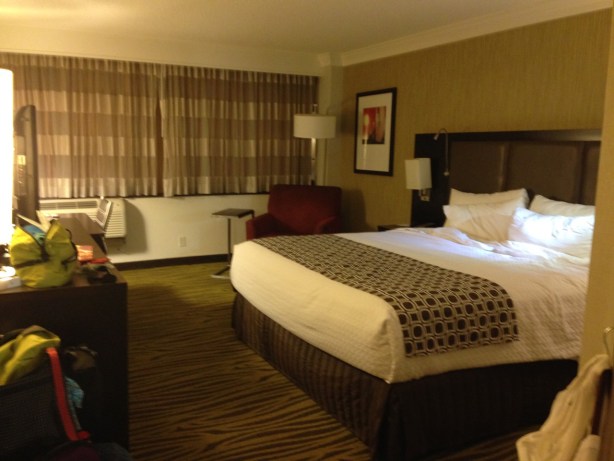
NZ Crowne Plaza LAX hotel room - 1Upon arrival in New Zealand, I had already acclimated from the Eastern to Pacific zone (USA West Coast) which represents half of the total time shock. Though the flight is lo-o-o-o-ong, most of the travel between California and New Zealand is in a southerly direction. You only drop three more time zones on that 12 hour flight.

Heading west is also usually less difficult in terms of jet lag.

Continue reading

Luggage brands & bag styles I’m traveling with regularly in 2017

Here’s my recent luggage use pattern:

Rolo, when carried, ends up crammed inside Tom Bihn or Red Oxx, however. It has been used as a carry-on in conjunction with a Tom Bihn Aeronaut 45, a Red Oxx Small Aviator Bag, and even a Tom Bihn Shop Bag tote.

I haven’t posted about the brand before, but my one set of wheeled luggage is Sherpani. We need to talk about them, too.

Yes, I’m on the record railing against wheeled “roll-aboard” bags here and in real life, but my Sherpani wheels are on a larger, checked-luggage sized suitcase. I never lift them over my head, and I don’t try to carry them on. Large wheeled bags are the best for trips involving a lot of stuff.

It is possible that I bought my Sherpani wheeled suitcase primarily because it came in a really fetching brown and purple color scheme. Highly unusual for luggage carousel spotting! Coordinated with clothes I wore frequently for travel! The presence of cute little daisies in charming spots could also have been a factor.

The more similar your trips, and the more similar your needs during travel, the less likely it is that you need a variety of pieces of luggage. If, on the other hand, you sometimes fly carry on only in basic economy, but other times enjoy extended voyages with extensive wardrobe requirements, you might appreciate having a range of bags that can exactly suit the given style of travel.

If I didn’t have the budget or the storage space for all four types of luggage, I would rank their order of importance to me exactly as I introduced them above:

  1. Ultra-lightweight carry on,
  2. Sturdy check-able duffle in a moderate size that could also be carried on,
  3. Specialized bag optimized for organization,
  4. Specialized larger bag for extra long trips with more specific requirements.

For someone who flies rarely or has the strength to find all carry on luggage of trivial weight, I would prioritize item #2 above all else in most cases. A sturdy rectangular bag is the most versatile option available, by far.

Some people can make do with everyday items (shopping bags or school day packs) in lieu of travel gear; some people are willing to spend more on luggage than they do on the trip itself. Most of us fall somewhere in between.

A good brand will only produce bags of high quality, but that won’t matter if you buy the wrong bag for your needs.