
Late spring polls—and the blessed waning of the COVID-19 pandemic, in the USA, at least—have prompted headlines like this one from the Boston Globe:
“After a difficult academic year, the majority of Mass. parents want in-person school this fall”
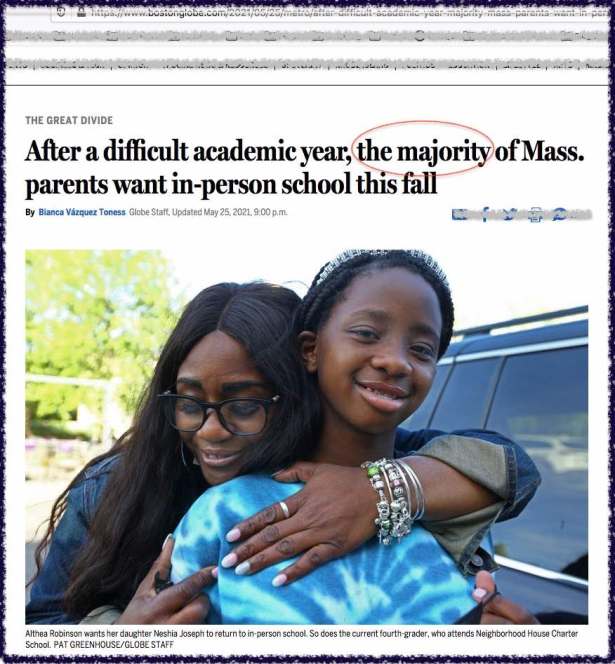 That unambiguous headline hides the whopping 31% of parents who disagreed with the sentiment. Almost a third of the 1,619 parents polled by MassINC Polling Group are NOT eager for mandatory, full-time, in person education just a few short months from now.
That’s more than three out of every ten people. In my childhood classrooms that averaged around 30 kids, that would have meant nine or 10 were attending against their families’ best instincts. I don’t think numbers this significant can be dismissed as a “trivial” minority over whose preferences the majority can ride roughshod with impunity.
An earlier Gallup poll restricted to 14 to 18 year old high school students in the same state of Massachusetts showed similar dissonance with an equally head-scratching headline:
“Few Massachusetts Students Prefer Remote Learning”
The data in that case also shows that most people, shown a few narrow options, prefer to travel the path of least resistance and do what they’ve always done. Half (50%) of the kids polled, if given these three choices, would attend “in person full-time.” Only 16% would choose “remote school full-time.”
Then again, 34% in the Gallup poll selected the third option: a hybrid “in person/remote” approach. That third of the student body can’t necessarily be described as “preferring” in person education. A more accurate headline would have been: Half of Massachusetts Students Prefer Full-Time, In Person Learning.
“Half of Massachusetts Students Prefer Full-Time, In Person Learning”
Some of these students might’ve been reacting more to a lousy remote education experience—one they got stuck with during a worldwide crisis—rather than alternative learning in general. Even with widespread reports of low quality remote instruction in 2020, from this data, I see that half of the polled teens expressed an interest in at least some education outside of the traditional brick school building.
From yet another source, I offer a press release from National Parents Union including a third poll (poll data here) producing similar statistics. The NPU poll shows 56% of surveyed parents “value having a choice between in-person and remote” learning. Roughly half prefer in person classrooms, but 17-25% of parents depending upon geographic region would prefer a hybrid model.
As with the other polls, 20% of these respondents would prefer full-time remote learning in 2021-22.
The right to an education
Before I say anything more, let me be clear: I do believe that opening schools this fall looks likely to be safe enough for most. The decision to do so appears to be based upon a sound assessment of current conditions in the USA.
Families who want to send their children back to schools in person should absolutely have that option based upon currently available data.
American children have a right to an education. Maybe even a constitutional right to at least basic literacy. In no way am I looking to dictate the best way for other people’s children to learn.
I grow frustrated by the outright dismissal of the reasonable preferences of a sizeable minority of parents and children who want continued access to remote learning options for those who prefer them.
If even “just” 16-20% of students would choose remote learning, that’s 4.8 to six students in my hypothetical classroom of 30. I find it interesting that 20% of respondents in the NPU poll (see question 14) also reported their pupils “learning more than they normally would” during remote classes† than they felt they had attending school in person.
These are real outcomes from American students for whom remote education works well.
The 31% from the first poll of families who don’t want to send their kids back to traditional school buildings—for now, or perhaps forever—deserve to be heard and accommodated by the public system. They may not be the majority, but the group is large enough, and the stakes are high enough, that ignoring the needs of these families is a dereliction of a very reasonable duty of care.
Let’s face reality: it’s not as though our system has been offering an excellent education to every child who wants one up to this point. (An example: the fierce fighting over scarce seats at Boston’s best public schools.) We have a lot of room for innovation and improvement. The point at which 16-31% of participants in the system ask for an alternative seems like an ideal time to start.
Parents usually judge best what works for their own kids
Barring extreme dysfunction, parents know their own children best. While most moms and dads aren’t professional educators, they are experts on the subject of their offspring.
I have two kids, and only one of them was educated at home before the pandemic. 2020-21 was as much of a wild academic ride for us as it was for students everywhere!
I posted about my family’s educational choices here—Home education as a radical act—back in 2017. I was also grateful to take advantage of my son’s school’s outdoor classes during the pandemic.
I mention the different choices made on behalf of my two children because I’m not a rabid proponent of homeschooling at all costs. My sociable younger son is enrolled in school because he prefers learning in a group, and evidence suggests the system works… for him.
My other kid has definitely found his groove, but even my homeschooler didn’t love the shape of every part of learning through a pandemic. That child, too, is eager to return to some classrooms for some subjects; my kid can’t wait to have choices again.
Home education allows for remote learning
This rambling? preamble has served to get me to the following point:
Families who aren’t well-served by the public system are entitled to remove their kids from it. Aside from expensive private institutions, home education is a legal right in all 50 states. Remote classes—many taught by trained professional educators—can be a part of homeschooling.
The internet began offering amazing online opportunities to homeschooling families many years ago, and the pandemic actually increased and enhanced the quality of the choices found thereon.
- You don’t have to be a trained teacher to do a fine job teaching your own child.
- You can purchase ready-made curricula for a term or a year, by grade level, or for individual subjects.
- If your kid excels in one area while struggling with another, you can tailor everything to his or her needs on your own, or with targeted help by hiring tutors or joining group classes.
Here’s a post about a particular online foreign language program that worked out well for my kids: YES! CLV’s Virtual Village is great remote language learning for kids. I’m also a fan of the affordable online courses offered by Royal Fireworks Press.
Roughly 2.5 million American students were learning from home before the pandemic; by March of 2021, that number doubled to 4.5 – 5 million. (Homeschool statistics from NHERI) Plenty of families rejected their schools’ responses to COVID-19 and took the plunge at the time; all of us can make that choice today based on what we’ve learned over the past year and a half of disruption.
If you know that returning full time to a classroom isn’t the best decision for your child, I encourage you to try home education… if you believe it might be a good fit. Making this choice now doesn’t commit you or your child to this course forever; many kids transition in and out of homeschooling every year.
The NHERI link I gave above offers more detail on the subject of the success of home educated students, but the short version I believe everyone deserves to know can be summarized thusly:
- Homeschoolers as a group perform better on standardized tests than those educated in public schools— 65-80th percentile for the home educated vs. 50th percentile for public institutions (Ray, 2015)
- Homeschoolers as a group “succeed and perform statistically significantly better than those who attended institutional schools (Ray, 2017)” as functioning adults
- “87% of peer-reviewed studies on social, emotional, and psychological development show homeschool students perform statistically significantly better than those in conventional schools (Ray, 2017)”
Oh yes, and, add to those points: selective colleges are generally very accepting of well-prepared home educated applicants because they also tend to perform as well as institutionally-educated enrollees at the university level.
Beyond these general facts gathered prior to the ravages of the coronavirus over the 2020-21 school year, it is worth acknowledging that a child who doesn’t feel safe at school is less likely to learn well. A parent who fears for her offspring’s health and safety is likely to perform less well in her own work. These are not insignificant issues; these feelings deserve to be dealt with in a constructive way.
Where state governments or boards of education dismiss out of hand the wishes of 20-30% of their enrolled families, I offer the option of parent-led home education, not as a prescription, but as a valid choice available for those who want it.
Though I’m not a home education focused blogger, per se, I’m happy to answer any specific questions that I can, or to provide links to specific types of resources that have worked for my family, if asked. Ask away in the comments!
♦
†If one fifth of students learned more during the pandemic, it seems obvious to me that public schools have an obligation to understand why that happened, retain that advantage going forward, and incorporate remote options for that sizeable chunk of their constituents.

 Am I the only mom in America whose family seems oblivious to visible schmutz on the floor?
 The floors really are pretty filthy in spite of all of these assignments and my own quick swipes with broom,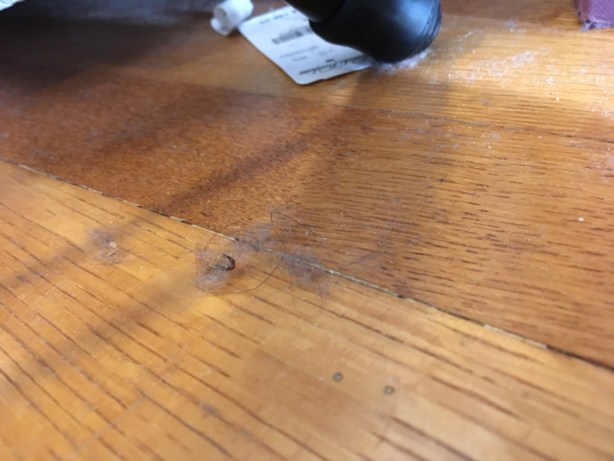

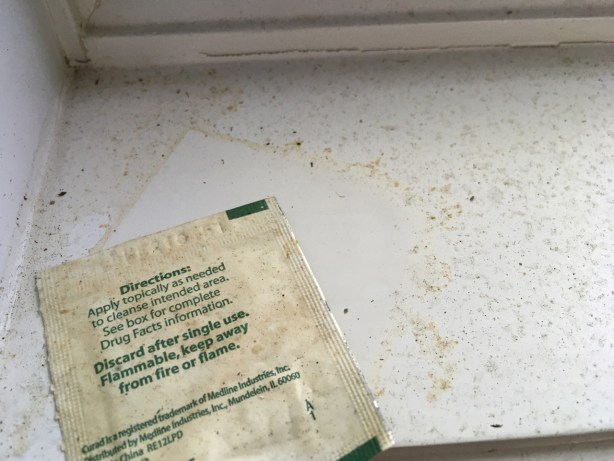
 Perhaps it is an extreme reaction on my part. Should I stop sending them the filthy photos?


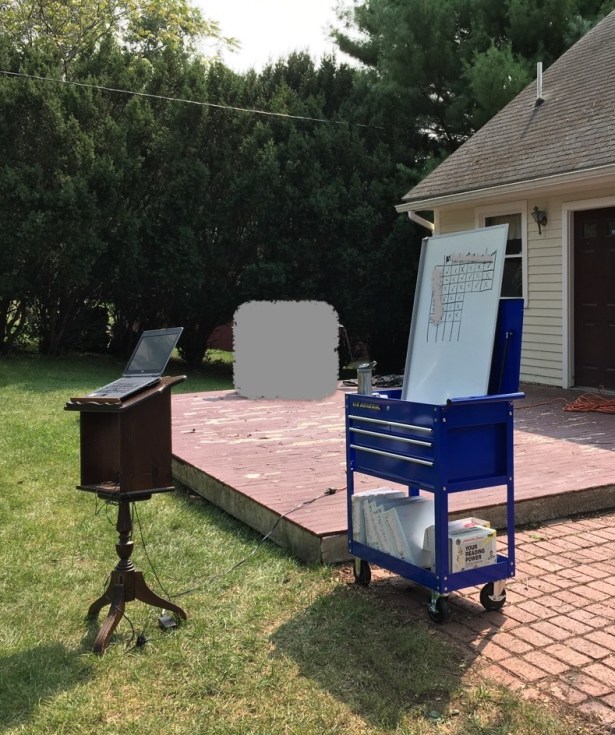 My child requested a return to in person school, and we agreed that he may go until they move indoors with the caveat that any surge in local virus outbreaks or lax enforcement of health protocols at school could change our position.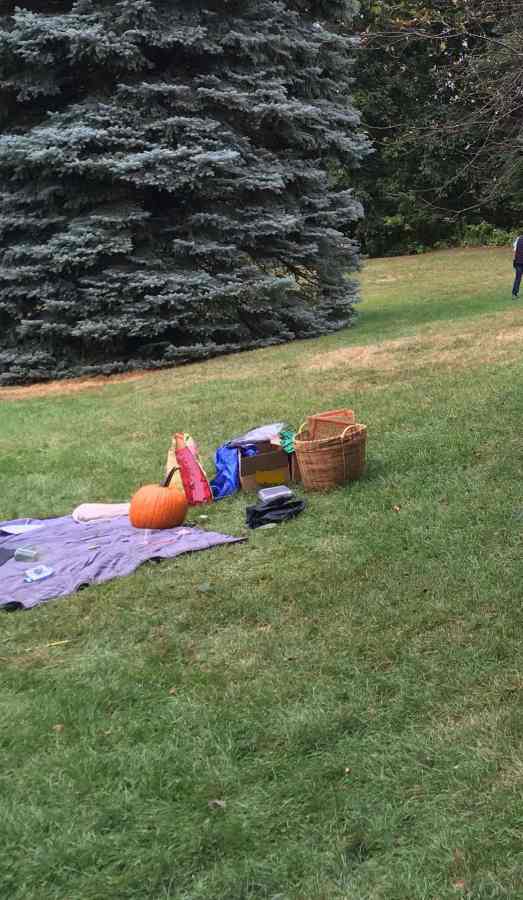
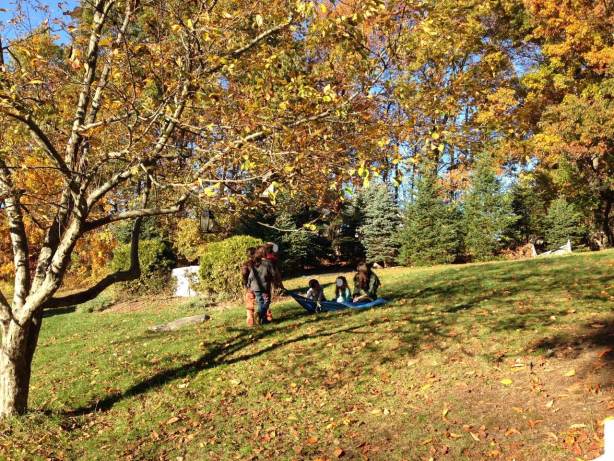
 Watching the children organically form into a whooping, running mass as they re-accustomed themselves to being together was one of the most heart-lifting things I’ve seen since the pandemic began. These kids are thrilled to be in each other’s company again, and the joy of play was plain on every covered face. I felt terrible each time I had to interrupt a game to remind a kid that his mask was slipping.
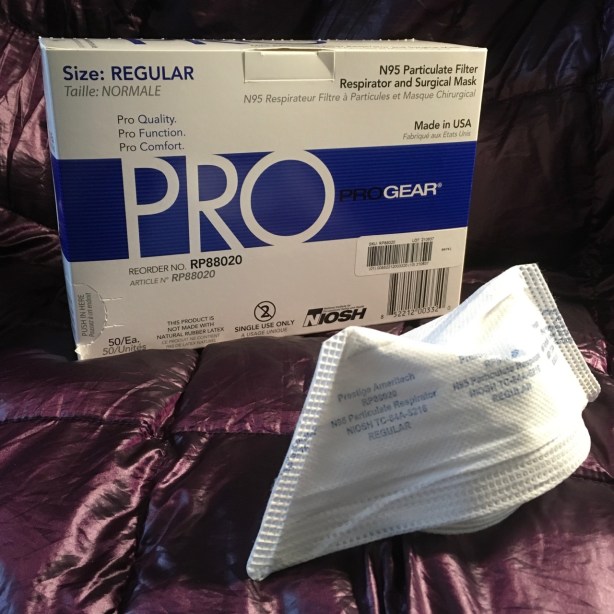
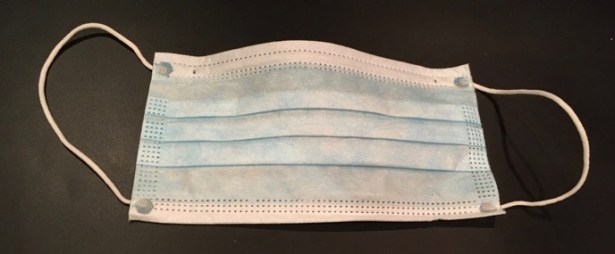
 Try to get your kid to jog around the block in a new mask before sending her with it to “in person” school. A kid with a mask that doesn’t fit well—or feel comfortable—is being set up for discipline and failure. There are many mask styles available now, so keep looking until you find one your child can tolerate.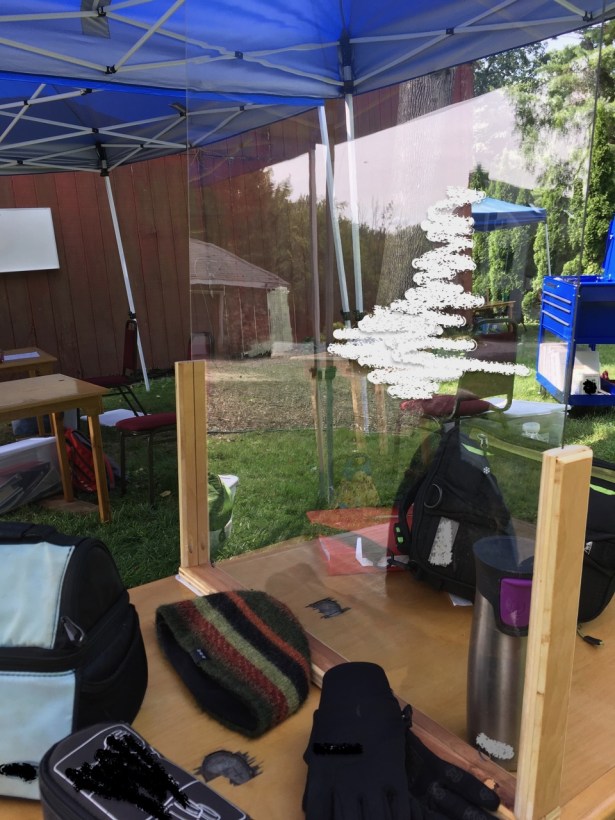
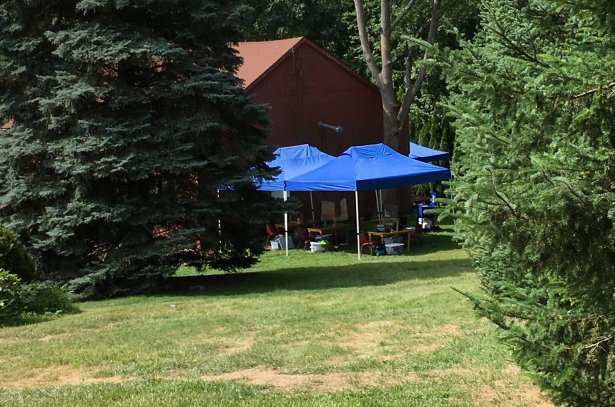 On a fine September morning, tents nestled alongside a red-painted barn appear positively idyllic. School started with each child finding his desk ready for him, each with a personal bin for books and papers. The same fellow had to source and procure these new materials after doing the planning to figure out what was needed and how to pay for it.
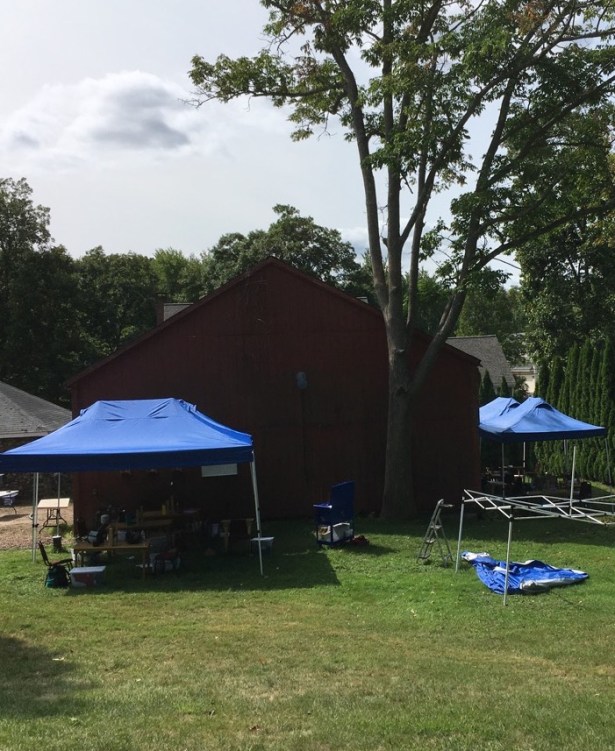 Of course, there is more to weather than rain. When the breeze picked up, kids realized that outdoor classrooms require heavier jackets much earlier in the season.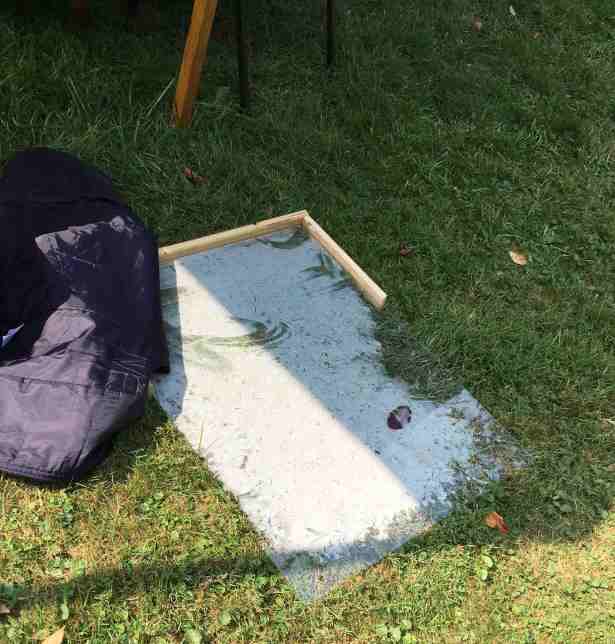
 Some teachers aren’t at particularly high risk for complications from the novel coronavirus, and want to get back into classrooms quickly. By all means, let’s put those educators to work in communities where infection rates make that a sensible solution. Other teachers have pre-existing conditions or would prefer to teach remotely: there’s an audience


 Kids are resilient. Thank God! Most of the kids will be all right. That’s the best we can do in the face of a viral adversary that has killed 171,787 Americans
  Highly paid elected officials in D.C. and other capitals deserve the pressure and expectation of doing more, because they are the ones who dropped this particular ball. Give them the blame they’ve earned. The U.S.A. is failing in its attempt to manage the COVID-19 pandemic, but it isn’t for lack of effort on the part of average American parents.
 Really Wonderful Things