Prevalent smoking should, perhaps, keep you from visiting Austria

Austria is a lovely place to visit. It has gorgeous scenery, world class art and architecture to enjoy, and a population that generally struck me as warm and welcoming.

img_0895Bilingual acquaintances from the German language learning camp in Minnesota we attended told us that we would be given more opportunity to practice our speaking skills in Austria when compared with Germany. I found this to be true.

Austrians were, as a rule, friendly and helpful. They really didn’t immediately switch to English when they heard my attempts to speak deutsch. (Germans generally do, in my experience. And, yes, their English is better than my German, almost to the man, and woman, and very small child...)


Perhaps the one overriding negative experienced by an American tourist in Österreich—if the language barrier is a benefit to you as it is to me, as opposed to a real barrier—is the constant exposure to second hand smoke.

img_1055.jpgI’m old enough to remember the bad old days of smoking sections in the closed compartment of an airplane, though, thankfully, those disappeared before I began flying several times per year to attend college. Smoky bars and restaurants where I wouldn’t go with my friends due to air pollution were a real issue well into my young adulthood.

Being in Austria is like being transported into the past in this regard. It took me several days to adjust. Young people in the USA today probably don’t have the adaptive response to scope out a cafe before taking a seat lest one inadvertently land in the stinking smoking section.

Though there was some Austrian legislation enacted in recent years to create separate smoking and non-smoking sections in restaurants, I still experienced unpleasantly smoky interiors several times during my trip.

Worse yet, it seems that Austrians don’t feel a need to segregate outdoor space for both smokers and non-smokers in any way. Some of us are sensitive enough that, no, even being seated the great outdoors is not enough to make it okay to sit at a table adjacent to or downwind from an active smoker.

My eyes water, and I start to cough. It’s not posturing; the smoke simply does affect me that quickly. My tearing eyes swelling shut and the irritation in my throat make me look around for the source, not the other way around.

Worse yet, because smoking is taken so much for granted in Austria, newcomers into a restaurant or onto a terrace who plan to smoke don’t think to take seats at a maximum distance from non-smokers who are already there. Try though I did to sit “far away” from all the smokers in otherwise lovely cafes, I was constantly being smoked out by new arrivals in Austria.

img_9405

These polite Austrian smokers sat at the stern of our pleasure cruise ship on the Danube, but the entire open top deck stank of cigar smoke from one man sitting forward at the bow

I gather that the xenophobic right wing government* currently in power is working to defend the rights of smokers even more violently valiantly in Austria. What a tragedy for the health of Austria’s citizens. Because, while I am easily swayed by libertarian arguments on many issues, smoking is simply not the same as free thought or speech.

The smoker has at least the option of a filter between himself and the known carcinogen he opts to ignite and inhale; standing nearby, my right to breathe freely is stolen from me.

Smoking in public places fundamentally infringes on the health and safety of others in the space. There are few other vices so directly malevolent to the public good.

Heavy drinker? While you could overindulge and vomit onto my shoes, you may be a quiet, maudlin drunk and not affect me at all. There is no equivalent for smokers. Anyone in the presence of a lit cigarette is being affected; the only remedy is to leave.

When someone invents the “smoker’s spacesuit” that operates with complete isolation of its user’s air supply and exhaust, there will be room to discuss the rights of smokers to light up in crowded public spaces.

I acknowledge your right to smoke, but I’d say the responsibility you shoulder when exercising that right is to maintain a great distance between yourself and others while you do so. The fact that you can no longer smell smoke from a few feet away is a part of the burden you’ve elected to carry with your habit; healthy people can be negatively affected at a dozen feet or more.

I was charmed by many kind, witty, thoughtful Austrians whom I encountered there. It was otherwise a wonderful place to visit, and there are many sights around the country I’d love to come back to see. Until a more modern and health-conscious public smoking policy has been enacted, however, I will probably stay away, and I would most certainly never take my asthmatic child to such a dangerous place.

Schade. What a shame.

*Self styled as the “Freedom Party,” though formed by former Nazi party members after WWII. Once again, do we see the same party harming others to grant themselves more freedom to enjoy their own lives?

A NY Times article I read while writing this post goes into more details of the political situation.

When I won’t give up my seat on a plane to a stranger’s child

It’s not all that uncommon for me to give up my assigned seat to a stranger on a plane. I do it for couples, not just for children separated from mothers. I try to take actions that make the world a slightly better place.

I’ve been that mom flying alone with her kids, feeling more than a little desperate to keep them close to me. I’ve carefully selected seats only to have my plans disrupted by the airline when an equipment change erases all the previous selections.

On a recent Icelandair flight from KEF to BRU, I made a selfish choice. When the flight attendant asked me if I would give up my window seat for a child, I said, “No.”

Though I think my reasons were valid, I’m clearly carrying some guilt from that decision. I hate to make a child sad. I enjoy most kids, even on airplanes, and am more likely to help out another mom than glare when her baby kicks up a fuss.

Major exception: when your kid is kicking my seat, I am just one step away from being annoyed, and I will turn around and ask you to stop him or her. Apologetic and helpful parents defuse all of my frustration… unless the kid is old enough to be doing it on purpose and seems inclined to keep it up.

Children are free agents, no matter how hard we try to remain diligent. I police my own kids pretty hard in that regard because, as a traveler with chronic pain, I am being literal when I say, “I feel your pain!”

On a bad day, a rhythmic seat kicking is torture for me. I won’t yell at you or your kid, but I will expect you to do your best to stop the behavior.

And this segue brings us around to my primary motivation for saying no to another mother on Flight 554. I was already in pain.

I select window seats on flights most of the time because I want to get as far away as possible from the jostling at the aisle. Never mind a direct hit by the beverage cart, even a pair of average sized passengers passing in the aisle can result in a brush with my side that hurts. I’ve been smacked more than once by people carelessly removing bags from the overhead bin, too.

I’m sitting in a window seat because I like the view, but even more to avoid actual pain from accidental touch.

I think that alone is sufficient justification for turning down a fellow passenger, though it obviously still makes me feel bad.

In this case, it is also worth mentioning that this was a mother with three kids who looked to be preteens and above. The child in question was probably 12 or more, standing shoulder high to her mother. She didn’t look frightened or upset to be separated from her mom, she looked bored. She had headphones on and didn’t seem to be talking to her family members anyway.

I pointed out that the middle seat in our row was free, even closer to her family across the aisle than mine by the window. I held firm to the fact that I needed to stay where I was to avoid being bumped by other passengers.

I don’t know where the girl ended up sitting, but it wasn’t in my row, though the rest of the family stayed put across the aisle.

If a woman with a toddler had been standing in the aisle with pleading eyes, I would have moved before I even thought to protect my own fragile state. This was at the mere beginning of a two week trip, no less, when preserving my energy was really important.

Some people think it is always obnoxious for any passenger to ask another to give up a seat. Nonsense! The airlines are operating a virtual free-for-all of Darwinian proportions at 30,000 feet. It is easy for even an experienced traveler to end up separated from children who really aren’t in a good position to care for themselves.

Others suggest that families should always be accommodated. I wouldn’t go quite that far, but I do believe that commercial airlines should be compelled by law to seat children under about age 12 or anyone with significant special needs adjacent to a caregiver before charging average passengers for the privilege of seats that suck less.

Airlines should profit less on seat selection. It costs them nothing compared with serving food, say, is a pure profit opportunity, and yet it creates real stress for groups traveling together. Unless paying for a reserved seat is an ironclad guarantee that I’m going to get exactly the seat and amenities I’ve selected–read the fine print, it usually is not a guarantee of anything but a charge to your credit card–then the system is a scam.

As a mom, if I can’t sit by my teen, I think, “Gee, too bad.” Then I return to my book. It’s no big deal.

When the situation is placement of my younger child who gets motion sick and has allergies and asthma, I work a little harder for a more satisfactory resolution. I suggest that I must be at least within sight of him lest he struggle with his breathing, though that situation is thankfully very rare.

I also tell whomever he’s seated next to that they might want to keep a barf bag ready, just in case. Maybe it’s just my family, but my kids tend to vomit on the person next to them at least as often as they get sick on themselves!

I’m totally honest with other airline passengers: my son doesn’t always throw up on a flight. It isn’t even most trips by airplane. Then again, he has vomited more than once due to turbulence.

Most passengers and/or flight attendants work together to help a parent find a better solution for a child with that kind of need. Though why the hell any passenger ever has to get involved is part of what makes me angry with the airlines: this is their problem to solve. It doesn’t belong to the poor soul who thought she’d reserved her favorite type of seat and would get to sit in it. Nor can a hapless parent who travels occasionally be expected to navigate the Byzantine world of airline chicanery.

Filing a complaint? No doubt there will soon be a $25 fee for that, too.

As my “more complicated to travel with” son nears the end of elementary school, however, even his “interesting” issues are less of a concern to me than they were with younger children in tow.

At this point, the kid might manage by himself to barf into a bag on his lap; when he was five, that chance was zero. I’m honestly uncertain as to what he would do with said bag once it was full of vomit unless I was there next to him to take it off his hands.

Parents should sit with their kids because this stuff happens, and no one cares as much as a child’s own parent. The parent isn’t trying to offload any responsibilities to other poorly placed passengers. Airline policies are simply inhumane and short-sighted.

It is patently obvious that this is not a black and white situation, but a matter of multiple shades of grey. Like most of life, actually, including whether or not a relatively nice person such as myself, a caring mother and lover of children, gives up her window seat to humor a pre-teen.

This time, I didn’t, but my conscious is clear. Well, mostly. After all, I did take the time to write this piece.

Just enough German to be paranoid: hören vs. gehören

Sometimes, a little knowledge is a dangerous thing.

I’ve “been studyingGerman for over 20 years!

But, of course, that misleading statement represents one academic year of university courses in the language, then a decade’s gap, and eventually picking it up again as an autodidactic hobby when one of my kids started to study German in school.

Ich verstehe nur ein biβchen Deutsch.I don’t know where I stand as far as the state sanctioned “level” of my ability to understand the language, but I am almost finished with the Pimsleur Level II audio course.

PimsleurI think my official designation is probably something like “rank amateur,” or “what’s lower than A1?”

Case in point: I was researching a future trip and using the Wiener Linien website to download a PDF map of the public transit system. I found this tag line printed on the bottom of each map:

Die Stadt gehört Dir.

Die Stadt gehoert DirThis gave me pause. The more learned amongst you can chuckle knowledgeably while reading through my thought processes in the rest of this post.

I’m quite clear on what “Die Stadt” means. Die Stadt*is “the city.”

FlashSticks German deployed1

Die Lego Stadt, or Lego City

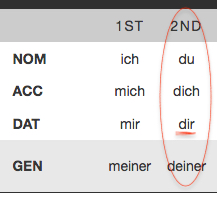
“Dir” is the second person informalpronoun for “you.” It’s used when the word “you” is the indirect object in a sentence.

I frequently make mistakes about when to use the accusative and dative cases as I create (i.e., speak) my own sentences, but I always know who we’re taking about when I hear du, dich, or dir.

German pronounsIt was the verb that confused my weak grasp of the German language.
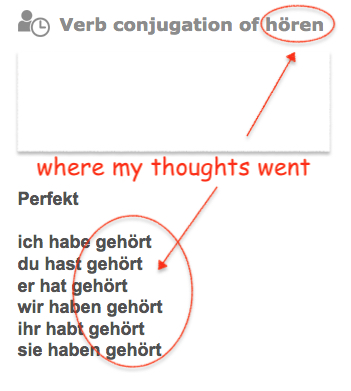
I know the verb hören pretty well. It means “to hear.”

verb conjugation hoeren

Naturally, I leapt to the conclusion that the Vienna transit authority was telling me:

The city hears you.

Or, giving it a creepier meaning, because I’m a bit paranoid:

The city is listening to you.

Even that might be a well-intentioned statement. My son also misread the sentencemaking the same mistake that I did. He thought Wiener Linien was indicating a customer service orientation with the same language I associated with eavesdropping.

Perhaps I’m the only one whose thoughts turn immediately to Big Brother in 1984 and “his” perpetual observation of the hapless citizens in that dystopian classic?

Google translateMy friend, Google translate, taught me the error of my ways. In fact, Wiener Linien would like me to know that:

The city belongs to you.

That’s so much better, right? Especially if I’m just visiting as a tourist. I mean, how generous, but, really, Vienna, you needn’t go to so much trouble!…

The verb that is actually being used in this sentence is gehören. I should probably learn it. “To belong to [someone]” is an incredibly helpful thing to be able to say when traveling.

I recognize that I am easily tricked by German verbs that begin, in the present tense, with “ge-“ because of how the past perfect (Perfekt) tense is formed. I.e., usually, by adding “ge—” and doing some other stuff to the end based upon rules I’ve read but not memorized.

Please consult someone who actually knows German instead of trying to learn any grammar specifics here. Otherwise, you, too, could frighten yourself as to the actually well meaning intentions of public transit authorities in German speaking countries.

A little knowledge clearly is a dangerous thing. Which somehow forces me to conclude with “the rest is commentarynow go study!

*Stadt being a false friend for the English word “state,” but clearly a related word in the sense of historical precedents such as the Greek “city-state” concept.

My apologies to Maimonides.

Exposé: My alarm clock is for the birds

My alarm clock doesn’t beep, it chirps.

Actually, I think it could simply beep, but I selected bird sounds as the least annoying option on the menu. I’ve got a fancy alarm clock.

Bedside clock nightstand Mg - 1I didn’t buy it for the birdsong option, but because I need light in order to wake up. That’s another topic worthy of a lot more discussion, but I’ll save it for another day.

The clock’s large lamp begins to glow and the intensity of light gradually increases for about half an hour before the time for which the alarm is set. It’s simulating a natural sunrise.

This bright, sunny morning, I was already awake and started on a bit of blogging over my mug of tea well before my alarm went off.

Sitting at my little table, finishing up my Mother’s Day post, I heard those silly, simulated, alarm clock birds start carrying on. I hurried over to hush them up before they disturbed the rest of the household.

But the clock wasn’t lighting up. Its lamp wasn’t glowing! Usually, the birds don’t sing until the virtual dawn has well and truly arrived.

Was my fancy alarm clock broken? Why wouldn’t the off button work?

And then I realized: the unholy chorus was outside my window.

Bird robin tree sky - 1Ah, spring! It’s for the birds.

Clothes Treated with ‘Hot Feet’ Coating Could Keep Ticks Away

Here’s a recent report about a family health issue I consider vitally important: preventing the spread of tick-borne illnesses such as Lyme Disease.

Source: Clothes Treated with ‘Hot Feet’ Coating Could Keep Ticks Away

My first post on this issue, Ticks Suck! Literally, includes a couple of cost effective DIY solutions that may help you protect your family with commercially applied permethrin treated fabrics.

There’s some risk to yourself and particularly your pets if you opt to treat your own clothing items at home with insecticide solution.

As of May 2018, Insect Shield bandanas are widely available on Amazon.com for $10-20.