What if student loan forgiveness were tied to public college costs?

Some American politicians want to forgive all student loan debt. I disagree with this notion, mostly because I think many private colleges are now charging a ridiculous, inflated price, not supported by evidence of their inherent value to the individual or to society.

I am all in for learning. I want more kids to earn the benefit of a meaningful education that supports their personal and career goals. I believe that our entire society would benefit if we did a better job teaching our children, from cradle to adulthood.

I agree that our current system is dysfunctional. My opinion is that reforms should aim to correct something more fundamental than the particular loans taken by students who have already left the system. The pricing structure for a university education should be made more rational, not cloaked in additional government intervention.

I don’t want my government paying current “list prices” for private colleges for every student—already a narrow group, disproportionately representing our richest, most privileged children—and especially so when younger, more vulnerable pupils fail to learn in crumbling buildings with more attention paid to test scores than human potential in our mediocre K-12 system.school supplies - 1

That being said, I am also on the side of those who argue that our system is inherently unfair and biased against the scores of bright, motivated students often representing the first generation of their families to reach higher education. The financial aid system is byzantine; true costs of attendance are cloaked by “merit aid” and government contributions based on “need” can’t be assessed without filling out reams of paperwork.

The less experience one’s family has with American higher education as a system, the harder it is to understand any of it at a glance, or even with a great deal of study! Actual costs are opaque. It’s hard to even justify paying a $75 fee to apply to a university whose website says it charges $75,000 per year when your parents earn $7.25* per hour.

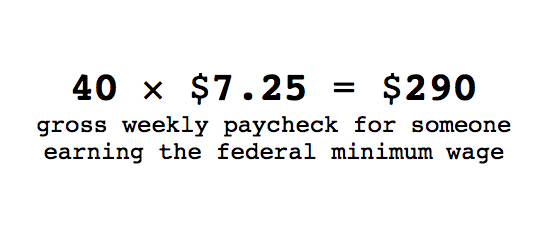
That those are real figures which just happen to look like an elegant visual numerical alliteration is the best thing that happened to me today.40 hours per week times federal minimum wage equals $290 gross take home paySure, fee waivers are available, but how many times does a poor student deserve to be reminded of his deprivation within a single application process? And high school seniors apply to around seven colleges each. math written out 7 times 75 dollars equals $525
Imagine being the 17 year old high school senior, living in poverty, who has to say:

“Hey, Mom, can I have two full weeks’ of your take home pay to buy the privilege of applying for the chance of spending more than five times your annual earnings every year for the next four years to get educated? Yup, that’s right, Mom. The webpage says the price for a college degree is 20 times what you earn per annum.”

Of course financial aid is available to those who qualify; the vast majority (86%) of American students receive some financial assistance towards paying for college. To qualify for aid requires one to complete the Free Application for Federal Student Aid (FAFSA.) That process takes about an hour… if you have ready access to recent financial records and tax returns plus social security numbers for both yourself and your parents.

Aside from the insanity of the FAFSA using a different definition of “dependent child” from the same U.S. government’s Internal Revenue Service (IRS), there is also literally no recourse for a student under age 21 whose parents won’t provide their financial records for the purpose of filling out the form.

Per the Filling Out the FAFSA® Form › Reporting Parent Information page:

“…if your parents don’t support you and refuse to provide their information on the application, you may submit your FAFSA form without their information. However, you won’t be able to get any federal student aid other than an unsubsidized loan—and even that might not happen.”

Until you are age 24—if you’re unlucky enough to have unsupportive parents—unless you can prove via written records that they are in jail, that you had “an abusive family environment” (remember: proof required!), you can’t find your folks at all, or you are over 21 and also “either homeless or self-supporting and at risk of being homeless,” it’s hard to know whether completing the FAFSA will even be worth the effort.

The travail of merely filling out the FAFSA, appears to prevent kids from under-served communities from even approaching applications to higher education.

Oh yeah, and the federal government audits a disproportionate number of financial aid applications submitted by young adults from neighborhoods where the majority of the population is comprised of people of color.

COVID-19 has increased the size of all of these hurdles, apparently. Rates of application to community colleges, for financial aid, etc., have all plummeted in 2020-21 for precisely those students who would benefit most by furthering their educations—those born under a burden of poverty, placed there by circumstance, but forced to carry it on each young back until the lucky ones access the tools required for self-liberation. Education is the most common lever used to pry that burden off.

Go ahead and add that loss to the half a million lives cut short, and tack the cost onto the pandemic’s final bill.

Pile of moneyIt is an indisputable fact that the United States has systematically de-funded public colleges and universities within the span of my lifetime, rendering even “public” universities difficult to access for all but the wealthiest students. To me, that represents an utter failure of public higher education, a human service that is so important to our nation’s civic character and economic growth that I would consider it part of our basic infrastructure.

By definition, I believe public education should be attainable** by 100% of the citizenry.

A recent Boston Globe article detailed a tug of war between the Biden administration which proposes $10,000 per student in loan forgiveness vs. a progressive position championed by Elizabeth Warren and others to forgive $50,000 per student.

Here’s my response: why not tie governmental student loan forgiveness amounts to public college tuition and fees? Whether this is a federal average, rates for institutions in the region where s/he got her education, or the price where s/he lives now, at least this figure would remain tied to some actual, real cost of higher education as it changes over time.

Yet that public tuition rate should also reflect an efficient system, one hopes, seeking to offer a good return on the state’s investment in its future taxpayers. Without the option for limitless borrowing to go elsewhere, the discretionary facilities arms race of ever grander stadiums and shinier, newer dorms to entice potential first years should slow, if not stop altogether.

Typical colleges would have an incentive to keep their published tuition rates aligned to what borrowers could reasonably find the means to pay. Elite universities might maintain higher prices, but their rich endowments would continue to make generous aid packages possible for anyone they chose to admit.

View of community college building on campusGovernment regulations tied to hard figures always end up skewed by inflation; income and prices change year by year, typically trending upwards. The Alternative Minimum Tax, for example, was designed to apply to very high income earners who were taking “too many” legitimate deductions, but now it routinely catches upper middle class, dual income families in expensive coastal cities in an indiscriminate dragnet while much richer folks pay money managers to hide and protect larger assets.

I’m imagining a scenario where a billionaire politician could pay only $750 in federal taxes while those of us earning far less pay many thousands more…

It strikes me as fundamentally fair and equitable for students electing to attend private colleges to remain entitled to their share of government help, but not necessarily more help than those who opt for public institutions. This would act as a brake on runaway tuition hikes overall while never preventing any private entity from charging whatever it wishes. That seems like common sense, and protective of the public interest.

Another idea that can only be addressed at the federal level would be to offer international skilled worker visas preferentially to companies that implement effective training programs for American workers simultaneously. Those same corporations could sponsor scholarships for domestic students—or create in house programs for local unemployed or underemployed citizens—on a some-to-one or even one-to-one basis for future hires. No reasonable person should expect businesses to hire employees incapable of filling the requirements of a particular role, but our government could ask that those allowed to important talent also take part in reducing that same need going forward.

The U.S. Government should remain involved in higher education. Without an educated populace, the chance that America remains a global superpower rapidly dwindles to near zero. Power—and the money that goes with it—flows to those who control the currency of the day. In 2021, information and technology reign supreme in that arena. The field depends upon a trained workforce to function, though, and there aren’t enough Americans with the requisite skills to fill open positions in U.S. technology firms today. I haven’t seen much evidence to suggest that those odds are improving, either.

The pandemic’s winnowing of the best and brightest poor students in the United States from the ladder of upward mobility via advanced degrees will damage our ability as a nation to compete in the global marketplace, and never mind the real, tragic human cost to those young souls. The ideal role central government can play in education is to ensure equitable access to it for the broadest possible swathe of the populace. Financial Aid is a means to that end, but the American version is a tool that requires sharpening to be used to better effect.

In the meantime, if you are trying to figure out how much college costs right now, be aware that American colleges and universities are required to offer a “net price calculator” somewhere on their websites. Search for it directly from your web browser as some institutions bury this useful tool deep under their admissions information. Also consider Googling the “common data set” for any university you are considering; this standardized form is where U.S. News & World Reports and all those other comparison sites get their college facts. Section H2 will give you a lot of information about how many students receive both need-based and merit aid at the school you are considering.

I’m fundamentally academic by nature. I left the workforce to devote many of my prime earning years toward the education of my own children. I believe in the transformative power of learning to change peoples’ lives for the better.

Finding an “average price” for college is not straightforward because of the obfuscation about which I’m complaining! Here’s an entire article going into detail about how “net price” differs from official tuition figures, and also separating out the living expenses which paid for by the same source: typically, financial aid. From that US News & World Report article, I got an average price for public colleges of $9,687 compared with $35,087 at private ones. That said, we must recognize that Harvard College’s 2020-21 undergraduate tuition may be $49,653 with fees of $4,315, while its actual, billed “cost of attendance” is $72,357. Tuition itself is almost irrelevant in this discussion, because that latter amount is what “financial aid” would cover.

Harvard hides its tuition information, by the way, not even providing a direct link on its admission page. I had to search for “tuition,” and, not coincidentally, that was the top search term on their FAQ page. Instead of making its price easy to find, Harvard inundates the admission seeking high school student with multiple pages extolling their rich and abundant financial aid offerings. That’s all well and good because such a large proportion of the student body receives aid, but it precisely underscores my point that the system as it stands is wildly complex at the expense of the well being of the student population.

* US Federal minimum wage as of 2020 is $7.25 per hour

** I specifically mean attainable financially here. I do not believe that 100% of the human population should attend traditional colleges and universities, and I think the push in that direction does a disservice to those with inclinations outside of the classroom. If it were up to me, we would have a national network of trade schools administered much like the community colleges, and with identical access to easy, straightforward financial aid for those who need it.

I would argue that it remains imperative for colleges and universities to maintain academic entrance standards. Some students will be excluded because not everyone develops the intellectual capacity for the most abstract forms of thinking, but I’ve never seen credible evidence that this kind of aptitude is distributed inequitably amongst various ethnic, racial, or social groups. Rather, most studies on this issue point to the distractions of poverty and oppression as levers operating against the success of some. I wholeheartedly support reforms that provide every schoolchild with the same opportunity to reach his or her highest potential, but I don’t believe that every one of us was cut out to be a physicist, say, or a fine artist, nor would I hold those individuals up as fundamentally superior to the plumbers and mechanics who keep the systems we rely upon working smoothly.

BraceletStreet offers accessible necklace manageable by arthritic hands

I like to wear a little jewelry even when I’m “only” visible to my household. The pandemic hasn’t affected my daily wardrobe at all!

Rings, watches, and most bracelets feel to me as if they interfere with my daily activities, but earrings and necklaces make me happy. Adding a little sparkle—and even more color—to an outfit is something I do for myself, not to show off or impress others.NZ capsule wardrobe jewelry - 1

Yet another annoying side effect of systemic arthritis is the sometimes unpredictable stiffness in my fingers that makes tiny clasps difficult to manage. It’s no accident that all the earrings in my photo above are hooks that don’t require attaching itty bitty backs!

Add slightly paranoid tendencies to even mild physical disability, and I can end up feeling frantic* about a necklace that I can’t get off when I want it gone. This scenario triggers my claustrophobia, in fact.

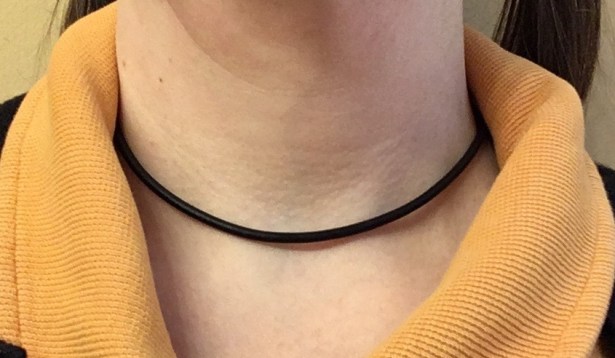
For this reason—and because my only simple, black vinyl? pendant cord c. 1994? recently broke, leaving me with no aesthetically pleasing option for wearing a favorite amber bead—I went looking for a replacement with an easier to manipulate clasp. I wanted to upgrade to a thin, genuine leather strap with a magnetic fastener.

Et voilà!

Bracelet Street 15" black leather 3mm necklace with magnetic claspI turned to Etsy, though I often struggle on that site to identify actual self-employed artisans vs. foreign outfits with unknowable labor practices. I ended up buying two leather necklaces with magnetic fasteners made by Bracelet Street USA, a woman-owned business in Kentucky if I’m reading their About page right. I’ve had no personal contact with this company aside from making the single online purchase.

First, allow me to admit that I feel like an utter fool for having waited this long to seek out more manageable jewelry clasps. Obviously, it could be costly or impossible to retrofit a large collection of mostly inexpensive, costume jewelry, but there was nothing preventing me from making this useful discovery except my own lack of attention.

Sometimes, the steady barrage of failures that come from living with autoimmune disease can prevent me from even trying new solutions that turn out to be easy fixes.

When everyday life confronts you constantly with “trivial” activities you can no longer manage for yourself, it is easy to become disheartened and just give up on stuff. This sometimes applies to things you love. Even silly little victories—like wearing a favorite pendant—enhance the texture of life’s fabric, and are worth pursuing.Pendant necklaces: amber bead on black cord, ammonite fossil pendant on brown cord, blue stone on bronze cord

For those with fully able bodies, some of the visible manifestations of the Americans with Disabilities Act (ADA) can seem excessive or superfluous—“too many” empty handicapped spots in an otherwise packed lot, or the lift at the public pool that a healthy observer never sees used—but the reality is that, for those who have been cut off from so many common daily tasks, accommodations like these make the difference between feeling welcome to participate in the world at large…or not.

My new necklaces aren’t going to suddenly empower the disenfranchised or fundamentally change the world, but they do look nice, work precisely as they should, and offer me the dignity of doing one more thing for myself. That makes the purchase money well spent.Etsy order confirmation for two 3mm round leather necklaces with magnetic clasps

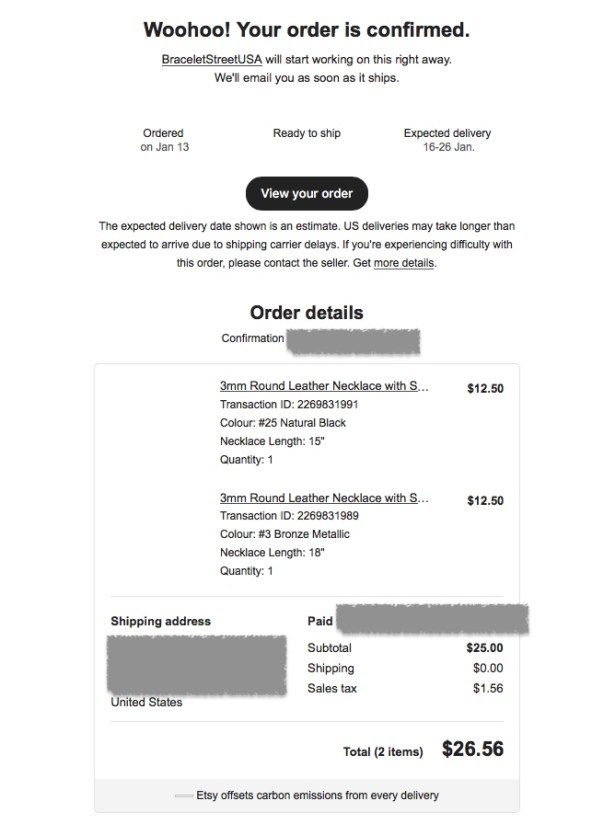
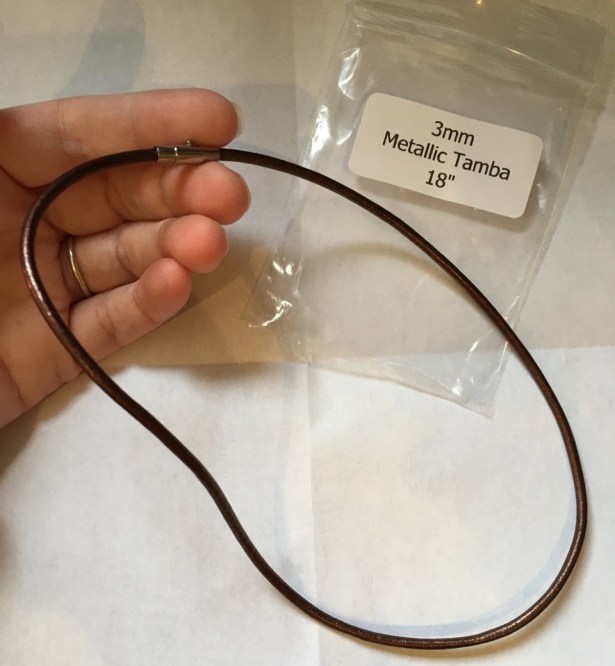
I ordered two magnetic clasp, 3mm diameter necklaces, one a #25 Natural Black (15 inch) and the other a #3 Bronze Metallic (18 inch), paying $26.56 including tax. I was sent a third (18 inch Metallic Tamba) for free as an unexpected “gift with purchase.”Bracelet Street 18" leather cord, magnetic clasp necklace with 3mm diameter in Metallic Tamba color

I’m assuming such little additions are par for the course with this company. Bracelet Street could have had no way of knowing I am a blogger** who might write about the purchase. I didn’t even login to my existing Etsy account since I was accessing the site from my phone instead of my desktop and I couldn’t remember the password. I wouldn’t have seemed like a special customer of any sort.

Bracelet Street USA shipped their products in sufficient, simple packaging that protected what was inside without creating too much superfluous waste. Each necklace came in a labeled mini zip top plastic pouch. I save these for use to keep earrings separate and chains untangled when I travel, so they will be re-used.

The inclusion of a hand-written thank you note made an impression on me, and very much increased my desire to share my positive experience with the company. I appreciate a human touch to my purchases, especially when I’m buying hand-crafted items online. I always hope I’m supporting small businesses with satisfied employees, but it can be so hard to tell who you’re doing business with on the web.

If you plan to wear an existing pendant with one of these magnetic clasp necklaces, be aware that I had to have a larger ring added to my amber bead in order for it to fit over either end of the Bracelet Street USA 3 mm leather necklace. The non-opening end of the simple metal “springring” clasp on my old vinyl cord was smaller.

Fortunately for me, my mother-in-law is a hobbyist jewelry maker, so it was easy for her to add a larger link to my pendant. Actually, I believe she gifted me all three of the pendants featured above on my new Bracelet Street necklaces. If, like me, you are buying magnetic clasp necklaces due to a lack of dexterity, you may need a friend or loved one to help you attach a larger bail to some of your own pieces to make them compatible with these thicker fasteners.Close up of Bracelet Street magnetic necklace clasp slot end

I would also like to add that the little bump or nubbin on the insertion side of the fastener is not a button requiring fine manipulation. I wasn’t sure how it worked when I first looked at it. The two ends of the magnetic closure will “snap” together on their own due to the magnet’s attraction, but you aren’t quite done when it does! A slight twisting motion slides the nubbin into the slot on the other side. This seems to provide extra security to what could otherwise be a “breakaway” clasp.

Breakaway jewelry might be ideal protection if you’re operating a lathe, but it’s kind of a bummer when you’re wearing the pendant great-grandma carried with her from the Old Country.

With a lightweight charm, I believe you could get away without the gentle twisting required to get the clasp fully closed, but I did have a heavier pendant (the ammonite fossil visible in my photo above) fall off into my lap before I’d quite mastered the fastening process. Since I learned to fully secure the clasps by twisting, this hasn’t happened again. To be clear, though, I rarely wear heavy jewelry as it exacerbates the discomfort from my systemic arthritis.

If you’re looking for a simple necklace that can be put on and taken off in spite of mild- to moderate-dexterity issues in your hands, I recommend those sold on Etsy by Bracelet Street USA. They are fairly priced, functional, and the company really seems to care about pleasing its customers. Each has a clean, simple aesthetic—appropriate for anyone, masculine or feminine—with 36 colors available in lengths ranging from 12 to 26 inches. I can’t speak to longevity after just a couple of weeks, but my initial impression of the three necklaces in my order is that they offer good quality for the price.

* Even my kids have been subject to my sudden demand to “help, help, help me get this off before I have to start yanking on it!” Since some of my jewelry was my departed mother’s finer stuff, ripping it apart would be less than ideal…

FYI, “Metallic Tamba” as a color name doesn’t mean much to me. I’d describe the shade as a multi-hued, warm-toned, mostly dark brown metallic melange

** Frankly, I’m also not a very significant blogger, so I’m not sure “knowing who I am” would have any effect on the way any merchant would treat me!

I had to look up the proper name for the round, metal circular fastener with the tiny lever you have to pull with a fingernail to open it, pulling an itsy bitsy wire out of the center of the hollow hoop. The internet told me it is a springring clasp, invented around 1921.

Sending “filthy” photos to my kids when their chores demand attention

My kids have chores. They are both old enough now to lend a hand that’s actually useful. They ought to be able—and feel obligated—to assist in the smooth running of our household.

And, for the most part, they do. With some nagging required, absolutely, but they are good kids and reasonably helpful.Boy holding stick vacuum as if cleaning the floor

I’ve posted before about the best option I’ve found for keeping the kids on track with relatively less nagging: a chore checklist. Where I used to have one master list for the whole family, the enforced togetherness of the pandemic—and our loss of our usual paid help for the heavy cleaning—has prompted me to print a separate list for each kid, and even a new list* to remind my husband of the jobs I need him to cover.

For your reading pleasure, here are copies of my teen’s daily chore list and the middle schooler’s version. By all means, use them to prove to your own kids that they are not, in fact, the only children forced to help out around the house. Or, if your kids work much harder than mine, please let me know in the comments so I can educate my own wee punks the next time they complain about sweeping the kitchen.

And speaking of crumbs…

Visible dirt, crumbs and spills on white tile floorAm I the only mom in America whose family seems oblivious to visible schmutz on the floor?

If you peeked at the chore chart PDFs, you may have noticed that both kids are assigned to sweeping the kitchen tile once per day, and that it’s a totally separate job from plain old vacuuming which is also meant to include the kitchen. This isn’t because my standards are all that high; it reflects the reality that the dust bunnies threaten to outweigh we mere humans on a regular basis.

NZ Brush Co bannister brush used for sweeping up kitchen crumbsThe floors really are pretty filthy in spite of all of these assignments and my own quick swipes with broom, brush, or hand vac a few times each day. This fact leads inexorably to my new habit of sending the kids “filthy” photos via text message with disturbing regularity. Here are a few examples:
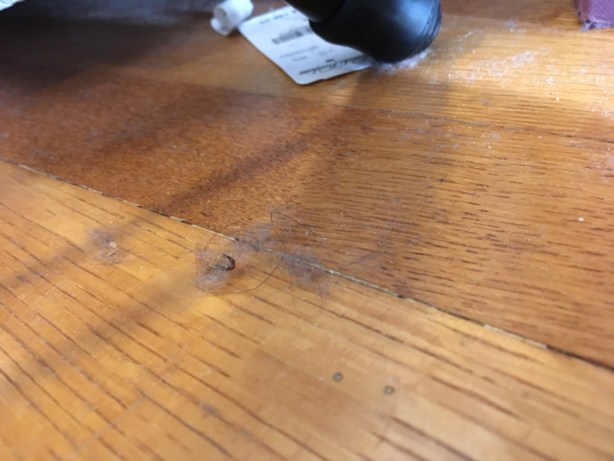
There’s hardwood with dust bunnies

dust, hair, and an old price tag on hardwood floor near chair leg

Corners with cobwebs very tricky to photograph spider silk, by the way

Cobweb formed in corner near door jamb over tile floor

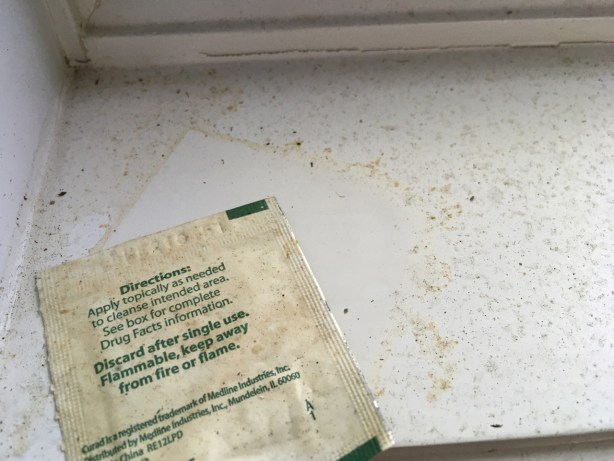
And the supposedly “dusted” windowsill covered in not just pollen, but also an unused alcohol wipe still in its package that left a visible outline when shifted! Can that even be a mere week’s accumulation?Topical wipe covered in pollen on pollen-coated windowsill near outline from the shifted packet

I’ll spare you the picture of the toilet visibly in need of scrubbing. Even the teen objected to that disturbing image, asking me if sending it was really necessary.

“Do your chores,” I replied. “Believe me, I wish I hadn’t had to see it either!”

The word "dust" scraped onto a dusty black surfacePerhaps it is an extreme reaction on my part. Should I stop sending them the filthy photos?
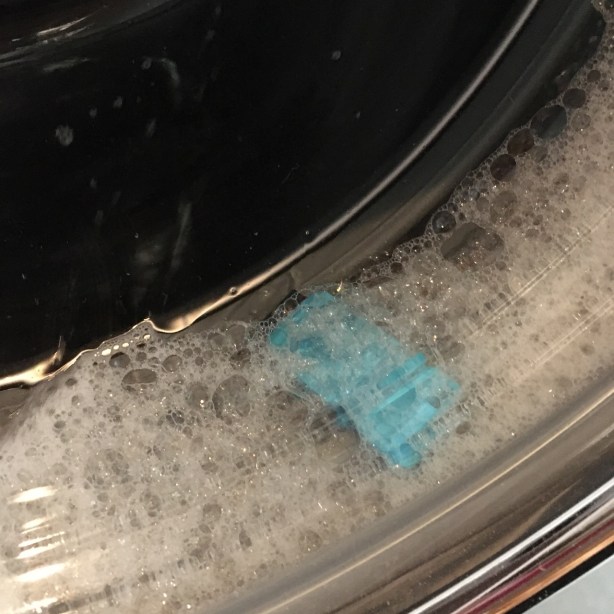
Then again, here’s a squeaky clean picture that still led to nagging:

Bright blue plastic USB drive housing in pile of suds viewed through washing machine door

That turquoise blue plastic visible in the suds inside my washing machine is a thumb drive someone forgot to remove from his pocket before dumping clothes in the laundry.

Not sure that’s what’s scrubbing your files is supposed to look like…

A persistent, unequal distribution of household labor has pounded the mental and physical health of mothers during the COVID pandemic. The demands I place on my kids to shoulder their share of the load are my reaction to that. I think it is a rational one.

Sometimes, I give in to the urge to take over a job myself, unable to stand literally! on that sticky spot on the tile any longer, but, mostly, I squawk at the kids instead. It’s for my own benefit, of course, but it’s for their own good, too. Children who pitch in at home are going to become more useful adults. Printed instructions titled Housework is Hard! describing how to wipe kitchen counters and clean the microwave

Perhaps these boys I’m raising will grow up to be more equitable partners to their own spouses someday. That’s my hope. For the time being, I will keep nagging, provide clear instructions on how tasks can be done effectively, and remind my kids that they are valuable, contributing members of our family and household.

I’ll probably keep doing that via lots of dirty pictures.

* My husband’s list is pretty short as he already works something-teen hours per day in his full time job while also running a side hustle as a self-employed scientific consultant. I do need his help with the physically demanding tasks, such as vacuuming multiple floors with the full-size machine. (The kids just use the lightweight Dyson hand vacuum which doesn’t have the same power to tackle the *sigh* wall-to-wall carpeting as our plugged in, full sized Miele canister vac.) I’m not quite ready to watch the boys bash the woodwork with the machine, either.

DH’s new list does also include the task I need help with most: reminding the kids to do their own damn chores before he gives in to all of their demands for attention and snacks in the evening! It’s only fair that Dad take on his share of the nagging duties, though he’s better at science than he is at disciplining his own children.

For anyone who’d like to piggy-back on my step-by-step approach to getting effective assistance from older kids who might do a job half-heartedly without definitive instructions, here are links to PDF documents describing How to Clean the Microwave OvenHow to Wipe Clean the Kitchen Counter, and How to Clean the Bathroom. Inflict them on your own hapless helpers with my blessing!

Seeking only perfect role models means failing to learn from history

Like many others—including the city’s mayor—I find the choice by the San Francisco Board of Education to spend its time focused on name changes for 1/3 of its public schools in the midst of a pandemic quite shocking. It strikes me as a misuse of resources when the children the Board is commissioned to serve are struggling to learn remotely with no* firm re-opening plans in place.

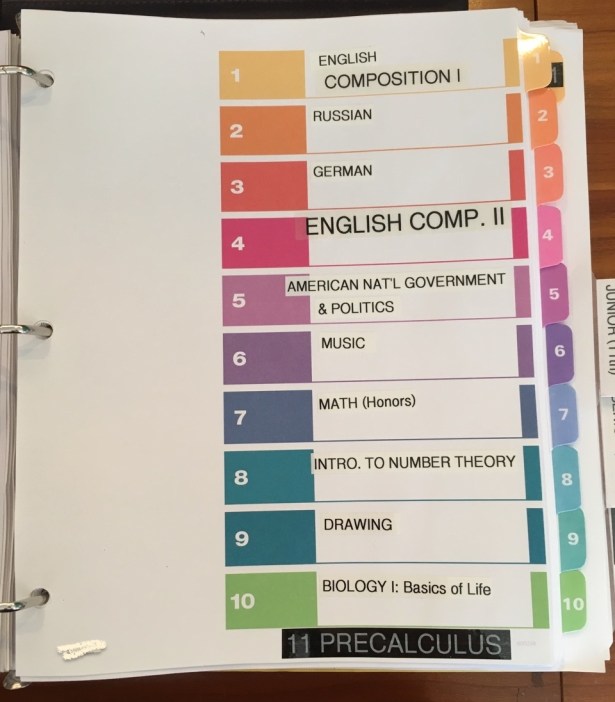
Binder page listing high school courses for grade 10Contrary to the far right, white supremacist commentators who unilaterally dismiss that Board of Education’s actions as essentially foolish, I’d like to make clear that I support discussion of social justice issues in this context. The feelings of enrolled students about the namesake of their institution deserve to be recognized, though, crucially in my opinion, not catered to by default, and never without extensive study and careful reflection when a preponderance of reasonable people hold differing opinions.


Talking about thorny questions is helpful, even vital to each pupil’s education. Confronting difficult episodes in our shared history enables us to be better as a nation and to become better individual human beings. I disagree with some of the ultimate decisions made by the San Francisco Board of Education about striking particular names from schools, but it’s not because I am unaware of mistakes made by leaders in earlier eras.

By my reckoning, the great hubristic error shown by that Board is the futile quest to pretend any perfect role model exists, unblemished enough to “deserve” to have a school named for him or her.back side of Christopher Columbus monument in Barcelona, Spain

No man or woman can be held up as a paragon of all virtues for all times. All of us fail; the very best of us will lead a life full of foibles. Some of us succeed handsomely in our own time, but later run afoul of changing notions of decency in another era.

The greater the risks taken in life, the more likely we are to make at least one real doozy of an error. People who devote lives to public service will fail with an audience, by definition. Should we teach our children to avoid any action to circumvent the possibility of failure? Do we want tomorrow’s adults to be more afraid of being judged by history than they are of taking part in—and becoming leaders of—public life?

Speaking for myself: no, I would not choose to teach that lesson to my kids or anyone else’s. I think the San Francisco Board of Education is doing a grave disservice to the children it serves by wielding nuanced history as a blunt instrument. Ironically, time is unlikely to be kind to its members. If they are remembered at all, it may well be for presumption and self-righteousness.

There is evidence that children allowed to fail, shown how to learn from their mistakes, then given opportunities to try again to find success grow into healthier, more productive adults. Given the 100% probability that a human being will screw up, a focus on incremental improvement seems like the wisest approach to raising and teaching young ones.

Christen your institutions with improper nouns defining high ideals if you still demand perfection: Liberté, égalité, fraternité, perhaps? Freedom? Justice? Unity? My personal favorite is Integrity.

Statue of LibertyIrreproachable individuals don’t exist, San Francisco Board of Education, but I’m curious to see who you believe holds up better to scrutiny than yesterday’s heroes with their feet of clay.

The social justice warriors on San Francisco’s Board of Education might not like being compared to fascists, but, to me, the parallels are obvious. People in power are attempting to strong-arm the world into abiding by their own narrow standards, ignoring complex reality in favor of pat party lines and simplifications that cast “the other” as willfully evil. Without a doubt, extremist elements on the left are also prone to seeking economic and social regimentation with forcible suppression of opposition.

Our young people didn’t invent cancel culture. Students of history will recognize the eradication of the names of pharaohs such as Akhenaten and Hatshepsut as a similar insult to non-conformists. The term damnatio memoriae may be modern**, but the concept is not.

Let’s teach our children to honor what’s good in our history while recognizing errors for what they were: human failings. Then, we learn what we can from those past mistakes, incorporating their lessons into our own pursuit of a better future. Isn’t that the ultimate point of public education?

* As of January 29, 2021, as I write these words, only one school’s re-opening plan has reached the Site Assesment stage and zero (0) applications to re-open have been accepted.

Presenting a role model as too perfect actually prevents teens from seeing a path to similar success for him- or herself. According to the linked study, kids benefit more from learning about Thomas Edison who worked very hard to achieve success (in spite of his reputation as a real jerk) vs. Albert Einstein whom most regard as a born genius with preternatural intellectual abilities.

On a television show I watched recently, the teens attended a school called Excellence. That’s a fine paradigm for which to aim.

Too bad one of the hyper-pressured teen characters felt compelled to abuse drugs to keep up and cope with the stress, and an otherwise ethical teacher on the show guides a young child toward cheating on high stakes exams to chase the academy’s pursuit of excellence in its reputation over the needs of that pupil.

** 17th century

Costco Executive Member swap of paper Reward Certificate for online use

2021 Update! The process I describe in this post still applies. I mailed in my 2021 Reward Certificate in November and had a Shop Card at my home a few weeks later.

Today’s tip will apply to a fairly narrow audience.

  • Are you a Costco Executive Member?
  • Do you still have your annual Reward Gift Certificate that was mailed out in 2020?
  • Are you avoiding shopping in person due to the COVID-19 pandemic?

If all three of those points apply to you, you may appreciate something I found out last month after a bit of searching. You can submit your paper Reward Certificate to the Costco home office by mail, and they will send you a Shop Card* redeemable for online purchases as well as in person, for example, at their gas pumps.

Costco Wholesale club Executive Membership Reward Gift Certificates dated 11/01/2019 and 11/01/2020As it happens, I hadn’t even gotten around to using my November 2019 certificate when I made my last in person visit going inside a Costco back in March 2020. The arrival in November 2020 of the next one brought the matter to my attention.
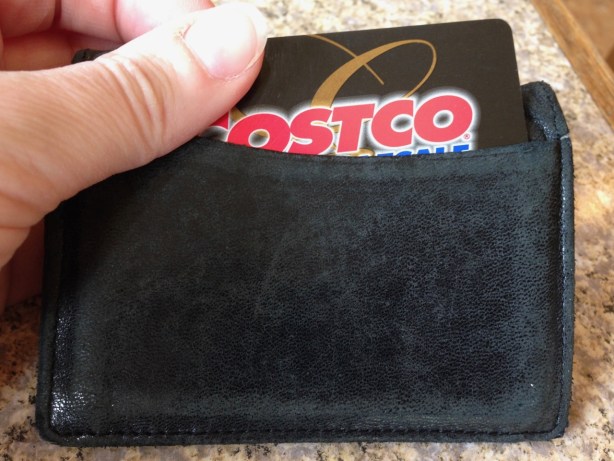
I was actually a few dollars shy of the break even amount for 2019—regular membership costs $60/year while Executive Members pay $120/year but earn back 2% of their spending in the form of this Reward Gift Certificate—and the $59 coupon in my wallet had completely slipped my mind.Costco Executive membership card in black leather wallet

My shopping habits changed a lot in 2020, however, and my two figure Reward from 2019 was more than doubled this year. In addition to regular orders of 2 Day Delivery shelf stable staples and household goods, I also bought Mountain House freeze dried meals and other long term storage foods, exercise equipment, and an expensive new vacuum cleaner from my favorite big box store.

While I frequented the Costco warehouse and gas station far less often during the pandemic, I did try to order as much as possible via Costco.com. I appreciate Costco’s consistent appearance on “America’s Best Employer” lists like this on from Forbes, plus their emphasis on value for dollar vs. lower prices on lesser quality goods matches my own preferences as a consumer. I feel much better shopping there than giving more of my money to Jeff Bezos over at Amazon.

With two Reward Certificates in hand, I found this page on Costco’s web site that explained how to redeem them for an equivalent amount of online-use-eligible gift certificates. I encourage you to follow the instructions on the official site at the link above, but here are the details on how to make the swap for yourself.

Mail your Executive 2% Reward certificate to Costco at:

Costco Wholesale
ATTN: Executive 2% Department
1455 11th Ave NW
Issaquah, WA 98027

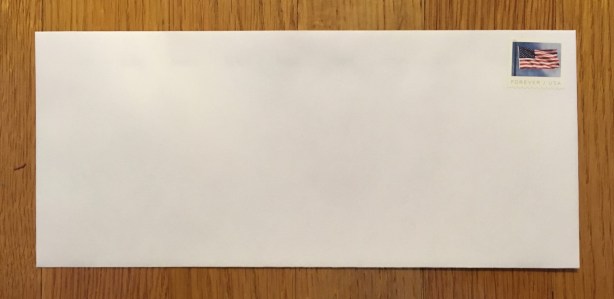
Number 10 (business size) envelope with stampMake sure to include the following in a cover letter:
  • Member’s name
  • Membership number
  • Address to which you’d like the Costco Shop Card sent
  • Phone number in case they need to reach you
  • Executive 2% Reward certificate(s)

I took the precaution of photocopying my Reward Certificates before mailing them to Costco, and I’d advise anyone else to do the same or snap a readable photo. For good measure, and because my printer also works as a scanner, I captured an image of my membership card to the same document lest a foolish typo on my part prevent me from getting my money back!

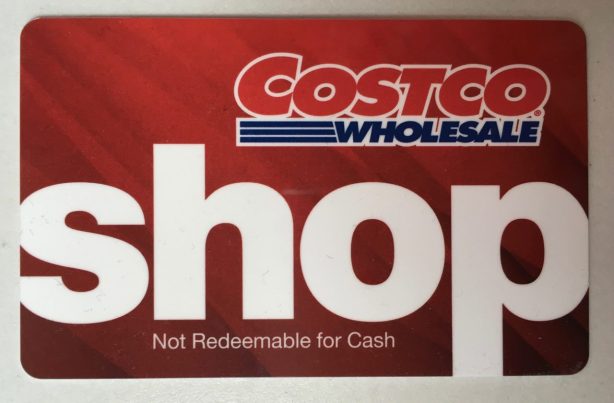
I didn’t put the date on which I mailed my Certificates on my calendar, nor did I note receiving the replacement Shop Card, but the process felt pretty quick. I’d estimate that I had gift card in hand within a couple of weeks, even with the widespread postal delays of this past holiday season.Costco Shop Card gift certificate - 1

I was given no guff about submitting two annual Executive 2% Reward certificates, and the Costco home office combined both dollar amounts onto a single Shop Card gift certificate as I’d indicated was my preference in my cover letter.Pile of money

If, like me, you are sitting on a couple of hundred dollars or more in Costco IOU’s due to COVID-19, consider taking these simple steps to gain access to the money you’ve earned via your patronage. You might also want to express your appreciation for the opportunity as I did. Once again, Costco’s commitment to customer service has made me happy to continue my patronage of the chain, and I made sure they were aware of how their effort affected my feelings about my membership.

* Costco’s name for their gift cards