
Taxing actual miles is better, but vehicle weight should be a factor for VMT

Because I’m in the 99th percentile for having strong opinions, a recent Washington Post article about some states experimenting with “vehicle-miles driven” (VMT) taxes in place of gasoline taxes got my attention. I’ve been complaining about the rampant up-ramping inadequacy of taxing only gas as a proxy for road usage for years.

Wear & tear is a cost of all cars, not just gas burners

Though they use less gasoline, it is obvious that hybrid and electric cars also cause wear and tear on roads, just like those powered by internal combustion engines do. Excluding those which weigh less than an average human being, every driver of any* vehicle on the asphalt should be paying a share of maintenance for streets, tunnels, and bridges.Pile of money

First let me point out that I think eliminating the gas tax entirely would be stupid. We should continue to tax fuel purchases for as long as they occur commercially because burning gas directly tracks with carbon dioxide emissions. Every breathing creature on the planet is affected by that pollution, not just the people driving automobiles. Taxing it is just!

I believe America’s leadership made a terrible mistake when it didn’t radically increase the fuel tax after 9/11. At that moment, patriotism might have mitigated the political hit. The true cost of every gallon of gasoline includes our spending on wars in the Middle East, defense against terrorism, and the ongoing environmental damage of carbon emissions and oil spills.

Gas is a dirty fuel in every sense of the word.USA flag - 1

With that being said, even 100% electric vehicles are not without deleterious effects upon our motorways. Never mind the generation of electricity—environmental issues there can be managed via different levers—but consider the physical reality of the cars themselves. A 2021 Toyota Camry rolls 3310 to 3475 lbs around our pavements depending upon trim level; a Camry Hybrid weighs in at an even heftier 3580 lbs.

That hybrid is eating some asphalt.

Space is occupied by hybrids as readily as by conventional cars

Add road congestion, parking issues, and traffic to the question of wear and tear. Engine type doesn’t affect those either.

To be clear, my position is that a combination of a fuel tax collected at the gas pump and VMT computed from individual vehicle data should start out with a total tax burden similar to today’s for a typical driver—specifically, those opting for efficient, mid-sized cars traveling an average number of miles.

I’m not advocating for a sudden huge jump in tax collection—though I believe most of us should be paying more than we do now to reflect the true cost of operating private vehicles—but for the choice of vehicle combined with actual miles driven to dictate the total tax burden per driver.

Allowing these rates to rise gradually over time would protect commuters from a sudden financial shock while allowing for desperately needed infrastructure improvements to begin across America. Escalating costs for operating outmoded, oversize vehicles in inappropriate environments would also nudge manufacturers and consumers toward more rational conveyances designed specifically for the types of trip actually being made day in and day out.

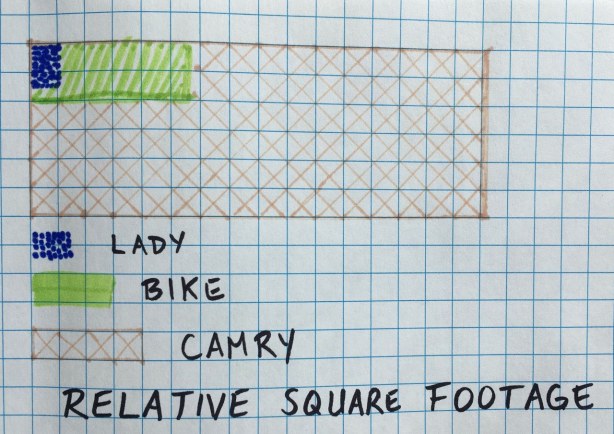
That Camry I mentioned occupies about 96.6 square feet (192.1″ x 72.4″ per Toyota’s specs) standing still. I’m pretty broad in the beam, yet my own standing square footage requirements are about 1.5′ × 1′ or 1.5 sq. ft.  math working out square footage of Toyota Camry

For reference: An average bicycle is 68″ long by roughly 24″ wide; therefore, a bike occupies about 11 ¹⁄3 sq. ft.

Here’s a quick visual comparison of the relative square footage occupied by a human body (lady) vs. an average bike vs. that same Toyota Camry. Remember to consider this graphic should be multiplied by the almost 8 billion human inhabitants of planet Earth to fully grasp the big picture.sketch on graph paper showing relative sizes of lady, bike, car
As a person with some physical disabilities, I’m hardly suggesting that all of us should walk or bike everywhere instead of using powered machines we’ve improved for that purpose over the course of millennia. Still, I’d argue that the ideal single person vehicle should be much closer to the size and weight of a bike if not the human body itself vs. a Heavy Duty pickup truck or even a sedan like that Camry on which I keep picking.

Even “compact” private vehicles operating with single passengers are a wildly inefficient use of space. That’s a more noticeable issue in dense cities, but the inappropriateness is blatant in any context given a modicum of though.two children stand next to blue hatchback

Again, as a person with physical limitations, I remain loathe to ban passenger cars outright from most spaces—even urban cores—but I absolutely support governmental policies that reflect the full, true costs of our dependence upon personal vehicles sized to hold entire families or a small sports team yet routinely carrying individual bodies.

A preposterous percentage of Americans—who carry multiple occupants on a given vehicular trip only 49% of the time, on average, per 2011 data from the U.S. Department of Transportation Bureau of Transportation Statistics—elects to drive something rather larger than a sedan.

According to Edmunds, in 2020, four of the top ten “Most Popular Cars in America” were full size trucks; three others were SUVs. That makes 70% of the favorite American choices for mostly carrying one human body even larger than the Camry I’ve been offering as an example of a standard passenger car.

According to this Bloomberg City Lab article, “Since 1990, U.S. pickup trucks have added almost 1,300 pounds on average. … the biggest vehicles on the market now weigh almost 7,000 pounds.” It would appear that human bodies in America aren’t the only ones experiencing an obesity epidemic.

The way that larger trucks have regulatory status as commercial machines, not passenger vehicles, making them exempt from EPA fuel economy reporting rules must be addressed. A solo commuter to an office should pay—literally, via her tax bill—for inefficient choices that affect others.

Those hauling heavy machinery or farm equipment may be reasonably held to a different standard of taxation. Differentiating between legitimate commercial vehicles and passenger use in calculating VMT strikes me as wise.

Major popular objections to VMT as implemented in 2021

Returning to the specifics of the states currently enacting—or testing— VMT in 2021, two major objections are noted (from the same Post article from paragraph one, bolded emphasis mine):

“Surveys of drivers involved in pilot programs revealed questions of privacy and data security as top concerns. Many environmentalists also are opposed, saying that taxing gasoline also[sic] is also an effective tax on carbon dioxide emissions. Under a miles-driven system, the highest-emission vehicles stand to gain a tax break.”

I see simple solutions to both of these non-problems with implementing a sensible VMT.

Environmental solution via VMT: factor in weight

To address the concern that fuel-guzzling trucks and SUVs will be under-taxed given their tendency to pollute, the miles driven tax rate ought to be multiplied by the weight of the vehicle.

Accounting for actual weight corrects for the environmental damage done by over-sized SUVs and pickups used frivolously in place of fuel efficient passenger cars for urban commuting. A Gross Vehicle Weight Rating (GVWR) is already required of all manufacturers. Use that information to tax drivers based upon their chosen vehicle multiplied by the number of miles s/he drives. That result offers a pretty reasonable assessment of how much wear and tear one individual puts on our public roads.

I believe the best policy in a free society is to allow the real price of operating even the most bloated conveyance to convince drivers to make better choices when conscience fails. I wouldn’t ban Hummers, but I’d like to see their owners pay for more of what they’re currently getting away with stealing from future generations.

Allow people to continue to “express their individuality” by driving one of the most popular “cars” i.e., full sized trucks if they wish, just make them pay their fair share of what they’re using.

Privacy objection to VMT: read the odometer, stupid

The privacy issue is hugely important to me, but carrying an intrusive GPS tracking device at all times is hardly the only option for implementing VMT.

You don’t need location data to assess miles driven. There’s an odometer built into every modern vehicle.

States like mine already require annual safety inspections of any vehicle operating on public roads. Adding an odometer reading to that process—done in state-certified facilities in every community—would add only a trivial amount of time and effort to that process. Remitting one’s “actual miles driven” tax after an annual safety or emissions inspection could be required before new window or license plate stickers were provided.

States could offer tracking devices like those used in Oregon’s program to those who prefer to pay smaller, more manageable, more frequent periodic bills, but also allow drivers to accrue billable mileage with collection due quarterly, annually, when registrations are renewed, or simply upon sale of the vehicle. That could lead to a large tax bill for someone making the latter election, but it effectively removes all privacy issues from the tax.

Odometer readings could be self-reported or taken at government facilities or in approved private garages such as car dealerships or service stations; any discrepancies could be caught upon sale or transfer of the vehicle. Deposits based upon averages—the individual’s historic mileage as these programs persist over the years or from data captured by auto insurance actuarial tables—could be held in escrow by the state if necessary.

In the longer term, odometers could be designed to transmit readings without coupling that information to GPS location data. Data transmission of this type is well within the bounds of current technology.

In short, there are no insurmountable technical or privacy obstacles to implementing a fair, cost-effective collection of VMT in 2021.

Bigger, heavier vehicles take up more than their fair share of space, they cause roads to deteriorate faster, and they represent a greater threat to the health and safety of pedestrians, cyclists, and other motorists. A properly designed VMT should tax individuals for their choice of vehicle in combination with the quantity of miles driven. That would be by far the most fair and reasonable option I can imagine.

* Though this may not be a universal position, I believe that every human has the right to navigate the world under his or her own power without taxation. Bicycles and skateboards probably do exert a small toll upon the surfaces they transit, but I suspect their effects are negligible compared with that of most powered conveyances.

The electric bike pictured in the photo to the right of the construction trucks was used by my father to commute to his last full-time professional job before retirement. He was in his 60’s at the time and found the electric motor assist necessary to cope with a particularly steep hill between home and office. To be fair, he always had access to a car for days when the Oregon weather made cycling miserable or unsafe, but Dad makes a fair proxy for a non-young, not-above-average-in-fitness commuter.

Again, from the same Washington Post article, here’s a description of how Oregon is currently implementing its VMT program:

“Participants in the state have three ways to sign up — two privately run systems and one administered by the state Department of Transportation. The private companies send drivers a device that logs where and how much they drive or pull the data directly from vehicles. Then they send out bills and turn over the revenue to the state. Drivers get reimbursed for gas taxes they pay at the pump.

The companies keep drivers’ data for 30 days, and participants have options that include not sharing information about their locations.”

What if student loan forgiveness were tied to public college costs?

Some American politicians want to forgive all student loan debt. I disagree with this notion, mostly because I think many private colleges are now charging a ridiculous, inflated price, not supported by evidence of their inherent value to the individual or to society.

I am all in for learning. I want more kids to earn the benefit of a meaningful education that supports their personal and career goals. I believe that our entire society would benefit if we did a better job teaching our children, from cradle to adulthood.

I agree that our current system is dysfunctional. My opinion is that reforms should aim to correct something more fundamental than the particular loans taken by students who have already left the system. The pricing structure for a university education should be made more rational, not cloaked in additional government intervention.

I don’t want my government paying current “list prices” for private colleges for every student—already a narrow group, disproportionately representing our richest, most privileged children—and especially so when younger, more vulnerable pupils fail to learn in crumbling buildings with more attention paid to test scores than human potential in our mediocre K-12 system.school supplies - 1

That being said, I am also on the side of those who argue that our system is inherently unfair and biased against the scores of bright, motivated students often representing the first generation of their families to reach higher education. The financial aid system is byzantine; true costs of attendance are cloaked by “merit aid” and government contributions based on “need” can’t be assessed without filling out reams of paperwork.

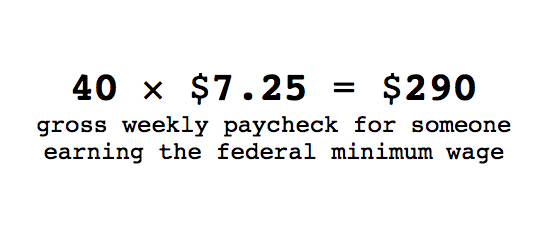
The less experience one’s family has with American higher education as a system, the harder it is to understand any of it at a glance, or even with a great deal of study! Actual costs are opaque. It’s hard to even justify paying a $75 fee to apply to a university whose website says it charges $75,000 per year when your parents earn $7.25* per hour.

That those are real figures which just happen to look like an elegant visual numerical alliteration is the best thing that happened to me today.40 hours per week times federal minimum wage equals $290 gross take home paySure, fee waivers are available, but how many times does a poor student deserve to be reminded of his deprivation within a single application process? And high school seniors apply to around seven colleges each. math written out 7 times 75 dollars equals $525

Imagine being the 17 year old high school senior, living in poverty, who has to say:

“Hey, Mom, can I have two full weeks’ of your take home pay to buy the privilege of applying for the chance of spending more than five times your annual earnings every year for the next four years to get educated? Yup, that’s right, Mom. The webpage says the price for a college degree is 20 times what you earn per annum.”

Of course financial aid is available to those who qualify; the vast majority (86%) of American students receive some financial assistance towards paying for college. To qualify for aid requires one to complete the Free Application for Federal Student Aid (FAFSA.) That process takes about an hour… if you have ready access to recent financial records and tax returns plus social security numbers for both yourself and your parents.

Aside from the insanity of the FAFSA using a different definition of “dependent child” from the same U.S. government’s Internal Revenue Service (IRS), there is also literally no recourse for a student under age 21 whose parents won’t provide their financial records for the purpose of filling out the form.

Per the Filling Out the FAFSA® Form › Reporting Parent Information page:

“…if your parents don’t support you and refuse to provide their information on the application, you may submit your FAFSA form without their information. However, you won’t be able to get any federal student aid other than an unsubsidized loan—and even that might not happen.”

Until you are age 24—if you’re unlucky enough to have unsupportive parents—unless you can prove via written records that they are in jail, that you had “an abusive family environment” (remember: proof required!), you can’t find your folks at all, or you are over 21 and also “either homeless or self-supporting and at risk of being homeless,” it’s hard to know whether completing the FAFSA will even be worth the effort.

The travail of merely filling out the FAFSA, appears to prevent kids from under-served communities from even approaching applications to higher education.

Oh yeah, and the federal government audits a disproportionate number of financial aid applications submitted by young adults from neighborhoods where the majority of the population is comprised of people of color.

COVID-19 has increased the size of all of these hurdles, apparently. Rates of application to community colleges, for financial aid, etc., have all plummeted in 2020-21 for precisely those students who would benefit most by furthering their educations—those born under a burden of poverty, placed there by circumstance, but forced to carry it on each young back until the lucky ones access the tools required for self-liberation. Education is the most common lever used to pry that burden off.

Go ahead and add that loss to the half a million lives cut short, and tack the cost onto the pandemic’s final bill.

Pile of moneyIt is an indisputable fact that the United States has systematically de-funded public colleges and universities within the span of my lifetime, rendering even “public” universities difficult to access for all but the wealthiest students. To me, that represents an utter failure of public higher education, a human service that is so important to our nation’s civic character and economic growth that I would consider it part of our basic infrastructure.

By definition, I believe public education should be attainable** by 100% of the citizenry.

A recent Boston Globe article detailed a tug of war between the Biden administration which proposes $10,000 per student in loan forgiveness vs. a progressive position championed by Elizabeth Warren and others to forgive $50,000 per student.

Here’s my response: why not tie governmental student loan forgiveness amounts to public college tuition and fees? Whether this is a federal average, rates for institutions in the region where s/he got her education, or the price where s/he lives now, at least this figure would remain tied to some actual, real cost of higher education as it changes over time.

Yet that public tuition rate should also reflect an efficient system, one hopes, seeking to offer a good return on the state’s investment in its future taxpayers. Without the option for limitless borrowing to go elsewhere, the discretionary facilities arms race of ever grander stadiums and shinier, newer dorms to entice potential first years should slow, if not stop altogether.

Typical colleges would have an incentive to keep their published tuition rates aligned to what borrowers could reasonably find the means to pay. Elite universities might maintain higher prices, but their rich endowments would continue to make generous aid packages possible for anyone they chose to admit.

View of community college building on campusGovernment regulations tied to hard figures always end up skewed by inflation; income and prices change year by year, typically trending upwards. The Alternative Minimum Tax, for example, was designed to apply to very high income earners who were taking “too many” legitimate deductions, but now it routinely catches upper middle class, dual income families in expensive coastal cities in an indiscriminate dragnet while much richer folks pay money managers to hide and protect larger assets.
I’m imagining a scenario where a billionaire politician could pay only $750 in federal taxes while those of us earning far less pay many thousands more…

It strikes me as fundamentally fair and equitable for students electing to attend private colleges to remain entitled to their share of government help, but not necessarily more help than those who opt for public institutions. This would act as a brake on runaway tuition hikes overall while never preventing any private entity from charging whatever it wishes. That seems like common sense, and protective of the public interest.

Another idea that can only be addressed at the federal level would be to offer international skilled worker visas preferentially to companies that implement effective training programs for American workers simultaneously. Those same corporations could sponsor scholarships for domestic students—or create in house programs for local unemployed or underemployed citizens—on a some-to-one or even one-to-one basis for future hires. No reasonable person should expect businesses to hire employees incapable of filling the requirements of a particular role, but our government could ask that those allowed to important talent also take part in reducing that same need going forward.

The U.S. Government should remain involved in higher education. Without an educated populace, the chance that America remains a global superpower rapidly dwindles to near zero. Power—and the money that goes with it—flows to those who control the currency of the day. In 2021, information and technology reign supreme in that arena. The field depends upon a trained workforce to function, though, and there aren’t enough Americans with the requisite skills to fill open positions in U.S. technology firms today. I haven’t seen much evidence to suggest that those odds are improving, either.

The pandemic’s winnowing of the best and brightest poor students in the United States from the ladder of upward mobility via advanced degrees will damage our ability as a nation to compete in the global marketplace, and never mind the real, tragic human cost to those young souls. The ideal role central government can play in education is to ensure equitable access to it for the broadest possible swathe of the populace. Financial Aid is a means to that end, but the American version is a tool that requires sharpening to be used to better effect.

In the meantime, if you are trying to figure out how much college costs right now, be aware that American colleges and universities are required to offer a “net price calculator” somewhere on their websites. Search for it directly from your web browser as some institutions bury this useful tool deep under their admissions information. Also consider Googling the “common data set” for any university you are considering; this standardized form is where U.S. News & World Reports and all those other comparison sites get their college facts. Section H2 will give you a lot of information about how many students receive both need-based and merit aid at the school you are considering.

I’m fundamentally academic by nature. I left the workforce to devote many of my prime earning years toward the education of my own children. I believe in the transformative power of learning to change peoples’ lives for the better.

Finding an “average price” for college is not straightforward because of the obfuscation about which I’m complaining! Here’s an entire article going into detail about how “net price” differs from official tuition figures, and also separating out the living expenses which paid for by the same source: typically, financial aid. From that US News & World Report article, I got an average price for public colleges of $9,687 compared with $35,087 at private ones. That said, we must recognize that Harvard College’s 2020-21 undergraduate tuition may be $49,653 with fees of $4,315, while its actual, billed “cost of attendance” is $72,357. Tuition itself is almost irrelevant in this discussion, because that latter amount is what “financial aid” would cover.

Harvard hides its tuition information, by the way, not even providing a direct link on its admission page. I had to search for “tuition,” and, not coincidentally, that was the top search term on their FAQ page. Instead of making its price easy to find, Harvard inundates the admission seeking high school student with multiple pages extolling their rich and abundant financial aid offerings. That’s all well and good because such a large proportion of the student body receives aid, but it precisely underscores my point that the system as it stands is wildly complex at the expense of the well being of the student population.

* US Federal minimum wage as of 2020 is $7.25 per hour

** I specifically mean attainable financially here. I do not believe that 100% of the human population should attend traditional colleges and universities, and I think the push in that direction does a disservice to those with inclinations outside of the classroom. If it were up to me, we would have a national network of trade schools administered much like the community colleges, and with identical access to easy, straightforward financial aid for those who need it.

I would argue that it remains imperative for colleges and universities to maintain academic entrance standards. Some students will be excluded because not everyone develops the intellectual capacity for the most abstract forms of thinking, but I’ve never seen credible evidence that this kind of aptitude is distributed inequitably amongst various ethnic, racial, or social groups. Rather, most studies on this issue point to the distractions of poverty and oppression as levers operating against the success of some. I wholeheartedly support reforms that provide every schoolchild with the same opportunity to reach his or her highest potential, but I don’t believe that every one of us was cut out to be a physicist, say, or a fine artist, nor would I hold those individuals up as fundamentally superior to the plumbers and mechanics who keep the systems we rely upon working smoothly.

Seeking only perfect role models means failing to learn from history

Like many others—including the city’s mayor—I find the choice by the San Francisco Board of Education to spend its time focused on name changes for 1/3 of its public schools in the midst of a pandemic quite shocking. It strikes me as a misuse of resources when the children the Board is commissioned to serve are struggling to learn remotely with no* firm re-opening plans in place.

Binder page listing high school courses for grade 10Contrary to the far right, white supremacist commentators who unilaterally dismiss that Board of Education’s actions as essentially foolish, I’d like to make clear that I support discussion of social justice issues in this context. The feelings of enrolled students about the namesake of their institution deserve to be recognized, though, crucially in my opinion, not catered to by default, and never without extensive study and careful reflection when a preponderance of reasonable people hold differing opinions.
Talking about thorny questions is helpful, even vital to each pupil’s education. Confronting difficult episodes in our shared history enables us to be better as a nation and to become better individual human beings. I disagree with some of the ultimate decisions made by the San Francisco Board of Education about striking particular names from schools, but it’s not because I am unaware of mistakes made by leaders in earlier eras.

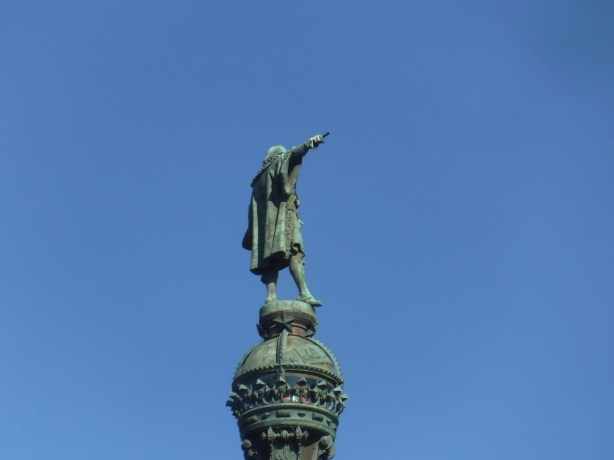
By my reckoning, the great hubristic error shown by that Board is the futile quest to pretend any perfect role model exists, unblemished enough to “deserve” to have a school named for him or her.back side of Christopher Columbus monument in Barcelona, Spain

No man or woman can be held up as a paragon of all virtues for all times. All of us fail; the very best of us will lead a life full of foibles. Some of us succeed handsomely in our own time, but later run afoul of changing notions of decency in another era.

The greater the risks taken in life, the more likely we are to make at least one real doozy of an error. People who devote lives to public service will fail with an audience, by definition. Should we teach our children to avoid any action to circumvent the possibility of failure? Do we want tomorrow’s adults to be more afraid of being judged by history than they are of taking part in—and becoming leaders of—public life?

Speaking for myself: no, I would not choose to teach that lesson to my kids or anyone else’s. I think the San Francisco Board of Education is doing a grave disservice to the children it serves by wielding nuanced history as a blunt instrument. Ironically, time is unlikely to be kind to its members. If they are remembered at all, it may well be for presumption and self-righteousness.

There is evidence that children allowed to fail, shown how to learn from their mistakes, then given opportunities to try again to find success grow into healthier, more productive adults. Given the 100% probability that a human being will screw up, a focus on incremental improvement seems like the wisest approach to raising and teaching young ones.

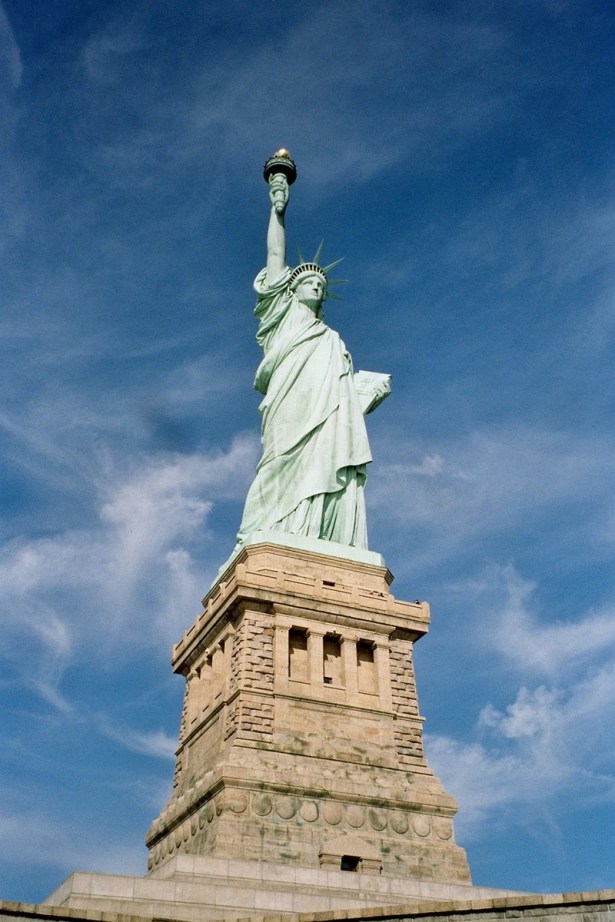
Christen your institutions with improper nouns defining high ideals if you still demand perfection: Liberté, égalité, fraternité, perhaps? Freedom? Justice? Unity? My personal favorite is Integrity.

Statue of LibertyIrreproachable individuals don’t exist, San Francisco Board of Education, but I’m curious to see who you believe holds up better to scrutiny than yesterday’s heroes with their feet of clay.
The social justice warriors on San Francisco’s Board of Education might not like being compared to fascists, but, to me, the parallels are obvious. People in power are attempting to strong-arm the world into abiding by their own narrow standards, ignoring complex reality in favor of pat party lines and simplifications that cast “the other” as willfully evil. Without a doubt, extremist elements on the left are also prone to seeking economic and social regimentation with forcible suppression of opposition.

Our young people didn’t invent cancel culture. Students of history will recognize the eradication of the names of pharaohs such as Akhenaten and Hatshepsut as a similar insult to non-conformists. The term damnatio memoriae may be modern**, but the concept is not.

Let’s teach our children to honor what’s good in our history while recognizing errors for what they were: human failings. Then, we learn what we can from those past mistakes, incorporating their lessons into our own pursuit of a better future. Isn’t that the ultimate point of public education?

* As of January 29, 2021, as I write these words, only one school’s re-opening plan has reached the Site Assesment stage and zero (0) applications to re-open have been accepted.

Presenting a role model as too perfect actually prevents teens from seeing a path to similar success for him- or herself. According to the linked study, kids benefit more from learning about Thomas Edison who worked very hard to achieve success (in spite of his reputation as a real jerk) vs. Albert Einstein whom most regard as a born genius with preternatural intellectual abilities.

On a television show I watched recently, the teens attended a school called Excellence. That’s a fine paradigm for which to aim.

Too bad one of the hyper-pressured teen characters felt compelled to abuse drugs to keep up and cope with the stress, and an otherwise ethical teacher on the show guides a young child toward cheating on high stakes exams to chase the academy’s pursuit of excellence in its reputation over the needs of that pupil.

** 17th century

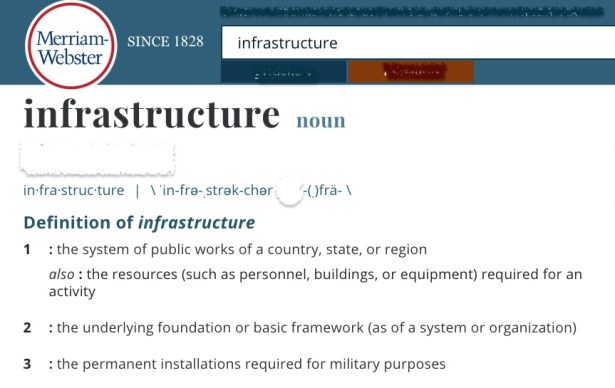
Where is the line between infrastructure and socialism?

Where do you, personally, draw the line between infrastructure and socialism?

Merriam Webster dictionary definition of infrasctructure, the system of public works of a country, etc.I ask this sincerely, with no desire to engage in polarized internet snipe-fests, but in the spirit of attentiveness to what government services various individuals might deem “necessary” and which are “overreach.”

Even more interesting than the what, is the why.

Only deep ignorance of history allows one to pretend there’s anything universal about this question. Our republican forebears in Rome—whose architecture we aped in the United States capitol in part due to the Founding Fathers’ lionization of that civilization—prioritized very different governmental interventions than we do today.

Proving myself, as always, a true dilettante and no real scholar, I’ll begin by pointing to a series of mystery novelsthat I read years ago. They turned me on to a startling fact: the ancient Romans had no police force.

police car parked at justice centerRome, civilization par excellence, did not feel that it owed average citizens the protection of civil police. The military kept order to an extent that suited the needs of the state, but there was no one to call when your silver was stolen. It wasn’t until the great republic became an empire that Augustus formed the Praetorian Guard in 27 BCE… to protect himself.

And all this in spite of the fact that the Ancient Greek city of Athens had seen the nascent formation of a police force (c. 400 BCE) to keep order and arrest and manage prisoners using publicly owned Scythian slaves. Investigating and detecting crime, in the ancient world, was the responsibility of individual free citizens.

So, is a police force a basic piece of infrastructure, a right that should be available to all, or is investigation and detection by paid government agents an imposition against individual freedoms as the Romans seemed to believe?

In spite of our turbulent times and the fraught political environment, I’ll admit it: I think this is a fascinating question. In a democracy, it is, in fact, the duty of every citizen to ponder these essential assumptions.

Do modern American people on the right and on the left really have such different ideas about what a government ought to do, or are our differences more about degree and descriptive nomenclature?

Continue reading

Treason in the U.S. Senate & rioters storming the Capitol

Be aware of the following feckless U.S. Senators:

  • Ted Cruz (R-Texas),
  • Ron Johnson (R-Wisconsin), ?
  • James Lankford (R-Oklahoma), ?
  • Steve Daines (R-Montana),
  • John Kennedy (R-Louisiana),
  • Marsha Blackburn (R-Tennessee), ?
  • and Mike Braun (R-Indiana),

and Senators-Elect:

  • Cynthia Lummis (R-Wyoming),
  • Roger Marshall (R-Kansas),
  • Bill Hagerty (R-Tennessee), ?
  • and Tommy Tuberville (R-Alabama)

These Members of Congress signed a posted statement inciting violence in my nation’s capitol today. Lawless Trump supporters have even breached the Capitol Building itself, forcing the U.S. Senate and House to bar their doors and interrupt their proceedings at around 14:30 on January 6, 2021.

Official Election Mail trademark authorized by US Postal ServiceThe Senators’ statement pretends that there remains valid and significant contention about the results of our November 2020 election. These men and women are intentionally ignoring the fact that our courts have already acted in accordance with the law and found no legal justification for further action regarding purported irregularities.
2% of Americans believe the Earth is flat in spite of evidence to the contrary being plainly visible to the naked eye at sea or from a plane; the fact that a population being fed a steady diet of misinformation by social- and partisan media doubts reality makes it no wonder that, as per the Senators’ statement, “39% of Americans believe ‘the election was rigged.’

By your own admission in your statement, then, Senators, 61% of Americans must believe the election was valid. With the majority holding such an opinion, how do you justify encouraging rioting in the streets of Washington, D.C. and the interruption of the work of our nation’s government?

By continuing to defy the United States Constitution to which they’ve sworn allegiance, our laws, and the reasoned decrees of our state and federal judges, the Senators I’ve listed are feeding their constituents’ inflated paranoia, not doing their jobs as duly elected representatives.

Trump is attempting a coup. These Senators are complicit.

By all means, the Feckless Eleven—and others like freshman Senator Josh Hawley (R-Mo.)—are entitled to hold opinions and do their own research into how, when, and why our elections are imperfect. If they find any actual evidence of wrongdoing, they should bring it to the attention of the courts. It’s hard not to ask, however:

If they sincerely doubt the results of November’s ballots, how do the four newly elected Senators feel justified in showing up in Washington, D.C. at all? By their own logic, they have not received any mandate from their respective constituencies!

If [Senators-elect Lummis, Marshall, Hagerty, Tuberville, and Hawley] sincerely doubt the results of November’s ballots, how do [they] feel justified in showing up in Washington, D.C.?

Perhaps these treacherous Senators should use their own funds to continue investigating, if they sincerely believe there really are unsettled questions; their frequently seditious* states are also free to launch investigations from their own budgets. After all, elections in the United States of America are conducted by the states, each with its own local authority.

One might suppose the representatives of states known to still promote the idea that the Civil War was primarily about States’ Rights’ as opposed to slavery could comprehend this distinction.

These so-called Senators will earn a salary of at least $174,000 per annum to defend the U.S. Constitution. I’ve read that one woman inside the Capitol Building has already been shot. What are the odds it was one of these highly paid politicians glibly spouting conspiracy theories for personal gain as opposed to an aide or security guard serving her country for minimum wage?

Shame on you, Senators. America will remember your names, right alongside that of Benedict Arnold.USA flag - 1

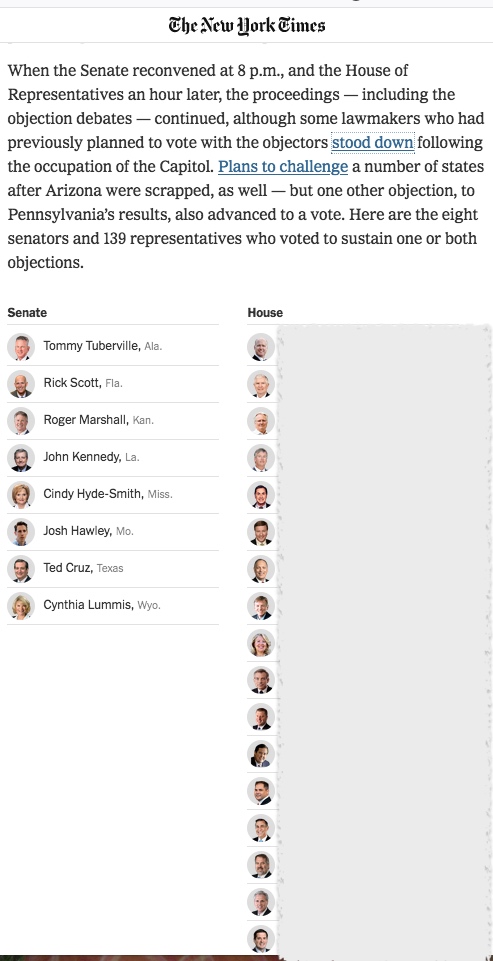
Senators Daines and Braun publicly stated that they would not opt to object to Biden electors after violent extremists stormed the Capitol. In recognition of the update, I’ve lined through their names in my post. Screenshot from NYT article listing 8 Senators and 139 Reps who objected to Nov 2020 electoral votes for president

The Senators after whose names I’ve appended a question mark do not appear to have voted to object according to the New York Times, but they were not included in the AP statement I linked to above.

139 Members of the House of Representatives voted to object; their names are included in the NYT link above.

For those who haven’t followed the news, I’ll include the relevant snippet of Trump’s speech that literally instructed his supporters to march on the U.S. Capitol Building. It should be noted that the man himself was lying when he stated that he would join the protestors in that action. Trump went back inside the White House and is reported to have spent the afternoon watching the chaos he’d instigated on television.

“…we’re going to walk down to the Capitol… I know that everyone here will soon be marching over to the Capitol building to peacefully and patriotically make your votes heard today.”

—Donald Trump’s speech of January 6, 2021 as reported on Snopes

* Seven states formed the Confederacy, seceding and initiating the U.S. Civil War: South Carolina, Mississippi, Florida, Alabama, Georgia, and Louisiana, followed shortly thereafter by Texas.

The short-lived Confederate States of America added Virginia, Arkansas, Tennessee, and North Carolina to total eleven states. Slave states Missouri and Kentucky were acknowledged as members, but neither officially declared secession. The Confederate Territory of Arizona is also worth remembering.

Half of the Senators I’ve called out in this post for their reckless, Constitution-violating actions hail from states with a history of rejecting the rule of U.S. law. Three of the others represent states did not yet exist as of 1861: Oklahoma, Montana, and Wyoming.