
Managing chronic pain on the 12+ hour flight to New Zealand

Since developing chronic pain that accompanies an autoimmune condition, I’ve continued to indulge my love of travel, but learned to adapt my bookings and my belongings to minimize pain and maximize comfort.


Flights of six hours or so are regular occurrences for me and my family. I’ve had a couple of very painful trips of this duration, but, more typically, I can tolerate them by adjusting my medication slightly and employing a few aids such as wrist braces, inflatable cushions, and hot water bottles.


This winter, I faced the longest single flight I’ve ever taken: 12 hours and 40 minutes just for one leg from Los Angeles, CA to Auckland, New Zealand. The combination of traversing the United States from our New England home (6.5 hours), crossing the Pacific (12.7 hours), then connecting to our final destination of Christchurch, NZ on the South Island (1.4 hours) made for a total time in the air of 20.5 hours.

Of course, one must also add to that total the requisite airport waiting time required by international flight connections, customs, security, and the necessity of allowing adequate buffers in case of delays. At least two full days of my calendar were bound to be eaten up by this voyage in each direction.

After considering many options, I elected to travel in two distinct stages for both directions of travel. This meant parting ways with my husband entirely for the domestic portion of our trip. His schedule doesn’t allow for an unnecessary day spent in transit where tighter connections are possible.†

I was away from home for a total of fourteen days; DH, by taking his domestic and international flights serially on the way out—and heading home on a red eye straight off the international leg—traveled for twelve days.

Though this post isn’t really meant to be a trip report, it must be said: even two weeks is barely adequate for visiting the antipodes. If you can squeeze more days out of your schedule, use them for a trip of this magnitude.

New Zealand is awesome, and well worth every hard won vacation day.

My itinerary outbound:

BOS-PDX on Alaska Air 33, Saturday 16:20-20:10

Three night stay with family in the Pacific NW

PDX-LAX on Alaska Air 568, Tuesday 10:50-13:22

LAX-AKL on Air New Zealand 5, Tuesday 21:40-Thursday 07:20*

AKL-CHC on Air New Zealand 527, Thursday 09:00-10:20

My itinerary for the return:

CHC-AKL on Air New Zealand 574, Friday 20:00-21:20

AKL-LAX on Air New Zealand 2, Friday 22:50-13:35**

Overnight hotel stay at the Crown Plaza LAX

LAX-BOS on Virgin America flight 1360, Saturday 07:05-15:34

Itinerary adaptations to reduce pain

I’ll repeat what I feel was the single most important adaptation I made to my itinerary to accommodate my autoimmune condition and its symptoms: I took extra time.

Travel. Stop. Recover. Repeat.

Heading west, I took advantage of family who live near the Portland airport who don’t seem to mind my visits, spending three nights at their home. This sleepover gave me time to recover from the initial cross country flight and ease my body’s adjustment to a change of three time zones.
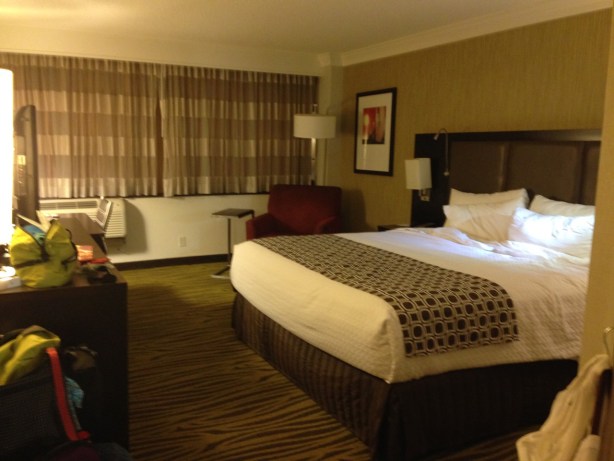
NZ Crowne Plaza LAX hotel room - 1Upon arrival in New Zealand, I had already acclimated from the Eastern to Pacific zone (USA West Coast) which represents half of the total time shock. Though the flight is lo-o-o-o-ong, most of the travel between California and New Zealand is in a southerly direction. You only drop three more time zones on that 12 hour flight.

Heading west is also usually less difficult in terms of jet lag.

Continue reading

Rushing for life experiences when chronic illness fuels your fears

I’ve had the great fortune to travel regularly throughout my life.

I enjoyed those pivotal vacation experiences of a happy middle class childhood: a couple of trips to Disneyland and bragging rights about having flown on airplanes and crossed a national border or two, if only to near neighbors Mexico and Canada.

I attended college in a different region from Home. I flew cross country at least four times a year because of this one fact. I built my desire to see the world into my educational plans, and it worked out well for me.

I didn’t even mind long distance romances in my youth, because what could offer better motivation for frequent trips? I love having a journey coming up in my calendar.

Later, working as a software engineer, I had the privilege of visiting subcontractor sites in Denmark and Spain on my employer’s dime. At the same time, I was a single, adequately employed young adult during the roaring 1990’s before the dot.com bubble burst.

For as long as I’ve had the option, I’ve traveled regularly, and I’ve enjoyed most of it. I dream of “seeing the world.” I’ll be grateful for every corner that I reach.

Yet, in spite of all this to-ing and fro-ing, there has been a certain rhythm to my rambling. At my youthful peak, I was not a high energy traveler. As a middle aged mother with a couple of kids in tow, my pace is typically sedate, and I prioritize comfort and convenience over the heights of adventure.

Looking back over our family travels, a pattern emerges. Every few years, we’ve had a “grand adventure.” How grand is Grand has changed with our finances and family status, but it’s always been a cycle of plan, anticipate, then go.

Maybe Go! with a capital and an exclamation mark expresses it better.

“But lately something’s changed, it ain’t hard to define…”* Or, rather, it isn’t hard to unearth the cause of the shift. I’m scrambling. I’m rushing. I’m tumbling from one trip to another without enough time to fully digest each experience.

Some of my trips bump up hard enough against the next that I feel more overwhelmed than anticipatory.

I know why I’m doing it, too. I’m afraid.

I’ve been saying yes to one trip after another because I’m afraid it will be my last chance to travel before I’m sidelined by infirmity and pain. Continue reading

Bluetooth keyboard: Logitech K780 liberates a writer on the move

If I hadn’t purchased a Bluetooth keyboard, this blog would have about 30% of its current content. My preferred portable input device is a Logitech K780 model.

I bought mine from Amazon about a year ago when I began writing regularly for my blog. I quickly realized that hand discomfort was my limiting factor for writing long form content away from my desk with an iPad. I paid $75 then; today’s price is several dollars less.

keyboard in use - 1

My Logitech K780 keyboard in use on a lap desk

The dedicated keys for switching almost instantaneously between three devices are a major factor in my enjoyment of this particular keyboard. Those are the three white keys at the upper left of the K780 in the photo above.

Because I experience arthritis pain and stiffness in my fingers and wrists, tapping on a touchscreen while holding a device can be difficult, excruciating, or even impossible.

If I have my keyboard out, I use it to enter even short, simple text messages into my Android Blu R1 phone. Using the Logitech K780 is that much more comfortable for me.

keyboard Logitech bluetooth K780 - 5

Slim, but for the hump

Two other functions made the K780 the best keyboard for me:

  1. I prefer a keyboard with a numeric keypad for efficient data entry, and
  2. the indented slot simultaneously holds phones and tablets in place while I work.

That first one won’t matter to many users. If you don’t use the number pad on your current keyboard often or ever!, then by all means choose a smaller, lighter Bluetooth keyboard for your use on the go.*

Logitech offers the K380 model which has one touch device switching, like my K780, but without the built-in stand, or the K480, with stand, but using a fussy-looking dial instead of a keystroke to change devices. I haven’t tried either of those.

The little ledge that holds a device, however, will likely appeal to many users. Imagine a small, parallelogram-shaped valley parallel to your top row of keyboard keys, and you’ll have the form of this feature on the Logitech K780. It works well, supporting even a full sized iPad without a wobble on flat surfaces.

What makes this work exceedingly well for me is the full width keyboard (remember that numeric pad!) that leaves room for an iPad Pro—inside its thin, folio style case—as well as two cell phones. Not only can I swap which device I desire to control in an instant with the press of a physical button, but I also have that same device in view without juggling electronics.

Because we’ve talked about how well I juggle these days, right? My arthritis makes me drop things frequently as well as causing pain.

Continue reading

New symptoms, however trivial, seem an insult with chronic illness

When you live with a chronic illness, you become accustomed to what might be a whole host of pains, inconveniences, and symptoms in general. No matter how difficult or debilitating, the ever so flexible human being adapts to the situation, and she carries on.

But, a new symptom? Each one strikes me as an insult. It might be the most trivial yet, with fewer obvious repercussions for my overall health in the long run, but I’m outraged.

Why?

Because I’ve gotten used to my symptoms, so this strange one must be… someone else’s? I don’t know. But it isn’t on my list.

Until it is. And then there is one more thing to add to the bundle that I’m carrying. Some days, I really, really wish I could just set that burden down.

This isn’t meant to as a complaint. I actually noticed this reaction in myself recently, and found it kind of funny. I thought I was overreacting to a tiny change.

Health eyes Systane drops - 1Dry eyes? Big deal! And they aren’t anything that can’t be dealt with using over the counter drops. Thus spake the ophthalmologist. It’s silly, really.
Amusing, anyway, until a trivial symptom gives way to a more troubling cousin, and then the immediate annoyance makes more sense.

Annoyance stands in for anxiety, or even fear, and there’s not much use in that when there’s no one to fight and nowhere to flee.

I’d rather be grumpy and in control of something, even if that something is my own foul mood.

Capsule wardrobe for San Francisco in October: nary a neutral in sight

My capsule wardrobes reflect my needs and values. I’m less about fashion for its own sake, and more about function that avoids exacerbating my chronic health condition.

That said, I like to express myself with my wardrobe. I feel better when surrounded by beautiful things, including the clothes I wear.

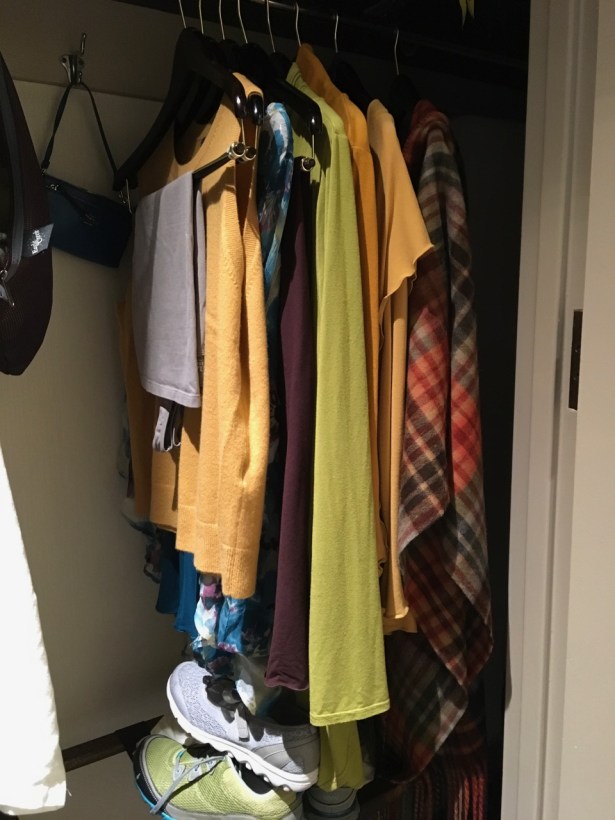
SF wardrobe in closet - 1

I’m particularly fond of today’s capsule wardrobe because it involves almost no neutral colors. Instead, it’s built around coordinating shades of rich gold, acid green, and deep purple. This is my favorite autumnal palette.

I love wearing these vibrant colors, and I even enjoyed the way they looked hanging together in the closet at the hotel. No neutral-based travel wardrobe would offer me that side benefit!

Compact capsule wardrobe saves precious vacation time

Packing an effective combination of pieces in a capsule wardrobe means I can dress for any occasion that arises during my trip without wondering whether I will be:

  1.  suitably attired, and
  2. sufficiently comfortable.

I care about both of these points, even more so when I’m joining my high profile* husband on a work-related trip. I had no role to play at the event DH was attending, but other participants were staying in the same hotel. It wasn’t out of the question to bump into someone who knows me by sight.

Dressing appropriately while maintaining health & function

My autoimmune condition involves widespread joint pain. I suffer particularly from foot problems. My wardrobe is constrained by the limiting factors of shoes that accommodate bulky, rigid orthotic inserts and clothes that don’t squeeze or pinch even when inflamed joints swell.

My symptoms flare when I’m tired. Travel, no matter how wonderful, comes with physical and sometimes mental stress. Traveling light is one way to reduce symptoms of my condition: I’m less likely to wear myself out, physically, with a lighter weight bag.

Continue reading