When I won’t give up my seat on a plane to a stranger’s child

It’s not all that uncommon for me to give up my assigned seat to a stranger on a plane. I do it for couples, not just for children separated from mothers. I try to take actions that make the world a slightly better place.

I’ve been that mom flying alone with her kids, feeling more than a little desperate to keep them close to me. I’ve carefully selected seats only to have my plans disrupted by the airline when an equipment change erases all the previous selections.

On a recent Icelandair flight from KEF to BRU, I made a selfish choice. When the flight attendant asked me if I would give up my window seat for a child, I said, “No.”

Though I think my reasons were valid, I’m clearly carrying some guilt from that decision. I hate to make a child sad. I enjoy most kids, even on airplanes, and am more likely to help out another mom than glare when her baby kicks up a fuss.

Major exception: when your kid is kicking my seat, I am just one step away from being annoyed, and I will turn around and ask you to stop him or her. Apologetic and helpful parents defuse all of my frustration… unless the kid is old enough to be doing it on purpose and seems inclined to keep it up.

Children are free agents, no matter how hard we try to remain diligent. I police my own kids pretty hard in that regard because, as a traveler with chronic pain, I am being literal when I say, “I feel your pain!”

On a bad day, a rhythmic seat kicking is torture for me. I won’t yell at you or your kid, but I will expect you to do your best to stop the behavior.

And this segue brings us around to my primary motivation for saying no to another mother on Flight 554. I was already in pain.

I select window seats on flights most of the time because I want to get as far away as possible from the jostling at the aisle. Never mind a direct hit by the beverage cart, even a pair of average sized passengers passing in the aisle can result in a brush with my side that hurts. I’ve been smacked more than once by people carelessly removing bags from the overhead bin, too.

I’m sitting in a window seat because I like the view, but even more to avoid actual pain from accidental touch.

I think that alone is sufficient justification for turning down a fellow passenger, though it obviously still makes me feel bad.

In this case, it is also worth mentioning that this was a mother with three kids who looked to be preteens and above. The child in question was probably 12 or more, standing shoulder high to her mother. She didn’t look frightened or upset to be separated from her mom, she looked bored. She had headphones on and didn’t seem to be talking to her family members anyway.

I pointed out that the middle seat in our row was free, even closer to her family across the aisle than mine by the window. I held firm to the fact that I needed to stay where I was to avoid being bumped by other passengers.

I don’t know where the girl ended up sitting, but it wasn’t in my row, though the rest of the family stayed put across the aisle.

If a woman with a toddler had been standing in the aisle with pleading eyes, I would have moved before I even thought to protect my own fragile state. This was at the mere beginning of a two week trip, no less, when preserving my energy was really important.

Some people think it is always obnoxious for any passenger to ask another to give up a seat. Nonsense! The airlines are operating a virtual free-for-all of Darwinian proportions at 30,000 feet. It is easy for even an experienced traveler to end up separated from children who really aren’t in a good position to care for themselves.

Others suggest that families should always be accommodated. I wouldn’t go quite that far, but I do believe that commercial airlines should be compelled by law to seat children under about age 12 or anyone with significant special needs adjacent to a caregiver before charging average passengers for the privilege of seats that suck less.

Airlines should profit less on seat selection. It costs them nothing compared with serving food, say, is a pure profit opportunity, and yet it creates real stress for groups traveling together. Unless paying for a reserved seat is an ironclad guarantee that I’m going to get exactly the seat and amenities I’ve selected–read the fine print, it usually is not a guarantee of anything but a charge to your credit card–then the system is a scam.

As a mom, if I can’t sit by my teen, I think, “Gee, too bad.” Then I return to my book. It’s no big deal.

When the situation is placement of my younger child who gets motion sick and has allergies and asthma, I work a little harder for a more satisfactory resolution. I suggest that I must be at least within sight of him lest he struggle with his breathing, though that situation is thankfully very rare.

I also tell whomever he’s seated next to that they might want to keep a barf bag ready, just in case. Maybe it’s just my family, but my kids tend to vomit on the person next to them at least as often as they get sick on themselves!

I’m totally honest with other airline passengers: my son doesn’t always throw up on a flight. It isn’t even most trips by airplane. Then again, he has vomited more than once due to turbulence.

Most passengers and/or flight attendants work together to help a parent find a better solution for a child with that kind of need. Though why the hell any passenger ever has to get involved is part of what makes me angry with the airlines: this is their problem to solve. It doesn’t belong to the poor soul who thought she’d reserved her favorite type of seat and would get to sit in it. Nor can a hapless parent who travels occasionally be expected to navigate the Byzantine world of airline chicanery.

Filing a complaint? No doubt there will soon be a $25 fee for that, too.

As my “more complicated to travel with” son nears the end of elementary school, however, even his “interesting” issues are less of a concern to me than they were with younger children in tow.

At this point, the kid might manage by himself to barf into a bag on his lap; when he was five, that chance was zero. I’m honestly uncertain as to what he would do with said bag once it was full of vomit unless I was there next to him to take it off his hands.

Parents should sit with their kids because this stuff happens, and no one cares as much as a child’s own parent. The parent isn’t trying to offload any responsibilities to other poorly placed passengers. Airline policies are simply inhumane and short-sighted.

It is patently obvious that this is not a black and white situation, but a matter of multiple shades of grey. Like most of life, actually, including whether or not a relatively nice person such as myself, a caring mother and lover of children, gives up her window seat to humor a pre-teen.

This time, I didn’t, but my conscious is clear. Well, mostly. After all, I did take the time to write this piece.

Sleep on silk for healthier hair

I’ve started to wear a silk night cap when I sleep in pursuit of healthier hair. It’s comfortable and doesn’t disturb my rest, though it does look a little goofy. It seems to work to prevent tangling and perhaps also pulling and damage to my fragile locks.

Silk sleep bonnet - 3I have had more good hair days since I started sleeping in a coif.

Systemic illness affected my coiffure

One of the side effects of autoimmune disease is a little trivial, but a lot disheartening to sufferers. Autoimmune disorders can affect your hair. Breakage, hair loss, even premature graying can result from this type of systemic illness.

Hair loss can be a terrible blow to self esteem at the same time that physical pain is eating away at one’s psyche.

In my case, I felt compelled to cut off my long hair to an above-chin-length bob about 18 months into my tentative diagnosis with an autoimmune disease.

Aside from losing far more hair than usual (overall thinning of my already very fine hair), what remained became positively bedraggled and ragged at the ends. It was breaking off as well as falling out.

Comb with hair - 1While I was waiting with my son in a barbershop, the stylist asked me if something had “happened” to my hair, and would I like her to try to fix it? This was a traditional barber shop that only deals with short (men’s) hairstyles.

I cut it most of it off shortly *ahem* thereafter. It looked so bad that a professional tried to do me an act of kindness out of pity as I went about my daily life. Talk about your bad hair days!

My health overall has improved since that initial period. Perhaps the precipitating event just ended. Maybe my medications are working. The dietary changes I implemented could have eased some of it.

There’s very little medical certainty about my health status.

My hair, on the other hand, has grown back to shoulder length. I’m taking more care with it. If it looks sickly again, I will cut it again. Having a sick head of hair made me feel more like an invalid.

If it gets bad enough, I will shave my head bald and consider wearing a wig before I walk around crowned with scraggly frizzles. I sincerely hope it doesn’t get to that point!

Most of us are aware of the fact that there are myriad fancy shampoos and other products to apply to hair and scalp, but today I’ll introduce one of my less mainstream solutions to the Sick Hair Problem.

Silk is one solution to prevent damaged hair

This Highdeer Silk Sleep Cap for Women ($12-16, depending upon style and color selected) is a silk bonnet designed to be worn to bed. It is meant to protect delicate hair from friction and pulling that can cause damage.

Silk sleep bonnet - 1

I bought my bonnet on Amazon.com and paid $11 in April of 2018. Though sold as “Rubber Red” in color, my interpretation would be “warm-toned pink.” It is, in fact, somewhat similar to the pink color of a classic hot water bottle or a pencil eraser, so perhaps that is the natural color of rubber. Continue reading

Managing chronic pain on the 12+ hour flight to New Zealand

Since developing chronic pain that accompanies an autoimmune condition, I’ve continued to indulge my love of travel, but learned to adapt my bookings and my belongings to minimize pain and maximize comfort.


Flights of six hours or so are regular occurrences for me and my family. I’ve had a couple of very painful trips of this duration, but, more typically, I can tolerate them by adjusting my medication slightly and employing a few aids such as wrist braces, inflatable cushions, and hot water bottles.


This winter, I faced the longest single flight I’ve ever taken: 12 hours and 40 minutes just for one leg from Los Angeles, CA to Auckland, New Zealand. The combination of traversing the United States from our New England home (6.5 hours), crossing the Pacific (12.7 hours), then connecting to our final destination of Christchurch, NZ on the South Island (1.4 hours) made for a total time in the air of 20.5 hours.

Of course, one must also add to that total the requisite airport waiting time required by international flight connections, customs, security, and the necessity of allowing adequate buffers in case of delays. At least two full days of my calendar were bound to be eaten up by this voyage in each direction.

After considering many options, I elected to travel in two distinct stages for both directions of travel. This meant parting ways with my husband entirely for the domestic portion of our trip. His schedule doesn’t allow for an unnecessary day spent in transit where tighter connections are possible.†

I was away from home for a total of fourteen days; DH, by taking his domestic and international flights serially on the way out—and heading home on a red eye straight off the international leg—traveled for twelve days.

Though this post isn’t really meant to be a trip report, it must be said: even two weeks is barely adequate for visiting the antipodes. If you can squeeze more days out of your schedule, use them for a trip of this magnitude.

New Zealand is awesome, and well worth every hard won vacation day.

My itinerary outbound:

BOS-PDX on Alaska Air 33, Saturday 16:20-20:10

Three night stay with family in the Pacific NW

PDX-LAX on Alaska Air 568, Tuesday 10:50-13:22

LAX-AKL on Air New Zealand 5, Tuesday 21:40-Thursday 07:20*

AKL-CHC on Air New Zealand 527, Thursday 09:00-10:20

My itinerary for the return:

CHC-AKL on Air New Zealand 574, Friday 20:00-21:20

AKL-LAX on Air New Zealand 2, Friday 22:50-13:35**

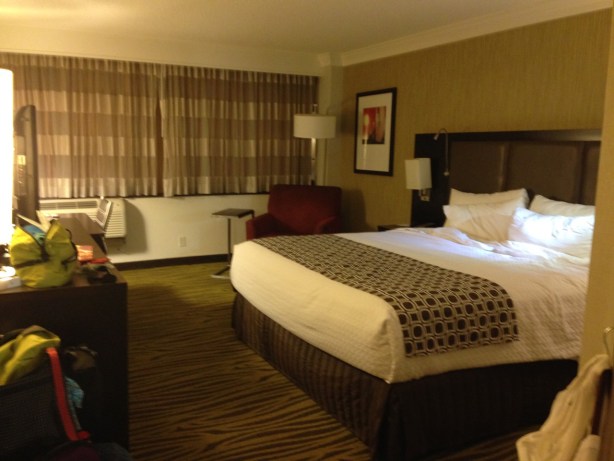
Overnight hotel stay at the Crown Plaza LAX

LAX-BOS on Virgin America flight 1360, Saturday 07:05-15:34

Itinerary adaptations to reduce pain

I’ll repeat what I feel was the single most important adaptation I made to my itinerary to accommodate my autoimmune condition and its symptoms: I took extra time.

Travel. Stop. Recover. Repeat.

Heading west, I took advantage of family who live near the Portland airport who don’t seem to mind my visits, spending three nights at their home. This sleepover gave me time to recover from the initial cross country flight and ease my body’s adjustment to a change of three time zones.

NZ Crowne Plaza LAX hotel room - 1Upon arrival in New Zealand, I had already acclimated from the Eastern to Pacific zone (USA West Coast) which represents half of the total time shock. Though the flight is lo-o-o-o-ong, most of the travel between California and New Zealand is in a southerly direction. You only drop three more time zones on that 12 hour flight.

Heading west is also usually less difficult in terms of jet lag.

Continue reading

Rushing for life experiences when chronic illness fuels your fears

I’ve had the great fortune to travel regularly throughout my life.

I enjoyed those pivotal vacation experiences of a happy middle class childhood: a couple of trips to Disneyland and bragging rights about having flown on airplanes and crossed a national border or two, if only to near neighbors Mexico and Canada.

I attended college in a different region from Home. I flew cross country at least four times a year because of this one fact. I built my desire to see the world into my educational plans, and it worked out well for me.

I didn’t even mind long distance romances in my youth, because what could offer better motivation for frequent trips? I love having a journey coming up in my calendar.

Later, working as a software engineer, I had the privilege of visiting subcontractor sites in Denmark and Spain on my employer’s dime. At the same time, I was a single, adequately employed young adult during the roaring 1990’s before the dot.com bubble burst.

For as long as I’ve had the option, I’ve traveled regularly, and I’ve enjoyed most of it. I dream of “seeing the world.” I’ll be grateful for every corner that I reach.

Yet, in spite of all this to-ing and fro-ing, there has been a certain rhythm to my rambling. At my youthful peak, I was not a high energy traveler. As a middle aged mother with a couple of kids in tow, my pace is typically sedate, and I prioritize comfort and convenience over the heights of adventure.

Looking back over our family travels, a pattern emerges. Every few years, we’ve had a “grand adventure.” How grand is Grand has changed with our finances and family status, but it’s always been a cycle of plan, anticipate, then go.

Maybe Go! with a capital and an exclamation mark expresses it better.

“But lately something’s changed, it ain’t hard to define…”* Or, rather, it isn’t hard to unearth the cause of the shift. I’m scrambling. I’m rushing. I’m tumbling from one trip to another without enough time to fully digest each experience.

Some of my trips bump up hard enough against the next that I feel more overwhelmed than anticipatory.

I know why I’m doing it, too. I’m afraid.

I’ve been saying yes to one trip after another because I’m afraid it will be my last chance to travel before I’m sidelined by infirmity and pain. Continue reading

Flu

Just one word: flu.

I never use one word when one thousand will do, so, naturally, I will elaborate.

As if winter’s lingering darkness and New England’s coldest temperatures in years weren’t enough, we have to add widespread influenza infection to the list of legitimate complaints for still nascent 2018.

If my local children’s librarian* is to be believed, our corner of our state is the hardest hit in the area with this more-severe-than-average flu.

My situation isn’t even so bad. We are a house divided: only one of us has flu. I’m hunkering down with the sick one while DH keeps his distance and manages the healthy one. They leave us trays of food outside the door and occasionally send word about the outside world.

flu gear - 2The good news is that we have space enough to almost completely quarantine the sick kid. He hasn’t been downstairs for several days. Our over-the-top 1980s house came complete with a wet bar in the spacious master bedroom; between the mini fridge and the microwave, I can cover most of our needs without venturing forth myself.

We’re also lucky that the vicious cold spell is over. I can crack a window for ventilation between the child’s Petri dish of a nest and my frequently wiped down seat on the other side of the room. He isn’t lonely, and I haven’t caught the Plague yet. The separate heating zone for this room also assuages some of my guilt about sending so much heat literally out the window.

The bad news is that it’s the kid with the underlying condition making flu particularly dangerous that caught it.**

The doctor didn’t even want me to bring him in, citing the risk of exposure for others. He called in a prescription for Tamiflu and told me to plan on spending four to five days at home. The drug is the best thing medicine has got for reducing flu symptoms, but it only knocks half a day or so off the illness’s expected duration.

flu gear - 1Since the only side effect we’ve noticed is mild nausea and the evidence suggests Tamiflu reduces my son’s risk of hospitalization, I have no regrets about following this course of action.

An interesting aside: my husband’s doctor recommended getting the nasal swab flu test, but the pediatrician did not want to risk exposing others at a medical facility. DH’s internist would also have prescribed Tamiflu as a preventative to the rest of our household. The pediatrician did ask if my other son needed an Rx, too, but didn’t suggest Tamiflu for the adults.

We generally prefer to avoid taking drugs until they are absolutely necessary, so none of the rest of us are taking antiviral medication, but I found the variety of approaches interesting.

I should add here that, though I have a chronic illness, I am not considered immunocompromised at this point. If I were, I would take the Tamiflu without argument; as it is, I will play the odds.

We’ve increased the dosage on my son’s usual meds as directed, and I know the danger signs of severe illness for which I should watch, but the primary treatment for my sick kid is the same as for the rest of us unlucky enough to catch the flu: plenty of fluids and lots of rest at home.

I’m keeping myself sane by the following means:

  • Alphabears app on my iPad ~ the best word game I’ve played since my paid version of Bookworm stopped being supported after wretched EA bought innovative game developer PopCap.
  • Skullduggery Pleasant audiobooks ~ a great story that amuses both mom and child in the sickroom, but my older son had to jump through hoops to get the later books since they were only released in the UK. Read what you can get your hands on here in the USA, then agitate for the rest of Derek Landy’s series to be readily available where ever it is wanted.
  • Refining my packing list—and taking photos of same—for an upcoming trip that I will blog about after the fact ~ if you see better than usual pics after my next big adventure, you can thank 100 hours or so of enforced idleness wherein the closet became a welcome break from the monotony of the bedroom.
  • Wiping down doorknobs, light switches, and remote controls with disinfectant ~ okay, so that one isn’t so much fun as functional, but it does keep my brain occupied. “What did the child touch?” Right. Just about everything. Sigh.

Stay healthy, dear readers!

Wash yours hands often, or use hand sanitizer. Humidify your air if it approaches arid arctic conditions. The influenza virus is weakened at normal to high humidity levels aim for 50% RH***, and simple soap and water or the alcohol in sanitizer are sufficient to deactivate it on your skin before you transfer it to your vulnerable mucus membranes (i.e., nose and mouth, where the virus usually gets in.)

And if you do get sick with the flu, please, stay home until you’re no longer contagious.

Not sure if it is just a cold or the dreaded flu? Call your doctor!

If you’re not willing or able to do that, your best clues are:

  • sudden onset of symptoms,
  • severity of symptoms, and
  • presence of a fever.

When in doubt, stay home while sick. You are most contagious during the first few days with influenza.

If you have flu, you are spraying a cloud of virus into the surrounding environment with every breath. The person standing next to you could have a compromised immune system or a preemie at home.

Keep your germs to yourself. Let’s all work together so that this flu season winds down soon.

*I didn’t ask if she’d used her librarian superpowers to find out this fact, or the same gossip mere mortals employ to assess epidemic illness trends, so that might just be hearsay. As it served my preexisting notions, I just assumed she was correct.

**When I called his school to let them know he would be out sick, I learned that several other children from his class had the same symptoms. Ah, children. They’re the cutest little vectors for disease.

***Relative Humidity