Accessibility notes by a visitor to Iceland’s awesome public pools with hints for proper locker room & swim protocol

Icelanders expect you to follow the letter of their law when going for a swim: wash, naked, with soap before entering a public pool or hot tub.

I’m shocked by how many Americans post comments about washing first not being required at home. Actually, at my local YMCA in New England, a sign clearly states that “soap showers are required” before entering the pool.

It’s just that, at American pools, nobody enforces the law.

We have laws against jaywalking, too, but you’d never know it in most cities based upon enforcement.

Also, our instructional posters are plain English language ones without the helpful “red zone” graphics employed in Iceland.

Cell phone or camera use isn’t allowed in locker rooms thank God! so I’ll point you to others’ mysteriously captured photos for illustrations. Follow the links to pool etiquette articles, below.

Picture the typical men’s room sign “guy” infographic, then add big red circles glowing around head, armpits, groin, hands, and feet. Those are the parts it is mandatory to wash with soap before entering an Icelandic public swimming pool or hot tub.

I’m reinventing the wheel here, but it bears repeating again! since every Icelander seems to know that Americans (and Brits) arrive unprepared for proper Icelandic pool protocol. I read about a dozen “how to use a public pool in Iceland” posts myself, and yet, here I am reiterating much of the same advice.

IHeartReykjavik.net posted my favorite for average travelers (make sure to read some of the 133+ comments); IcelandWithKids.com is also very thorough, especially with information for families and parents traveling with children.

Those posts helped me, so I hope to offer the same to another reader. Good travelers respect the places that they visit by following the rules.

Access for visitors with mild physical impairments to Icelandic pools

Another, perhaps less common, thing I want to address is accessibility in Icelandic public pool locker rooms.

I did find one blogger who writes about access from the perspective of a wheelchair user, but he only seemed to visit the swanky Blue Lagoon spa. For over $40 per person, it darn well better be fully accessible!

I was looking for an affordable, family-oriented experience more akin to what average Icelanders might enjoy with their own kids.

Also, my needs are far less intensive than those of a pool user who requires a lift (hoist) to access the water. I have arthritis and chronic pain due to an autoimmune condition. My accessibility needs are variable, but often minimal, and most relate to twisting and pushing with the hands.

Sometimes, however, hip or knee joint stiffness makes it hard for me to reach my own feet. Heck, I couldn’t get my arms high enough overhead (shoulder stiffness) for the requisite TSA scan when I departed from Boston the night before I visited my first Icelandic pool.

Some days, aside from morning stiffness in my fingers, I bend like a healthy person; other days, not so much. This is a big part of what drew me to the famous geothermal hot pots of Iceland during even a brief stopover.

When my joints are stiff, I’m also more prone to balance issues and potentially falling. My limbs don’t always respond the way I’m expecting to the commands sent from my brain.

I had questions before my first visit to a public pool in Iceland to which I couldn’t find answers online. I’ll try to enlighten those of you with similar concerns according to my own experience as an English speaking tourist with about two weeks’ experience in that country.

Continue reading

When I won’t give up my seat on a plane to a stranger’s child

It’s not all that uncommon for me to give up my assigned seat to a stranger on a plane. I do it for couples, not just for children separated from mothers. I try to take actions that make the world a slightly better place.

I’ve been that mom flying alone with her kids, feeling more than a little desperate to keep them close to me. I’ve carefully selected seats only to have my plans disrupted by the airline when an equipment change erases all the previous selections.

On a recent Icelandair flight from KEF to BRU, I made a selfish choice. When the flight attendant asked me if I would give up my window seat for a child, I said, “No.”

Though I think my reasons were valid, I’m clearly carrying some guilt from that decision. I hate to make a child sad. I enjoy most kids, even on airplanes, and am more likely to help out another mom than glare when her baby kicks up a fuss.

Major exception: when your kid is kicking my seat, I am just one step away from being annoyed, and I will turn around and ask you to stop him or her. Apologetic and helpful parents defuse all of my frustration… unless the kid is old enough to be doing it on purpose and seems inclined to keep it up.

Children are free agents, no matter how hard we try to remain diligent. I police my own kids pretty hard in that regard because, as a traveler with chronic pain, I am being literal when I say, “I feel your pain!”

On a bad day, a rhythmic seat kicking is torture for me. I won’t yell at you or your kid, but I will expect you to do your best to stop the behavior.

And this segue brings us around to my primary motivation for saying no to another mother on Flight 554. I was already in pain.

I select window seats on flights most of the time because I want to get as far away as possible from the jostling at the aisle. Never mind a direct hit by the beverage cart, even a pair of average sized passengers passing in the aisle can result in a brush with my side that hurts. I’ve been smacked more than once by people carelessly removing bags from the overhead bin, too.

I’m sitting in a window seat because I like the view, but even more to avoid actual pain from accidental touch.

I think that alone is sufficient justification for turning down a fellow passenger, though it obviously still makes me feel bad.

In this case, it is also worth mentioning that this was a mother with three kids who looked to be preteens and above. The child in question was probably 12 or more, standing shoulder high to her mother. She didn’t look frightened or upset to be separated from her mom, she looked bored. She had headphones on and didn’t seem to be talking to her family members anyway.

I pointed out that the middle seat in our row was free, even closer to her family across the aisle than mine by the window. I held firm to the fact that I needed to stay where I was to avoid being bumped by other passengers.

I don’t know where the girl ended up sitting, but it wasn’t in my row, though the rest of the family stayed put across the aisle.

If a woman with a toddler had been standing in the aisle with pleading eyes, I would have moved before I even thought to protect my own fragile state. This was at the mere beginning of a two week trip, no less, when preserving my energy was really important.

Some people think it is always obnoxious for any passenger to ask another to give up a seat. Nonsense! The airlines are operating a virtual free-for-all of Darwinian proportions at 30,000 feet. It is easy for even an experienced traveler to end up separated from children who really aren’t in a good position to care for themselves.

Others suggest that families should always be accommodated. I wouldn’t go quite that far, but I do believe that commercial airlines should be compelled by law to seat children under about age 12 or anyone with significant special needs adjacent to a caregiver before charging average passengers for the privilege of seats that suck less.

Airlines should profit less on seat selection. It costs them nothing compared with serving food, say, is a pure profit opportunity, and yet it creates real stress for groups traveling together. Unless paying for a reserved seat is an ironclad guarantee that I’m going to get exactly the seat and amenities I’ve selected–read the fine print, it usually is not a guarantee of anything but a charge to your credit card–then the system is a scam.

As a mom, if I can’t sit by my teen, I think, “Gee, too bad.” Then I return to my book. It’s no big deal.

When the situation is placement of my younger child who gets motion sick and has allergies and asthma, I work a little harder for a more satisfactory resolution. I suggest that I must be at least within sight of him lest he struggle with his breathing, though that situation is thankfully very rare.

I also tell whomever he’s seated next to that they might want to keep a barf bag ready, just in case. Maybe it’s just my family, but my kids tend to vomit on the person next to them at least as often as they get sick on themselves!

I’m totally honest with other airline passengers: my son doesn’t always throw up on a flight. It isn’t even most trips by airplane. Then again, he has vomited more than once due to turbulence.

Most passengers and/or flight attendants work together to help a parent find a better solution for a child with that kind of need. Though why the hell any passenger ever has to get involved is part of what makes me angry with the airlines: this is their problem to solve. It doesn’t belong to the poor soul who thought she’d reserved her favorite type of seat and would get to sit in it. Nor can a hapless parent who travels occasionally be expected to navigate the Byzantine world of airline chicanery.

Filing a complaint? No doubt there will soon be a $25 fee for that, too.

As my “more complicated to travel with” son nears the end of elementary school, however, even his “interesting” issues are less of a concern to me than they were with younger children in tow.

At this point, the kid might manage by himself to barf into a bag on his lap; when he was five, that chance was zero. I’m honestly uncertain as to what he would do with said bag once it was full of vomit unless I was there next to him to take it off his hands.

Parents should sit with their kids because this stuff happens, and no one cares as much as a child’s own parent. The parent isn’t trying to offload any responsibilities to other poorly placed passengers. Airline policies are simply inhumane and short-sighted.

It is patently obvious that this is not a black and white situation, but a matter of multiple shades of grey. Like most of life, actually, including whether or not a relatively nice person such as myself, a caring mother and lover of children, gives up her window seat to humor a pre-teen.

This time, I didn’t, but my conscious is clear. Well, mostly. After all, I did take the time to write this piece.

Sleep on silk for healthier hair

I’ve started to wear a silk night cap when I sleep in pursuit of healthier hair. It’s comfortable and doesn’t disturb my rest, though it does look a little goofy. It seems to work to prevent tangling and perhaps also pulling and damage to my fragile locks.

Silk sleep bonnet - 3I have had more good hair days since I started sleeping in a coif.

Systemic illness affected my coiffure

One of the side effects of autoimmune disease is a little trivial, but a lot disheartening to sufferers. Autoimmune disorders can affect your hair. Breakage, hair loss, even premature graying can result from this type of systemic illness.

Hair loss can be a terrible blow to self esteem at the same time that physical pain is eating away at one’s psyche.

In my case, I felt compelled to cut off my long hair to an above-chin-length bob about 18 months into my tentative diagnosis with an autoimmune disease.

Aside from losing far more hair than usual (overall thinning of my already very fine hair), what remained became positively bedraggled and ragged at the ends. It was breaking off as well as falling out.

Comb with hair - 1While I was waiting with my son in a barbershop, the stylist asked me if something had “happened” to my hair, and would I like her to try to fix it? This was a traditional barber shop that only deals with short (men’s) hairstyles.

I cut it most of it off shortly *ahem* thereafter. It looked so bad that a professional tried to do me an act of kindness out of pity as I went about my daily life. Talk about your bad hair days!

My health overall has improved since that initial period. Perhaps the precipitating event just ended. Maybe my medications are working. The dietary changes I implemented could have eased some of it.

There’s very little medical certainty about my health status.

My hair, on the other hand, has grown back to shoulder length. I’m taking more care with it. If it looks sickly again, I will cut it again. Having a sick head of hair made me feel more like an invalid.

If it gets bad enough, I will shave my head bald and consider wearing a wig before I walk around crowned with scraggly frizzles. I sincerely hope it doesn’t get to that point!

Most of us are aware of the fact that there are myriad fancy shampoos and other products to apply to hair and scalp, but today I’ll introduce one of my less mainstream solutions to the Sick Hair Problem.

Silk is one solution to prevent damaged hair

This Highdeer Silk Sleep Cap for Women ($12-16, depending upon style and color selected) is a silk bonnet designed to be worn to bed. It is meant to protect delicate hair from friction and pulling that can cause damage.

Silk sleep bonnet - 1

I bought my bonnet on Amazon.com and paid $11 in April of 2018. Though sold as “Rubber Red” in color, my interpretation would be “warm-toned pink.” It is, in fact, somewhat similar to the pink color of a classic hot water bottle or a pencil eraser, so perhaps that is the natural color of rubber. Continue reading

Considering antidepressant medication? Try vitamin B-12 first.

This isn’t medical advice. I’m not qualified* to offer that.

Vitamin bottle B12 - 1I am simply a self-educated consumer who lives with a chronic health condition. I’ve drawn my own conclusions from research done as an intelligent lay person, tempering it with common sense. I invite you to do the same.

Many of us diagnosed with autoimmune conditions, degenerative neurological diseases, and chronic pain will be prescribed antidepressants. There are fine reasons for this.

Some chronic pain responds positively to antidepressant medications. Given in lower doses than those prescribed for psychological reasons, side effects are often less as well.

Here’s a link to a (long, almost 2 hrs!) YouTube presentation by Dr. Dan Clauw, M.D. that offers a great explanation for the current understanding of why these drugs may help certain types of pain.

Depression is also a normal human response to learning you can expect to spend the rest of your life with constant pain or in a rapidly degenerating physical condition.

That is a depressing situation for any rational person to contemplate. Treating mental health problems is important, and I do not sit in judgement of anyone who takes pharmacological steps toward better self care.

If you are a danger to yourself, please seek immediate, aggressive care. Do whatever it takes to get well. Your life matters.

That said, I’ve recently learned that the major physical symptoms of depression mirror almost exactly those of a vitamin B-12 deficiency. Hmm…

Even patients with valid diagnoses of other conditions—here’s a study about multiple sclerosis, for example—often have other stuff going on in the body that can make symptoms worse. Large numbers of hospitalized, depressed patients have measurable Vitamin B-12 deficiencies.

It isn’t known yet whether B vitamin deficiencies help create conditions that allow us to develop disease, result from lifestyle responses to living with chronic illness, or are direct side effects/symptoms of disease processes.

I’d argue that the underlying mechanism doesn’t matter so much when we’re talking about supplementing with vitamin B-12.

Why? There is no known upper tolerable limit for safety for supplemental B-12. Say that in plain English? No one ever “overdosed” on this vitamin.

Here’s a link to a more reputable (than me) resource, a state university, for detailed mainstream medical information on the subject of Vitamin B-12. And another to a US government fact sheet on the vitamin for American consumers.

B-12 is water soluble. If you take too much to be used by your body, it will leave your system naturally via your urine. You might “waste” the vitamins you’ve bought and paid for, but odds are tiny** that they will hurt you in any appreciable way.

If someone is ready to prescribe antidepressants to a patient, that patient must have at least one medical doctor who could also be consulted about taking vitamin supplements. Ask your doctor before starting a new treatment, including Vitamin B-12, but, odds are, you will be told this is safe to try.

You may also hear that vitamin B-12 won’t help you. But, then again, antidepressants aren’t a guarantee either. They include a long list of side effects, some of which are very unpleasant. Those prescription pills can also be expensive.

Also, it’s just as unscientific to assume the vitamins won’t help you as to assume that they will.

I’ve come to realize that no one cares as much about my health outcomes as I myself do. With good insurance and caring doctors, I’m still left with unanswered questions and a merely tentative diagnosis for what causes my chronic pain and fatigue. Where stakes are low and scientific certainty is lacking, I choose to perform nutritional experiments upon myself.

If it is highly unlikely to hurt you, and it could help you, why not take some extra vitamins for a while and see if you feel better, too?

Assuming your doctor said such a trial is safe, the only possible barrier is cost.

I picked up a bottle of store brand vitamin B-12 at wholesale giant Costco with 300 pills for $19. Each offered thousands of percent (20,833%) of the RDA***, making a bottle good for the better part of a year taking one per day.

That works out to $23.12 annually. Costco typically offers very good value.

At an expensive local vitamin specialty retailer, a three month supply (of 16,667% RDA pills) cost $16, coming out to about $64 per year. I suspect it would be hard to spend much more than this for these vitamins.
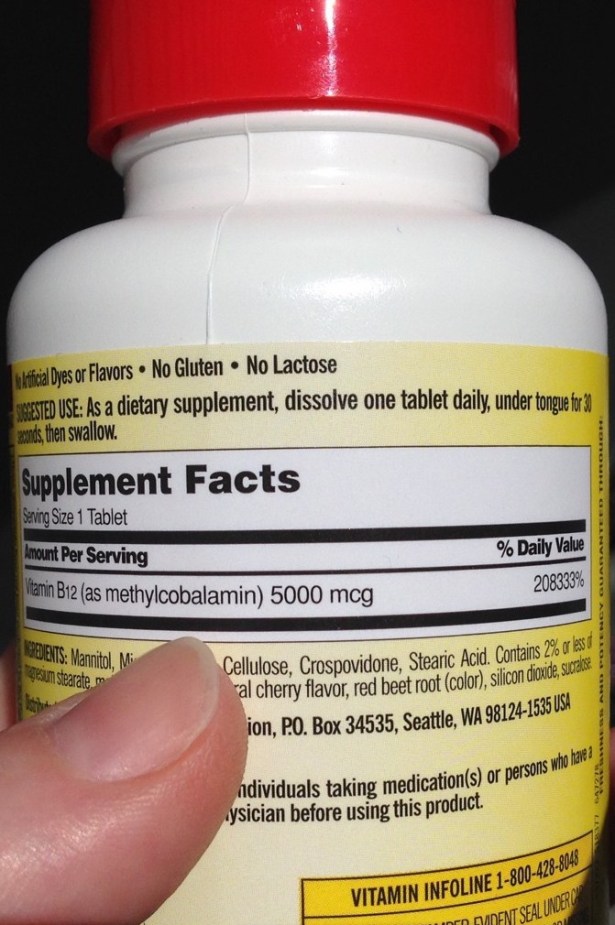
vitamin-bottle-b12-2.jpgThere are several forms of B-12 available, and both of these offerings are for the most expensive type, Methylcobalamin.

Some users have reported that the most common, cheaper form, Cyanocobalamin, doesn’t resolve their symptoms, but the Methylcobalamin form does. At less than $20 per bottle, it seems within financial reach of most Americans to do this self experiment with the potentially most effective version of the supplement.

My two sample bottles also both contain dissolving lozenges to be held under the tongue rather than swallowed and processed through the digestive system. Again, some argue that a sublingual or injected B-12 is more effective than a swallowed dose. I went out of my way to test this type of supplement, just in case, though science tends to think it is irrelevant for most.

In all of this, note that my primary interest is in clinical results, i.e., how I feel. It will be great if research comes to understand why and how B-12 or any other supplement improves patient outcomes. But I am not a working scientist.

The bottom line for how I make a decision about self-treatment comes down to whether or not I feel better, and at what risk.

The “clinically small” improvement of a group of MS study participants quoted above may be of only slight statistical significance, but when your function or your sense of well being has descended to, say, 25% of your old normal, well, then, 27% or 30% represents a win.

I don’t know what you should do to help yourself live a healthier life. I do have some opinions about which alternative health practices represent good risks worth a try for a person in pain. Perhaps this little experiment can ease some of yours, too.

Your body; your choices. Make them in good health.

*My education in both Biology and Chemistry ended in high school as my college science classes were limited to Physics courses. My major was Mathematical & Physical Sciences with a concentration in Computer Science.

Make no mistake that the side effects can be significant, however. They are also likely to affect your offspring, not just yourself. There are studies showing this in very obvious and less direct ways.

Powerful drugs are appropriate to treat significant illness, but I’d argue that they should be employed after milder alternatives have been tried and found insufficient.

Other sources, regarding. depression.and .neurological and psychiatric disorders

**There are some instances of allergic reactions to vitamin B-12, but I only read of such response to injections (shots), not over the counter vitamin pills. Reports of acne or skin rash in response to large dose vitamin pills do occur with some regularity.

You decide whether temporary skin issues are something that would stop you trying a larger dose of this vitamin for yourself.

***In most cases, we do NOT know the “optimal” level of vitamin intake. Vitamin B-12 reference ranges vary from 180-914 ng/L in the USA, 135-650 pmol/L (183-881 pg/mL) in Australia, and 500 – 1300 pg/mL. (ng/L=pg/mL, so no conversion necessary there.)

If you think this is an important thing for people to know, write to your government representatives and tell them you support basic nutrition research. Private companies have very little motivation to pay for this kind of work; there’s no resulting drug patent to fund the endeavor.

There’s a reason some public services, like infrastructure and basic research, are paid for by taxation. Otherwise, they simply aren’t available to all of us.

Business Premier eases chronic pain on 13 hour Air New Zealand long haul flight: Part 1 (OneUp upgrade bid win)

On the economics of getting into business class for members of the 99% with chronic pain: how I did it for 37% of the paid fare with an upgrade bid, and why every penny was totally worth it.

I didn’t know until I arrived at LAX for my 13 hour flight from the USA to Auckland that my bid for upgrade to business class had been accepted. Air New Zealand might surprise you with such information at the very last minute. Luckily, this is the best kind of surprise.

I am a frequent flier in US domestic economy who occasionally splurges or upgrades with miles/status to first class. I also live with an autoimmune disease and chronic pain.

In spite of this, I continue to indulge my love of travel as often as I can. Now, however, I must sometimes make adjustments to accommodate my body’s varying demands.

What follows is my assessment of a very long haul flight in the Business Premier cabin. I’ll try to specifically address the experience of a traveler with chronic pain.

While I’ve found a plethora of reviews sharing the opinions of healthy business and luxury flyers, my own sometimes odd and very specific wonderings are rarely addressed.

Air NZ awards upgrade bids up to the last minute

Last year’s Swiss International Airlines (SWISS) upgrade from economy to SWISS Business was awarded several days before my flight. SWISS may even have provided a full week’s notice.

This time, I received a “too bad, you lost” email from Air New Zealand in the days before my trip. I took off from an intermediate stop at PDX with no knowledge of the highly beneficial change of plans.

Try to imagine my delight upon receiving a text message of congratulations for having my OneUp Business Premier upgrade bid accepted by Air New Zealand at the last minute. I learned of it as my Alaska flight touched down in Los Angeles and I resumed cellular connection to the world.

Having chatted with my nearest seatmate about our respective travels during lunch on Alaska 568, I couldn’t help but turn to her to share news of my good fortune:

“I just got the upgrade from Premium Economy to Business Premier for the long flight to New Zealand!” I crowed

“That’s great!” She replied. “Now your husband won’t have to feel guilty or to share his better seat.”

Air NZ Business Premier pix - airport espresso

It was reason for both DH and myself to celebrate, indeed. He is a gentleman, and he worries about me.

Of course, a man who will wait in line to buy an espresso for his tired wife in a busy airport even though he thinks caffeine is a pernicious addiction like heroin that shouldn’t be catered to or socially acceptable will always give his seat up to a lady.

To be crystal clear, however, on our return, when we were seated in different classes of service, I never did ask him to shove over or swap with me. I spent 13 hours in Premium Economy flying AKL-LAX towards home. I’ll add a link here to my post on the subject once I’ve finished writing it.

Continue reading