Sending “filthy” photos to my kids when their chores demand attention

My kids have chores. They are both old enough now to lend a hand that’s actually useful. They ought to be able—and feel obligated—to assist in the smooth running of our household.

And, for the most part, they do. With some nagging required, absolutely, but they are good kids and reasonably helpful.Boy holding stick vacuum as if cleaning the floor

I’ve posted before about the best option I’ve found for keeping the kids on track with relatively less nagging: a chore checklist. Where I used to have one master list for the whole family, the enforced togetherness of the pandemic—and our loss of our usual paid help for the heavy cleaning—has prompted me to print a separate list for each kid, and even a new list* to remind my husband of the jobs I need him to cover.

For your reading pleasure, here are copies of my teen’s daily chore list and the middle schooler’s version. By all means, use them to prove to your own kids that they are not, in fact, the only children forced to help out around the house. Or, if your kids work much harder than mine, please let me know in the comments so I can educate my own wee punks the next time they complain about sweeping the kitchen.

And speaking of crumbs…

Visible dirt, crumbs and spills on white tile floorAm I the only mom in America whose family seems oblivious to visible schmutz on the floor?

If you peeked at the chore chart PDFs, you may have noticed that both kids are assigned to sweeping the kitchen tile once per day, and that it’s a totally separate job from plain old vacuuming which is also meant to include the kitchen. This isn’t because my standards are all that high; it reflects the reality that the dust bunnies threaten to outweigh we mere humans on a regular basis.

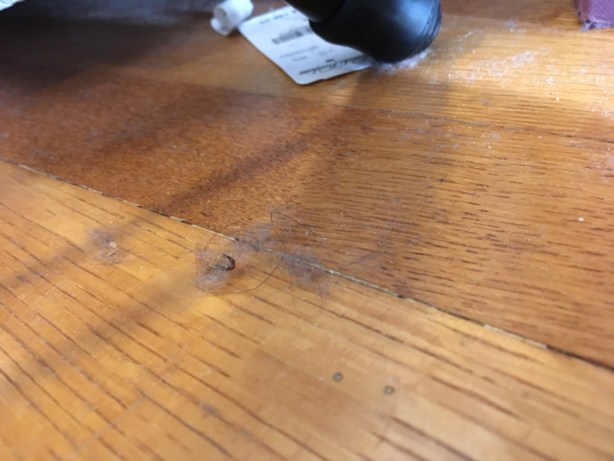
NZ Brush Co bannister brush used for sweeping up kitchen crumbsThe floors really are pretty filthy in spite of all of these assignments and my own quick swipes with broom, brush, or hand vac a few times each day. This fact leads inexorably to my new habit of sending the kids “filthy” photos via text message with disturbing regularity. Here are a few examples:

There’s hardwood with dust bunnies

dust, hair, and an old price tag on hardwood floor near chair leg

Corners with cobwebs very tricky to photograph spider silk, by the way

Cobweb formed in corner near door jamb over tile floor

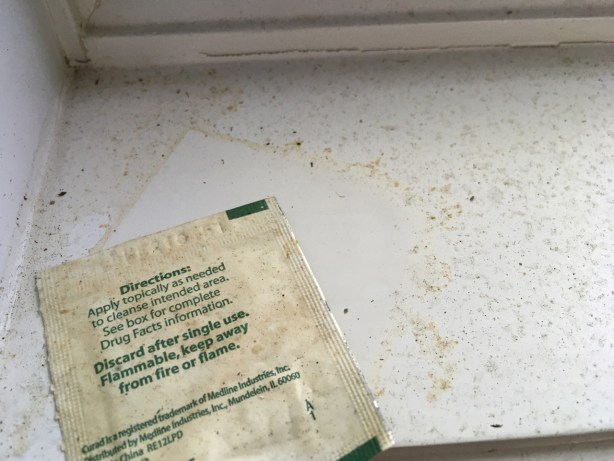
And the supposedly “dusted” windowsill covered in not just pollen, but also an unused alcohol wipe still in its package that left a visible outline when shifted! Can that even be a mere week’s accumulation?Topical wipe covered in pollen on pollen-coated windowsill near outline from the shifted packet
I’ll spare you the picture of the toilet visibly in need of scrubbing. Even the teen objected to that disturbing image, asking me if sending it was really necessary.

“Do your chores,” I replied. “Believe me, I wish I hadn’t had to see it either!”

The word "dust" scraped onto a dusty black surfacePerhaps it is an extreme reaction on my part. Should I stop sending them the filthy photos?

Then again, here’s a squeaky clean picture that still led to nagging:
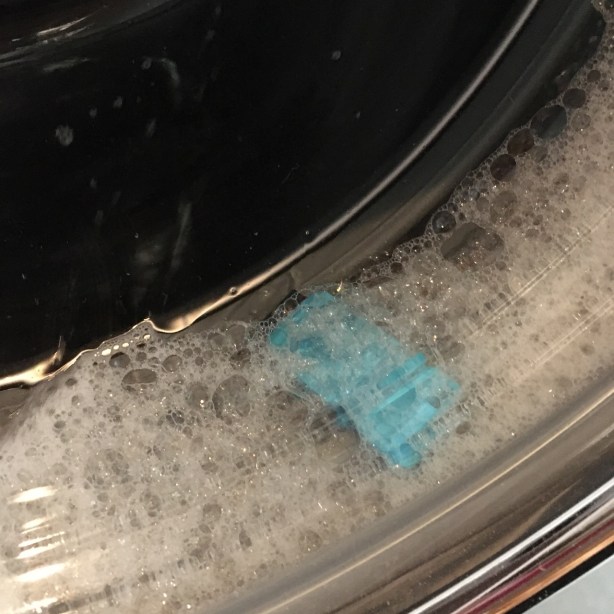
Bright blue plastic USB drive housing in pile of suds viewed through washing machine door

That turquoise blue plastic visible in the suds inside my washing machine is a thumb drive someone forgot to remove from his pocket before dumping clothes in the laundry.

Not sure that’s what’s scrubbing your files is supposed to look like…

A persistent, unequal distribution of household labor has pounded the mental and physical health of mothers during the COVID pandemic. The demands I place on my kids to shoulder their share of the load are my reaction to that. I think it is a rational one.

Sometimes, I give in to the urge to take over a job myself, unable to stand literally! on that sticky spot on the tile any longer, but, mostly, I squawk at the kids instead. It’s for my own benefit, of course, but it’s for their own good, too. Children who pitch in at home are going to become more useful adults. Printed instructions titled Housework is Hard! describing how to wipe kitchen counters and clean the microwave

Perhaps these boys I’m raising will grow up to be more equitable partners to their own spouses someday. That’s my hope. For the time being, I will keep nagging, provide clear instructions on how tasks can be done effectively, and remind my kids that they are valuable, contributing members of our family and household.

I’ll probably keep doing that via lots of dirty pictures.

* My husband’s list is pretty short as he already works something-teen hours per day in his full time job while also running a side hustle as a self-employed scientific consultant. I do need his help with the physically demanding tasks, such as vacuuming multiple floors with the full-size machine. (The kids just use the lightweight Dyson hand vacuum which doesn’t have the same power to tackle the *sigh* wall-to-wall carpeting as our plugged in, full sized Miele canister vac.) I’m not quite ready to watch the boys bash the woodwork with the machine, either.

DH’s new list does also include the task I need help with most: reminding the kids to do their own damn chores before he gives in to all of their demands for attention and snacks in the evening! It’s only fair that Dad take on his share of the nagging duties, though he’s better at science than he is at disciplining his own children.

For anyone who’d like to piggy-back on my step-by-step approach to getting effective assistance from older kids who might do a job half-heartedly without definitive instructions, here are links to PDF documents describing How to Clean the Microwave OvenHow to Wipe Clean the Kitchen Counter, and How to Clean the Bathroom. Inflict them on your own hapless helpers with my blessing!
Seeking only perfect role models means failing to learn from history

Like many others—including the city’s mayor—I find the choice by the San Francisco Board of Education to spend its time focused on name changes for 1/3 of its public schools in the midst of a pandemic quite shocking. It strikes me as a misuse of resources when the children the Board is commissioned to serve are struggling to learn remotely with no* firm re-opening plans in place.

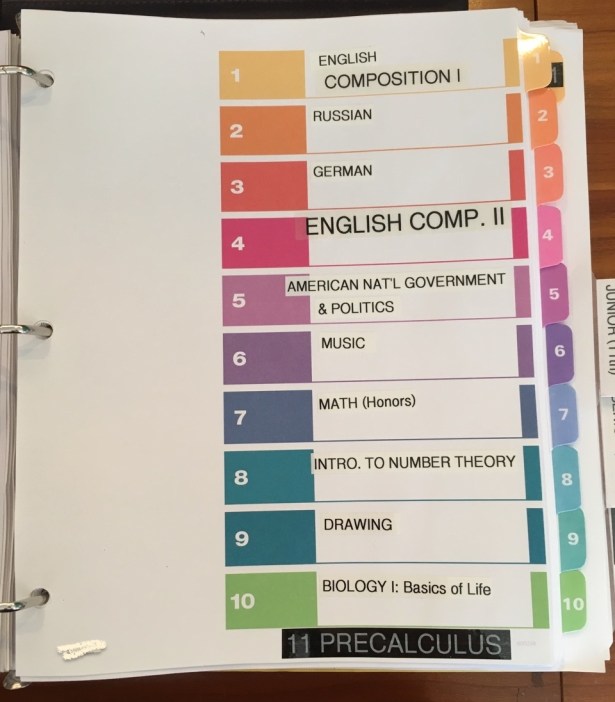
Binder page listing high school courses for grade 10Contrary to the far right, white supremacist commentators who unilaterally dismiss that Board of Education’s actions as essentially foolish, I’d like to make clear that I support discussion of social justice issues in this context. The feelings of enrolled students about the namesake of their institution deserve to be recognized, though, crucially in my opinion, not catered to by default, and never without extensive study and careful reflection when a preponderance of reasonable people hold differing opinions.


Talking about thorny questions is helpful, even vital to each pupil’s education. Confronting difficult episodes in our shared history enables us to be better as a nation and to become better individual human beings. I disagree with some of the ultimate decisions made by the San Francisco Board of Education about striking particular names from schools, but it’s not because I am unaware of mistakes made by leaders in earlier eras.

By my reckoning, the great hubristic error shown by that Board is the futile quest to pretend any perfect role model exists, unblemished enough to “deserve” to have a school named for him or her.back side of Christopher Columbus monument in Barcelona, Spain

No man or woman can be held up as a paragon of all virtues for all times. All of us fail; the very best of us will lead a life full of foibles. Some of us succeed handsomely in our own time, but later run afoul of changing notions of decency in another era.

The greater the risks taken in life, the more likely we are to make at least one real doozy of an error. People who devote lives to public service will fail with an audience, by definition. Should we teach our children to avoid any action to circumvent the possibility of failure? Do we want tomorrow’s adults to be more afraid of being judged by history than they are of taking part in—and becoming leaders of—public life?

Speaking for myself: no, I would not choose to teach that lesson to my kids or anyone else’s. I think the San Francisco Board of Education is doing a grave disservice to the children it serves by wielding nuanced history as a blunt instrument. Ironically, time is unlikely to be kind to its members. If they are remembered at all, it may well be for presumption and self-righteousness.

There is evidence that children allowed to fail, shown how to learn from their mistakes, then given opportunities to try again to find success grow into healthier, more productive adults. Given the 100% probability that a human being will screw up, a focus on incremental improvement seems like the wisest approach to raising and teaching young ones.

Christen your institutions with improper nouns defining high ideals if you still demand perfection: Liberté, égalité, fraternité, perhaps? Freedom? Justice? Unity? My personal favorite is Integrity.

Statue of LibertyIrreproachable individuals don’t exist, San Francisco Board of Education, but I’m curious to see who you believe holds up better to scrutiny than yesterday’s heroes with their feet of clay.

The social justice warriors on San Francisco’s Board of Education might not like being compared to fascists, but, to me, the parallels are obvious. People in power are attempting to strong-arm the world into abiding by their own narrow standards, ignoring complex reality in favor of pat party lines and simplifications that cast “the other” as willfully evil. Without a doubt, extremist elements on the left are also prone to seeking economic and social regimentation with forcible suppression of opposition.

Our young people didn’t invent cancel culture. Students of history will recognize the eradication of the names of pharaohs such as Akhenaten and Hatshepsut as a similar insult to non-conformists. The term damnatio memoriae may be modern**, but the concept is not.

Let’s teach our children to honor what’s good in our history while recognizing errors for what they were: human failings. Then, we learn what we can from those past mistakes, incorporating their lessons into our own pursuit of a better future. Isn’t that the ultimate point of public education?

* As of January 29, 2021, as I write these words, only one school’s re-opening plan has reached the Site Assesment stage and zero (0) applications to re-open have been accepted.

Presenting a role model as too perfect actually prevents teens from seeing a path to similar success for him- or herself. According to the linked study, kids benefit more from learning about Thomas Edison who worked very hard to achieve success (in spite of his reputation as a real jerk) vs. Albert Einstein whom most regard as a born genius with preternatural intellectual abilities.

On a television show I watched recently, the teens attended a school called Excellence. That’s a fine paradigm for which to aim.

Too bad one of the hyper-pressured teen characters felt compelled to abuse drugs to keep up and cope with the stress, and an otherwise ethical teacher on the show guides a young child toward cheating on high stakes exams to chase the academy’s pursuit of excellence in its reputation over the needs of that pupil.

** 17th century

Roasting vegetables is the right recipe for pandemic winter

  • Hate to cook?
  • Trying to shop less frequently because of a pandemic?
  • Know you should eat more vegetables, but enjoy almost every other food more?
  • Spending more time working and/or learning from home?

If, like me, you tick all these boxes, you should start roasting root vegetables as soon as possible. Best of all, you will have an excuse to purchase a rutabaga. If there’s a vegetable that’s more fun to name, I have yet to hear of it.

Say it out loud: ROOT-uh-BEG-uh! You’re smiling now, right?

Plate of oven roasted carrot, beet, turnip, sweet potato and onionYou will need access to an oven or a toaster oven to cook veggies this way. Beyond that, all that’s required is about one hour and:
  • a sheet pan or other wide, shallow, oven-safe cookware
  • oil
  • salt or other, more sophisticated seasonings
  • vegetables
  • cutting board or plate and a sharp knife

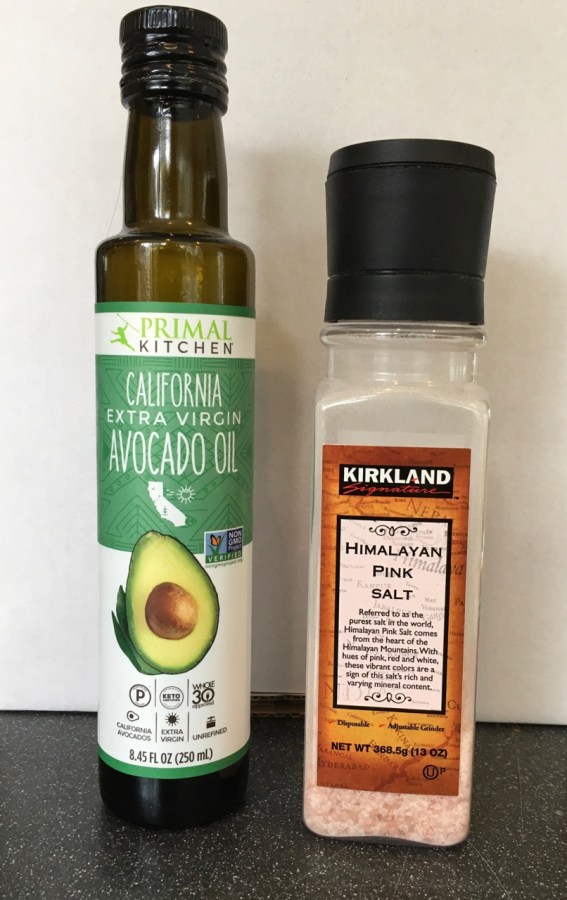
Primal Kitchen avocado oil and Kirkland Himalayan pink saltYou can roast many other things, but the long storing properties of most root vegetables make them ideal for a COVID-19 era menu. Broccoli comes in little bunches; potatoes are sold in great big bags. Shelf life is the main reason for the discrepancy.

Root vegetables in storage boxes and bags: carrot, beet, turnipHere’s a nice resource discussing healthy root vegetables and their nutritional characteristics.

In normal times, many people rush home after work and need dinner on the table within minutes. Roasting is a long, slow process, ill-suited to that kind of lifestyle. Now that a greater* proportion of us are working from home due to the pandemic, however, this kind of “prep it, put it in the oven, then ignore it for an hour while you get back to work” recipe is a lot more accessible.

I was introduced to the concept of roasting root vegetables by a functional nutritionist to whom I was referred by my primary care physician. I suspected that my diet affected the symptoms of my autoimmune condition, but I struggled under the burden of cooking every bite of food for myself given my near total lack of enjoyment of time in the kitchen. This was the best idea the nutritionist gave me from a fairly wide array.

Before I started roasting vegetables, I didn’t buy turnips, rutabagas, or parsnips. Now, I usually keep at least a couple of each on hand because it is so easy to prepare them this way, and the results invariably taste good. Note that these are not vegetables I typically enjoy otherwise.

If you’d like a professionally produced set of step by step instructions, feel free to carry on with Epicurious instead of my low budget advice. Otherwise, here’s my 2 ¢ as the laziest possible chef.

Recipe for roasted root vegetables

  1. Pre-heat your oven to 450° F if you remember; if you don’t, allow more cooking time. This is not a fussy recipe.
  2. Wash all your vegetables, and peel if you prefer.
  3. Chop vegetables into uniform, small-ish pieces.
  4. Pour—or brush with a pastry brush or a bit of paper towel—a thin film of oil onto your baking sheet, lined with foil or a silicone mat first if you prefer.
  5. Spread vegetables in a single layer on prepared baking sheet.
  6. Drizzle with a little oil, and sprinkle on salt and/or pepper, Borsari, or other dried herbs or spices.Borsari original seasoned salt bottle
  7. Roast vegetables, lowering heat to 425° F for about 20 minutes. Check at the 20 minute mark, stirring and flipping pieces over. Continue roasting in 10-15 minute increments until you think they’re done. Look for some darkened edges, or note when the sharp odor of raw vegetables is replaced by the sweeter scent of cooked ones. If in doubt, a total cooking time of 45-60 minutes is probably about right, and most vegetables won’t hurt you if raw or under-cooked, unlike meat.

Roasted vegetables on Silpat lined half sheet panVeg roasting tips from an unseasoned cook

My most often roasted vegetables are sweet potato, carrot, beet, and parsnip, but I use turnips and rutabagas pretty often, too. I have yet to regret roasting any vegetable, but, in my experience, the watery ones seem like extra work for less deliciousness.

Unless you’re cooking for my husband or a similar philistine, always include one small onion with your other vegetables. Caramelized onion is just so tasty unless you hate onions, and maybe even then, and even a small amount lends tons of flavor to the entire rest of the tray of vegetables.

Chop up your vegetables to the size you like to eat. I make little pieces that look like breakfast hash for myself; my husband prefers heftier chunks, a bit larger than dice. I can cook both in the same oven for about the same amount of time with no ill effects, so I’d say the size is purely a matter of personal taste.

Don’t crowd the pan! I always do, and the results will be softer, more “steamed” vegetables with less of the really yummy, caramelized, crunchy bits. Use a larger pan than you think need, and you’ll get the tastiest results. If, like me, you prioritize getting that last dish into the dishwasher instead, just recognize that a smaller batch might turn out better.

Proper chefs on the internet tell me I would get crispier, more delicious vegetables if I used an unlined baking sheet. I use a Silpat non-stick silicone mat anyway. Again, I prioritize easy clean up, and the food ends up good enough for me either way.

Try roasting vegetables you don’t think you like. You may feel differently about them once roasted! I do not normally care for beets or parsnips, but I like them roasted. I like raw carrots, but hate them cooked moist say in a soup; I love them roasted. You can see where I’m going with this. Your experience could differ, but this is a wonderful way to try eating unusual produce that might not normally appear in your diet. Most of us benefit from the addition of greater variety in this category.

Offer roasted vegetables to your kids, possibly not mentioning exactly what they are until they’ve rendered a verdict on taste. Make sure the distinct varietals are different colors so you can identify favorites for future reference. Encourage your kids to eat a whole rainbow of foods. Let them select spices from your cupboard and try roasting with them, possibly by sniffing each bottle until they find one that smells tempting.

My favorite is Borsari Original Seasoned Salt. This is the only “mixed” seasoning in my spice cupboard. It is delicious on duck… and everything else I’ve tried it with. A Whole Foods employee recommended it to me c. 2003.

* 7% of Americans reported being able to work remotely prior to the pandemic; as of October 2020, one third of us are working from home all the time, and 25% report doing so some of the time. More than half of Americans have worked from home for at least part of the pandemic.

Trampoline exercise to ease chronic pain & stiffness

A mini trampoline probably won’t solve your chronic pain issues. My JumpSport 550fi rebounder* has not cured my autoimmune disease, nor did I expect it to. What it has done is offer me is an opportunity to rise up from my seat and move in a way that doesn’t aggravate my sensitive joints.Hardback library book on JumpSport fitness trampoline to show relative size

JumpSport 550fi specs

I ordered my fitness trampoline from Costco.com and received it in mid-July, 2020. I believe the JumpSport 550fi model sold by Costco is simply the manufacturer’s 550f model with the optional Handlebar accessory included.

Here are the specs if you’re interested in the same rebounder I have:JumpSport 550f/fi specs including price, size, weight

My JumpSport 550fi came with two workout DVDs and a one year subscription for additional streaming content. The former was at an intensity too high for someone with my health issues, and I never attempted to access the latter. Watching the instructor led exercises on the disc was helpful for getting ideas about how I might adapt moves to my own level, however.

I wouldn’t go so far as to say I’m “bouncing my way to fitness,” but I am getting up off my backside and moving vigorously more often than I did without the trampoline. When even common, everyday tasks present you with physical challenges, this feels like a big win!

Recent studies suggest that even very sedentary people gain massive improvements in health and longevity from fairly small amounts of exercise. My personal goal is to always—every day, no matter how bad I feel—get my blood pumping on purpose for at least ten minutes. During pandemic lockdown, my fitness trampoline has become a key component in achieving that.

Continue reading

LunchBots stainless containers for life, even lids lost 10 years later

It can be hard to splurge on expensive items designed to last a lifetime when cheap, semi-disposable alternatives abound in our stores. Their ubiquity makes them seem like the obvious choice.

For parents preparing to pack daily lunches for school, stainless steel and glass containers are a perfect example. I can buy a week’s worth of plastic sandwich boxes for the price of a single stainless steel one.

Screen grab shows $17 for stainless sandwich box vs $8 for 3 plastic ones

Kids lose things. Kids break stuff. Kids aren’t necessarily careful with something just because Mom paid more for it.

And, after all, they are just children! While I want mine to grow up to be careful stewards of their possessions, I’d also like for them to be able to enjoy a meal without fretting about my reaction if the fancy new lunchbox gets dented or scratched.

In spite of such obstacles, the LunchBots brand proved to me this week that I was wise to invest a bit more cash in their products vs. the cheaper plastic competition in 2010. They stand behind their products, even 10 years after purchase!

LunchBots is one of a few companies I’ve personally patronized that opened for business c. 2008. That’s when plastic-as-poison was gaining mainstream steam, leading suburban moms like me to look for non-toxic alternatives to plastic food containers laced with BPA and other endocrine disrupting* compounds that may or may not leach at dangerous levels into what we eat and drink from them.

In 2020, LunchBots replaced a ten year old lid that my child lost. They didn’t charge me a cent, not even the actual cost of mailing it!

Replacement LunchBots Pico lid next to well worn 10 year old version Continue reading